DominateFund’s 2012 pitch deck is a concise, 9-slide presentation aimed at raising a $5M venture capital fund. The core thesis rests on a two-sided problem: celebrities lack access to top-tier startup deal flow, while startups lack the marketing and distribution power that celebrity investors provide. The deck leans heavily on the personal brands and 'social media expert' status of its three partners—Ben Parr, Matt Schlicht, and Mazy Kazerooni. By positioning themselves as the bridge between Hollywood and Silicon Valley, the team proposed a standard 2/20 fee structure with a $250,000 minimum…
Key takeaways
- The fund identified a specific market gap: celebrities missing out on tech investments and startups lacking celebrity relationships (Slide 2).
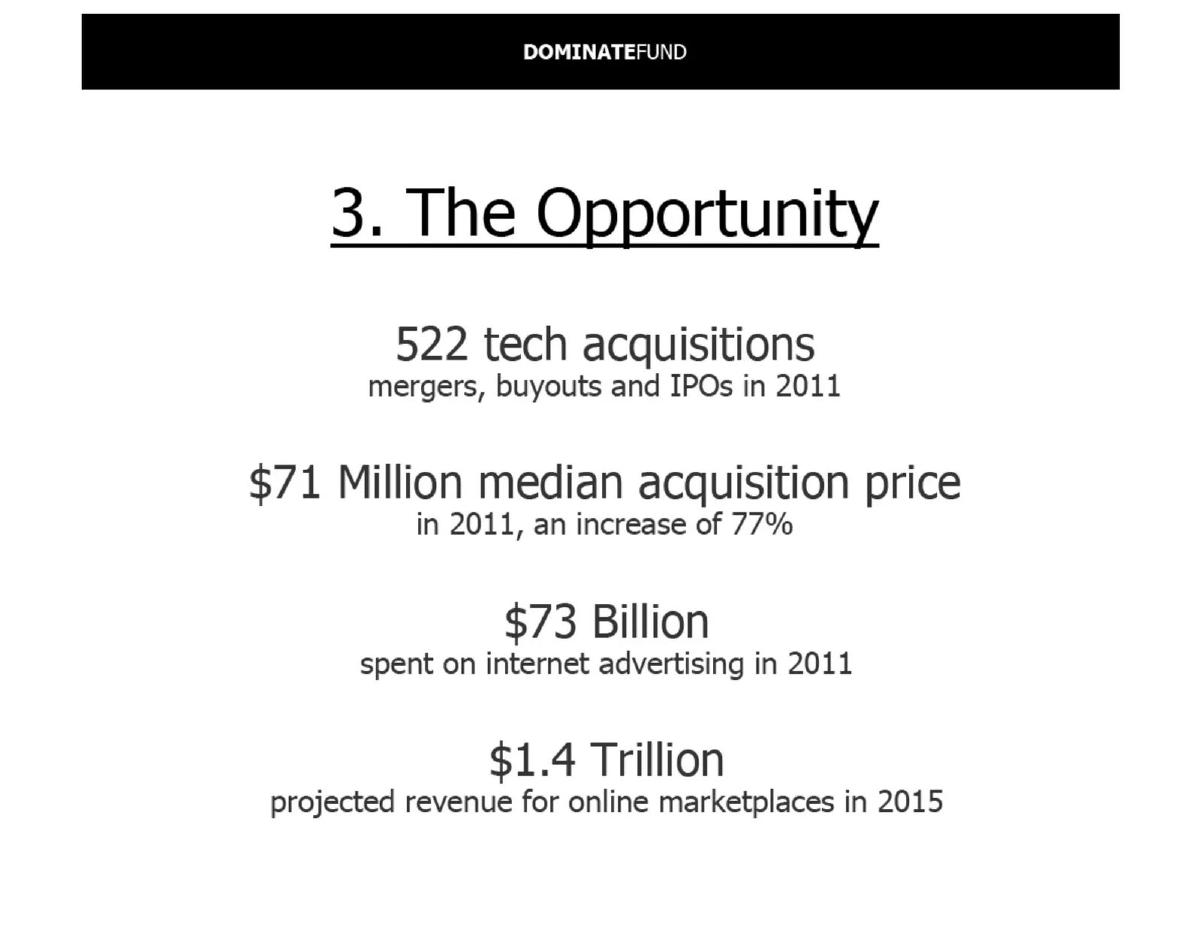
- The opportunity was framed by 2011 data, including 522 tech acquisitions and a $71 million median acquisition price (Slide 4).
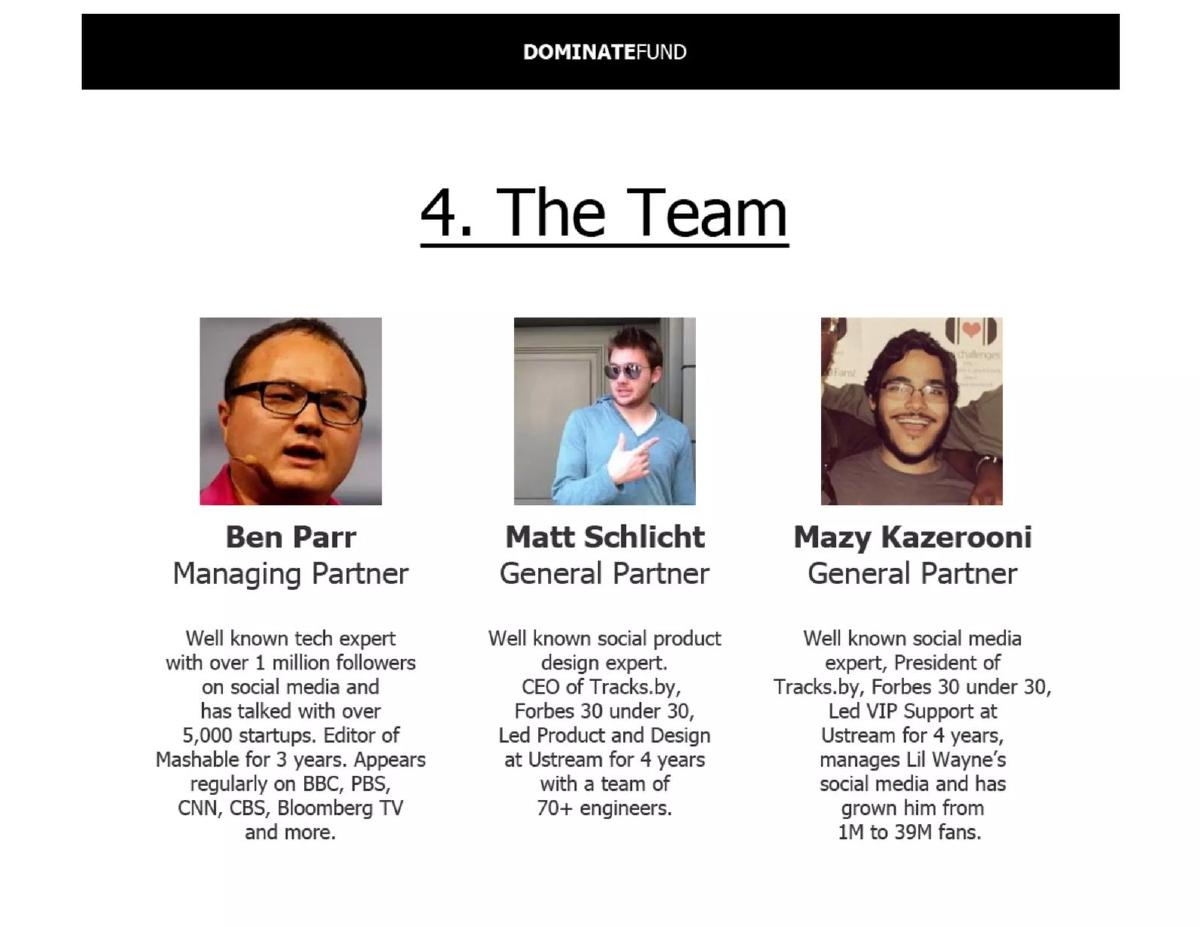
- The team highlighted massive social reach, citing Ben Parr's 1 million followers and Mazy Kazerooni's growth of Lil Wayne’s fan base from 1M to 39M (Slide 5).
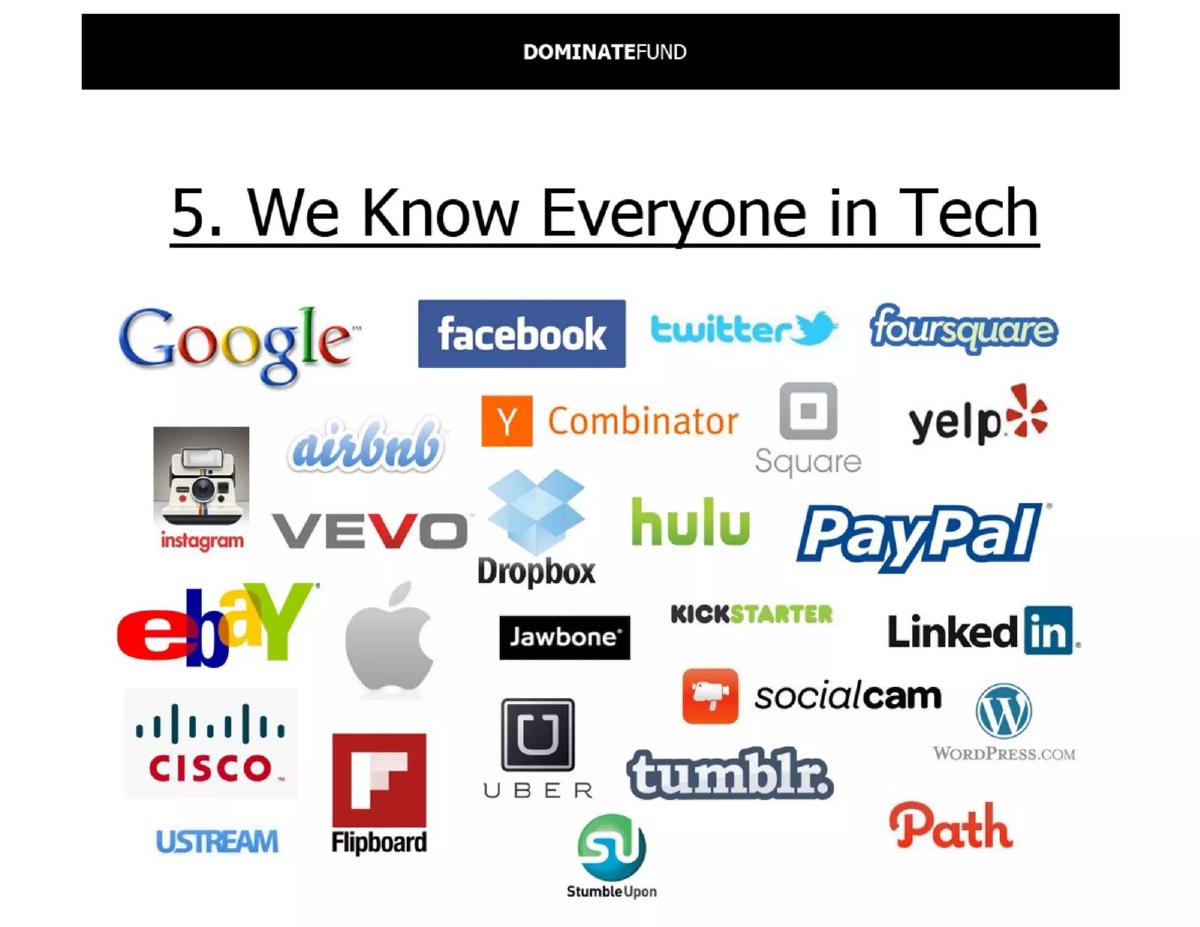
- A 'logo cloud' of 28 major tech companies, including Google, Facebook, and Uber, was used to signal industry connectivity without specifying the nature of those relationships (Slide 6).
- The investment thesis focuses on multi-billion dollar opportunities with easy-to-use products that benefit from celebrity involvement (Slide 7).
- The fund sought a total of $5M for 'Fund I' with a minimum LP check size of $250,000 (Slide 8).
- The economic structure followed the traditional VC model: 80% returns to LPs, 20% to GPs, and a 2% management fee (Slide 8).
- The deck concludes with a dense legal notice page, emphasizing the confidential and preliminary nature of the discussion (Slide 9).
Executive Summary: The Influencer-VC Blueprint
The DominateFund pitch deck from 2012 is a historical artifact of the early 'celebrity-as-investor' era. At only nine slides, it is remarkably brief for a venture capital fundraise. The deck does not sell a product; it sells access and expertise in the then-booming social media landscape. By positioning the partners as the gatekeepers between tech founders and Hollywood talent, the fund attempted to carve out a niche in a crowded seed-stage market.
Slide 1: Title Slide
The deck opens with a minimalist black-and-white title slide: DOMINATE FUND . There is no tagline, no imagery, and no date. It relies entirely on the strength of the name, which suggests an aggressive, high-growth investment philosophy.
Slide 2: The Problem
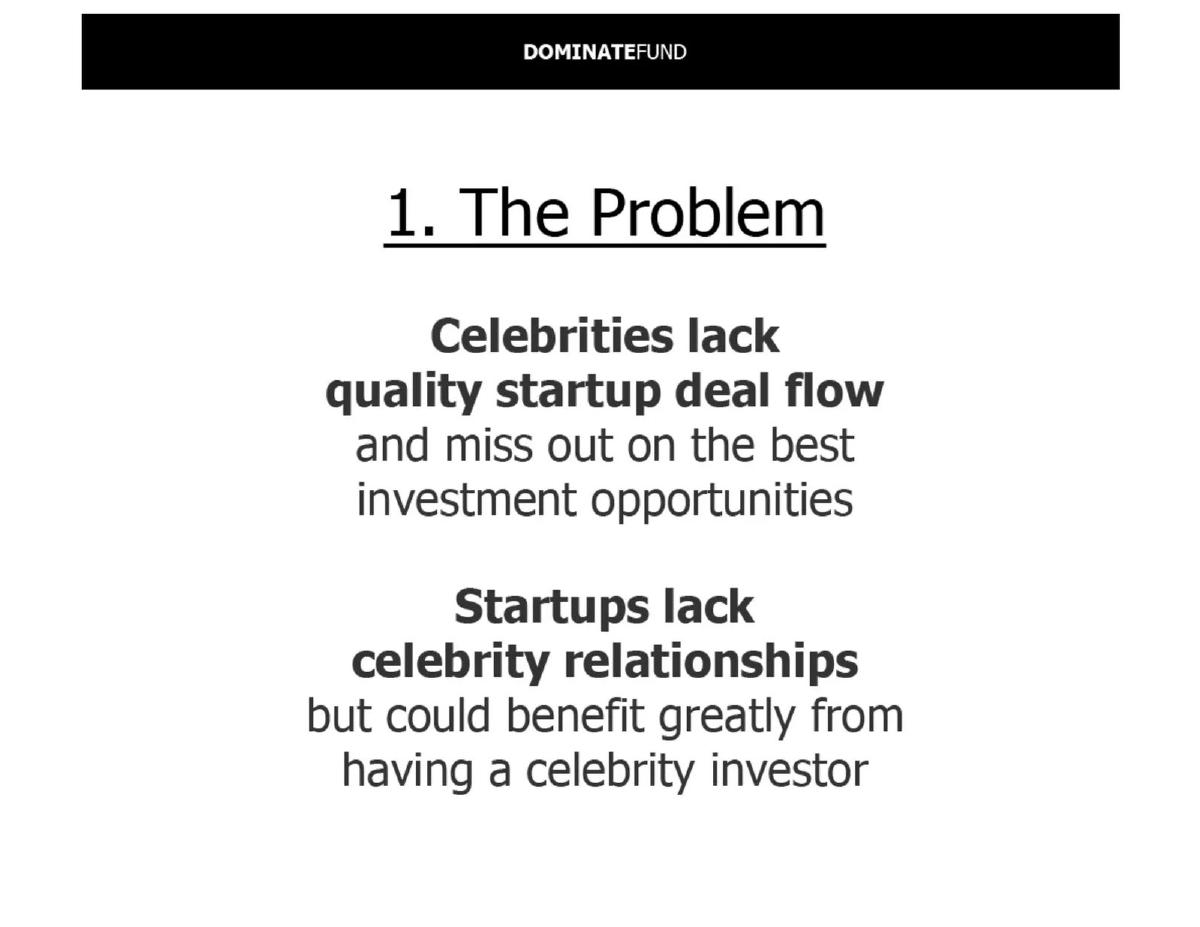
Slide 2 identifies a two-sided market inefficiency. First, it states that "Celebrities lack quality startup deal flow" and consequently miss out on top-tier investments. Second, it notes that "Startups lack celebrity relationships" despite the potential benefits. This slide establishes the fund's reason for existence: acting as the missing link between these two disparate worlds.
Slide 3: What We Do
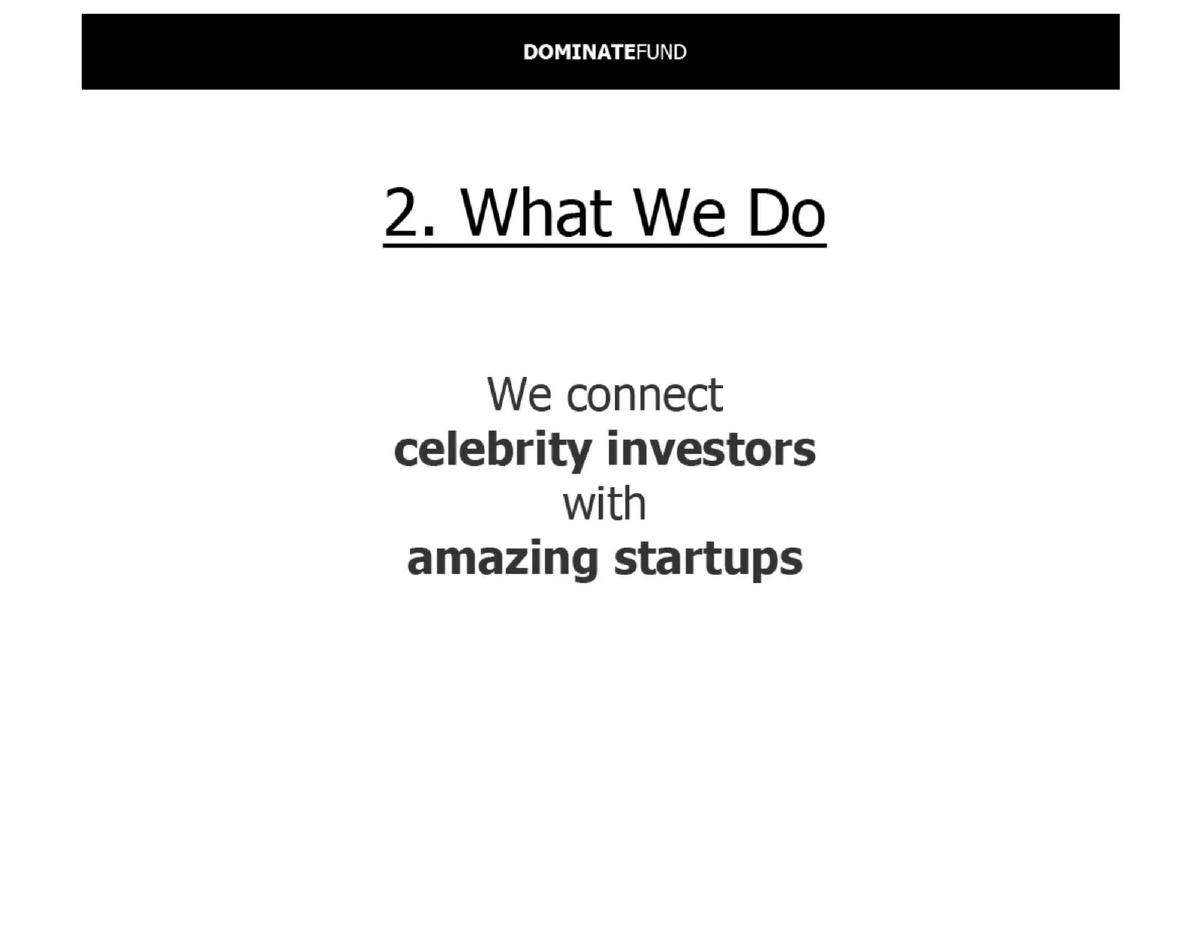
This is the solution slide, though it is framed as a mission statement. The text is simple: "We connect celebrity investors with amazing startups." By framing the fund as a connector, the partners are pitching their network as their primary asset.
Slide 4: The Opportunity
To justify the fund's existence to potential LPs, Slide 4 provides macro-economic context from 2011. It cites "522 tech acquisitions" and a "$71 Million median acquisition price," noting this was a "77% increase" over the prior year. It also highlights the scale of the digital economy, mentioning "$73 Billion spent on internet advertising in 2011" and a projected "$1.4 Trillion" in online marketplace revenue by 2015. These figures are intended to show that the tech exit environment is healthy and the advertising market—where celebrities have the most influence—is massive.
Slide 5: The Team
The team slide is the most detailed part of the deck, as the fund's value proposition is entirely dependent on the partners' reputations. Ben Parr is introduced as a tech expert with "over 1 million followers" and a former Editor of Mashable who has "talked with over 5,000 startups." Matt Schlicht is presented as a design expert and CEO of Tracks.by, having led a team of "70+ engineers" at Ustream. Mazy Kazerooni is highlighted for his social media management, specifically growing Lil Wayne’s fan base from "1M to 39M fans." The combined pedigree is designed to prove they understand both the 'tech' and 'celebrity' sides of the equation.
Slide 6: Industry Connectivity
Slide 6, titled "We Know Everyone in Tech," is a standard logo cloud. It features 28 logos, including Google, Facebook, Twitter, Airbnb, Uber, and Y Combinator. While the slide implies deep connections, it does not specify if these are personal relationships, former employers, or companies the partners have interviewed. In a fund deck, this is a common tactic to signal 'insider' status.
Slide 7: How We Invest
This slide outlines the investment criteria. The fund looks for "multi-billion dollar market opportunities," "bold teams," and "easy-to-use products." The final bullet point is the most critical: "We invest in startups that can benefit from celebrity involvement." This differentiates DominateFund from a generalist seed fund; they are looking for consumer-facing products where a celebrity tweet or endorsement can move the needle on user acquisition.
Slide 8: Fund Structure
Slide 8 provides the hard numbers for the raise. The target is "$5M for Fund I." The minimum investment for a Limited Partner is set at "$250K." The economics are standard for the industry: "80% of returns to Limited Partners, 20% of returns to General Partners" (the 'carry') and a "2% Management Fee." This transparency on terms is essential for LPs to evaluate the fund's overhead and incentive structure.
Slide 9: Legal Notices
The final slide is a wall of text containing standard legal disclaimers. It emphasizes that the presentation is "delivered to prospective investors on a confidential basis" and does not constitute an official offer to sell securities. It also notes that the fund expects to qualify as a "venture capital fund" under the Dodd-Frank Act.
What DominateFund Does Well
The deck is highly focused. It does not try to be everything to everyone; it identifies a specific niche—the intersection of celebrity and tech—and hammers it home. The team slide is particularly strong, providing concrete metrics (follower counts, fan growth numbers) that back up their claims of being social media experts. The fund structure is also clearly defined, leaving no ambiguity about the 'ask' or the fees.
Omissions and Weaknesses
The most glaring omission is a track record . While the partners have impressive individual backgrounds, the deck provides no evidence of their ability to pick winning startups as a collective unit. There are no 'angel' investments listed or case studies of how their celebrity connections helped a specific company in the past. Additionally, the 'Logo Cloud' on Slide 6 is vague; without context, it feels like a collection of famous tech brands rather than a map of actionable connections. Finally, the deck lacks a pipeline slide—LPs generally want to see 3-5 deals that the fund is ready to pull the trigger on immediately after closing.
Founder's Playbook: What to Copy
Specific Thesis: If you are starting a fund or a company, have a 'wedge.' DominateFund’s wedge was celebrity access. It makes the pitch memorable. · Quantified Expertise: Don't just say you are an expert. Use numbers like "1 million followers" or "grown from 1M to 39M fans" to prove it. · Clear Terms: Slide 8 is a model of clarity. If you are asking for money, be explicit about the amount, the minimums, and the fees. · Brevity: Nine slides is enough to get a meeting. You don't need a 40-page deck to explain a straightforward investment thesis.
Frequently asked questions
- What was the primary goal of the DominateFund pitch deck?
- The primary goal was to raise $5,000,000 for 'Fund I,' a venture capital fund. Unlike a typical startup deck seeking capital for operations, this deck was designed to attract Limited Partners (LPs) to invest in a fund that would, in turn, invest in early-stage technology companies that could benefit from celebrity endorsements and social media growth.
- Who were the key partners and what was their expertise?
- The fund was led by three partners: Ben Parr (former Editor of Mashable), Matt Schlicht (CEO of Tracks.by and Forbes 30 under 30), and Mazy Kazerooni (President of Tracks.by). Their collective expertise was rooted in social media management, product design, and tech journalism, specifically highlighting their ability to grow digital audiences for celebrities like Lil Wayne.
- What specific market data did the deck use to justify the fund?
- The deck cited 2011 tech market metrics, including 522 tech acquisitions (mergers, buyouts, and IPOs) and a median acquisition price of $71 million, which represented a 77% increase from the previous year. It also pointed to a $73 billion internet advertising market and a projected $1.4 trillion revenue for online marketplaces by 2015.
- What was the proposed investment strategy?
- DominateFund aimed to invest in 'multi-billion dollar market opportunities' led by 'bold teams.' The specific filter for their portfolio was startups with 'easy-to-use products' that had mass-market potential and, most importantly, could be significantly accelerated through celebrity involvement and social media distribution.
- What are the notable omissions in this pitch deck?
- The deck lacks a 'Portfolio' or 'Track Record' slide, which is common for a first-time fund but leaves LPs with no proof of investment acumen. It also fails to list specific celebrities already committed to the fund or a pipeline of startups they were targeting. Furthermore, there is no mention of the fund's expected lifespan or specific geographic focus.