Docsumo is an AI-based platform designed to automate the extraction and validation of data from unstructured documents. Their 15-slide pitch deck, used to raise a $3.5M Seed round in 2022, focuses heavily on the financial services vertical, specifically commercial lending and insurance. The narrative moves quickly from the technical problem of manual data entry to the business outcome of 'decisioning.' Key strengths of the deck include clear traction metrics—such as a 660% year-over-year revenue increase—and specific examples of account expansion, with one client growing their spend by 6.7x.…
Key takeaways
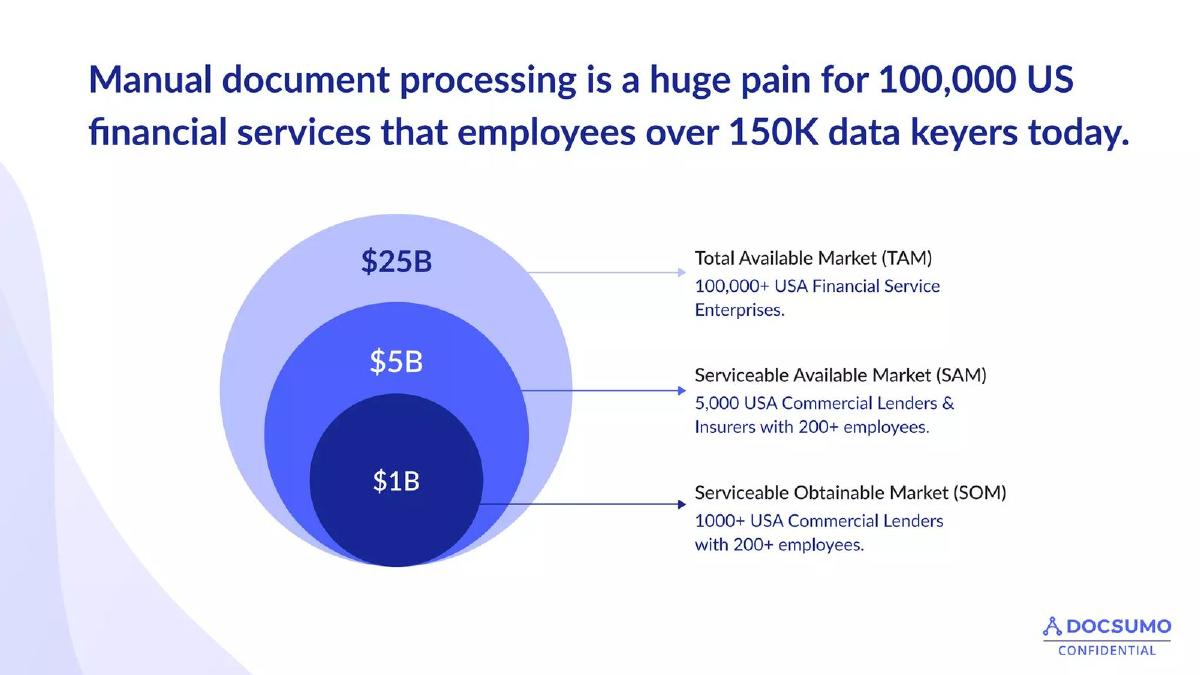
- The platform targets a $25B Total Available Market, specifically focusing on 100,000 US financial service enterprises (Slide 4).
- Docsumo positions itself as a 'decisioning' tool rather than just an OCR provider, using validation rules to automate business logic (Slide 3).
- The company reported a 6.5x (660%) increase in revenue over the 12 months leading up to the deck's publication (Slide 8).
- Customer retention is a core highlight, with the deck claiming a 100% renewal rate and significant account expansion (Slide 9).
- The team is composed of 22 members, with the largest department being Data Science at 9 employees (Slide 13).
- The founders have relevant backgrounds at Rocket Internet, bringing experience in scaling ventures and AI/ML engineering (Slide 13).
- The $3M ask (later reported as $3.5M) is split evenly between Enterprise Sales (34%) and Research & Engineering (34%) to fuel US growth (Slide 14).
- The competitive landscape slide emphasizes 'Self-serve' and 'Fully Automated Decisions' as the primary differentiators (Slide 11).
Executive Summary: The Shift from Capture to Decisioning
Docsumo’s 2022 pitch deck represents a classic 'wedge' strategy. By solving the highly manual and error-prone problem of document data entry, they have embedded themselves into the core workflows of financial institutions. The deck is structured to prove that they are no longer a pre-revenue startup but a scaling engine with 6.5x revenue growth. The narrative focuses on the transition from simple OCR (Optical Character Recognition) to 'Intelligent Document Processing,' where the software not only reads the data but validates it and makes business decisions based on it.
Slide 1: Title and Core Value Proposition
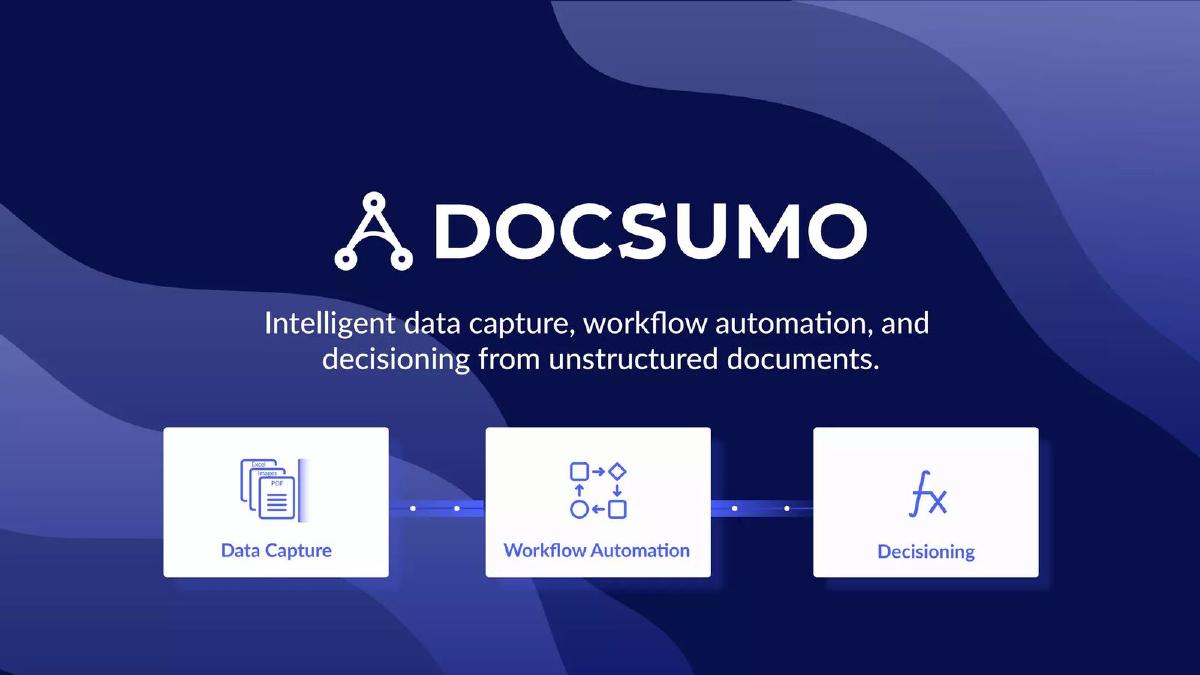
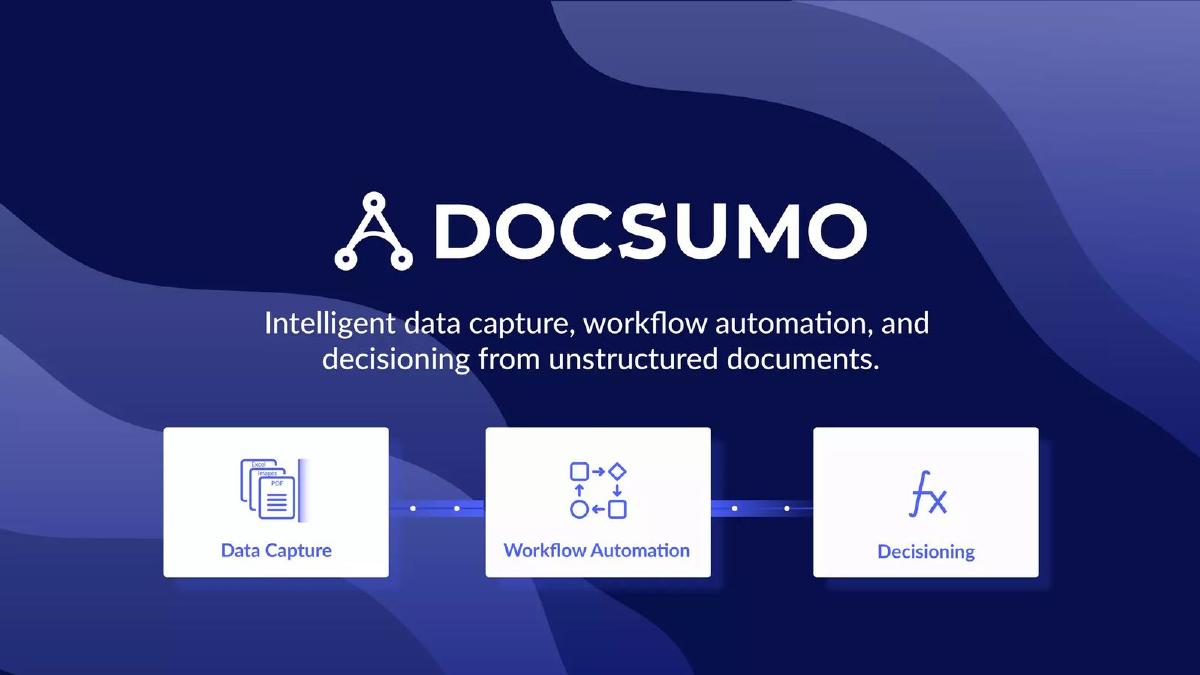
The cover slide introduces Docsumo with a clear three-pillar value proposition: Data Capture , Workflow Automation , and Decisioning . By including 'Decisioning' as the final stage, the company immediately signals to investors that they are moving up the value chain from a utility tool to a strategic platform. The visual language is clean, using a dark blue gradient that suggests a professional, enterprise-grade software solution.
Slide 2: The Problem of Manual Processing
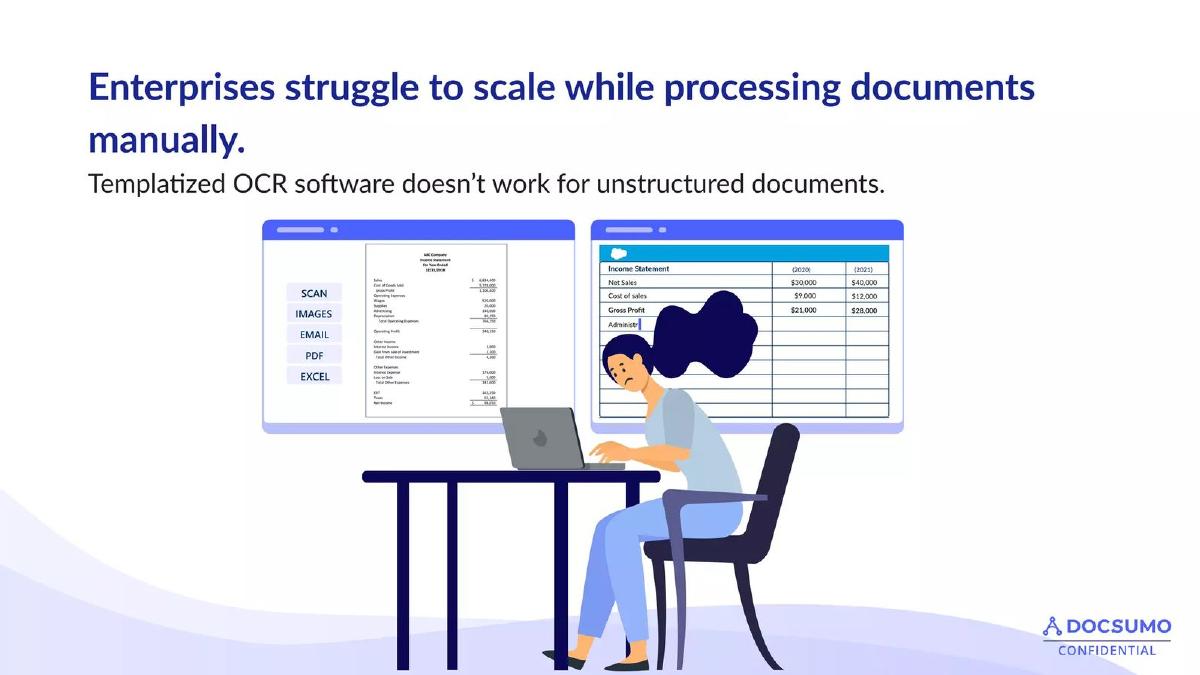
Slide 2 identifies the pain point: enterprises cannot scale while processing documents manually. It specifically calls out that 'Templatized OCR software doesn’t work for unstructured documents.' This is a critical distinction, as it separates Docsumo from legacy players who rely on rigid templates that break whenever a document layout changes slightly. The illustration of a frustrated worker highlights the human cost and inefficiency of the status quo.
Slide 3: The Solution - Validation and Decisioning
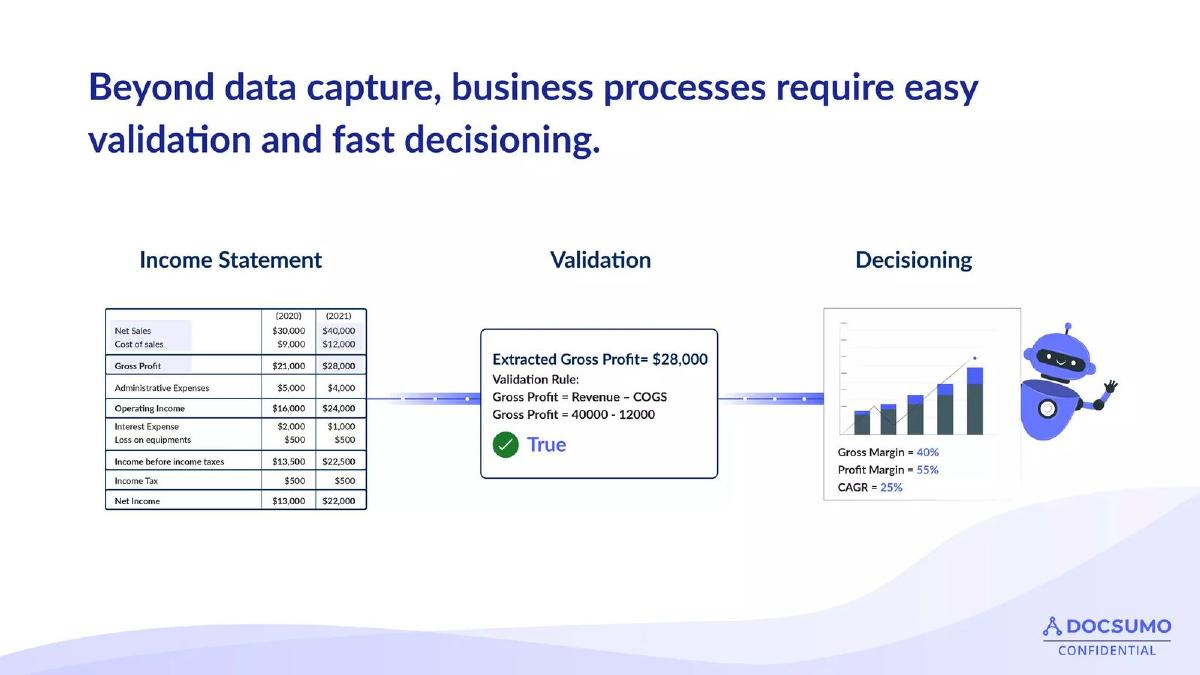
This slide provides a concrete example of how the platform works. It shows an income statement being processed, followed by a 'Validation' step where a rule (Gross Profit = Revenue - COGS) is checked. The final step is 'Decisioning,' visualized by a robot and a growth chart. This slide is effective because it moves the conversation away from technical AI jargon and toward the actual business outcome: faster, automated financial analysis.
Slide 4: Market Size and Opportunity
Docsumo defines its market with a standard TAM/SAM/SOM model. They cite a $25B Total Available Market consisting of 100,000+ US financial service enterprises. They narrow this down to a $1B Serviceable Obtainable Market (SOM) focusing on 1,000+ US commercial lenders with over 200 employees. The slide also mentions that there are 150,000 data keyers employed today, representing a direct labor cost that their software can replace.
Slide 5: Mission Statement
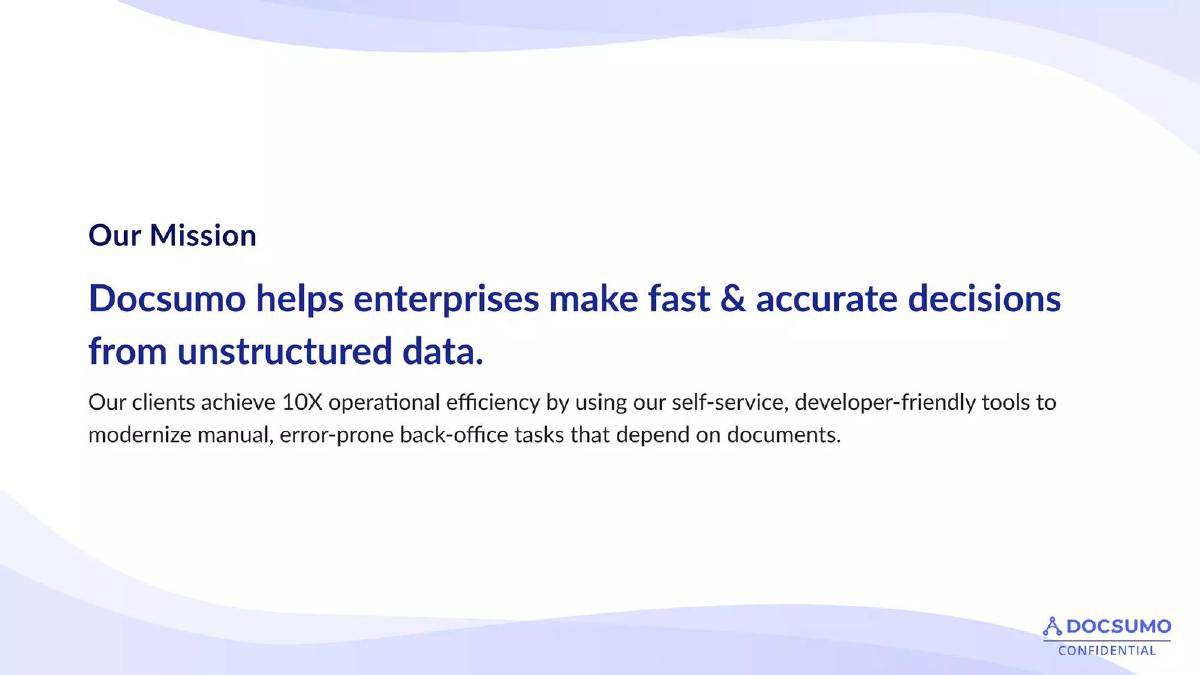
The mission slide is concise: 'Docsumo helps enterprises make fast & accurate decisions from unstructured data.' It claims that clients achieve 10X operational efficiency using their self-service tools. This slide serves as a bridge between the problem/market section and the product/traction section, reinforcing the 'self-service' and 'developer-friendly' nature of the product.
Slide 6: Product Focus - Financial Workflows
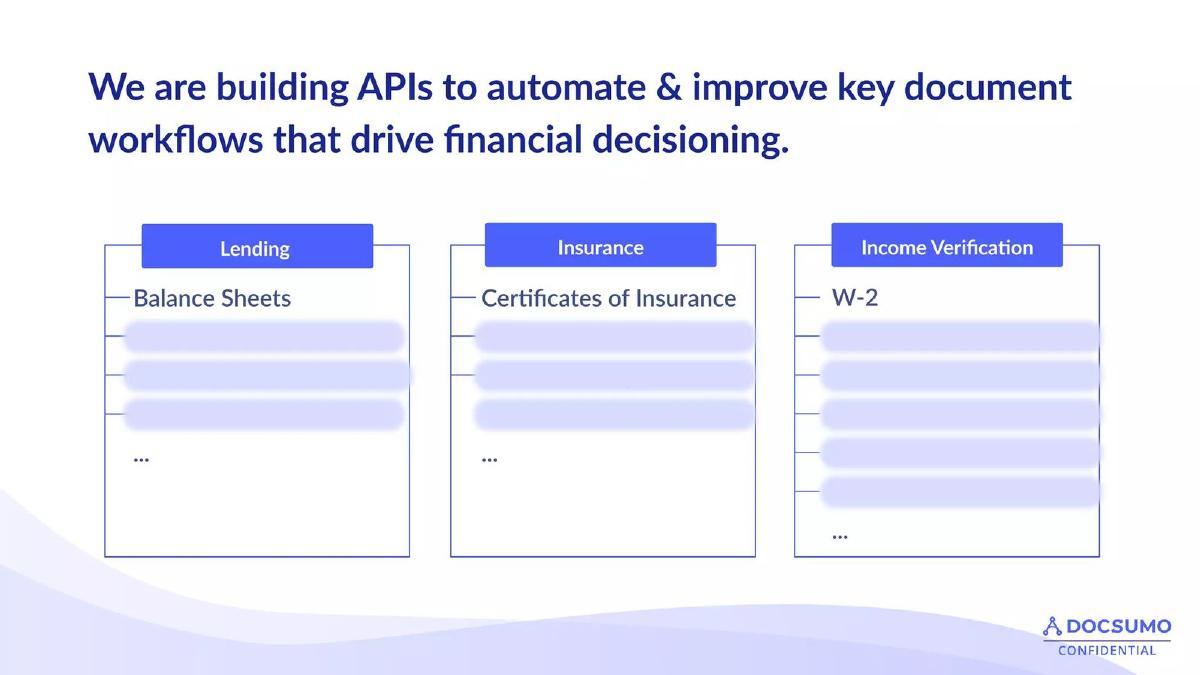
Slide 6 gets specific about the use cases. They are building APIs for Lending (Balance Sheets), Insurance (Certificates of Insurance), and Income Verification (W-2 forms). By showing these three distinct verticals, the company demonstrates that their technology is a horizontal platform applied to high-value vertical problems.
Slide 7: Customer Logos and Segmentation
The traction slide features recognizable logos like Hitachi , PayU , and National Debt Relief . It provides metadata for each client, including their category, geography, and employee count. This level of detail is excellent for investors as it proves the product works across different geographies (USA, India, Australia) and company sizes (from 50 to 5,000+ employees).
Slide 8: Growth and Milestones
This is the 'money slide.' It shows a timeline of growth from Jan 2019 to Dec 2021. Key data points include:
660% YoY Revenue Growth · 500% YoY Document Volume Growth · Raising a $330K Seed round in July 2020. · Processing 2 million documents by September 2021.
The slide uses blurred-out figures for specific ARR (Annual Recurring Revenue), but the percentage growth rates tell a compelling story of rapid acceleration.
Slide 9: Retention and Expansion
Slide 9 addresses a key concern for SaaS investors: churn. Docsumo claims a 100% renewal rate . Even more impressive is the 'Annual Subscription Expansion' chart, showing that Hitachi grew 2.8x, Biagi Bros grew 2.5x, and Jones grew 6.7x in a single year. This 'land and expand' data is a strong indicator of product-market fit and high switching costs.
Slide 10: Social Proof and Testimonials
Three detailed testimonials from Jones, National Debt Relief, and PayU reinforce the value proposition. The National Debt Relief quote is particularly strong, mentioning an STP (Straight Through Processing) rate of over 95% , which is a key performance indicator in the automation industry.
Slide 11: Competitive Landscape
The competitive matrix uses two axes: 'Implementation Style' (Heavy vs. Self-Serve) and 'Automation Level' (Partial vs. Fully Automated Decisions). Docsumo places itself in the top-right quadrant. While the competitor names are blurred, the positioning is clear: they aim to be the easiest to set up while providing the highest level of automated output.
Slide 12: Investor Pedigree
Docsumo highlights its backing by Sequoia (via Scout Program) , Better Capital , Barclays Accelerator (Techstars) , Common Ocean , Arbor , and Fifth Wall . They also list prominent angel investors like the CEOs of Better, Jupiter, and Pine Labs. This slide builds significant institutional credibility.
Slide 13: The Team
The founding team consists of Rushabh Sheth (CEO) and Bikram Dahal (CTO) . Both have experience at Rocket Internet, a well-known venture builder. The slide also breaks down the total team of 22: 9 in Data Science, 3 in Sales & Marketing, 4 in Product, and 4 in Operations. This distribution shows a heavy investment in the core technology.
Slide 14: The Ask and Use of Funds
The final substantive slide states they are raising a $3M seed round (though the source listing suggests the final round was $3.5M). The allocation is split: 34% for Enterprise Sales, 34% for R&D, 16% for Product Marketing, and 16% for Customer Success. The stated goal is to 'scale our business in North America.'
Slide 15: Contact Information
The deck concludes with a simple 'Contact Us' slide directing viewers to their website. It maintains the consistent branding seen throughout the presentation.
What Docsumo Does Well
The deck excels at quantifying success . Instead of just saying they are growing, they provide specific multipliers (6.5x revenue, 6.7x account expansion). The focus on 'Decisioning' rather than just 'Data Extraction' is a smart strategic move that justifies higher enterprise pricing. Furthermore, the inclusion of client metadata (Slide 7) gives a very clear picture of their Ideal Customer Profile (ICP).
What is Missing from the Deck
While the growth metrics are excellent, the deck is light on unit economics . There is no mention of Customer Acquisition Cost (CAC), Lifetime Value (LTV), or Gross Margins. For a Seed/Series A transition, investors typically want to see if the 6.5x growth is efficient. Additionally, the competitive slide (Slide 11) blurs out the names of rivals, which prevents a direct comparison of features or pricing against known entities like UiPath or ABBYY.
Founder Takeaways: What to Copy
Use the 'Land and Expand' Slide: Slide 9 is the strongest slide in the deck. If you have customers who have increased their spend significantly, showing the specific multiplier (e.g., 6.7x) is far more powerful than just stating a Net Revenue Retention (NRR) percentage. It tells a story of a product that becomes more valuable the more it is used.
Define Your Vertical SOM: Many founders present a massive TAM but fail to show they know exactly which 1,000 customers they are going after first. Docsumo’s Slide 4 does this perfectly by narrowing the focus to US commercial lenders with over 200 employees. This gives investors confidence that the sales team has a targeted list to execute against.
Visualizing the Workflow: Slide 3 is a great example of how to explain a complex AI process simply. By showing the 'Validation Rule' as a simple math equation, they make the 'black box' of AI feel transparent and reliable to a non-technical investor.
Frequently asked questions
- What specific problem does Docsumo solve?
- According to Slide 2, enterprises struggle to scale because they rely on manual document processing. Traditional 'templatized' OCR software fails when dealing with unstructured documents like scans, emails, and PDFs. Docsumo automates the capture, validation, and decisioning phases to replace manual data keyers.
- How does Docsumo differentiate itself from standard OCR?
- Slide 3 and Slide 11 explain that Docsumo goes 'beyond data capture.' While OCR just reads text, Docsumo applies validation rules (e.g., checking if Gross Profit equals Revenue minus COGS) to enable automated decisioning. They position themselves as a self-serve, ML-based platform rather than a heavy-implementation, templatized service.
- What does the company's growth trajectory look like?
- Slide 8 shows a timeline starting in Jan 2019. Key milestones include a $330K Seed round in July 2020 and reaching 2 million documents processed by September 2021. The most significant metric is a 660% year-over-year revenue growth and 500% document volume growth.
- Who are Docsumo's primary customers?
- Slide 7 lists several high-profile clients including Hitachi, PayU, and National Debt Relief. The deck segments these into Financial Services (CRE lending, debt relief) and Technology (software, consulting). Geographically, the clients are spread across the USA, India, and Australia.
- What is the intended use of the raised funds?
- On Slide 14, the company outlines a $3M funding goal. The budget is allocated to an Enterprise Sales Team (34%), Research & Engineering (34%), Product Marketing (16%), and Customer Success (16%). The primary strategic goal is to scale the business within the North American market.