Code First Girls successfully raised a $5.1M Series A in 2023 with a deck that prioritizes market demand and enterprise traction over traditional educational metrics. By framing their mission as a solution to the UK’s £30bn programming talent gap, they transitioned from a social impact project to a critical infrastructure partner for the FTSE 100. The deck is notable for its aggressive growth visualization, showing 80+ new clients since FY19/20 and a client list that spans 50% of the UK’s largest banks. While the deck lacks a formal team slide or detailed unit economics in this 11-slide versi…
Key takeaways
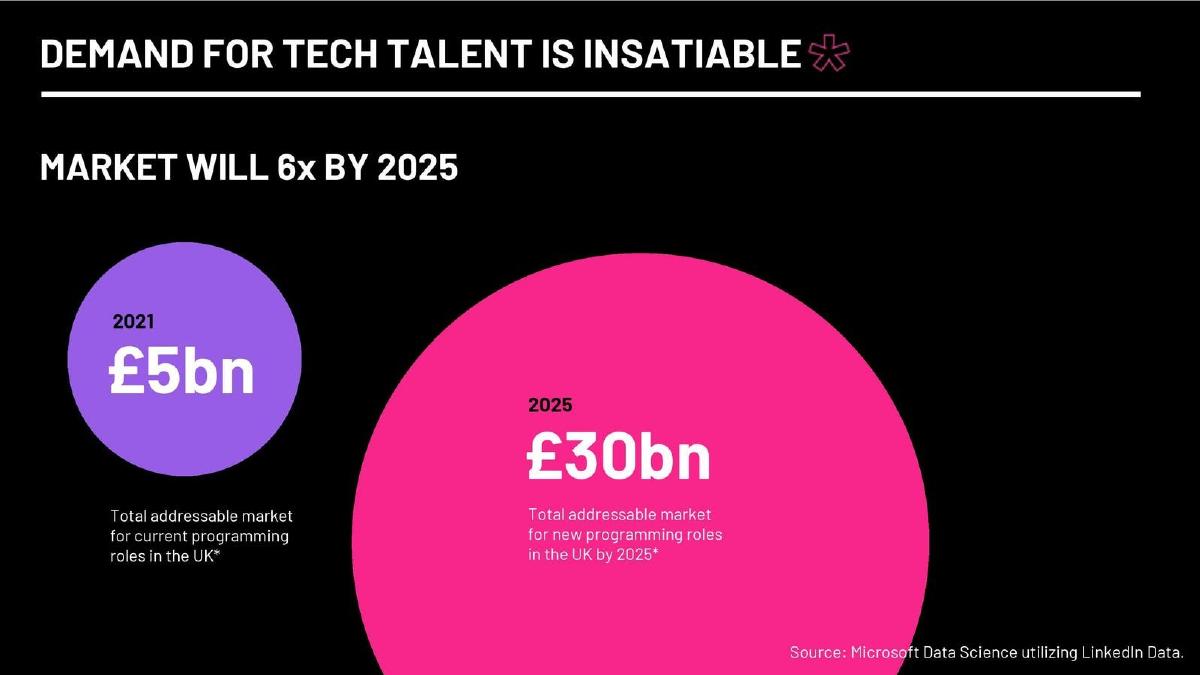
- The deck identifies a massive UK market expansion, projecting the TAM for programming roles to grow from £5bn in 2021 to £30bn by 2025 (Slide 2).
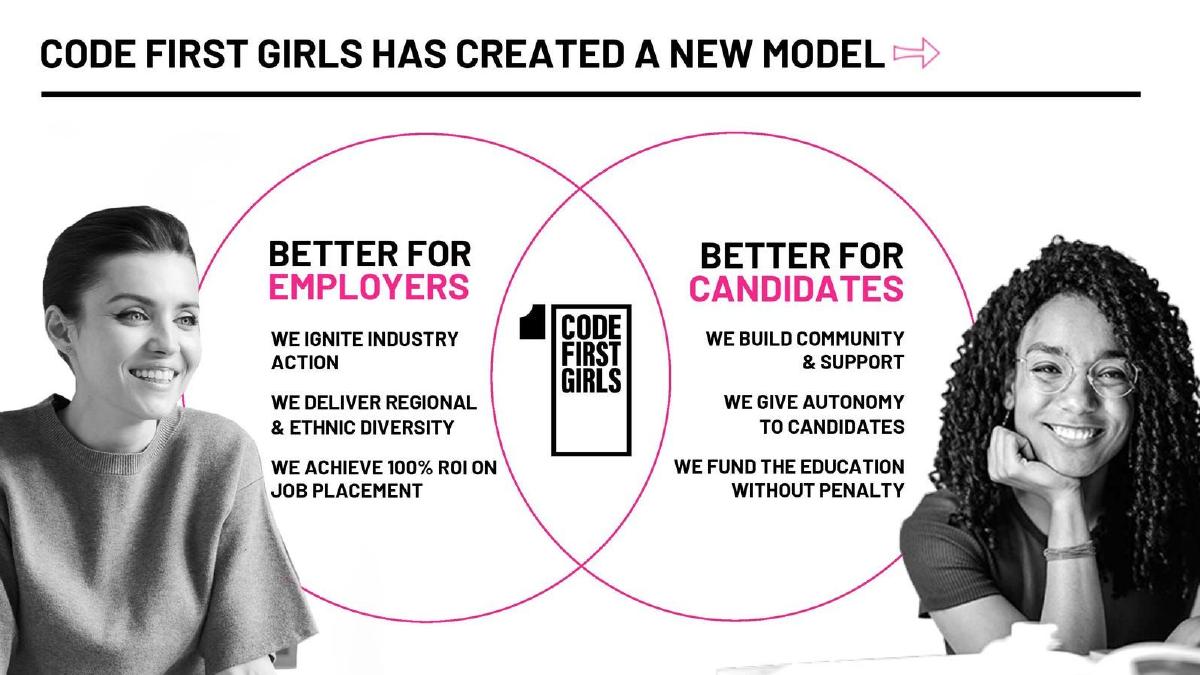
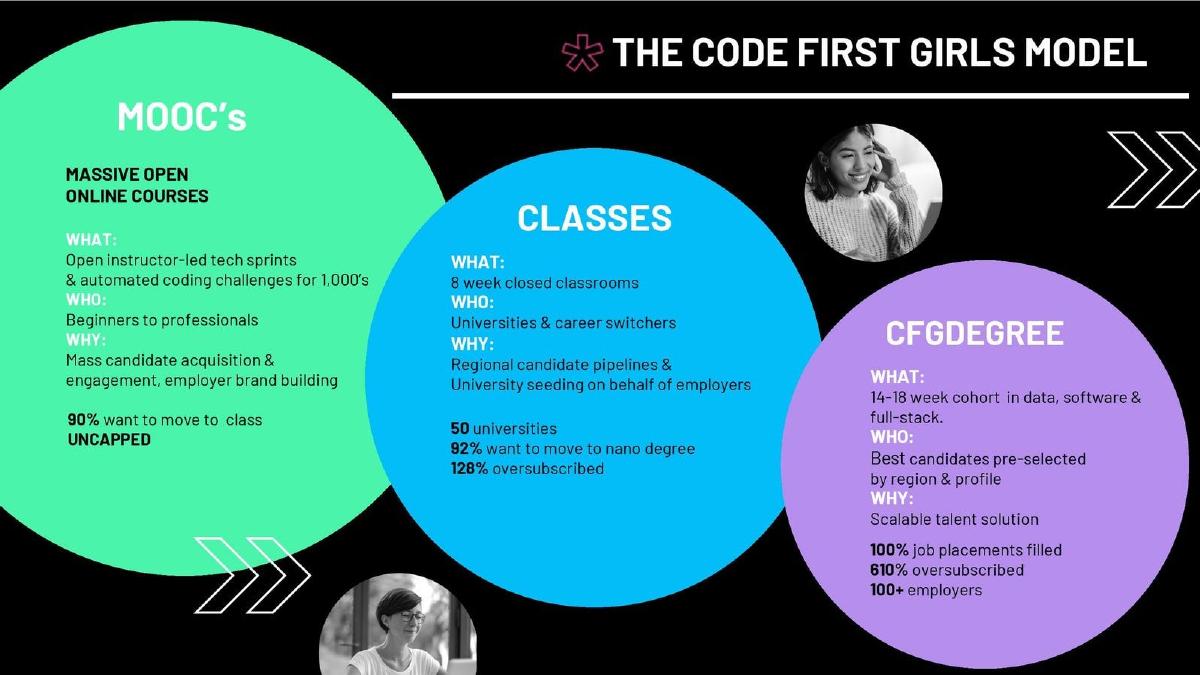
- A two-sided value proposition is established, promising employers 100% ROI on job placement and candidates free education without financial penalty (Slide 3).
- Client growth is visualized as an 'exploding' hockey-stick curve, moving from a flat baseline in 2020 to a steep ascent through 2022 (Slide 4).
- The startup has achieved significant enterprise penetration, counting 50% of the UK's biggest banks and 5+ government departments as clients (Slide 4).
- The long-term vision focuses on data moats, aiming to build the world's largest data set on women tech candidates within 10 years (Slide 5).
- Social proof is heavily weighted toward the buyer, featuring direct quotes from high-level executives at Deloitte and the Cabinet Office (Slide 6).
- The deck omits a traditional 'Team' slide, relying instead on the brand's established reputation and client list to convey credibility.
- Reported figures show the company raised $5.1M in 2023 to scale this 'new model' of integrated talent pipelines.
Code First Girls: The Series A Teardown
Code First Girls represents a shift in how social impact startups approach venture capital. In their 2023 Series A deck, which facilitated a $5.1M raise, the company moves away from the 'non-profit' aesthetic, instead presenting a high-octane B2B growth story. The deck is lean, at only 11 slides, and focuses heavily on the supply-and-demand imbalance in the UK tech market. By positioning themselves as the primary pipeline for female tech talent, they transform a diversity initiative into a business-critical utility for the FTSE 100.
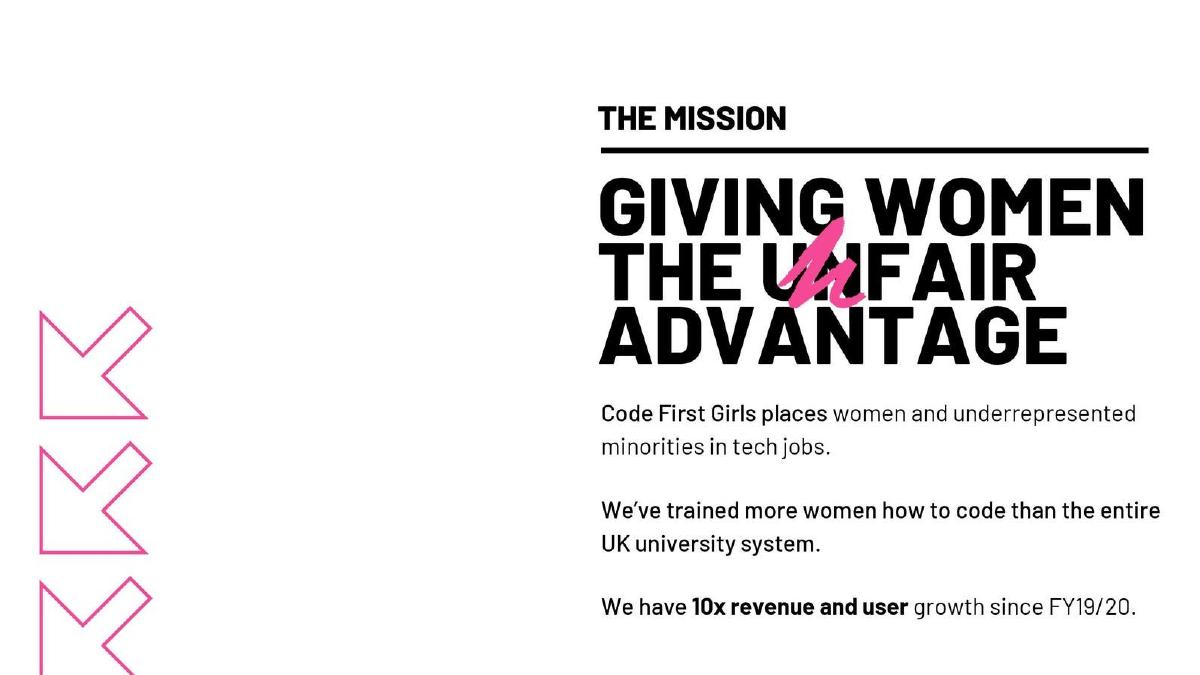
Slide 1: The Brand Identity
The title slide sets a high-energy tone. Using high-contrast black and white photography of women in tech environments paired with a vibrant pink accent color, the brand establishes itself as modern and professional. The '2022' branding suggests this deck was likely in circulation leading up to the 2023 close. It is a standard cover, but the inclusion of the logo and the year provides immediate context for the vintage of the data to follow.
Slide 2: The Macro Opportunity
Slide 2 is a classic 'Market Size' slide with a specific geographic focus. It claims the 'Demand for tech talent is insatiable' and predicts the market will 6x by 2025. The slide uses two circles to compare the 2021 TAM (£5bn) to the 2025 projected TAM (£30bn). The data is attributed to 'Microsoft Data Science utilizing LinkedIn Data,' which adds a layer of third-party credibility to the aggressive growth claims. By focusing on the UK market specifically, they make the opportunity feel tangible and immediate rather than a vague global estimate.
Slide 3: The New Model
This slide explains the mechanics of the business using a Venn diagram. It splits the value proposition between 'Employers' and 'Candidates.' For employers, the focus is on 'Regional & Ethnic Diversity' and a '100% ROI on job placement.' For candidates, the hook is 'free education without penalty' and 'autonomy.' This slide is crucial because it addresses the 'who pays' question. By stating they fund the education, they clarify that the candidate is the product and the employer is the customer. The mention of 'igniting industry action' suggests a B2B sales strategy that leverages corporate social responsibility (CSR) budgets alongside recruitment budgets.
Slide 4: The Traction Curve
Slide 4 is the 'money slide' of the deck. Titled 'Client Growth is Exploding,' it features a line graph showing a sharp upward trajectory starting in late 2021. The metrics provided are impressive: 80+ new clients since FY19/20, 50% of the UK’s biggest banks, 5+ government departments, and representation across 10+ industries. The bottom of the slide is a 'wall of logos' including Goldman Sachs, Deloitte, Rolls-Royce, and GCHQ. This level of enterprise social proof is rare for a Series A social impact startup and serves as the primary de-risking mechanism for investors.
Slide 5: The 10-Year Vision
Moving from the present to the future, Slide 5 outlines the long-term 'Network Effects.' The company aims to be the 'global community that empowers half the planet.' The specific goals listed are more grounded: building the world’s largest data set on women tech candidates and becoming an 'absolute necessity' for tech employers. This slide attempts to move the company from a 'recruitment agency' valuation to a 'data and platform' valuation by emphasizing the proprietary data set they are building through their community.
Slide 6: Social Proof and Testimonials
The final slide in this selection focuses on testimonials. Unlike many decks that feature student quotes, this slide prioritizes the buyer's voice. It features high-level endorsements from Issi Saumtally (Chief Data Officer, Cabinet Office) and Duncan Milne (Partner, Deloitte). The quotes emphasize the 'calibre of the candidates' and the 'brilliant set of candidates.' This reinforces the Slide 3 claim of 100% ROI and high-quality talent, proving that the 'free' education model does not result in lower-quality output.
What Code First Girls Does Exceptionally Well
The strength of this deck lies in its B2B framing . Many education startups fail to raise significant VC funding because they are viewed as low-margin 'bootcamps.' Code First Girls avoids this by focusing on the 'insatiable' demand from the enterprise side. They aren't selling courses; they are selling a solution to a £30bn talent gap.
The client concentration is also a major highlight. Capturing 50% of the UK's largest banks is a significant moat. In the enterprise world, banks are notoriously difficult to clear for procurement and security. By showing logos like Barclays and Goldman Sachs, Code First Girls signals to investors that they have already passed the most rigorous corporate hurdles, making future scaling much easier.
Finally, the visual consistency is excellent. The deck uses a limited color palette (Pink, Black, White) and high-quality photography that makes the company feel like a premium brand. This professional polish is necessary when your target customers are the Cabinet Office and Deloitte.
What is Missing from the Deck
While the 11-slide deck is effective, there are notable omissions that a founder should be aware of:
Team Slide: The provided slides do not include a breakdown of the leadership team. For a Series A, investors typically want to see the pedigree of the founders and their ability to execute in both the education and enterprise sales sectors. · Unit Economics: While they mention '100% ROI,' the deck lacks a slide on Customer Acquisition Cost (CAC) vs. Lifetime Value (LTV). How much does it cost to train one woman, and what is the average placement fee received from a partner like Deloitte? · Competition: The deck operates as if Code First Girls is in a vacuum. There is no mention of other coding bootcamps (General Assembly, Le Wagon) or diversity-focused recruitment platforms. · The Ask: The provided slides do not state the amount being raised or the intended use of funds. While we know from publisher reports that they raised $5.1M, a standard pitch deck usually concludes with a clear funding requirement and a roadmap for that capital.
Founder Lessons: How to Apply This Strategy
1. Solve a 'Burning' Problem: Code First Girls doesn't lead with 'it would be nice if more women coded.' They lead with 'there is a £30bn talent shortage.' Founders should always frame their mission as a solution to a massive, quantifiable economic problem.
2. Use Logos as a Moat: If you have enterprise clients, make them the centerpiece of your traction slide. A single logo from a company like Goldman Sachs is worth more than a thousand words of growth projections.
3. Define Your 'Data Moat': Slide 5 is a great example of how to pitch a service business as a tech business. By claiming they will own the 'world's largest data set' on their demographic, they are telling investors that their value isn't just in the placements they make today, but in the proprietary information they will own tomorrow.
4. Prioritize the Buyer's Voice: In a two-sided marketplace, the side that pays the bills is the one that needs to be featured in the testimonials. Code First Girls correctly identified that investors care more about what the Partner at Deloitte thinks than what a student thinks, because the Partner at Deloitte is the one who validates the revenue model.
Frequently asked questions
- What is the primary revenue model suggested by the deck?
- While specific pricing is not disclosed, Slide 3 and Slide 4 indicate a B2B recruitment and placement model. The company offers '100% ROI on job placement' for employers, suggesting that while education is free for candidates, the enterprise clients pay for access to the talent pipeline and diversity hiring services.
- How does Code First Girls define its market opportunity?
- They define it through the lens of the UK's tech talent shortage. According to Slide 2, they utilize Microsoft Data Science and LinkedIn data to show a Total Addressable Market that is expected to 6x, reaching £30bn by 2025 for new programming roles.
- Which industries are most represented in their client base?
- The deck highlights a strong presence in finance and government. Slide 4 explicitly mentions that 50% of the UK’s biggest banks are clients and displays logos for Goldman Sachs, Bank of America, Barclays, NatWest, and Credit Suisse, alongside the Cabinet Office and GCHQ.
- What is the 'Network Effect' mentioned in the vision slide?
- Slide 5 describes their network effect as the accumulation of the 'world’s largest data set on women tech candidates.' By becoming an 'absolute necessity' for tech employers to scale, they aim to integrate directly into the global talent pipelines of major corporations.
- Does the deck include financial projections or a specific 'Ask'?
- The 11-slide version provided focuses on traction, market size, and vision. It does not include a detailed use of funds, specific revenue projections, or the exact dollar amount being raised, though publisher data confirms the round resulted in $5.1M.