Coding Autism is a specialized coding academy targeting the 80% unemployment rate among adults with autism in the US. The deck highlights a significant market gap: a projected 1 million vacant tech jobs by 2020 contrasted with a large, underutilized talent pool of neurodivergent individuals. With a business model combining online and in-person instruction, the company reported $18,500 in early revenue and a pipeline of 25+ students as of May 2018. The ask is for $300k-$400k to scale operations, following $100k in previous seed funding. While the social impact is clear, the deck relies heavily…
Key takeaways
- The company addresses a massive social issue, citing that 80% of adults with autism in the US are unemployed or underemployed (Slide 2).
- Founder Oliver Thornton emphasizes founder-market fit as an adult with ASD, positioning his personal experience as a core competitive advantage (Slide 3).
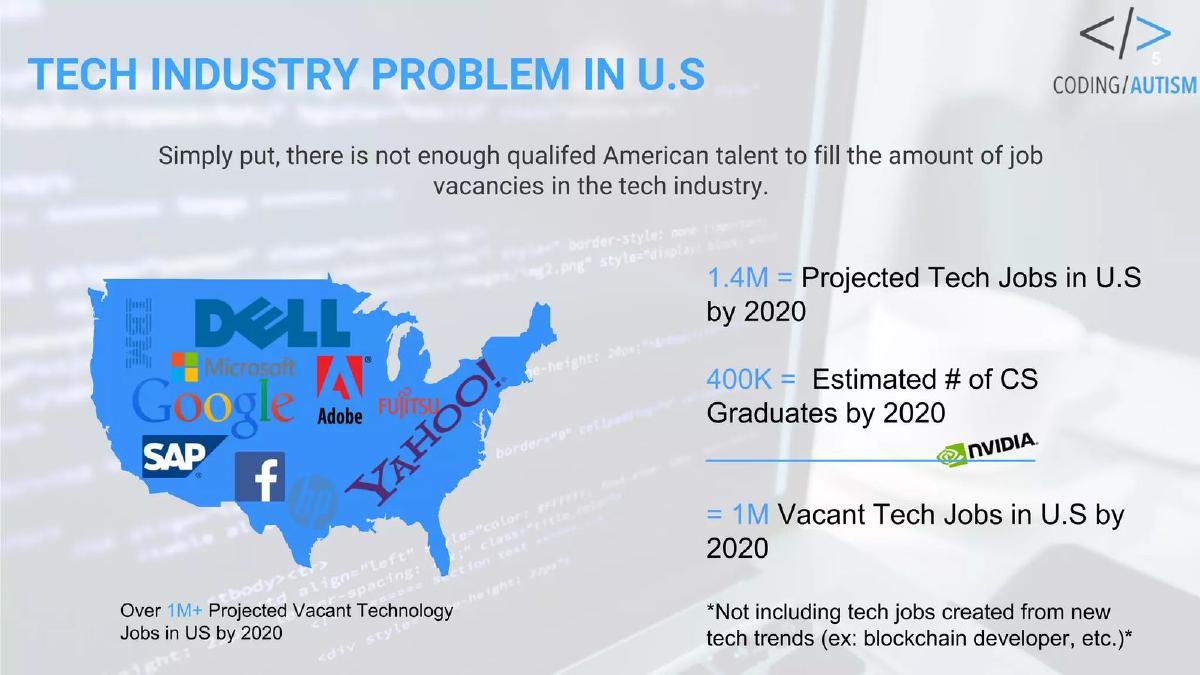
- The market opportunity is framed by a projected 1 million vacant tech jobs in the US by 2020 (Slide 5).
- Early traction includes 7 paying students and $18,500 in revenue with an average monthly income of $5,500 (Slide 11).
- The revenue model is aggressive, projecting a jump from 100 students in Year 1 to 1,400 students in Year 3 (Slide 13).
- The company is seeking $300k-$400k in new capital, having previously raised approximately $100k through crowdfunding and convertible notes (Slide 15).
- The deck lists an extensive roster of advisors from major tech firms like HPE and SAP, bolstering institutional credibility (Slide 18).
- Exit strategy explicitly names WeWork, General Assembly, and Thinkful as potential acquirers (Slide 16).
Executive Summary: The Social Enterprise Pitch
Coding Autism is a mission-driven startup that occupies the intersection of EdTech and social impact. The deck, published around mid-2018, seeks to capitalize on the growing corporate interest in neurodiversity. By framing autism not as a disability to be managed, but as a competitive advantage for technical roles, the company attempts to solve a labor supply issue for the tech industry while providing career paths for an underserved population.
Slide 1: Title and Mission
The deck opens with a clean logo and a clear sub-headline: "Navigating adults with autism to careers in tech." This immediately establishes the sector (EdTech/Recruitment) and the target demographic.
Slide 2: The Problem Statistics
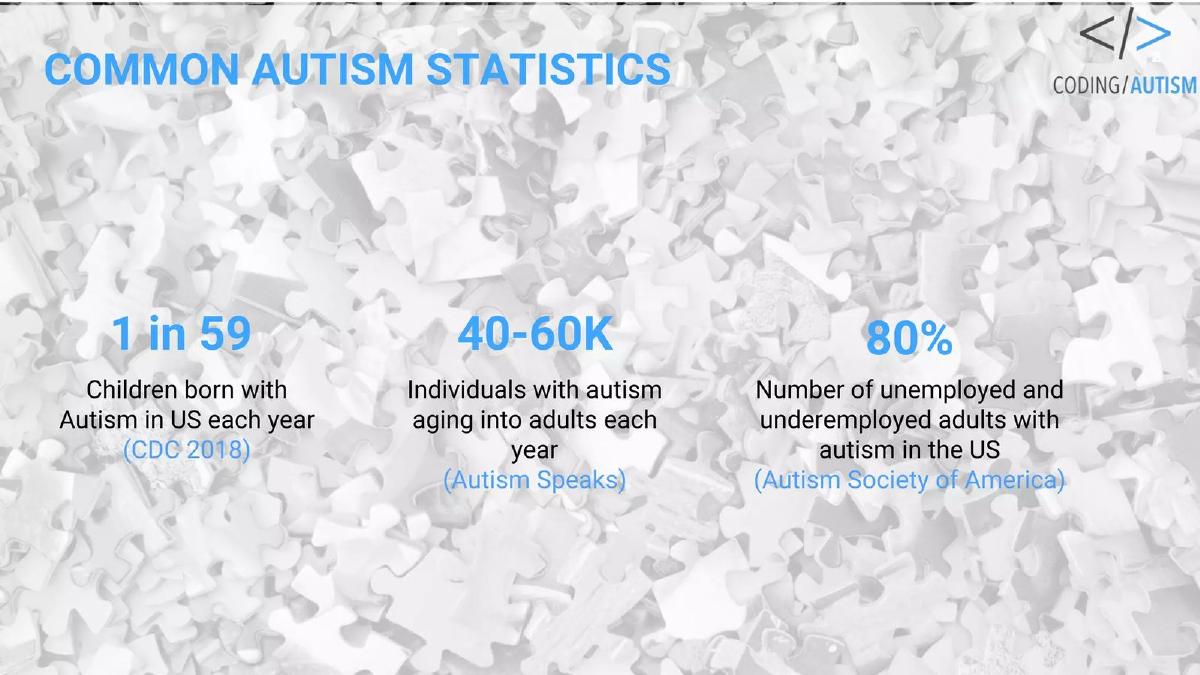
This slide uses three key metrics to establish urgency: 1 in 59 children are born with autism (CDC 2018), 40-60k individuals age into adulthood annually, and most critically, 80% of adults with autism in the US are unemployed or underemployed. Citing the Autism Society of America adds third-party credibility to these figures.
Slide 3: The Founder's Perspective
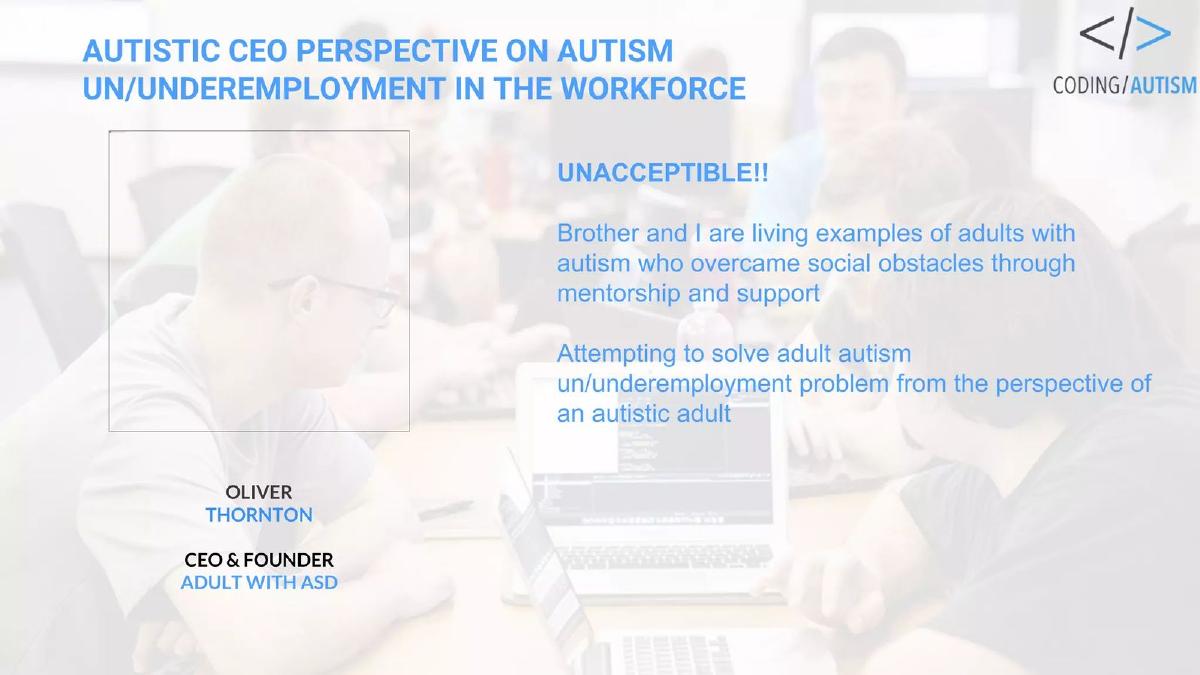
CEO Oliver Thornton is introduced not just as a founder, but as an "Adult with ASD." This is a classic "founder-market fit" move. The slide uses the word "UNACCEPTABLE!!" to inject emotion into the pitch, positioning the business as a personal mission to solve a problem the founder has lived through.
Slide 4: The Value Proposition of Neurodiversity
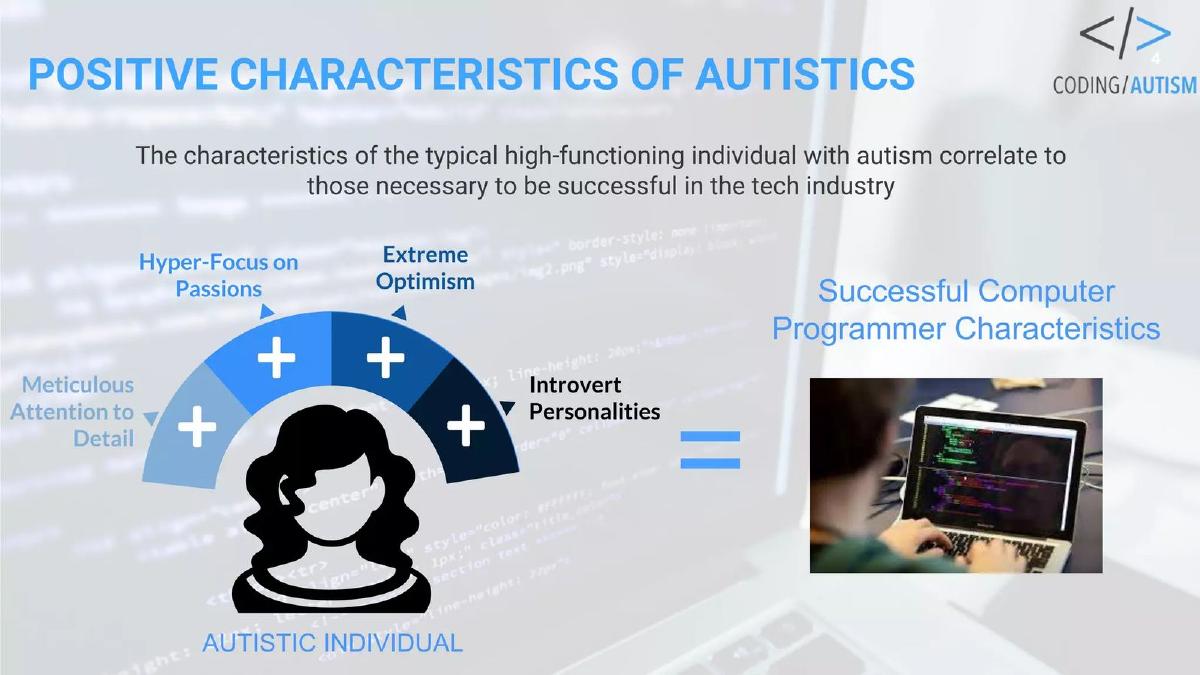
This slide attempts to rebrand autism for the tech industry. It lists traits like "Meticulous Attention to Detail," "Hyper-Focus on Passions," and "Introvert Personalities" as being equal to the characteristics of a successful computer programmer. This is the core of their marketing strategy to both students and employers.
Slide 5: The Macro Tech Problem
To prove the business is scalable, the deck points to the US tech talent shortage. It cites a projection of 1.4 million tech jobs by 2020 with only 400k CS graduates, leaving a gap of 1 million vacant jobs. This frames Coding Autism as a solution to a national economic problem, not just a social one.
Slide 6: Market Validation
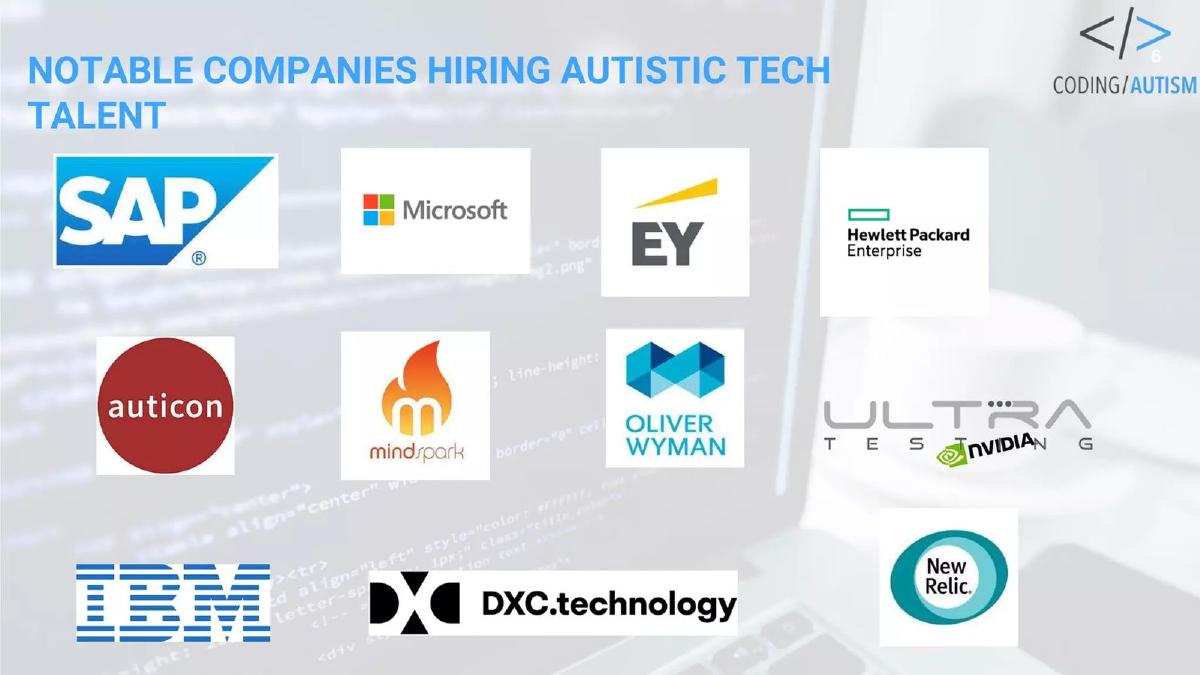
The slide displays logos of major companies already hiring autistic talent, including SAP, Microsoft, EY, HPE, IBM, and Nvidia. This serves as proof of concept—the demand for this specific talent pool already exists at the enterprise level.
Slide 7: Product Definition
Coding Autism defines itself as the "first autism specialized coding academy." It combines online education, community, and an "autism-savvy support team." The mission statement focuses on empowering individuals to reach their "maximum potential."
Slide 8: The Operational Workflow
The process is broken into four stages: Prep (50+ hours), Teach (4-9 months), Work (Interview prep and placement), and Community (Mentorship). It lists partnerships or tools like devCamp, Cybrary, and Hivebrite, showing that they aren't building everything from scratch.
Slide 9: Program Details
This slide provides granular details on the student experience. Key points include "On-Call Teacher Assistants," "Self-Paced Work," and the requirement of a high school diploma and proof of autism diagnosis. It emphasizes that no prior coding experience is needed.
Slide 10: Market Opportunity
The deck quantifies the market: a $266 million coding bootcamp market (2017) and over 4 million individuals with autism in the US. The company sets a bold goal: training at least 10,000 students on the spectrum by 2022.
Slide 11: Current Traction
As of May 29, 2018, the company reports 7 paying students, 2 graduates (1 employed in tech), and a pipeline of 25+ students. Financials show $18,500 in total revenue with an average monthly income of $5,500. While small, these numbers prove the model has moved past the ideation phase.
Slide 12: Competitive Landscape
A Venn diagram places Coding Autism at the intersection of Coding Education, Career Counseling, and Autism Specificity. It lists direct competitors like Thinkful, General Assembly, and Specialisterne, claiming their advantage lies in their specific focus and the founder's background.
Slide 13: Financial Projections
The revenue model is split between in-person ($20k/student) and online ($10k-$13.5k/student). The projections are very aggressive: Year 1 GOI of $1.1M, Year 2 of $3.08M, and Year 3 of $15.4M. The jump from Year 2 to Year 3 implies a massive scaling of student enrollment (from 280 to 1,400 students).
Slide 14: Future Revenue Streams
The company lists eight potential supplementary streams, including corporate re-training, parent consulting, and even "Co-Working & Living Spaces." While it shows ambition, it also risks looking unfocused for a seed-stage company.
Slide 15: Capital Raise and Structure
The company is a California LLC in the process of becoming a Delaware C-Corp with a pending B-Corp certification. They are seeking $300k-$400k. They disclose a previous $2.5M valuation for their convertible notes and a $20,000 grant from Autism Speaks & Game Stop.
Slide 16: Exit Strategy
This is a rare slide in early-stage decks. It explicitly names WeWork/WeGrow, Specialisterne, and General Assembly as potential acquirers. This signals to investors that the founders are thinking about liquidity events from the start.
Slide 17: Competition Results
A list of 12 awards and finalist positions in startup competitions (CLU, MIT Enterprise, etc.) serves as social proof and validation from the startup ecosystem.
Slide 18: The Team and Advisors
The core team is small (3 people), but the advisor list is heavy-hitting. Having the Director of Autism at Work from HPE and a mentor from SAP Autism at Work provides the necessary industry connections to ensure student placement, which is the most critical metric for any bootcamp.
Slide 19: Contact Information
The deck concludes with social media handles and the website URL, maintaining the clean branding established on the first slide.
What Coding Autism Does Well
Founder-Market Fit: The deck leans heavily into the CEO's personal experience with ASD, which builds immediate trust in the niche. · Advisor Network: The advisors aren't just names; they are specifically chosen from the exact corporate programs (HPE, SAP) that the company needs to partner with. · Clear Problem/Solution: The link between the tech talent shortage and the high unemployment rate of a high-aptitude demographic is logically sound and easy to grasp.
What is Missing from the Deck
Unit Economics: While they show tuition costs, they don't show the cost to acquire a student (CAC) or the cost to deliver the education (LTV/CAC ratio). · Placement Data: With only one student employed at the time of the deck, the "Work" part of their "Prep-Teach-Work" model is still largely unproven. · Scalability Details: The jump to 1,400 students in Year 3 is a 14x increase from Year 1. The deck doesn't explain how they will scale their "1:1 mentorship" and "on-call support" to handle that volume.
Founder's Guide: What to Copy
The Competitive Advantage Slide: Using a Venn diagram to show how you occupy a unique intersection that larger competitors cannot easily enter is a great way to handle the "Why you?" question. · The Traction Slide: Even though the numbers are small ($18k revenue), being honest and specific about paying students versus pipeline students builds credibility with investors. · The Exit Strategy Slide: For a niche play, naming specific acquirers who are currently expanding into your space (like WeWork was in 2018) shows you understand the M&A landscape.
Frequently asked questions
- What is the primary problem Coding Autism is trying to solve?
- The company addresses two simultaneous problems: the high unemployment rate (80%) among adults with autism and the massive talent shortage in the US tech industry, which was projected to have 1 million vacant jobs by 2020. By training neurodivergent individuals in coding, they aim to fill these vacancies with a demographic whose traits—such as meticulous attention to detail and hyper-focus—are well-suited for programming.
- How does the company differentiate itself from major bootcamps like General Assembly?
- Coding Autism claims 'Autism Specificity' as its primary competitive advantage. Unlike generic bootcamps, they provide specialized support teams, 1:1 soft skills training, and a curriculum tailored to the learning styles of individuals with ASD. The deck also highlights that the founder himself is an adult with ASD, providing a unique perspective that competitors lack.
- What are the financial projections presented in the deck?
- The deck projects significant growth for its online programs. Year 1 estimates 100 students generating $1.1 million in Gross Operating Income (GOI). By Year 3, they project scaling to 1,400 students (1,000 part-time, 400 full-time) generating $15.4 million in GOI. They also plan to launch in-person cohorts at $20,000 per student, aiming for 50 cohorts by 2020.
- What is the current funding status and the new investment ask?
- As of the deck's publication, Coding Autism had raised approximately $100k through bootstrapping, friends and family, rewards-based crowdfunding ($52,855), and convertible notes ($46,212). They are currently seeking $300k-$400k to scale, with discussions reportedly underway with University Impact and other co-investing groups.
- Who is on the leadership team and who advises them?
- The team is led by CEO Oliver Thornton, an adult with ASD. He is supported by Mellissa Toler (Director of Soft Skills) and Ian Earley (Director of Technical Mentorship). The advisory board is a notable strength, featuring Michael Fieldhouse (Director of Autism at Work at HPE) and Cheryl Morin (SAP Autism at Work Mentor), providing direct links to major potential employers.