CoinMall’s 11-slide seed deck targets the $100 billion digital products market by leveraging cryptocurrency to bypass traditional payment hurdles like chargebacks and high fees. The company positions itself as a user-friendly alternative to decentralized competitors like OpenBazaar, offering automated product delivery and a non-intrusive escrow system. While the deck effectively communicates the problem—specifically the 'financially-risky' label traditional processors apply to digital goods—it lacks critical financial data. There are no historical revenue figures, no specific user growth metr…
Key takeaways
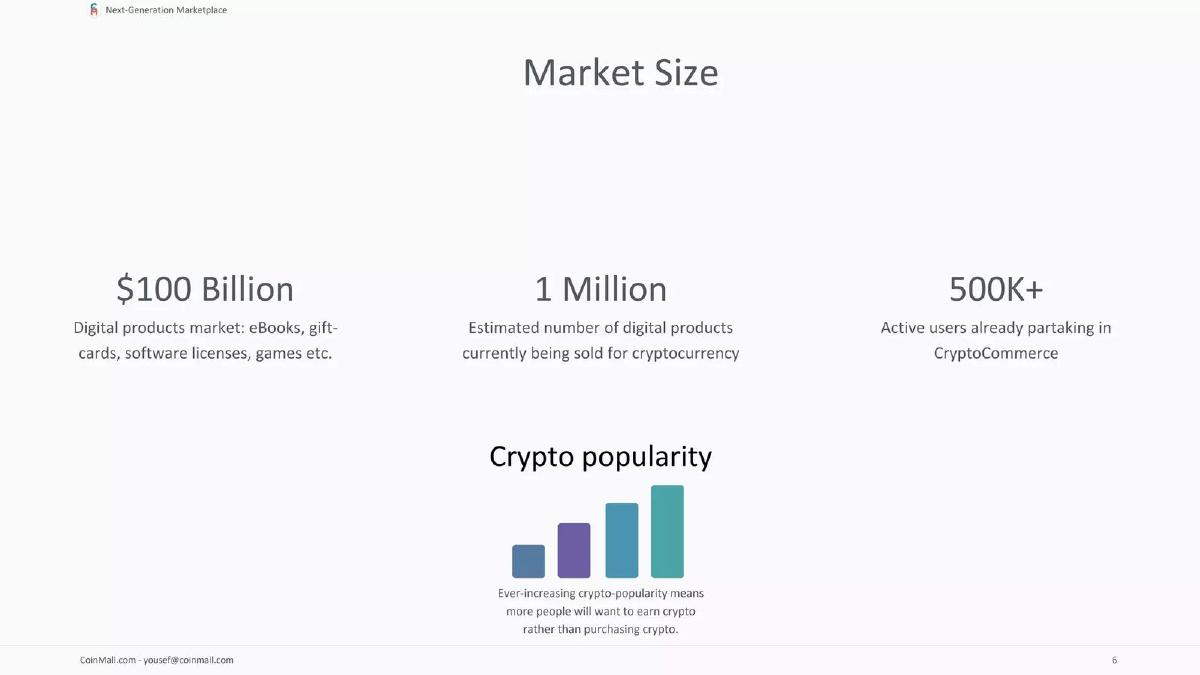
- The company identifies a $100 billion market for digital products including eBooks, gift cards, and software licenses (Slide 6).
- CoinMall differentiates itself from competitors like OpenBazaar and Bitify by offering both zero platform fees and automated product delivery (Slide 7).
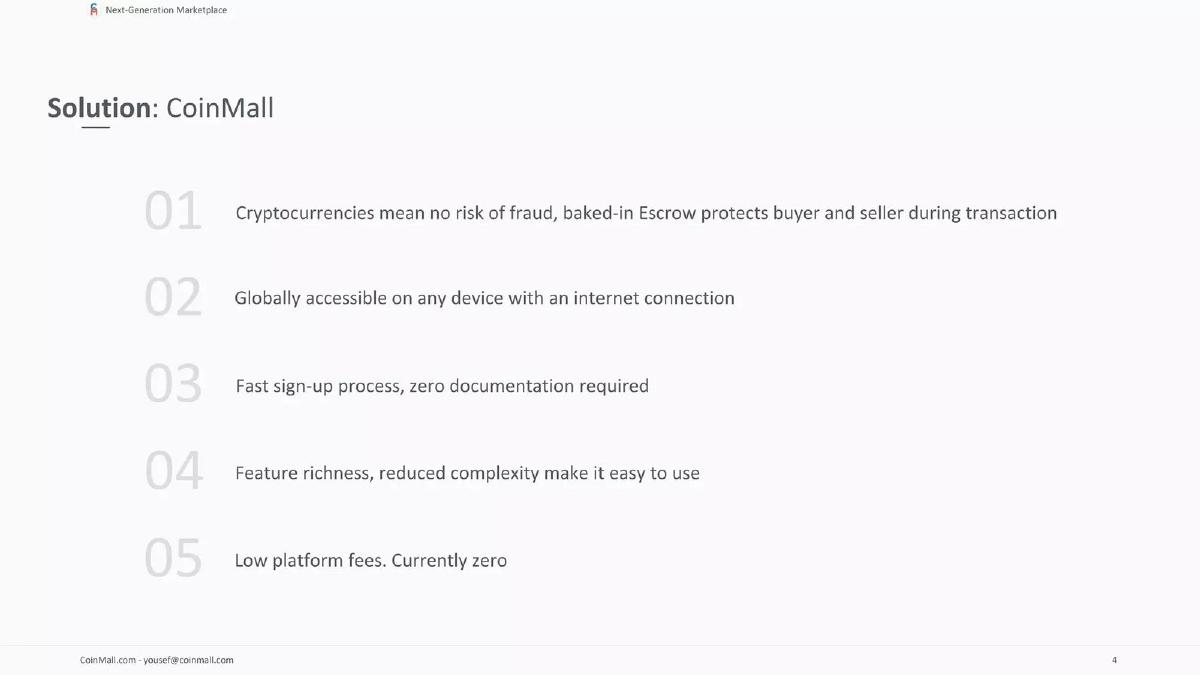
- The platform utilizes a 'baked-in Escrow' system to eliminate the risk of fraud and chargebacks common in traditional digital commerce (Slide 4).
- The business model proposes three revenue streams: vertical integration of in-house products, Shopify-style seller subscription plans, and transaction fees (Slide 8).
- CoinMall claims to have a working product and explicitly states they are 'Not an ICO,' distancing themselves from the 2017-2018 token sale trend (Slide 9).
- The team consists of two co-founders: Yousef Abdulhassan (CEO) and Michail Strokin (CTO), who claims to have found vulnerabilities on hundreds of sites 'for fun' (Slide 10).
- The deck fails to include a financial 'Ask' slide, leaving investors unaware of the funding amount sought or the intended use of proceeds.
- Market size estimates include 1 million digital products currently sold for cryptocurrency and 500k+ active users in 'CryptoCommerce' (Slide 6).
Slide-by-Slide Analysis
Slide 1: Title Slide
The deck opens with the CoinMall logo and the tagline: "The Digital Products Marketplace." The branding is clean, using a teal and coral color palette. It immediately establishes the company's niche in the digital goods sector.
Slide 2: Vision Statement
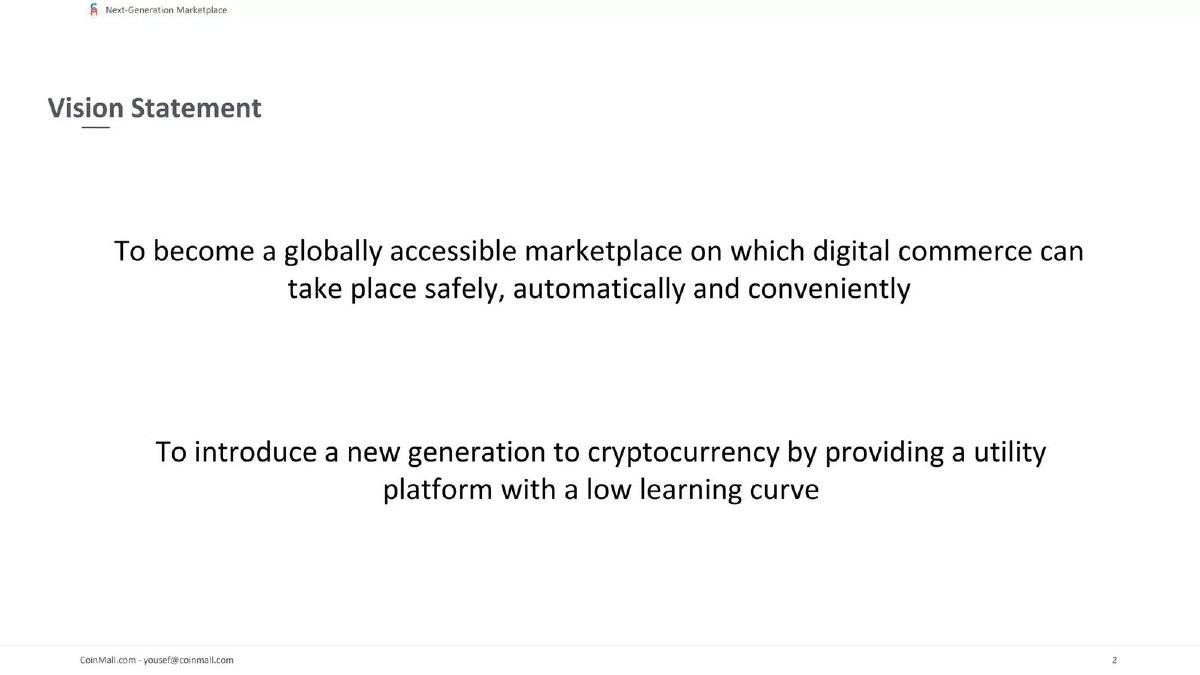
The vision is twofold: to create a "globally accessible marketplace" where commerce is safe and automatic, and to "introduce a new generation to cryptocurrency" via a platform with a low learning curve. This suggests the target audience isn't just crypto-natives, but mainstream users who find current blockchain tools too complex.
Slide 3: Problem: Digital Commerce
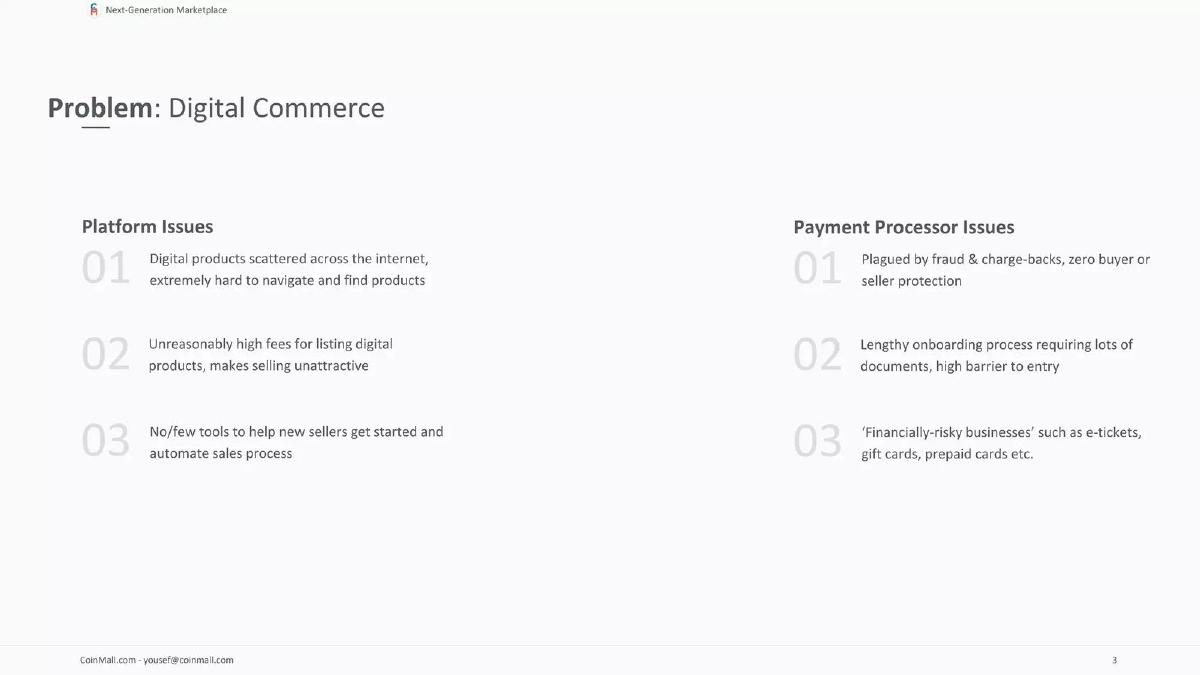
The problem is split into "Platform Issues" and "Payment Processor Issues." Under platforms, they cite scattered products, high fees, and a lack of seller tools. Under processors, they highlight fraud, chargebacks, lengthy onboarding, and the fact that digital goods are often flagged as "financially-risky." This is a strong slide because it identifies a specific pain point—the friction between traditional banking and digital assets like gift cards.
Slide 4: Solution: CoinMall
The solution lists five points: no fraud risk due to crypto, global accessibility, fast sign-up with zero documentation, ease of use, and low fees (currently zero). By stating fees are "currently zero," they emphasize a growth-first strategy to capture market share from incumbents.
Slide 5: Security
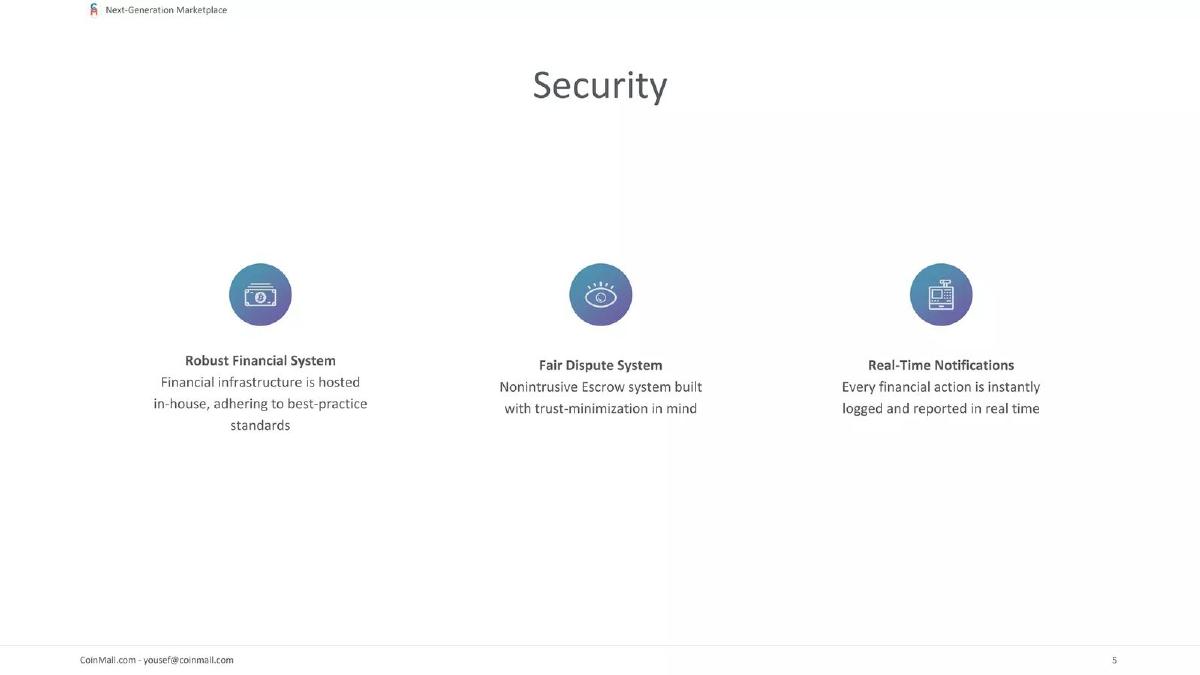
This slide focuses on the technical trust layer. It mentions a "Robust Financial System" hosted in-house, a "Fair Dispute System" using non-intrusive escrow, and "Real-Time Notifications." The emphasis on "trust-minimization" is a key crypto-economic principle that appeals to the blockchain investment community.
Slide 6: Market Size
CoinMall values the digital products market (eBooks, gift cards, software) at $100 Billion. They estimate 1 million digital products are currently sold for crypto and cite 500k+ active users in the space. A bar chart titled "Crypto popularity" shows upward growth but lacks specific Y-axis units or data sources, making it more of a visual aid than a hard metric.
Slide 7: Competitive Landscape
A comparison table pits CoinMall against OpenBazaar, Particl, and Bitify. CoinMall gives itself checkmarks across all categories: low barrier to entry, secure dispute mediation, 0% fees, multi-crypto support, and automated product delivery. Notably, it claims competitors like OpenBazaar and Bitify fail at automated delivery, which is a critical feature for a digital-only marketplace.
Slide 8: Business Model
The revenue strategy includes: Vertical Integration (selling their own gift cards/keys), Seller Plans (monthly subscriptions for premium features), and Fees (transaction-based). This is a standard marketplace monetization mix, though the deck does not provide projected margins for these streams.
Slide 9: Why invest now?
The company argues the market is moving from an "investment phase" to a "utility phase," citing Coinbase's acquisition of Earn.com as a signal. They reiterate their "Global Scale" and make a point to say they are "Not an ICO," which was a significant distinction during the era this deck was likely produced, signaling a preference for traditional equity over token speculation.
Slide 10: Team
The team consists of Yousef Abdulhassan (CEO) and Michail Strokin (CTO). Abdulhassan is credited with experience in selling digital goods and building platforms. Strokin is described as having 10 years of programming experience and having "found and fixed vulnerabilities on hundreds of sites for fun." While this demonstrates technical proficiency, the slide lacks specific past company names or successful exits.
Slide 11: Closing Slide
A simple logo slide. It lacks a call to action or contact information, though an email address was visible in the footer of previous slides.
What CoinMall Does Well
The deck is exceptionally clear about the problem-solution fit . By focusing specifically on the "financially-risky" nature of digital goods in the eyes of companies like Stripe or PayPal, CoinMall carves out a logical reason for cryptocurrency to exist in this transaction. The competitive matrix on Slide 7 is also effective; it doesn't just say they are better, it identifies specific functional gaps in competitors, such as the lack of automated product delivery.
The visual design is consistent and professional. It avoids the cluttered, text-heavy pitfalls of many early-stage decks, opting for iconography and short bullet points that are easy to digest during a quick flip-through.
What is Missing from the CoinMall Deck
The most glaring omission is The Ask . There is no slide indicating how much capital the founders are seeking, what the valuation expectations are, or how the funds will be allocated (e.g., 50% engineering, 30% marketing). Without this, the deck functions more as a product overview than a fundraising tool.
Furthermore, there is a total lack of Traction Data . While Slide 9 mentions they have a working product, there are no screenshots of the interface, no data on current Gross Merchandise Volume (GMV), no user retention stats, and no mention of how many sellers are currently active on the platform. For a "Seed" deck, investors typically expect to see some evidence of early product-market fit beyond just a live URL.
Finally, the Roadmap is missing. Investors want to see what the next 12-18 months look like. Will they add support for more cryptocurrencies? Will they launch a mobile app? The deck ends abruptly without showing the path forward.
Founder's Guide: What to Copy
Specific Problem Segmentation: Follow the example on Slide 3. Don't just say "commerce is broken." Break it down into platform issues (usability) and processor issues (financial friction). This shows you understand the nuances of your industry.
Feature-Based Competition: Slide 7 is a great template for a competitive grid. Instead of vague terms like "better service," use binary features like "Automated product delivery" or "Multi-crypto support." This makes your advantages objective rather than subjective.
The 'Not an ICO' Positioning: If you are building in a space that is currently experiencing a bubble or a specific trend (like AI or Crypto), explicitly stating what you are not can help de-risk the investment in the eyes of a cautious VC. CoinMall's Slide 9 does this effectively by emphasizing utility over speculation.
Clean Footer Information: Including the URL and a direct contact email on every slide (as seen in the footer) is a small but professional touch that ensures an investor can reach out even if they only have a printed copy of a single slide.
Frequently asked questions
- What specific problem is CoinMall trying to solve?
- According to Slide 3, CoinMall addresses two main areas: platform issues and payment processor issues. They highlight that digital products are currently scattered across the internet with high listing fees. More importantly, they target the 'high barrier to entry' and 'financially-risky' classification that traditional processors apply to digital goods, which often leads to fraud and chargebacks.
- How does CoinMall plan to make money if fees are currently zero?
- Slide 8 outlines a three-pillar business model. First, vertical integration by selling their own products like gift cards and game keys. Second, 'Seller Plans' where users pay a monthly fee for advanced features, similar to Shopify. Third, they intend to eventually charge a 'minimal fee' for every successfully processed transaction.
- Who are the primary competitors mentioned in the deck?
- Slide 7 compares CoinMall against OpenBazaar, Particl, and Bitify. The deck claims CoinMall is superior because it offers a low barrier to entry, secure dispute mediation, multi-crypto support, and automated product delivery—a combination the competitors allegedly lack.
- What is the current stage of the product?
- Slide 9 states that CoinMall 'already has a working product, today.' This is used as a key selling point to differentiate the startup from Initial Coin Offerings (ICOs) that often raised funds based on whitepapers rather than functional software.
- What information is missing from this pitch deck?
- The deck is missing several standard components: a specific funding ask (how much money they want), a roadmap of future milestones, detailed unit economics, and actual traction metrics (like GMV or user growth rates). It relies heavily on market potential rather than historical performance.