The Cofundit deck, dating to early 2011, represents a foundational era for European crowdfunding, specifically targeting the SME debt market rather than equity. The company positioned itself as a bridge between retail/sophisticated investors and growth companies needing working capital. By utilizing a 'bullet loan' structure with interest rates between 10% and 15%, Cofundit aimed to democratize access to private debt markets previously reserved for high-net-worth individuals. The deck relies heavily on a single case study—Faction Skis—to prove the model's efficacy, showing a CHF 170,000 raise…
Key takeaways
- The platform focuses exclusively on loan-based investments in non-quoted growth companies (Slide 1).
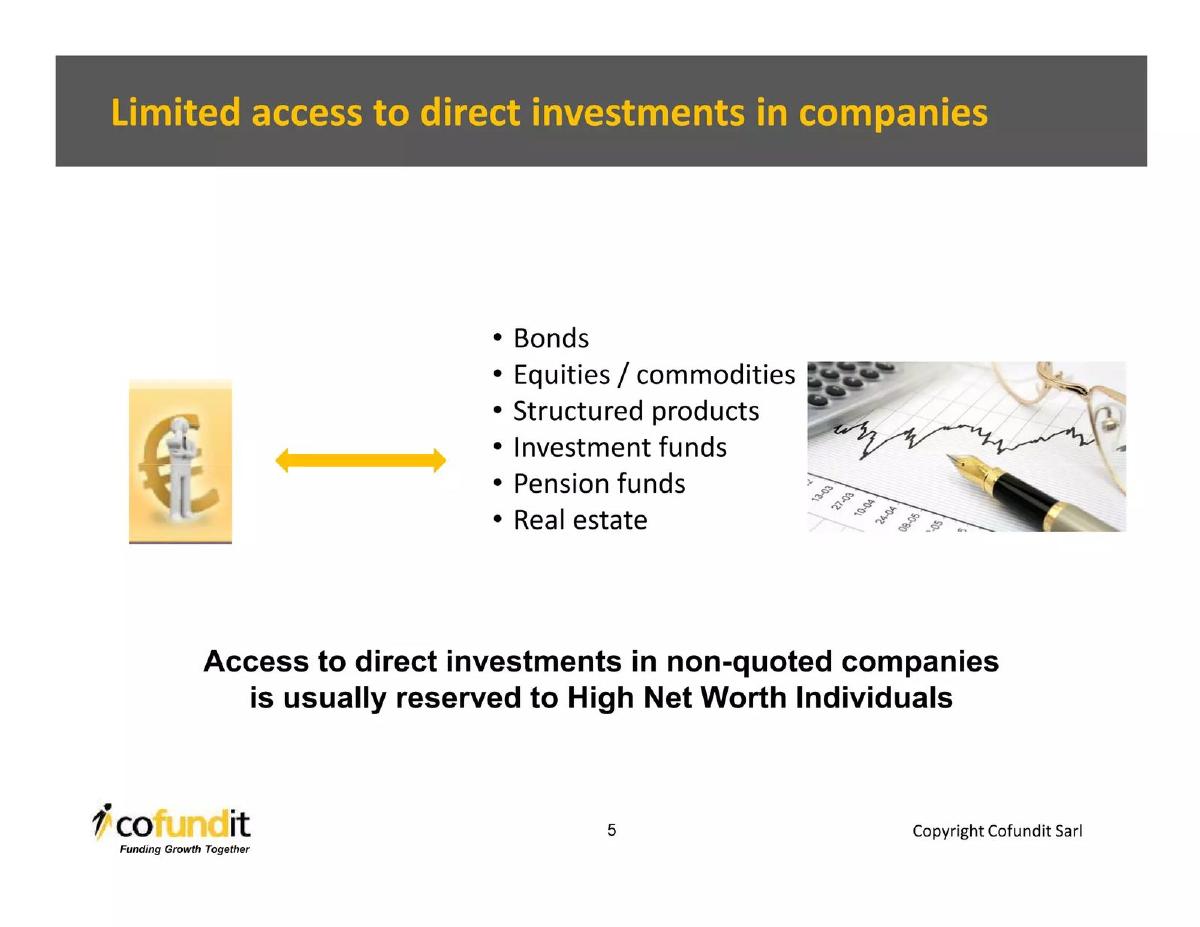
- Cofundit identifies a market gap where direct investment in private companies is typically reserved for High Net Worth Individuals (Slide 5).
- The revenue model includes a CHF 600 sign-up fee for entrepreneurs and a 5% success fee upon funding (Slide 9).
- Investors on the platform commit both a principal amount and a desired interest rate for specific funding tranches (Slide 9).
- A primary case study features Faction Skis, which raised CHF 170,000 as a 6-month bullet loan at 10-15% interest (Slide 11).
- The community strategy involves a mix of digital tools (webcasts, dashboard) and physical live events (3 per month) to build trust (Slide 13).
- The deck includes a press collage featuring Swiss publications like L'AGEFI and 24 heures to establish regional credibility (Slide 19).
- There is no slide detailing the founding team's backgrounds or professional history, though names appear in press clippings.
Cofundit: Democratizing SME Debt in the Early Crowdfunding Era
The Cofundit deck, labeled as 'Basics Investors Jan 2011,' serves as a time capsule for the early 2010s fintech movement. At a time when 'crowdfunding' was largely associated with creative projects on platforms like Kickstarter, Cofundit attempted to apply the model to the more rigid world of SME debt financing. Based in Switzerland (as evidenced by the Sarl designation and CHF currency), the deck focuses on bridging the gap between private growth companies and a broader investor base.
Slide 1: Title and Value Proposition
The cover slide establishes the core thesis: 'Enabling broad access to private investments.' It specifically defines the niche as 'Loan-based Investments in non-quoted Growth Companies.' The header uses a word cloud of keywords—Funding, Crowd, Trust, SME, Loan, Transparent, Reputation, Invest, Entrepreneur, Expertise—to set the thematic tone. The branding is professional, if somewhat dated, and clearly identifies the entity as Cofundit Sarl.
Slide 3: The Agenda
The agenda slide outlines a standard narrative flow: defining the problem (SME financing), explaining the mechanism (What is Crowd Funding?), detailing the process, providing a case study (Faction Skis), and explaining community engagement. This structure suggests the deck was intended for an audience that might still be unfamiliar with the concept of crowdfunding, necessitating an educational component.
Slide 5: The Problem - Limited Access
Slide 5 addresses the 'Why now?' and the market gap. It lists traditional investment vehicles—Bonds, Equities, Structured products, Investment funds, Pension funds, and Real estate—contrasting them with direct investments in companies. The slide explicitly states that access to direct investments in non-quoted companies is 'usually reserved to High Net Worth Individuals.' This identifies the 'democratization' angle that would become a staple of fintech pitches for the next decade.
Slide 7: Defining Crowdfunding
Because the deck was produced in early 2011, Slide 7 takes a step back to define the industry. It notes that crowdfunding involves a 'funding need of one party,' 'sourced from many,' 'usually through the internet,' and is 'mostly to support social / creative / political / startup projects.' Cofundit’s pivot is then stated: to broaden this reach to support 'established SME’s growth.' This is a critical distinction; they are not targeting high-risk pre-revenue startups, but rather companies with existing track records.
Slide 9: The Marketplace Mechanics
This slide is the most informative regarding the business model. It illustrates a two-sided marketplace flow:
Entrepreneur Side: The entrepreneur pays a CHF 600 sign-up fee to be validated. Once funded, they pay a 5% success fee. · Investor Side: Investors commit both an amount and a specific interest rate for 'funding tranches.' · Execution: The entrepreneur selects the most attractive tranches (presumably those with the lowest interest rates), and the loan contract is executed with funds wired directly to the entrepreneur.
This 'reverse auction' style for interest rates is a sophisticated feature for an early platform.
Slide 11: Case Study - Faction Skis
To prove the model, Cofundit presents a 'Working Capital Bridge Loan' case for Faction Skis. The slide provides concrete metrics:
Company Profile: Founded 2006, 1,200 pairs of skis sold in 2009/2010, sold in 13 countries, doubling revenues every year. · Loan Terms: CHF 170,000 total funded, 6-month term, structured as a 'Bullet loan.' · Interest Rate: 10% to 15%. · Tranches: Individual investor tranches ranged from CHF 10,000 to 50,000.
The slide includes a testimonial from Alex Hoye, Chairman of Faction Skis, confirming the loan was raised in four weeks to secure product shipments.
Slide 13: Community and Engagement
Slide 13 details how Cofundit maintains its ecosystem. It highlights four pillars:
Internet Platform: Featuring a funding request overview, discussion forum, and investor dashboard. · Live Events: Three events each month to meet entrepreneurs and fellow investors. · Investor Webcast: Weekly sessions with 1-2 companies pitching. · Cofundit Magazine: A quarterly publication covering crowdfunding topics and investor knowledge.
This multi-channel approach suggests a heavy emphasis on 'Trust' and 'Reputation,' keywords from the cover slide, which were essential for early fintech adoption.
Slide 15 & 17: Transitions
Slides 15 and 17 are simple transition slides for 'Questions?' and 'Appendix.' While they serve a functional purpose during a live presentation, they offer no data for a teardown analysis.
Slide 19: Press and Credibility
The final slide in the provided set is a collage of press clippings. It features logos and articles from L'AGEFI, Swiss Equity magazine, and 24 heures. The headlines, such as 'Le réseau de capital-risque online' and 'Nouvelle ressource de financement privé,' reinforce the company's position as a pioneer in the Swiss financial landscape. This slide is intended to provide third-party validation to mitigate investor perceived risk.
What Works in the Cofundit Deck
Specific Unit Economics: The deck does not hide its fees. By stating the CHF 600 sign-up fee and the 5% success fee on Slide 9, the founders provide a clear picture of how the platform sustains itself. This transparency is often missing in early-stage decks that focus only on 'scale' without explaining the 'how.'
Tangible Case Study: The Faction Skis slide is the strongest part of the deck. It moves the conversation from abstract 'crowdfunding' to a real-world financial transaction with specific terms (6 months, 10-15% interest). It proves that there is both demand from companies and supply from investors for this specific debt product.
Hybrid Strategy: The combination of a digital platform with live events and a physical magazine (Slide 13) shows a sophisticated understanding of the investor psychology of 2011. Before digital trust was ubiquitous, physical touchpoints were a powerful way to build a community of lenders.
What is Missing from the Cofundit Deck
The Team Slide: Perhaps the most glaring omission in the provided slides is a dedicated team slide. In early-stage investing, the pedigree of the founders is often as important as the idea. While names like Alec Vautravers and Hervé Flutto appear in the press clippings on Slide 19, their specific bios and relevant experience are not highlighted in the main narrative.
The 'Ask': The deck explains what Cofundit does for SMEs, but it never explicitly states what it wants from the investors reading the deck. There is no mention of the round size, the valuation, or the specific milestones the company intends to reach with new capital.
Competitive Landscape: The deck treats Cofundit as if it exists in a vacuum. By 2011, other platforms were beginning to emerge globally. A slide addressing why Cofundit’s debt-based, SME-focused model was superior to emerging equity-based competitors would have strengthened the case.
Financial Projections: While the Faction Skis case shows one successful transaction, the deck lacks a 'Platform Growth' slide. Investors need to see how many 'Factions' the company expects to fund over the next 12-24 months and what the resulting revenue looks like for Cofundit Sarl.
Lessons for Founders
Use Debt as a Hook: If you are building a marketplace, showing a completed transaction with high-yield returns (10-15%) is a very effective way to grab investor attention. It makes the 'opportunity' feel concrete rather than theoretical.
Define Your Terms: Cofundit was right to define 'Crowdfunding' on Slide 7. If you are operating in a new or misunderstood sector, never assume the investor knows the basics. Educating the investor builds your authority as an expert in the space.
Visualizing the Process: Slide 9 is a great example of how to use simple icons and arrows to explain a complex two-sided transaction. Founders should always aim to simplify their 'how it works' slide so it can be understood in under ten seconds.
Frequently asked questions
- What is the primary investment instrument offered by Cofundit?
- Cofundit focuses on debt-based instruments, specifically bridge financing and working capital loans. As shown in the Faction Skis case study on Slide 11, these are structured as 'bullet loans' with short terms (e.g., 6 months) and relatively high interest rates ranging from 10% to 15%.
- How does Cofundit generate revenue from its marketplace?
- According to the process flow on Slide 9, the platform employs a dual-fee structure. Entrepreneurs pay a CHF 600 sign-up fee to be validated for fundraising, and Cofundit charges a 5% success fee on the total amount raised once the funding tranches are executed.
- Who is the target audience for the Cofundit platform?
- The platform targets two sides: established SMEs looking for growth capital and a 'broad' base of investors. Slide 5 explicitly states that access to such investments is usually reserved for High Net Worth Individuals, implying Cofundit's mission is to lower the barrier to entry for smaller investors.
- What evidence of traction does the deck provide?
- The deck relies on a single, detailed case study for Faction Skis (Slide 11). It notes that the company, founded in 2006, sold 1,200 pairs of skis across 13 countries and doubled revenues annually. Cofundit successfully facilitated a CHF 170,000 loan for them in four weeks.
- What are the most significant omissions in this pitch deck?
- The deck lacks a dedicated team slide, which is standard for investor presentations. It also fails to provide a competitive analysis, a financial forecast for the platform itself, or a clear 'Ask' slide stating how much money the founders are seeking from investors and how they plan to use it.