EarnOS presents a compelling case for a decentralized advertising model, raising $18.5M in a 2024 Seed round. The deck identifies a massive $280B annual loss in ad spend due to bots and fraud, positioning 'verifiable human attention' as a scarce digital asset. The product utilizes Zero-Knowledge Transport Layer Security (zkTLS) to validate user actions across web2 and web3 applications without compromising privacy. By paying users directly in stablecoins for verified tasks, EarnOS aims to create a 'VeriGraph'—a decentralized social graph that users own. While the deck is heavy on high-level v…
Key takeaways
- The digital advertising market is valued at $1 trillion, but 28% ($280B) is lost annually to bots and fraud (Slide 3).
- EarnOS claims that 80% of all internet visits are currently generated by bots (Slide 3).
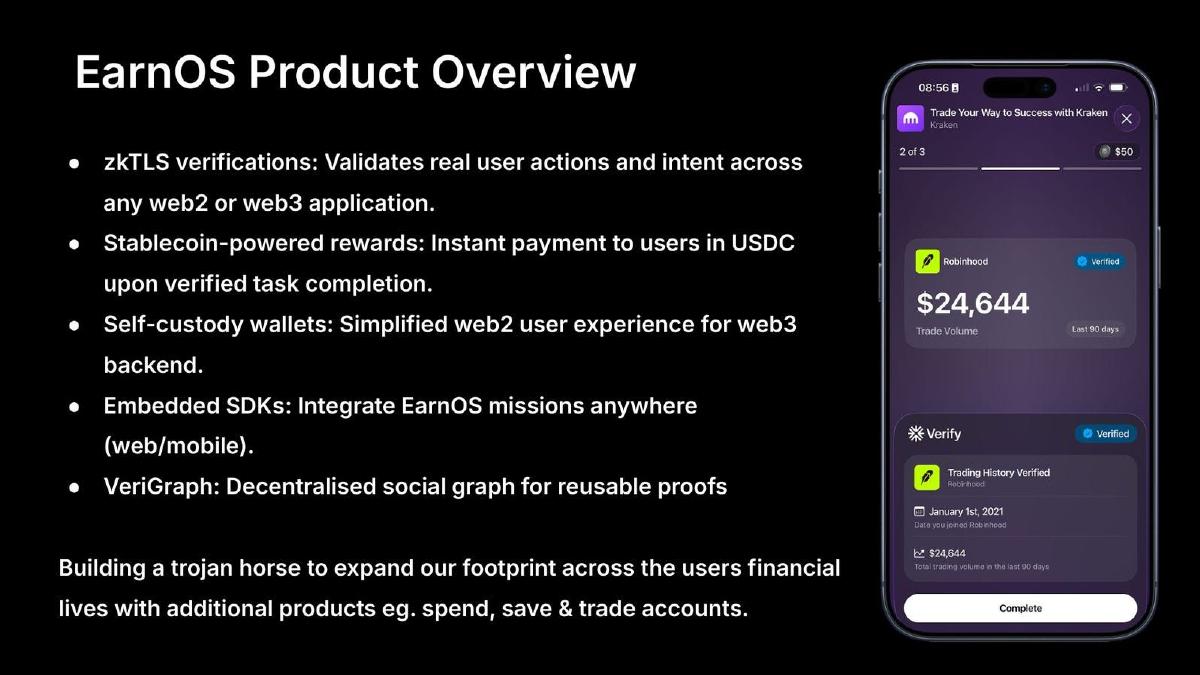
- The core technology relies on zkTLS verifications to validate real user intent across any application (Slide 2).
- Users are paid instantly in USDC stablecoins for completing verified tasks, utilizing self-custody wallets (Slide 2).
- The company positions its reward system as a 'trojan horse' to eventually offer spend, save, and trade accounts (Slide 2).
- The 'VeriGraph' allows users to own their credentials, which can be monetized repeatedly via an API, similar to 'Stripe for verified data' (Slide 6).
- The deck highlights a declining effectiveness in traditional ad attribution due to GDPR, CCPA, and cookie depreciation (Slide 3).
- EarnOS aims to compound its growth by building a data-gravity moat where more proofs lead to a richer, harder-to-replicate social graph (Slide 6).
The Internet's Reward Layer: A New Paradigm for AdTech
EarnOS entered the market in 2024 with a significant $18.5M Seed round, as reported by Business Insider. The company's pitch deck focuses on a fundamental shift in how digital attention is bought and sold. Rather than relying on the 'deteriorating cookie-based ads model,' EarnOS proposes a direct-to-consumer reward system powered by blockchain technology and zero-knowledge proofs. The deck is structured to highlight the failure of the current $1 trillion advertising ecosystem and present a technologically superior alternative that benefits both brands and users.
Slide 1-2: The Hook and Product Overview
The deck opens with a minimalist title slide featuring the EarnOS logo and the tagline 'The internet’s reward layer.' This is immediately followed by a comprehensive Product Overview on Slide 2. This slide is dense with technical and strategic information. It introduces zkTLS verifications as the core mechanism for validating user actions across web2 and web3. It also mentions stablecoin-powered rewards (USDC) and self-custody wallets . Crucially, the slide notes that EarnOS is building a 'trojan horse' to expand into broader financial services like spend, save, and trade accounts. This indicates that while they are starting in advertising, their ultimate goal is to become a fintech hub for verified users.
Slide 3: The $280 Billion Problem
Slide 3 provides the market context and the 'villain' of the story: bots and fraud. The slide claims that the $1 trillion digital advertising market is growing at an 8% CAGR, but 28% ($280B annually) of that spend is lost to bots. A line graph titled 'Global Digital Ad Spend Lost to Bots & Fraud (2015-2024)' shows a steep upward trajectory, reaching $100 billion in the most recent year. The slide also lists 'Increasing data privacy regulations (GDPR, CCPA)' and 'cookie depreciation' as factors preventing brands from reaching high-intent users. The most striking claim on this slide is that 80% of internet visits are bots , making 'verifiable human attention' the scarcest asset online.
Slide 4-5: The Solution and The New Economy
Slide 4 is a transition slide that states 'EarnOS inverts the model.' It promises to deliver verifiable engagement by connecting brands directly to consumers, not bots. Slide 5 expands on this by describing the 'convergence of key technologies' that have unlocked new economic potential. The new economy is defined by four pillars: Incentivised by brands (scalable), Powered by Web3 (global), Paid in Stablecoins (instant settlement), and Verified with zkTLS (a verified internet). This slide serves to justify why this solution is possible now, whereas it might have failed in previous years before the maturity of stablecoins and zk-proofs.
Slide 6: Moat and Network Effects
This slide outlines how EarnOS intends to defend its market position. It introduces the Reward -> Proof Loop , where every mission mints a new credential. The VeriGraph Flywheel is described as 'Stripe for verified data attestation,' where a single data point can generate recurring fee revenue. The 'Data-Gravity Moat' suggests that as the graph grows, it becomes harder for competitors to replicate the portable, privacy-safe identity data EarnOS holds. The slide concludes with a bold comparison, stating that their compounding network effects are 'similar to Google Ads in the 2000's.'
Slide 7-8: The Vision and The Decentralised Social Graph
Slide 7 uses the classic 'One more thing' trope to lead into the final summary. Slide 8 reiterates the network effect: 'More missions -> richer graph -> higher brand ROI -> more spend -> more quality users.' It emphasizes that users retain control of their data and build 'equity in their digital lives.' This framing shifts the product from a simple 'get paid to click' app to a foundational layer for a decentralised social graph . The deck ends on this high-level vision, focusing on the empowerment of the user within the digital economy.
What EarnOS Does Well
The deck excels at identifying a massive, quantifiable pain point. By citing the $280 billion lost to fraud, EarnOS makes the need for their product feel urgent and inevitable. The use of specific technical terms like zkTLS and USDC provides a sense of 'how' it works without getting bogged down in code, signaling to investors that the team understands the modern tech stack required to solve privacy and payment hurdles simultaneously.
The 'trojan horse' strategy is also a strong point. Investors often worry that 'earn' platforms have a ceiling; by explicitly stating that the reward layer is a lead generator for a broader financial ecosystem (Spend, Save, Trade), EarnOS increases its perceived Total Addressable Market (TAM) significantly.
What is Missing from the Deck
Despite the high-level technical explanation, the 8 slides provided in this sequence omit several critical components of a standard pitch deck:
Team Slide: There is no mention of the founders' backgrounds or their previous experience in advertising or blockchain. In a Seed round, the 'who' is often as important as the 'what.' · Unit Economics: While the deck mentions 'recurring fee revenue,' it does not provide specific details on the take-rate from brands or the cost of verifying a user. · Traction: There are no slides showing current user numbers, brand partnerships, or pilot results. The deck relies entirely on the market opportunity and the theoretical flywheel. · The Ask: The specific use of funds and the breakdown of the $18.5M raise are not detailed in these slides. · Competition: The deck ignores existing competitors in the 'Attention Economy' space, such as Brave Browser or other web3 quest platforms, focusing instead on the failure of traditional web2 ads.
Lessons for Founders
Founders can learn from EarnOS's ability to frame a technical solution as a macro-economic necessity. They don't just say 'we have a better ad bot detector'; they say 'verifiable human attention is the scarcest asset online.' This elevates the conversation from a tool to a platform.
Additionally, the concept of the 'VeriGraph'—turning one-time user actions into a reusable, queryable asset—is a masterclass in building a moat. Founders should look for ways to turn their product's output into a 'data gravity' source that becomes more valuable the more it is used. However, founders should be careful not to omit the 'Team' and 'Traction' slides in their own decks, as these are usually the first things an investor looks for after the problem/solution fit is established.
Frequently asked questions
- What is the primary problem EarnOS is trying to solve?
- EarnOS targets the inefficiency and fraud in the $1 trillion digital advertising market. According to Slide 3, $280 billion is lost annually to bots. With 80% of internet traffic being non-human and privacy regulations like GDPR limiting traditional tracking, EarnOS provides a way for brands to reach verified, high-intent human users directly.
- How does EarnOS verify that a user is actually human?
- The platform uses zkTLS (Zero-Knowledge Transport Layer Security) verifications. As stated on Slide 2, this technology validates real user actions and intent across both web2 and web3 applications. This allows for proof of activity without requiring the user to expose sensitive private data to the advertiser.
- What is the 'VeriGraph' mentioned in the deck?
- The VeriGraph is described on Slide 6 as a decentralized social graph. Each time a user completes a 'mission,' a new zk-verified credential is minted and stored in the user's wallet. This graph is queryable by other apps via an API, allowing the same proof to be monetized multiple times.
- How are users compensated for their engagement?
- Users receive instant payments in stablecoins (specifically USDC) upon the verified completion of a task. The deck notes on Slide 2 that the platform uses self-custody wallets but provides a 'simplified web2 user experience' to lower the barrier to entry for non-crypto users.
- What is the long-term business strategy beyond advertising?
- EarnOS views its advertising reward layer as a 'trojan horse.' Slide 2 and Slide 6 explain that by capturing user attention and providing a wallet, they intend to expand into a full suite of financial products, including spending, saving, and trading accounts.