Eadbox’s pitch deck is a masterclass in brevity, using only 10 slides to communicate a high-growth SaaS business in the Latin American EdTech space. The company focuses on a specific niche: moving offline consultants into the digital economy. By the time this deck was circulated, the company had already achieved significant scale, reporting over $3.2M in ARR and a customer base exceeding 1,000 clients. The financial health of the business is the primary selling point, highlighted by a 70% gross margin and an impressive 5x LTV/CAC ratio. While the deck lacks a formal 'Ask' slide or a detailed…
Key takeaways
- The company achieved a significant scale of $3.2M ARR with over 1,000 clients as shown on Slide 5.
- Eadbox demonstrates strong unit economics with a 70% gross margin and a 5x LTV/CAC ratio on Slide 10.
- The growth trajectory is aggressive, citing +130% growth Year-over-Year on Slide 5.
- The platform targets a specific price point of U$ 300/month per client, according to Slide 6.
- The market opportunity is defined as a U$ 5 Billion annual market in the Americas on Slide 3.
- The founding team has a track record of serial entrepreneurship, having founded 5 companies collectively (Slide 9).
- The product focuses on the 'Offline to Online' transition, specifically for consultants and speakers (Slides 1 and 7).
- The deck omits a specific funding request, valuation, or use of proceeds slide.
Executive Summary: The Power of Traction
The Eadbox pitch deck is a lean, 10-slide presentation that relies heavily on realized performance rather than future promises. In an industry often crowded with 'pre-revenue' visions, Eadbox enters the room with $3.2M ARR and 130% YoY growth . The narrative is simple: there is a massive market of offline consultants who need to go online to scale, and Eadbox is the engine that facilitates that transition for $300 a month.
Slides 1-2: The Hook and the Visual Problem
Slide 1 introduces the brand with a clear, punchy tagline: "Getting consultants online to scale their businesses." This immediately identifies the target persona—the consultant—and the primary benefit—scaling. It avoids technical jargon about 'LMS' or 'EdTech' in favor of a business outcome.
Slide 2 is a full-bleed image of a speaker on a stage in front of a large audience. This is a clever use of visual storytelling. It represents the 'Current State' of their target customer: one person, one room, limited by physical space. It sets the stage for the 'Offline to Online' transition that the product promises to solve.
Slides 3-4: Market Size and Value Proposition
Slide 3 defines the market opportunity with a single, massive figure: U$ 5 Billion year for the Americas. While the slide is sparse on the source of this data, it serves its purpose in a pitch setting by establishing the ceiling for the business. The focus on 'Americas' suggests an ambition that extends beyond their initial LATAM footprint.
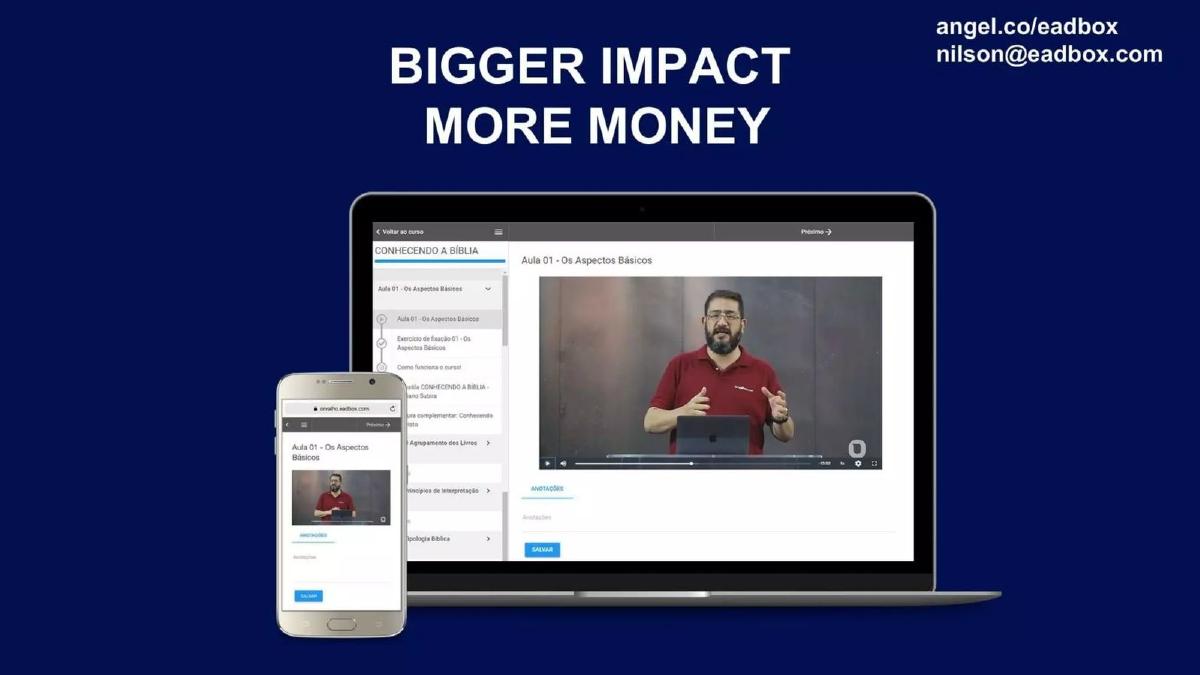
Slide 4 introduces the product's core promise: "Bigger Impact, More Money." It shows the software interface on both a laptop and a mobile device. The screenshot features a video lesson titled "Conhecendo a Bíblia," which demonstrates the platform's versatility across different content niches. The emphasis here is on the user experience—clean, professional, and accessible across devices.
Slides 5-6: Traction and Pricing Strategy
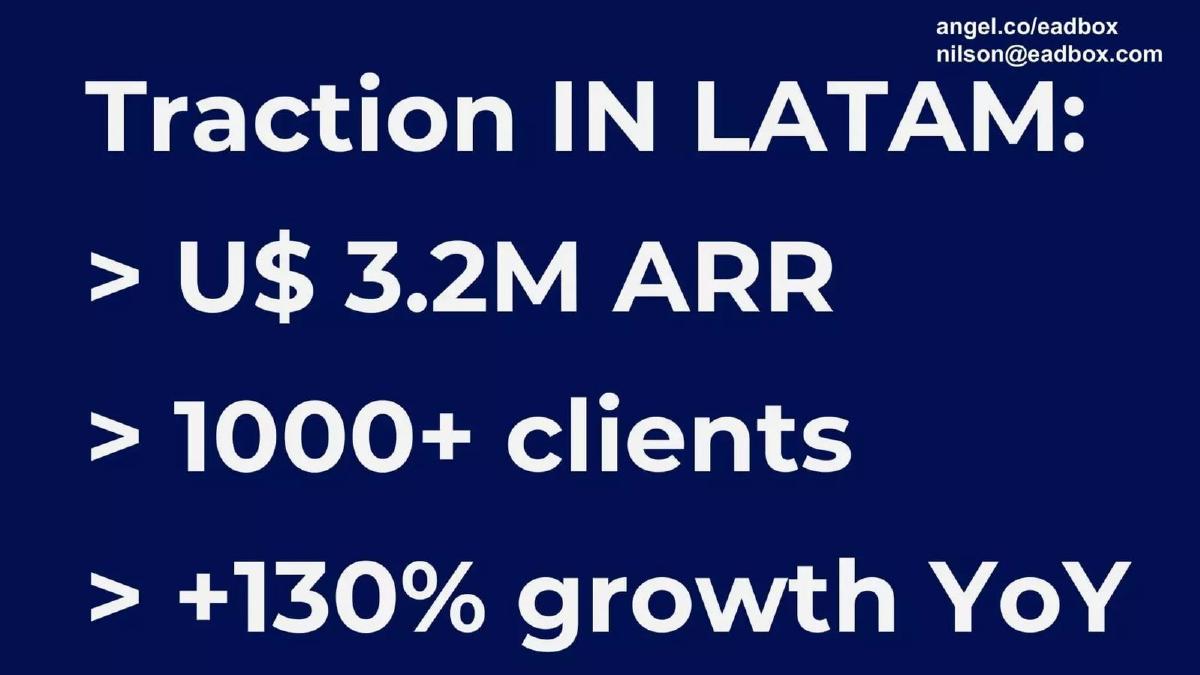
Slide 5 is the 'money slide' of the deck. It lists three critical data points: > U$ 3.2M ARR , > 1000+ clients , and > +130% growth YoY . For a 'Later' stage deck (as categorized in 2011), these numbers are the primary justification for investment. The mention of "Traction in LATAM" anchors their current success in a specific geographic stronghold.
Slide 6 poses a rhetorical question: "Why do clients pay U$ 300/month for EADBOX?" This slide is important because it establishes the price point. At $300/month, Eadbox is positioned as a premium professional tool rather than a low-cost consumer LMS. It implies a B2B relationship where the software is an investment in the client's revenue generation.
Slides 7-8: Product Utility and Internal Analytics
Slide 7 illustrates the 'Offline to Online' workflow. It shows a PowerPoint icon and a video icon being transformed into the Eadbox interface. This simplifies the product's utility: it takes the existing assets of a consultant and turns them into a structured online course. The screenshot shows a medical course on Alzheimer's, further proving the platform's reach into professional and technical education.
Slide 8 focuses on the 'Marketing and Sales' dashboard. This is a crucial differentiator. Eadbox isn't just a place to host videos; it’s a business management tool. The dashboard shows sales figures in Brazilian Real (R$), with one view showing R$ 455.015,85 in accumulated sales over 90 days. This proves that the platform actually helps its users make money, which justifies the $300/month subscription fee.
Slides 9-10: Team and Unit Economics
Slide 9 introduces the four-man leadership team. The standout fact here is that they have "Founded 5 Companies." This signals to investors that this is not their first rodeo. The inclusion of logos like IBM, Oracle, Citibank, and Stone provides institutional credibility, suggesting the team has experience in both high-growth startups and established corporate environments.
Slide 10 concludes the deck with a summary of the company's financial health. It reiterates the U$ 3.2M ARR but adds three vital SaaS metrics: 70% Gross Margin , LTV/CAC: 5 , and an NPS: 9 . A 5x LTV/CAC ratio is exceptionally strong, indicating that for every dollar spent on marketing, they generate five dollars in lifetime value. An NPS of 9 (on what is presumably a 1-10 scale, or a very high score on a -100 to +100 scale) suggests high customer satisfaction.
What Works in This Deck
Extreme Brevity: With only 10 slides, the deck never gets bogged down in technical minutiae. It stays focused on business outcomes and growth. · Metric-Driven Narrative: The deck relies on hard numbers ($3.2M ARR, 130% growth, 5x LTV/CAC) to do the heavy lifting. This is the most effective way to pitch a later-stage company. · Clear Persona Targeting: By focusing on 'Consultants,' the deck makes it easy for an investor to visualize the customer and the sales process. · Visual Proof of Success: Showing a customer's sales dashboard with nearly half a million Real in revenue is a powerful way to demonstrate product-market fit.
What Is Missing
The Ask: There is no slide indicating how much money the company is looking to raise or what the intended use of those funds would be. · Competitive Landscape: The deck does not mention competitors like Teachable, Kajabi, or Coursera. Investors would want to know how Eadbox defends its position in LATAM against global players. · Roadmap: While the current traction is impressive, the deck doesn't explain what the next 24 months look like. Are they expanding geographically? Adding AI features? Moving into enterprise? · Detailed Service Explanation: The catalogue description mentions a 'unique best practices framework' and 'lead generation support,' but the slides focus almost entirely on the SaaS technology.
What a Founder Should Copy
The 'Why do they pay?' Slide: Asking and answering why your price point is justified is a great way to handle objections before they arise. · SaaS Metric Summary: Grouping Gross Margin, LTV/CAC, and NPS on a single slide provides a snapshot of business health that every investor looks for. · The 'Offline to Online' Visual: Using simple icons (PowerPoint to Platform) to explain a complex digital transformation process is highly effective for clarity. · Focusing on Customer Revenue: If your product helps people make money, show a screenshot of them making money. It is the most compelling evidence of value.
Frequently asked questions
- What is Eadbox's primary business model?
- Eadbox operates as a SaaS platform for 'Education Entrepreneurs.' According to Slide 6, they charge a subscription fee of approximately U$ 300 per month. The platform allows consultants and authors to create, host, and sell online courses under their own brand, providing the technology stack, customer success services, and lead generation support to help these creators scale their businesses.
- How fast is Eadbox growing?
- Based on Slide 5, Eadbox is experiencing rapid expansion with a growth rate of over 130% Year-over-Year. At the time of the deck, they had reached $3.2M in Annual Recurring Revenue (ARR). This growth is supported by a client base of more than 1,000 paying customers, primarily located in the Latin American (LATAM) market.
- What are the key financial metrics of the company?
- The company boasts very healthy SaaS metrics on Slide 10. They report a 70% gross margin, which is standard for a mature SaaS business. More importantly, they maintain an LTV/CAC ratio of 5, meaning the lifetime value of a customer is five times the cost to acquire them. They also report an NPS of 9, suggesting high product-market fit and customer loyalty.
- Who is the team behind Eadbox?
- The leadership team, detailed on Slide 9, consists of Nilson Filatieri (CEO), Hernán Orti (COO/CFO), Jeferson Rodrigo (VP Sales), and Rafael Silva (CPO/CTO). The slide highlights that the group has founded 5 companies and includes logos from major corporations like IBM, Oracle, Citibank, and Stone, suggesting a mix of entrepreneurial and enterprise experience.
- What is missing from this pitch deck?
- The deck is notably missing an 'Ask' slide, which would typically define how much capital is being raised and at what valuation. It also lacks a detailed competitor analysis, a roadmap for future product features, and a specific breakdown of the 'Lead Generation' and 'Services' components mentioned in their catalogue description but only briefly alluded to in the slides.