The DVIBEWEAR pitch deck functions more as a brand lookbook than a traditional venture capital presentation. It successfully identifies a specific target audience—youth aged 18-30—and establishes a mission centered on individuality and community. However, the deck is critically thin on substance. There are no mentions of revenue, unit economics, manufacturing scale, or competitive analysis. The 'Fabric Quality and Sourcing' slide mentions a commitment to sustainability but provides no certifications or specific supply chain details. For a startup in the highly competitive custom apparel space…
Key takeaways
- The primary target audience is defined as the youth demographic, specifically those aged 18-30 (Slide 3).
- The brand mission focuses on empowering youth through fashion that speaks to individuality and inspires confidence (Slide 4).
- The vision is to become a leading brand in modern streetwear while maintaining affordability (Slide 4).
- Product differentiation is claimed through unique graphics and innovative patterns (Slide 5).
- The company claims a commitment to sustainability in its fabric sourcing, though no specific materials are named (Slide 6).
- The deck contains no financial data, historical sales figures, or projected growth metrics across the provided slides.
- There is no mention of the founding team, their experience, or the current corporate structure.
- The presentation lacks a 'The Ask' slide, leaving potential investors unaware of the capital requirements or valuation.
Brand Identity and Market Positioning
The DVIBEWEAR pitch deck is a minimalist presentation that prioritizes brand 'vibe' over business fundamentals. The title slide introduces the company name in bold, sans-serif typography against a black background, accompanied by the tagline 'Style Wahi, Jo Vibe De.' This sets an immediate tone of youth-centric, informal branding that aligns with the streetwear market.
Slide 1: Title and Tagline
The opening slide is functional but sparse. It includes a placeholder for a logo and a date placeholder (MM/DD/20XX). The tagline 'Style Wahi, Jo Vibe De' suggests a focus on the Indian market or a Hindi-speaking demographic, positioning the brand as a local player in the global streetwear trend. However, the lack of a finalized logo on a pitch deck is a missed opportunity to demonstrate brand readiness.
Slide 2: Brand Overview Transition
Slide 2 serves as a simple chapter header for the 'Brand Overview.' While clean, in a 13-slide deck, using entire slides for section headers can be seen as filler if the subsequent content is not dense with information. In this case, the deck remains high-level throughout.
Slide 3: Target Audience
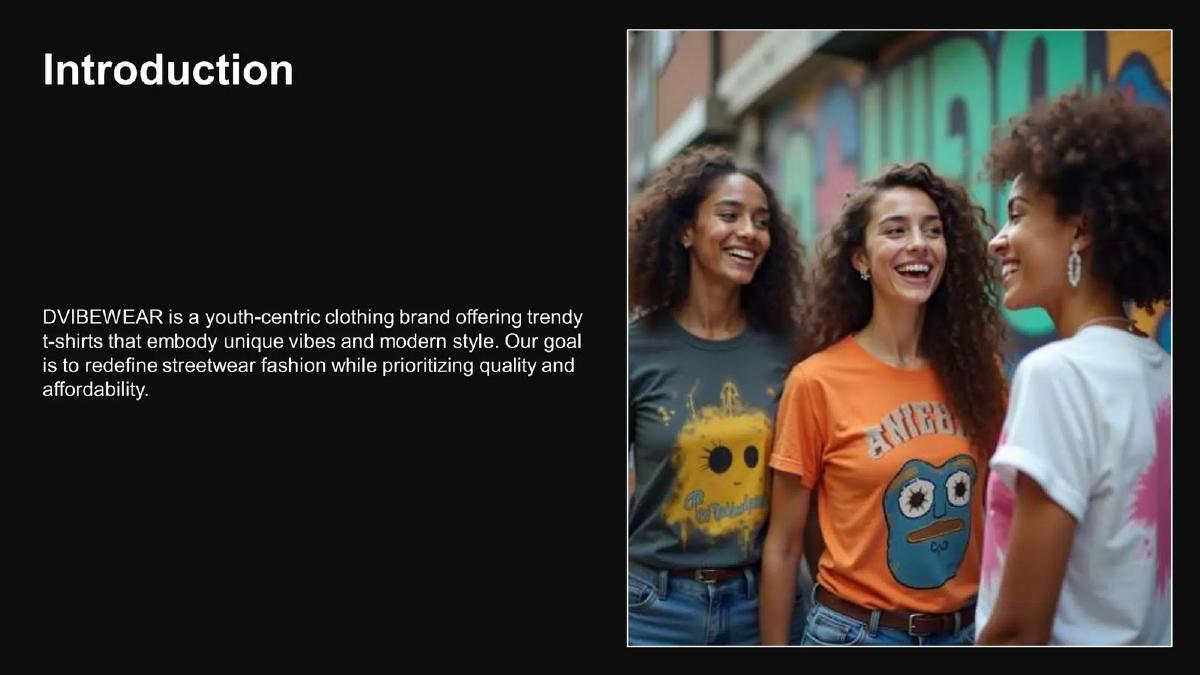
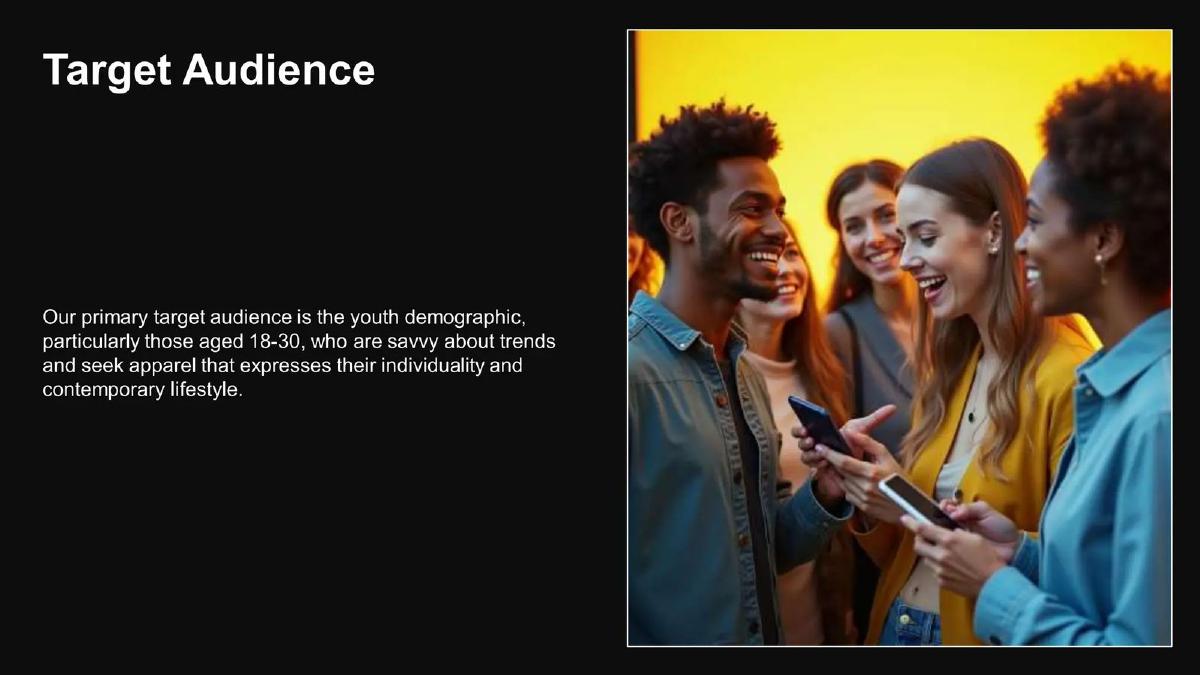
This slide provides the most specific data point in the entire presentation. It identifies the primary target audience as the 'youth demographic, particularly those aged 18-30.' The description notes that these individuals are 'savvy about trends' and seek 'individuality.' The imagery used features a diverse group of young adults, reinforcing the lifestyle aspect of the brand. From a fundraising perspective, this slide identifies the 'who' but fails to quantify the 'how many'—there is no mention of the Total Addressable Market (TAM) or Serviceable Obtainable Market (SOM).
Slide 4: Brand Mission and Vision
The mission is defined as empowering youth through fashion, while the vision is to be a 'leading brand' in modern streetwear. The slide mentions a commitment to 'quality and affordability.' While these are standard brand pillars, they are not unique. Investors typically look for a mission that solves a specific pain point; here, the mission is purely aesthetic and aspirational.
Slide 5: Trendy T-Shirt Designs
This slide attempts to showcase the product. It claims the collection features 'unique graphics and innovative patterns.' The accompanying image shows t-shirts on hangers in a retail-like setting. However, the designs shown are relatively generic graphic tees. To be successful in the 'custom' fashion space, a deck should ideally highlight the proprietary nature of the designs or the technology used to customize them, neither of which is present here.
Slide 6: Fabric Quality and Sourcing
Sustainability is a major selling point in modern fashion, and Slide 6 attempts to capitalize on this by stating a 'commitment to sustainability.' It mentions 'premium quality fabrics' sourced for durability. However, the slide lacks any concrete evidence, such as GOTS certification, specific fabric blends (e.g., organic cotton, recycled polyester), or details on the ethical standards of their sourcing partners. Without these details, the claim of being a 'responsible choice' remains unsubstantiated marketing copy.
Slide 7: Conclusion
The final slide is a simple 'THANK YOU!' against a black background. It lacks contact information, social media handles, or a call to action. This is a significant tactical error in a pitch deck, as it provides no path for an interested investor to follow up.
What is Missing from the DVIBEWEAR Deck
The most striking aspect of this teardown is what is not included. A standard pitch deck usually contains 10-12 core slides; DVIBEWEAR has omitted almost all the slides that involve numbers or strategy.
The Problem: There is no slide explaining why the market needs another t-shirt brand. Is there a lack of affordable streetwear? Is the current custom market too slow? The deck doesn't say. · The Solution: While they show t-shirts, they don't explain how their business model solves a market gap. · Market Size: There is no data on the size of the Indian or global streetwear market. · Business Model: It is unclear if this is a D2C (Direct-to-Consumer) e-commerce play, a retail play, or a B2B custom printing service. · Traction: There are no sales figures, website traffic stats, or social media follower counts. · Competition: The deck does not acknowledge competitors like Bewakoof, The Souled Store, or international giants like H&M and Zara. · Team: Investors invest in people. This deck does not introduce the founders or their relevant experience in fashion or retail. · The Ask: There is no mention of how much money is being raised or how it will be spent (e.g., 40% marketing, 30% inventory, 30% operations).
What Founders Should Copy
Despite the lack of business data, there are a few stylistic elements that are worth noting for early-stage conceptual decks:
Visual Consistency: The deck uses a consistent color palette (black and white) and clean typography. This creates a professional, if minimalist, aesthetic. · Clear Audience Definition: Narrowing the focus to the 18-30 age bracket is better than saying 'everyone who wears clothes.' It shows the founders have a specific customer profile in mind. · Brevity: The slides are not cluttered with text. Each slide has one clear message, which makes the deck easy to skim.
Final Analysis
The DVIBEWEAR deck is a 'pre-seed' or 'idea-stage' document that focuses entirely on brand identity. While the 'vibe' is consistent, it lacks the rigor required to secure professional investment. To move forward, the founders need to bridge the gap between 'fashion brand' and 'startup business' by providing unit economics, a clear go-to-market strategy, and a detailed breakdown of their supply chain and competitive advantages.
Frequently asked questions
- What is the core product offering of DVIBEWEAR?
- Based on Slide 5, the core product is a collection of trendy t-shirts featuring unique graphics and innovative patterns. The brand positions itself within the 'modern streetwear' category, emphasizing style that allows customers to express their individuality.
- Who is the intended customer for this brand?
- As stated on Slide 3, the brand targets the youth demographic, specifically individuals between the ages of 18 and 30. These customers are described as trend-savvy and seeking apparel that reflects a contemporary lifestyle.
- Does the deck provide information on manufacturing or supply chain?
- Slide 6 mentions that fabrics are 'carefully sourced' to ensure durability and comfort. It also claims a commitment to sustainability. However, the deck does not provide specific details on where the shirts are manufactured, who the suppliers are, or the cost of goods sold (COGS).
- What business metrics are included in the pitch?
- The deck includes zero business metrics. There is no information regarding customer acquisition cost (CAC), lifetime value (LTV), monthly recurring revenue (MRR), or even total units sold to date. It is purely a conceptual brand overview.
- Is this deck ready for a Seed or Series A funding round?
- No. The deck lacks the essential components of a professional fundraising document, including a team slide, a competitive landscape, a clear business model, and a financial ask. It serves better as an internal brand identity document than an investor pitch.