E62 Ventures represents a specific breed of 'alumni funds' designed to institutionalize the 'friends and family' round for elite business school graduates. The deck, dated March 2021, outlines a plan to raise a $1M target fund with an average contribution of $10K per member. By pooling capital from up to 250 accredited investors within the MIT Sloan community, the fund aims to provide privileged access to high-potential startups founded by classmates. The strategy focuses on seed and pre-seed deals with ticket sizes ranging from $25K to $200K. While the deck leans heavily on the prestige of t…
Key takeaways
- The fund targets a $1M total capital raise with an average contribution of $10K per person (Slide 12).
- Investment focus is strictly on seed and pre-seed deals globally, with ticket sizes between $25K and $200K (Slide 12).
- The fund operates without charging management fees or carry, aiming to optimize legal and operational expenses (Slide 8).
- MIT is ranked 4th globally for MBA programs producing startup founders, having raised $12.3B across 474 companies between 2006-2019 (Slide 6).
- The legal structure is a US-based LLC allowing up to 250 members, specifically designed to avoid the need for the Investment Advisor Act (Slide 17).
- The fund's leadership team consists of seven partners with backgrounds at firms like Goldman Sachs, BCG, and Morgan Stanley (Slide 16).
- A 'Warm up' phase from July to December 2020 involved drafting investment guidelines and creating a deal sourcing platform (Slide 13).
- The fund explicitly warns that 3 out of 4 investments will likely fail, emphasizing the high-risk nature of the asset class (Slide 15).
Executive Summary: The Alumni Network as an Asset Class
E62 Ventures is not a traditional venture capital firm. It is a community-driven investment vehicle created by and for the MIT Sloan Class of 2020. The pitch deck, dated March 2021, serves two purposes: recruiting new members to contribute capital and recruiting volunteers to help run the fund. The core thesis is that the MIT ecosystem is one of the most productive entrepreneurial hubs in the world, and by pooling capital, alumni can gain access to high-quality deals that would otherwise be reserved for institutional VCs or wealthy individuals.
Slides 1-4: Introduction and Objectives
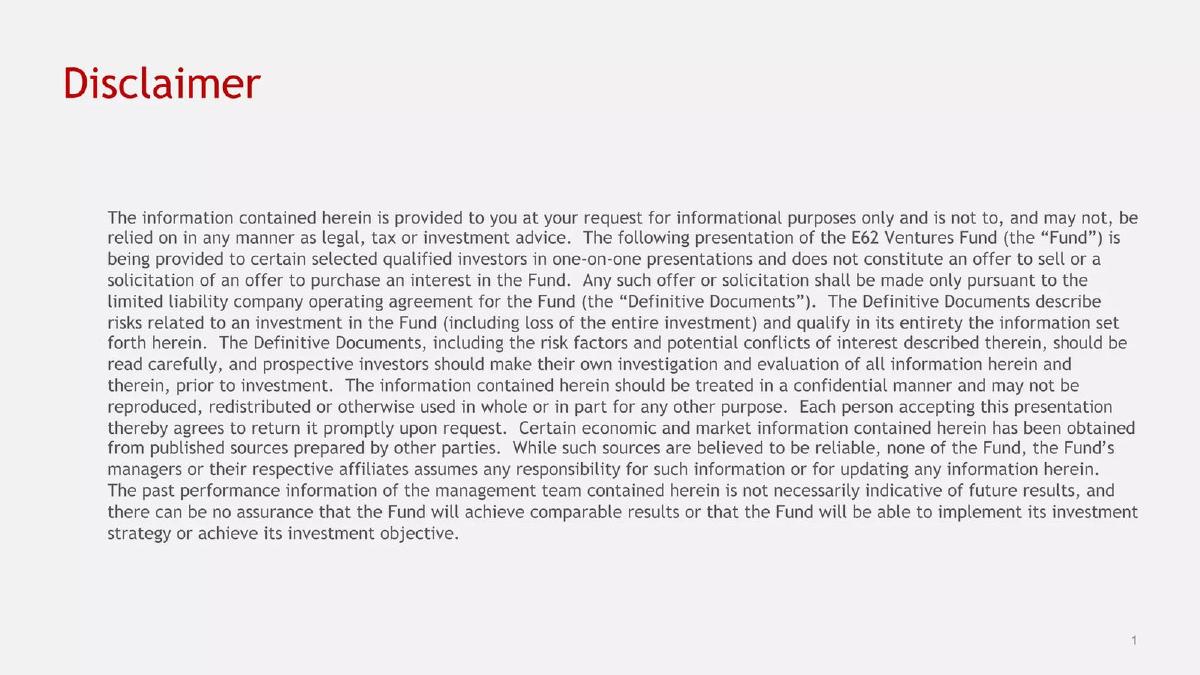
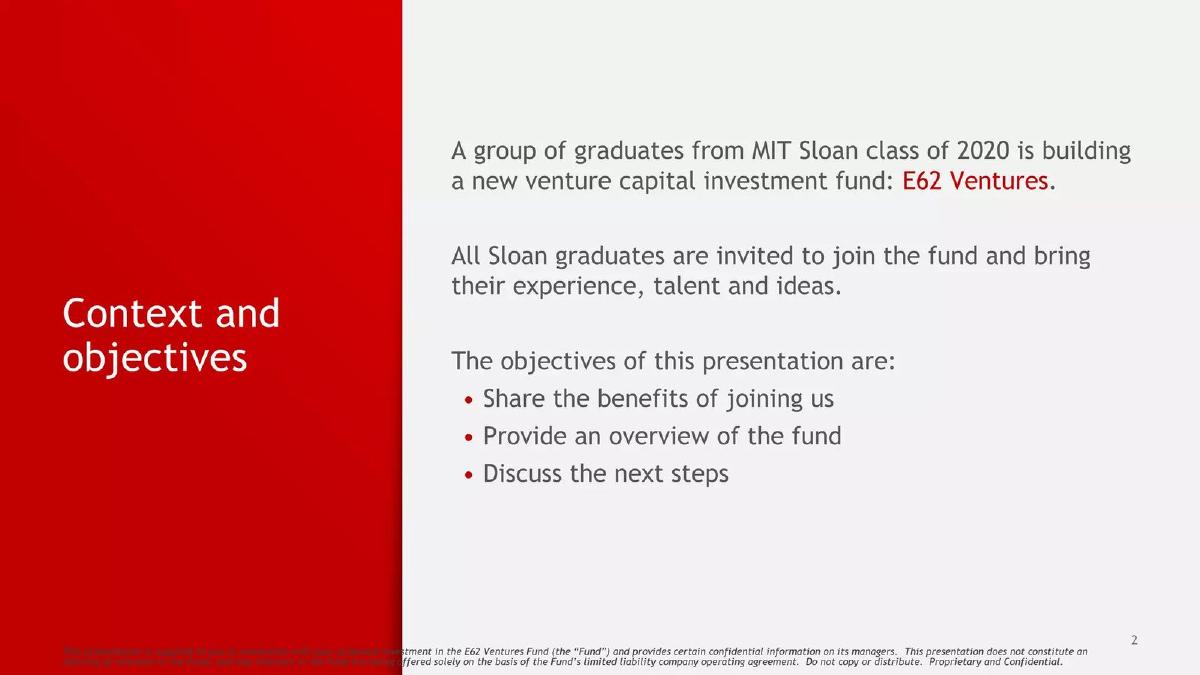
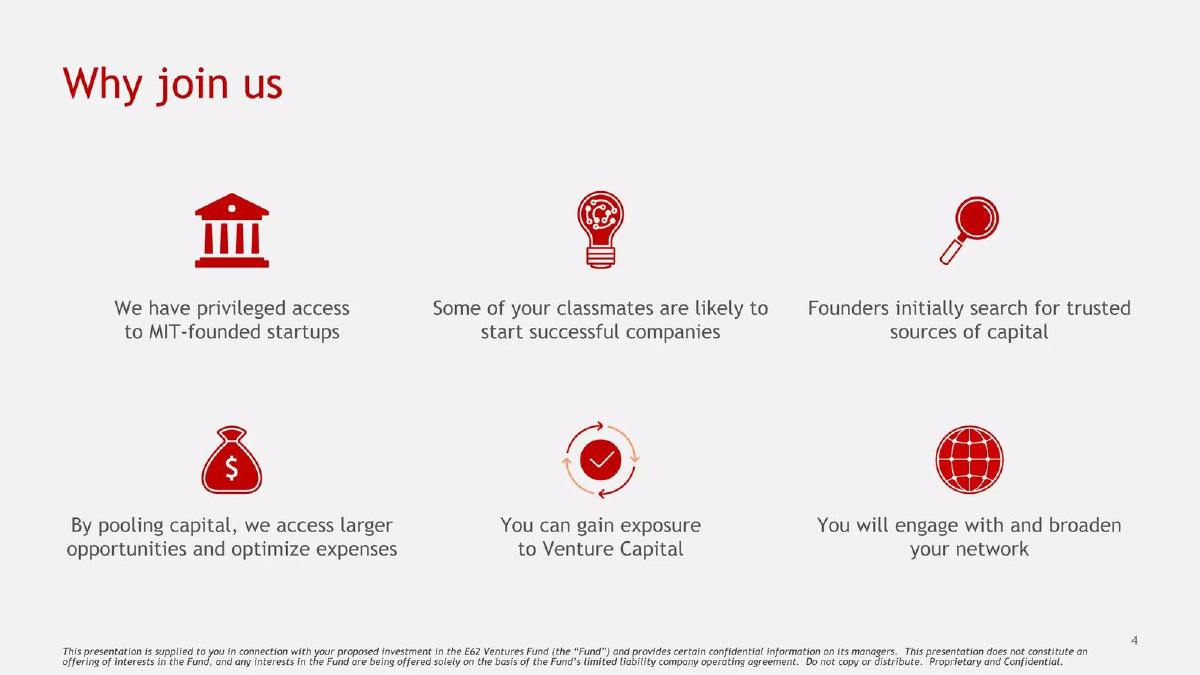
The deck opens with a photo of the MIT Sloan School of Management, immediately anchoring the brand in academic prestige. Slide 2 contains a standard legal disclaimer, noting that the presentation is for informational purposes and is not an offer to sell securities. Slide 3 defines the objectives: sharing the benefits of joining, providing a fund overview, and discussing next steps. Slide 4 introduces the 'Why join us' section, highlighting privileged access to MIT startups, the likelihood of classmates starting successful companies, and the opportunity for members to broaden their professional networks.
Slides 5-7: The MIT Advantage
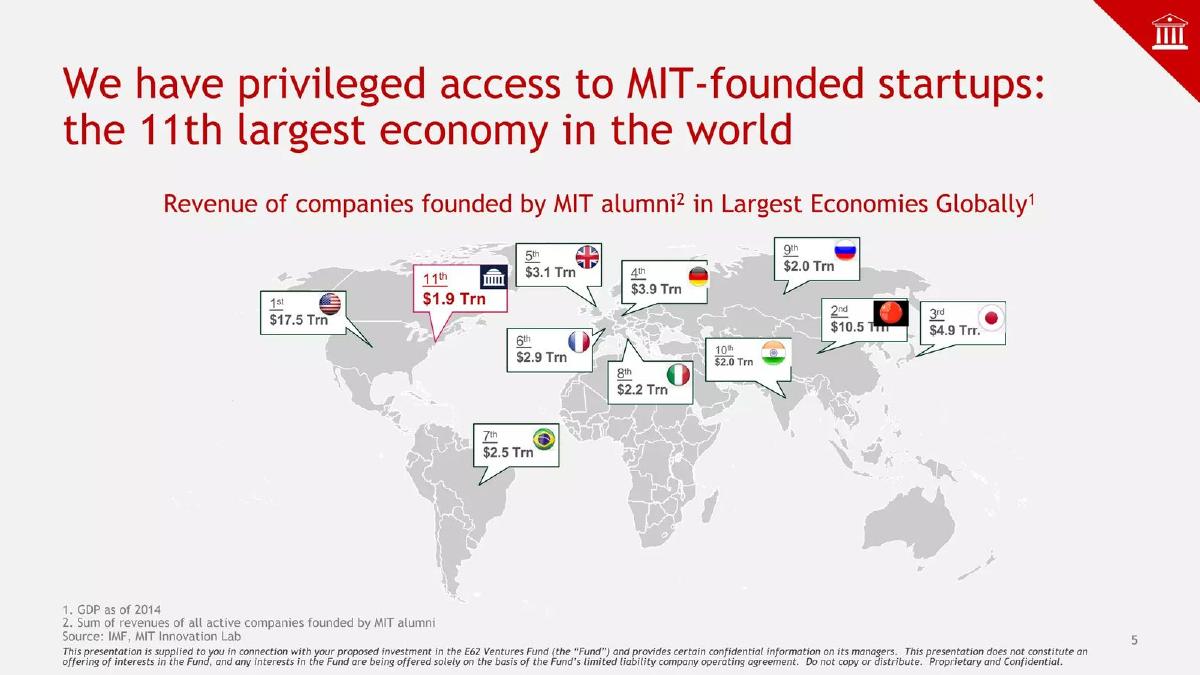
Slide 5 presents a compelling, if slightly dated, statistic: companies founded by MIT alumni generate $1.9 trillion in annual revenue, which would make the 'MIT economy' the 11th largest in the world if it were a country. Slide 6 uses PitchBook data to rank MIT 4th among MBA programs for producing startup founders, noting that between 2006 and 2019, 538 MIT founders raised $12.3 billion. The slide lists notable successes like Rocket Internet, Lazada Group, and HelloFresh. Slide 7 addresses the 'Friends and Family' gap, showing that 38% of total startup funding comes from personal savings or friends and family, totaling $60 billion in the US in 2013. E62 Ventures positions itself to capture this early-stage activity.
Slides 8-10: Member Benefits and Networking
Slide 8 explains the mechanics of pooling capital. By working together, the group can access a 'usually inaccessible asset class,' optimize expenses, and secure more favorable terms through a stronger negotiating position. Notably, the slide states the leadership team works without charging management fees or carry. Slide 9 focuses on the educational aspect, suggesting members can 'craft their "Why VC" story' and get first-hand experience in sourcing and closing deals. Slide 10 provides a breakdown of where Sloan MBA graduates work, with 30.7% in consulting and 28.2% in software/internet as of 2019, reinforcing the idea that the fund's members bring diverse industry expertise to due diligence.
Slides 11-12: Investment Strategy and Financials
Slide 12 is the most critical for understanding the fund's operations. The target is a $1M fund with an average contribution of $10K per person (minimum $5K). They plan to make 5 to 10 investments in seed and pre-seed deals globally. Ticket sizes are stated as $25K to $200K. The slide also breaks down costs: a one-time $10K legal setup fee and $1K-$2K in annual recurring administrative fees. This transparency regarding the 'low-cost' nature of the fund is a key selling point for alumni who might be wary of high fee structures in traditional private equity.
Slides 13-15: Traction, Benchmarking, and Risk
Slide 13 provides a timeline of the fund's development, from the initial pitch in May 2020 to the 'Takeoff' in early 2021, which included hiring James Killmond, a lawyer who helped set up the Stanford VC Fund. Slide 14 benchmarks E62 against similar projects at other business schools, showing press coverage from TechCrunch and Forbes about student-led funds at Stanford, Harvard, and Wharton. Slide 15 is a blunt assessment of risk, citing the Wall Street Journal for the statistic that '3 out of 4 investments will likely fail' and warning that capital may never be returned.
Slides 16-17: Team and Legal Structure
Slide 16 introduces the seven-person leadership team. The pedigree is high, with experience at Danaher, J.P. Morgan, BCG, Liberty Mutual, Morgan Stanley, and Goldman Sachs. The roles are clearly divided into Managing Partners, Investment Partners, Operations, Fund Setup, and Administrative Partners. Slide 17 details the legal setup: a US-based LLC for up to 250 members. It emphasizes that no managing member earns a salary or carry, and that managing members can be removed by a vote of the investors, providing a level of governance and accountability.
Slides 18-23: Next Steps and Recruitment
The final section of the deck focuses on execution. Slide 19 sets a timeline for the first investments in Fall 2021. Slide 20 and 21 provide a call to action, including a QR code and a TinyURL link for interested members to sign up for the operating agreement. Slide 22 is a recruitment ad for 'Fundraising Officers,' looking for three volunteers to dedicate 5-10 hours a week to coordinate the capital raise. The slide explicitly states this is a voluntary role with no compensation, further reinforcing the community-service aspect of the project.
What E62 Ventures Does Well
The deck excels at leveraging social proof and institutional prestige. By framing the fund as a way to participate in the '11th largest economy in the world' (the MIT alumni network), the founders create a sense of exclusivity and logic. The transparency regarding fees—specifically the lack thereof—is a powerful motivator for a peer-group investment vehicle. The deck also does a good job of defining the 'educational' value of the fund, recognizing that for many MBA graduates, the chance to learn the VC process is as valuable as the potential financial return.
What is Missing from the Deck
While the deck is strong on 'why' and 'how,' it is light on 'what.' There are no specific examples of startups currently in the pipeline, nor is there a detailed rubric for how the Investment Committee will evaluate deals beyond 'leveraging members' networks.' The deck also lacks a clear exit strategy for the fund itself. While it mentions the fund is 'closed-end,' it doesn't specify the expected life of the fund (e.g., 7 or 10 years). Additionally, the reliance on 2013 and 2014 data for some of the market sizing slides (Slides 5 and 7) makes the pitch feel slightly dated for a 2021 launch.
Lessons for Founders
1. Align Incentives with Your Audience: E62 Ventures knows its audience is composed of high-earning, brand-conscious professionals. By removing management fees and emphasizing networking, they align the fund's structure with the non-financial motivations of their classmates.
2. Use Benchmarking to Validate New Models: If you are building something unconventional (like a volunteer-run VC fund), show that others have done it successfully. Citing the Stanford and Harvard equivalents (Slide 14) reduces the perceived risk of the 'experiment.'
3. Be Brutally Honest About Risk: Slide 15's admission that 75% of startups fail is not just a legal requirement; it builds trust. In a community-led fund, managing expectations is vital to maintaining long-term relationships within the network.
4. Define Roles Early: Even in a volunteer-led organization, clear titles and responsibilities (Slide 16) are necessary to show potential investors that the project is being managed professionally and isn't just a hobby.
Frequently asked questions
- What is the primary value proposition of E62 Ventures?
- The primary value proposition is 'privileged access' to MIT-founded startups. The deck argues that because founders often seek capital from trusted sources first, an alumni-led fund is uniquely positioned to capture early-stage deals before traditional VC firms. It also offers members exposure to the venture capital process, including sourcing, due diligence, and deal closing, which serves as a networking and career-building tool for the participants.
- How does the fund handle management fees and carry?
- According to Slide 8 and Slide 17, the leadership team does not charge management fees or carry. The fund is structured to minimize overhead, with a one-time legal setup fee of approximately $10K and annual recurring administrative costs of $1K-$2K. This 'zero-fee' model is intended to maximize the capital actually deployed into startups and is possible because the managing members are also investors in the fund.
- What are the specific investment criteria mentioned in the deck?
- E62 Ventures targets seed and pre-seed stages. They aim to make 5 to 10 investments in total. While they leverage the MIT network for sourcing, the deck specifies that they look at deals 'globally.' The investment committee reviews sourced ideas and decides on ticket sizes, which range from $25K to $200K, with a portion of capital potentially reserved for follow-on rounds.
- Who is eligible to join the fund as an investor?
- The fund is specifically marketed to MIT Sloan graduates, particularly from the Class of 2020. However, Slide 17 notes that the fund is a US-based investment vehicle for up to 250 members, subject to accreditation requirements. It also mentions that 'internationals are allowed,' suggesting a global reach within the alumni network, provided they meet the necessary legal criteria for participation in a US LLC.
- What is the timeline for the fund's deployment?
- The deck, published in March 2021, outlines a clear roadmap. Fundraising was scheduled for April and May 2021, followed by a sourcing phase in June and July 2021. The plan was to analyze and compare startups over the summer to make the first set of investments between September and November 2021 (Fall 2021).