Dv01 raised $15M in 2019 with a Series B deck that focused heavily on workflow consolidation within the $20T+ fixed income market. The presentation successfully argues that incumbents like Bloomberg, Intex, and Moody's offer fragmented, expensive solutions that leave investors unable to answer basic portfolio questions. Dv01 positions itself as the 'one solution for the entire lifecycle,' leveraging a unique distribution advantage where they get paid directly out of the deal waterfall. While the deck is light on specific financial performance metrics like ARR or CAC, it compensates with stron…
Key takeaways
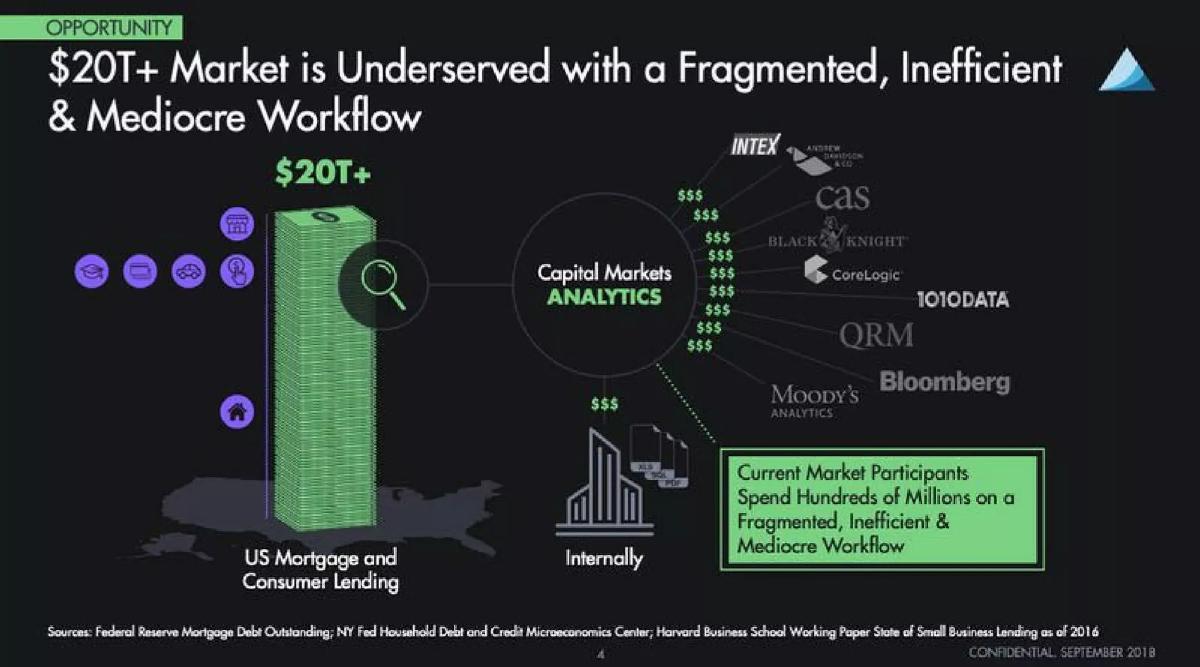
- The company identifies a $20T+ underserved market in US mortgage and consumer lending characterized by fragmented workflows (Slide 4).
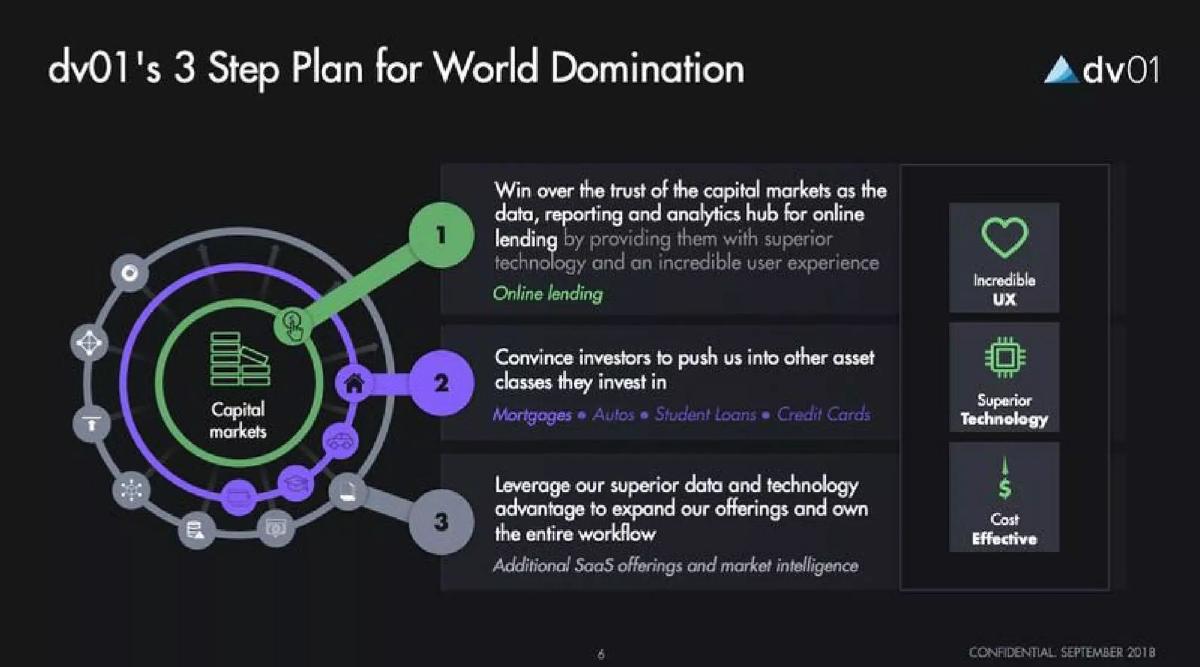
- Dv01 utilizes a 'land and expand' strategy, starting with online lending before moving into mortgages, autos, and student loans (Slide 6).
- A unique distribution advantage is highlighted: Dv01 acts as a Loan Data Agent and is paid directly out of the deal waterfall (Slide 12).
- The deck claims a perfect retention record, stating the company 'has not lost a single client' as of September 2018 (Slide 15).
- The total addressable market for their SaaS offering alone is estimated at over $500M in revenue opportunity (Slide 14).
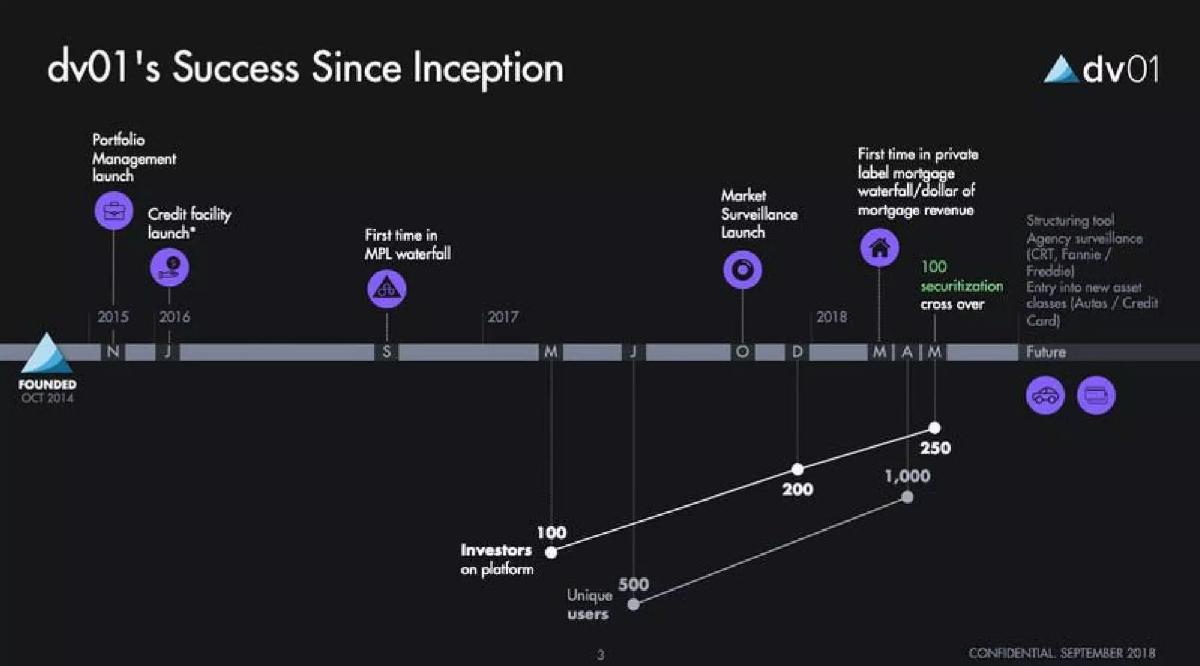
- The platform had reached 1,000 unique users and 250 investors by mid-2018 (Slide 3).
- The leadership team features deep domain expertise from JPMorgan, Bear Stearns, Goldman Sachs, and eBay (Slide 17).
- The deck omits specific financial figures such as current ARR, burn rate, or the specific dollar amount of the 'Ask' for the Series B round.
The Dv01 Series B Pitch Deck Teardown
Dv01's 2019 Series B deck is an exercise in structural narrative. At 17 slides, it avoids the fluff of early-stage decks and focuses on the mechanics of market displacement. The company positions itself not just as a software provider, but as a fundamental piece of financial infrastructure. By the time of this deck, Dv01 had already established a foothold in the online lending space and was ready to pivot toward the much larger mortgage market.
The Mission and Early Traction
Slide 1: Title The deck opens with a minimalist title slide. It is dated September 2018, indicating the fundraising process began well before the 2019 announcement of the $15M Series B led by Pivot Investment Partners.
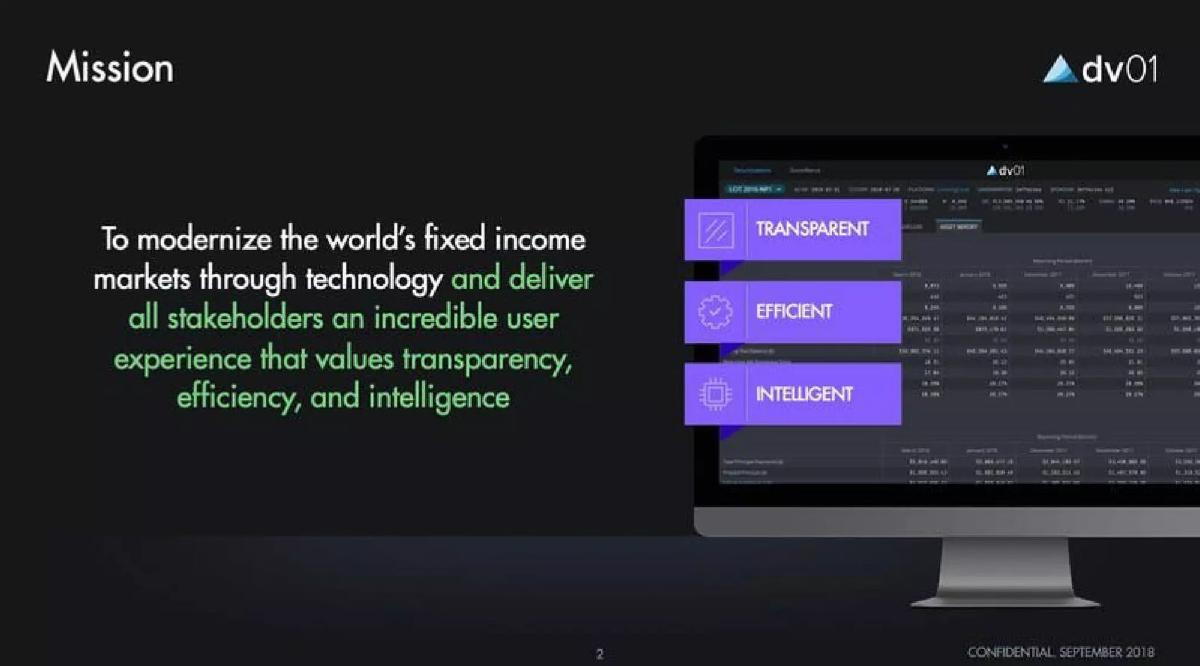
Slide 2: Mission The mission is stated as modernizing the world’s fixed income markets. They highlight three pillars: Transparent, Efficient, and Intelligent. The visual of a dashboard on a desktop monitor immediately establishes that this is a B2B SaaS play for professional users.
Slide 3: Success Since Inception This is a critical traction slide. It uses a dual-timeline approach. The top half shows product milestones (Portfolio Management launch in 2015, Market Surveillance in 2017). The bottom half shows user growth. The numbers are specific: 100 investors on platform by mid-2017, growing to 250 by mid-2018. Unique users grew from 500 to 1,000 in the same period. This 2x growth in a year for a high-touch institutional product is a strong signal of product-market fit.
The $20 Trillion Opportunity
Slide 4: Opportunity Dv01 identifies a $20T+ market in US Mortgage and Consumer Lending. They name-drop the 'fragmented, inefficient & mediocre workflow' of incumbents. A list of competitors—including Intex, Black Knight, CoreLogic, and Bloomberg—is shown as a web of expensive, disconnected services. The slide notes that market participants spend 'hundreds of millions' on these fragmented workflows.
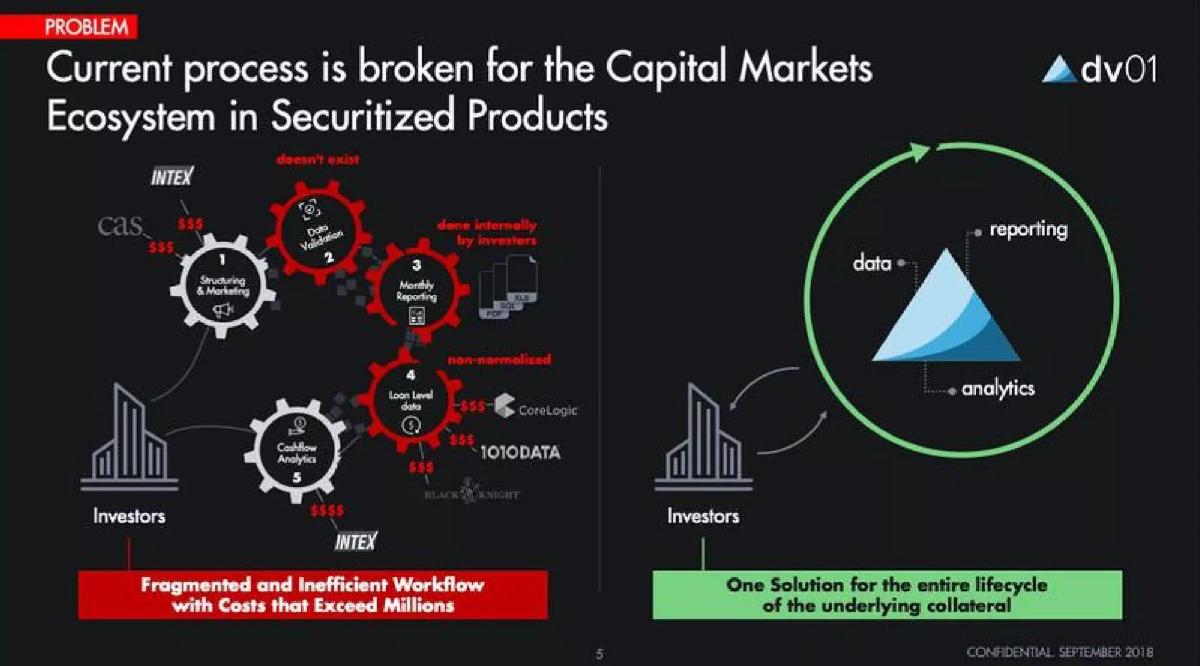
Slide 5: Problem The problem slide contrasts the 'broken' current process with Dv01’s 'one solution.' The current process is depicted as a series of red gears (data validation, monthly reporting, loan level data) that are 'non-normalized' or 'done internally by investors.' Dv01 replaces this with a clean, circular loop of data, reporting, and analytics.
Slide 6: 3 Step Plan for World Domination This is the strategic heart of the deck. Step 1 was online lending. Step 2 is mortgages, autos, student loans, and credit cards. Step 3 is owning the entire workflow. It’s a classic 'wedge' strategy: dominate a small, modern niche (online lending) to build the tech stack required to disrupt the massive, legacy-heavy mortgage market.
Product and Value Proposition
Slide 7: Total Domination of Online Lending This slide uses a rocket graphic to show how their success in securitizations leads to new business, high margins, and exclusive data. The 'Exclusive data to dv01' point is their primary moat—once they are the system of record for the data, they are impossible to dislodge.
Slide 8: Own the Entire Workflow A Swiss Army knife visual represents their SaaS suite: Structuring Tool, Loan Tape Uploader, Managed Database, 3rd Party Integrations, Advanced Cashflow Analytics, Alternative Data, and Market Surveillance. It’s a visual representation of their 'all-in-one' promise.
Slide 9: Simple Questions Investors Struggle With This is a highly effective 'pain point' slide. It uses cartoon characters to ask basic questions that current systems can't answer, such as: 'What % of my portfolio is in zipcodes currently considered by FEMA a disaster zone?' This highlights that legacy systems (represented by messy spreadsheets and stacks of paper) are failing at basic data synthesis.
Slide 10: Why Now? Why Us? This slide reinforces the 'Incumbents are ill-equipped' message. It claims Dv01 has the 'domain expertise, talent and backing' to provide a best-in-class product with superior technology and cost-effectiveness.
Slide 11: What do our customers gain? The benefits are categorized into four buckets: managing risk, faster decision making, performing analysis in seconds rather than days, and increased accuracy. It’s a standard value prop slide that connects the technology back to business outcomes.
Distribution and Market Expansion
Slide 12: Unique Distribution Advantage This is arguably the most important slide for a Series B investor. It explains that Dv01 is a 'Loan Data Agent' (LDA) and is 'paid out of the waterfall, alongside the trustee.' This means they aren't just a vendor waiting for an invoice to be paid; they are a structural part of the financial transaction. This ensures zero-friction payment and makes them 'accessible to every market participant at no additional charge,' which drives viral adoption among users.
Slide 13: Growth Drivers - Mortgages Since the Series B is about expansion, this slide focuses on the $15T mortgage market. They argue the timing is 'ripe for better ways of doing things given the crisis' (referring to the 2008 legacy) and that new issues in non-agency mortgages are expected to grow significantly.
Slide 14: Total Addressable Market - SaaS only Dv01 estimates a $500M+ revenue opportunity for their SaaS offering alone. They use a fishing metaphor to show that while incumbents are 'fishing' for small parts of the market, Dv01’s SaaS 'lure' can capture the whole opportunity across multiple asset classes.
Business Model and Team
Slide 15: How do we make money? The revenue model is transparent. They have four streams: Annual contracts for SaaS and Credit Facilities, and bps-based fees for Portfolio Management and Securitizations. The most powerful statement on this slide is in the purple box: 'dv01 has not lost a single client.' For a Series B company, a 0% churn rate is an incredible metric.
Slide 16: Competitive Analysis A feature matrix shows Dv01 as the only provider with a full row of purple bars across all seven categories. Competitors like Intex or CoreLogic only have one or two bars. It’s a standard 'check-box' slide, but it effectively visualizes the fragmentation they are solving.
Slide 17: Leadership Team The team slide is strong on pedigree. CEO Perry Rahbar (JPMorgan, Bear Stearns), CTO Dean Chen (eBay), and COO Amy Johnson (Goldman Sachs, Deutsche Bank) provide the necessary mix of 'Wall Street' and 'Big Tech' experience required to build a fintech platform of this scale.
What Works in This Deck
The 'Waterfall' Distribution Model: Explaining how they get paid out of the deal waterfall (Slide 12) is a brilliant way to demonstrate a 'moat.' It shows the business is embedded in the plumbing of the industry. · The Pain Point Specificity: Slide 9 uses very specific questions about FEMA disaster zones. This shows the founders deeply understand the daily frustrations of their target users. · The 0% Churn Claim: Stating they haven't lost a single client (Slide 15) is the ultimate evidence of product-market fit. · Clear Expansion Path: The '3 Step Plan' (Slide 6) makes the transition from a niche online lending tool to a mortgage market giant feel logical and inevitable.
What is Missing from This Deck
Financial Specifics: While they mention revenue streams, there is no mention of current ARR, gross margins, or historical revenue growth. For a Series B, investors usually expect a slide dedicated to the P&L. · The Ask: The deck does not state how much money they are raising or what the specific use of funds will be. While this is often left for the verbal pitch, including a high-level roadmap for the capital is standard. · Unit Economics: There is no mention of Customer Acquisition Cost (CAC) or Lifetime Value (LTV). Given the high-touch nature of institutional sales, understanding the efficiency of their sales engine is vital. · Regulatory/Compliance Section: Dealing with $15T in mortgages involves heavy regulatory oversight. A slide addressing how they handle data privacy, SOC2 compliance, or financial regulations would have been appropriate.
What a Founder Should Copy
The 'Wedge' Strategy: If you are attacking a massive market, show how you will dominate a smaller, underserved segment first to build credibility. · Visualizing Fragmentation: Slide 4 and Slide 16 do an excellent job of showing that the 'competitor' isn't just one company, but a mess of disconnected tools that the user has to stitch together. · Pedigree Logos: The use of recognizable logos (JPMorgan, eBay, Goldman Sachs) next to team photos (Slide 17) immediately establishes 'founder-market fit.' · The 'Simple Question' Slide: Instead of saying 'our analytics are better,' show the specific, difficult questions your tool answers that others cannot.
Frequently asked questions
- What is Dv01's core business model?
- Dv01 operates a multi-stream revenue model. They charge annual contracts for SaaS and Market Surveillance, basis points (bps) on portfolio size for management tools, and bps on collateral balances for securitizations. Notably, for securitizations, they are paid directly out of the 'deal waterfall' alongside the trustee, which ensures a highly reliable payment structure and integrates them into the transaction's infrastructure.
- How does Dv01 differentiate itself from incumbents like Bloomberg or Intex?
- According to Slide 16, Dv01 is the only provider offering an end-to-end solution across structuring, reporting, managed databases, 3rd party integrations, cashflow analytics, and market surveillance. Incumbents are portrayed as 'fragmented' and 'ill-equipped,' with most competitors only covering one or two of these functional areas, forcing investors to use multiple expensive vendors.
- What is the 'World Domination' plan mentioned in the deck?
- The plan consists of three steps: 1) Win the trust of capital markets as the data hub for online lending; 2) Expand into larger asset classes like mortgages ($15T), autos, and student loans; 3) Leverage their data advantage to own the entire workflow with additional SaaS offerings and market intelligence. This sequence allows them to build a moat in a smaller niche before attacking massive incumbents.
- What traction does the deck show?
- The deck shows steady growth from its 2014 founding through 2018. By the time of the pitch, they had surpassed 1,000 unique users and 250 investors on the platform. They also highlight a significant milestone in 2018: crossing 100 securitizations and entering the private label mortgage market. Crucially, they claim to have never lost a client since inception.
- Who is the target customer for Dv01?
- Dv01 targets the entire capital markets ecosystem, specifically institutional investors, banks, and originators. Their tools are designed for those who need to perform deep loan-level analysis, manage risk, and report on complex securitized products. Their user base includes over 200 institutions specifically buying Credit Risk Transfer (CRT) deals.