How B2B software startups show competition when buyers already run a stack of tools: replace one incumbent, consolidate point tools, or sit on top of them.
SaaS Competition Slide: Where You Sit in the Buyer's Tool Stack
A business software buyer rarely starts from nothing. They already run several tools, and your product will replace one, replace several, or plug into them. This guide compares ten real B2B software competition slides on one question: does the slide make clear which of those three positions the company takes, and does it give the investor a way to check it?
TL;DR
Say whether you replace one tool, replace several, or sit on top of the tools the buyer keeps, then show it on the slide. Vulcan Cyber maps rivals against the five steps of the buyer's workflow and leaves its own row empty on the first step, which shows it works on top of scanners rather than replacing them. Resgrid names its one main rival and lists what that product cannot do. Trym puts three of its named competitors on the next slide as integrations, which is honest but leaves the reader to work out who is a rival and who is a partner. Checkbox grids where the startup fills every cell (dv01) or where rivals go unnamed (Artisan) are easy to draw and hard to check.
SaaS competition slides from real pitch decks
Each example shows the slide above its analysis and links to the full teardown. Slides that state their position and give a reader something to check come first. Claims are as shown on the slides; checks and comments are ours.
Vulcan Cyber competition slide — slide 15
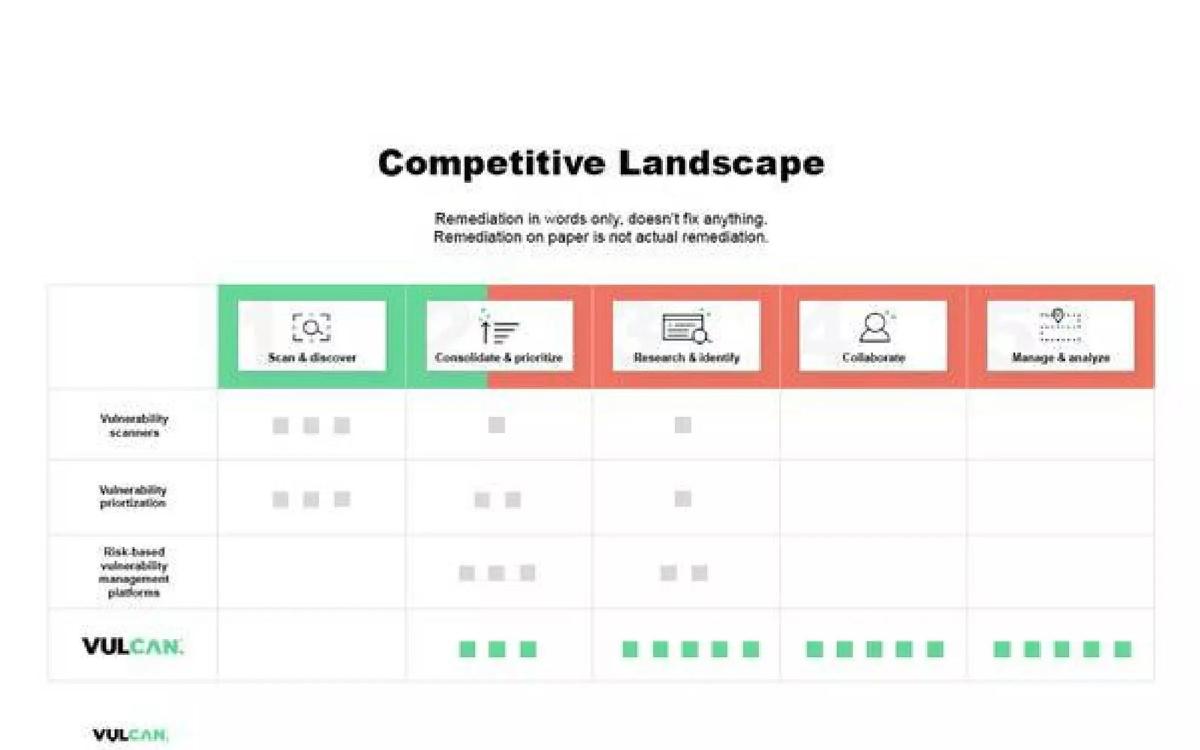
Vulnerability remediation software. A table of three competitor categories and Vulcan against five workflow steps.
Vulcan Cyber deck, slide 15. Exact stored slide matched to this analysis.
Our analysis: A layer position: Vulcan works on scan results from other tools and claims the steps after them, where the rival rows are empty.
Evidence and limitation: Rivals are grouped by category, not named. Scanners and prioritization tools have squares in the first three steps; risk-based platforms in steps two and three. Vulcan's row is empty in step one and filled in steps two to five, with five squares in each of the last three. The slide does not say what the number of squares measures. (The teardown describes this as full coverage; the slide itself leaves step one to others.)
What a founder can adapt: Lay out the steps of your buyer's job, place each category of rival in the steps it covers, and leave your own row empty where you rely on another tool. Say what a filled cell means.
Supporting analysis
What the deck claims: "Competitive Landscape." "Remediation in words only, doesn't fix anything. Remediation on paper is not actual remediation." Columns: Scan & discover, Consolidate & prioritize, Research & identify, Collaborate, Manage & analyze. Rows: Vulnerability scanners, Vulnerability prioritization, Risk-based vulnerability management platforms, Vulcan.
Presentation choice: Mapping against the buyer's workflow makes the gap visible, and the empty first cell is an honest signal of what Vulcan depends on.
When it does not fit: Unexplained square counts look like a score. Use filled or empty, or label the scale.
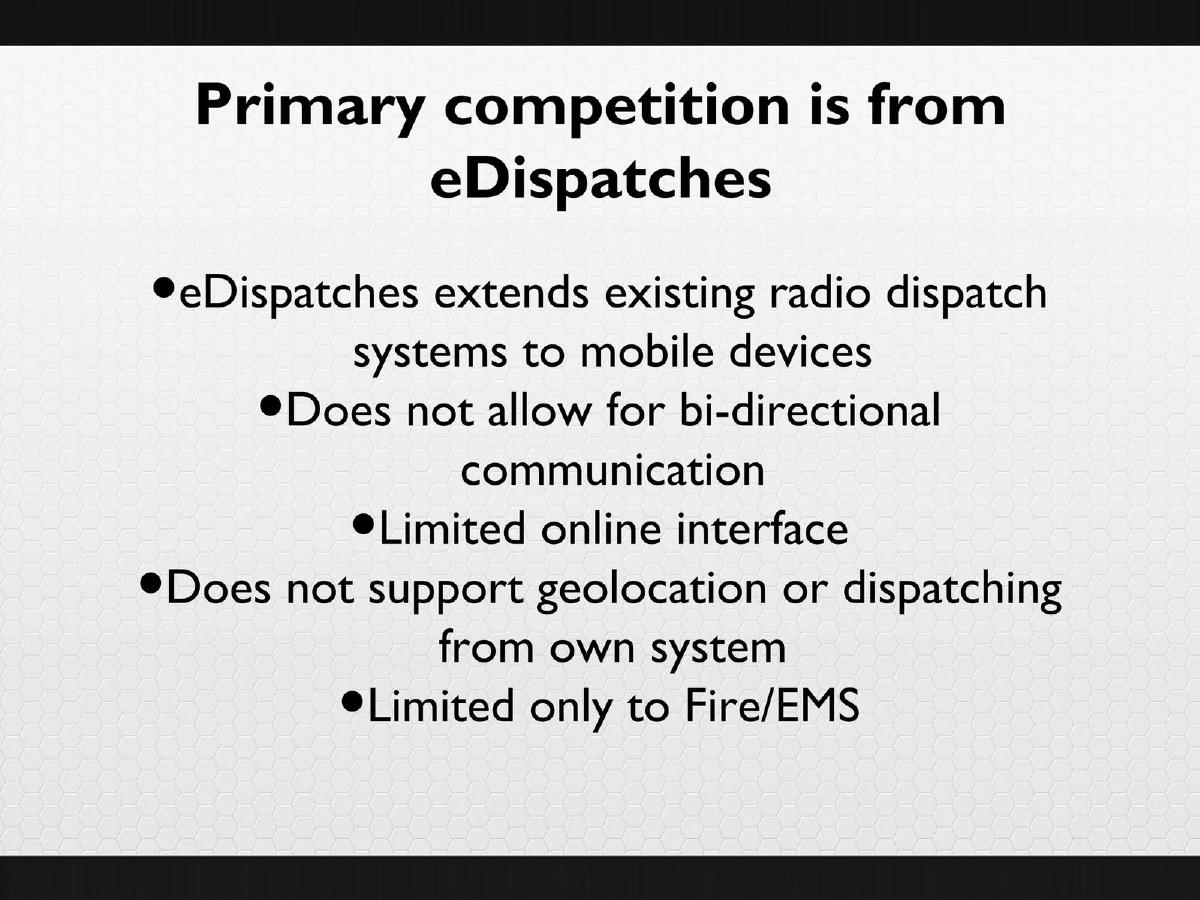
Dispatch and communication software for first responders. A text slide about one competitor.
Resgrid deck, slide 9. Exact stored slide matched to this analysis.
Our analysis: A replacement position against a single incumbent, with reasons to switch a buyer could test in a demo.
Evidence and limitation: One named rival and five specific limitations. The slide does not say Resgrid has each capability, though the rest of the deck describes a two-way system. No customer numbers or prices for either product.
What a founder can adapt: Name the tool your buyer uses now and list three or four things it cannot do that you can, each one testable.
Supporting analysis
What the deck claims: "Primary competition is from eDispatches." "eDispatches extends existing radio dispatch systems to mobile devices." "Does not allow for bi-directional communication." "Limited online interface." "Does not support geolocation or dispatching from own system." "Limited only to Fire/EMS."
Presentation choice: Each point is checkable: an investor can look at eDispatches and confirm whether it supports two-way messaging or geolocation.
When it does not fit: State your side of each point, and name the second-closest option so it doesn't look like you only know one.
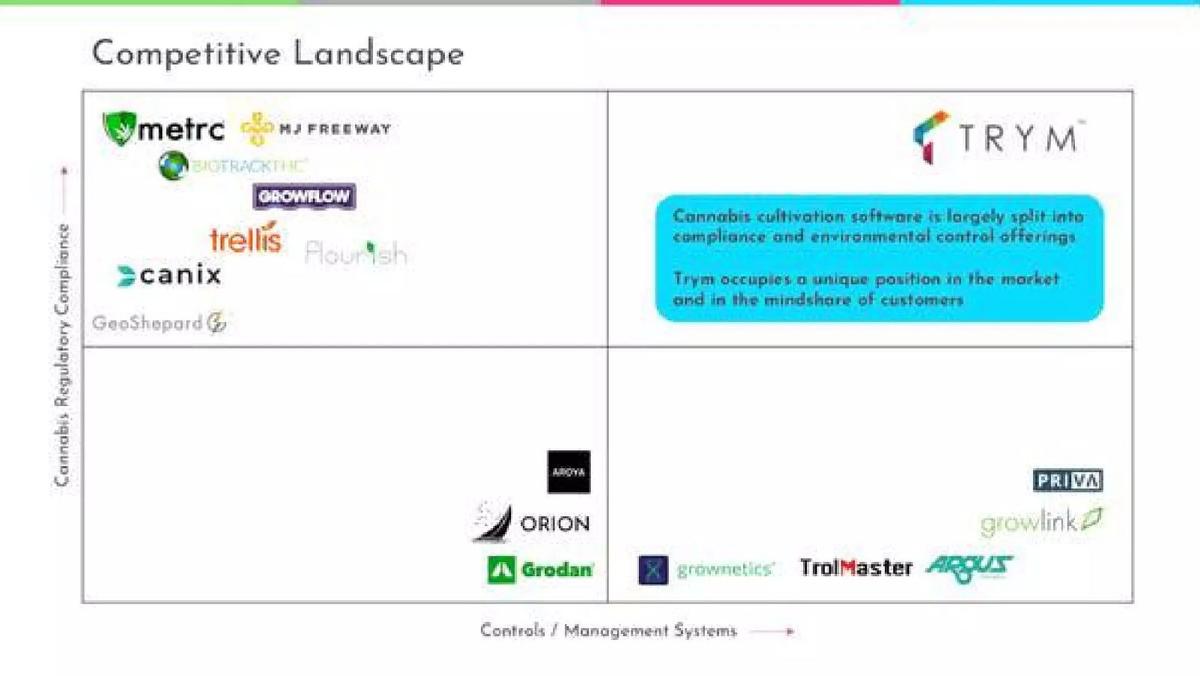
Cultivation management software for cannabis growers. A two-by-two chart followed by an integrations slide.
Trym deck, slide 10. Exact stored slide matched to this analysis.Trym deck, slide 11. Exact stored slide matched to this analysis.
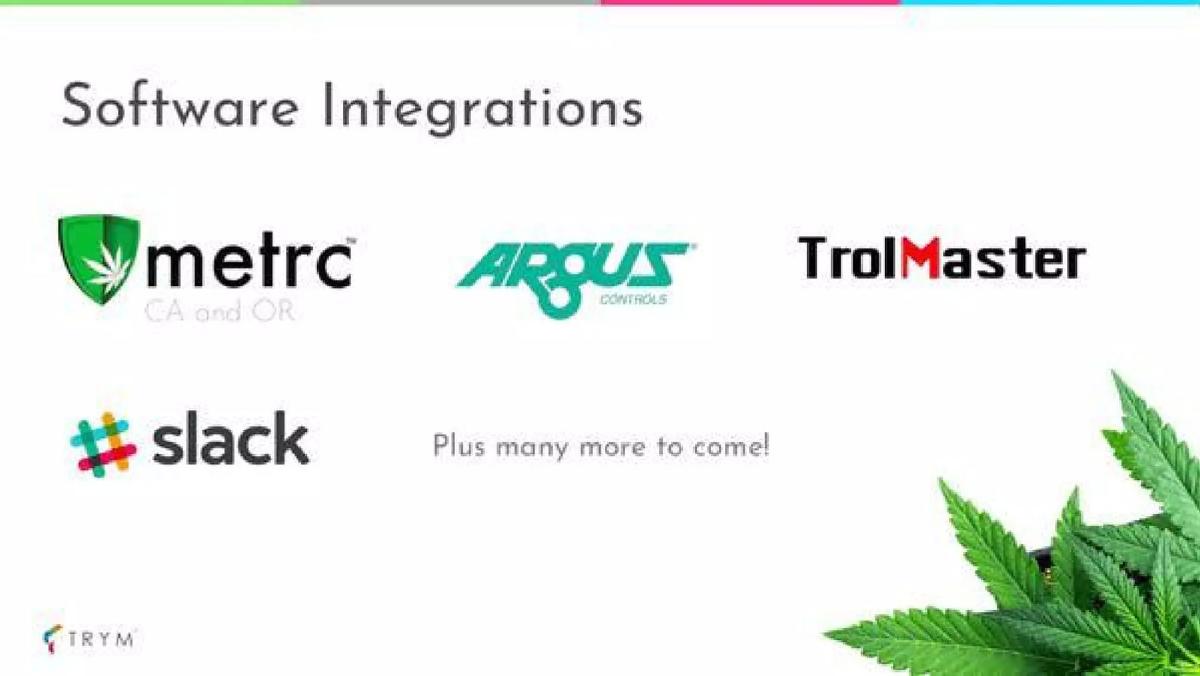
Our analysis: The chart reads as consolidation (one product for both categories), while the integrations slide reads as a layer that connects to tools in both corners. Both may be true, but the slides don't say which companies Trym replaces and which it works with.
Evidence and limitation: Three of the thirteen names on the competition chart (Metrc, Argus, TrolMaster) appear on the next slide as integrations. The "mindshare of customers" claim has no survey or figure behind it.
What a founder can adapt: Mark each name as a rival or a partner. If you integrate with a product, say whether customers keep it or drop it once they use you.
Supporting analysis
What the deck claims: Slide 10 axes: "Cannabis Regulatory Compliance" and "Controls / Management Systems". Top left: Metrc, MJ Freeway, BioTrackTHC, Growflow, Trellis, Flourish, Canix, GeoShepard. Bottom right: Priva, Growlink, Grownetics, TrolMaster, Argus. Top right: Trym alone, with "Cannabis cultivation software is largely split into compliance and environmental control offerings. Trym occupies a unique position in the market and in the mindshare of customers." Slide 11: "Software Integrations": Metrc (CA and OR), Argus, TrolMaster, Slack, "Plus many more to come!"
Presentation choice: The axes are the two categories buyers already buy, which makes the gap Trym claims easy to understand.
When it does not fit: A claim about customer mindshare needs a source, such as interviews or a survey, or should be cut.
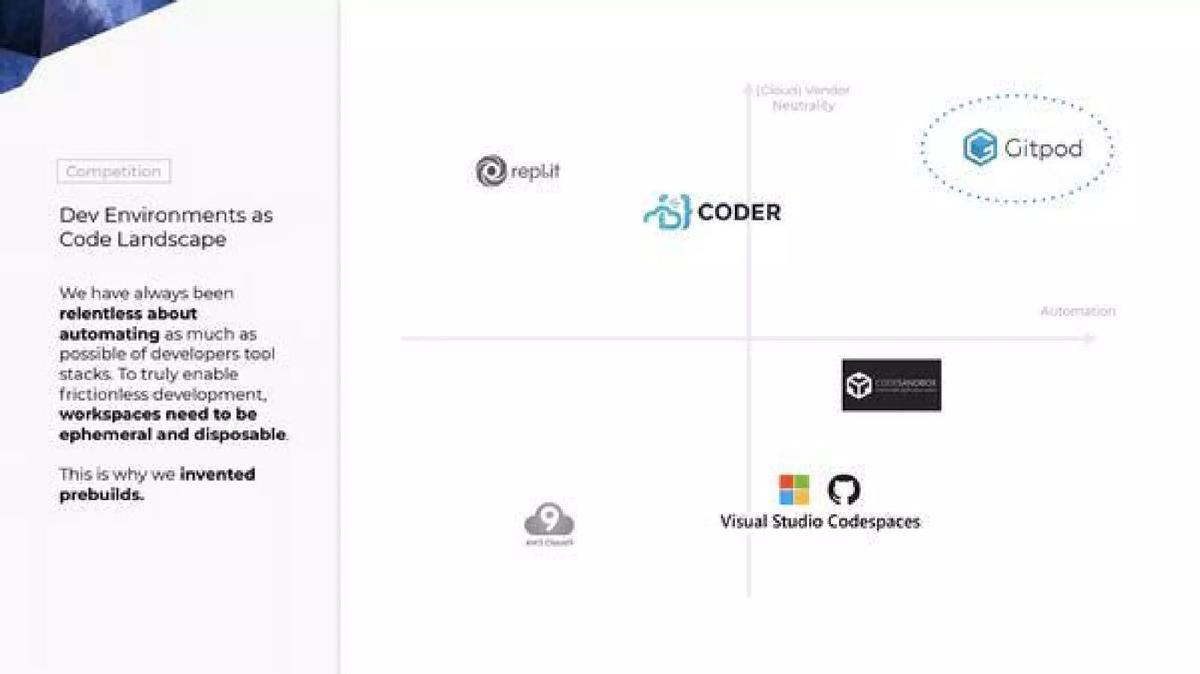
Cloud development environments. A two-by-two chart against developer tools including products from Microsoft and Amazon.
Gitpod deck, slide 8. Exact stored slide matched to this analysis.
Our analysis: The neutrality axis is a reply to the platform question: a buyer who doesn't want to be tied to one cloud provider can't get that from the Microsoft or Amazon option.
Evidence and limitation: Positions are the company's own placement; no data sets them. The chart names the two cloud providers' products directly.
What a founder can adapt: If a large platform sells a similar product, choose the dimension it can't easily match (neutrality, deployment, a specific buyer) and put it on an axis.
Supporting analysis
What the deck claims: "Dev Environments as Code Landscape." Axes: "(Cloud) Vendor Neutrality" and "Automation". Gitpod circled top right; Replit top left; Coder near the top, close to the centre line; CodeSandbox and Visual Studio Codespaces (Microsoft and GitHub logos) on the automation side, below the line; AWS Cloud9 bottom left. "We have always been relentless about automating as much as possible of developers tool stacks... workspaces need to be ephemeral and disposable. This is why we invented prebuilds."
Presentation choice: It names the largest rivals and picks an axis on which they are structurally unlikely to move, rather than claiming to beat them on features.
When it does not fit: Say why each rival sits where it does; self-placed dots invite the question of who decided.
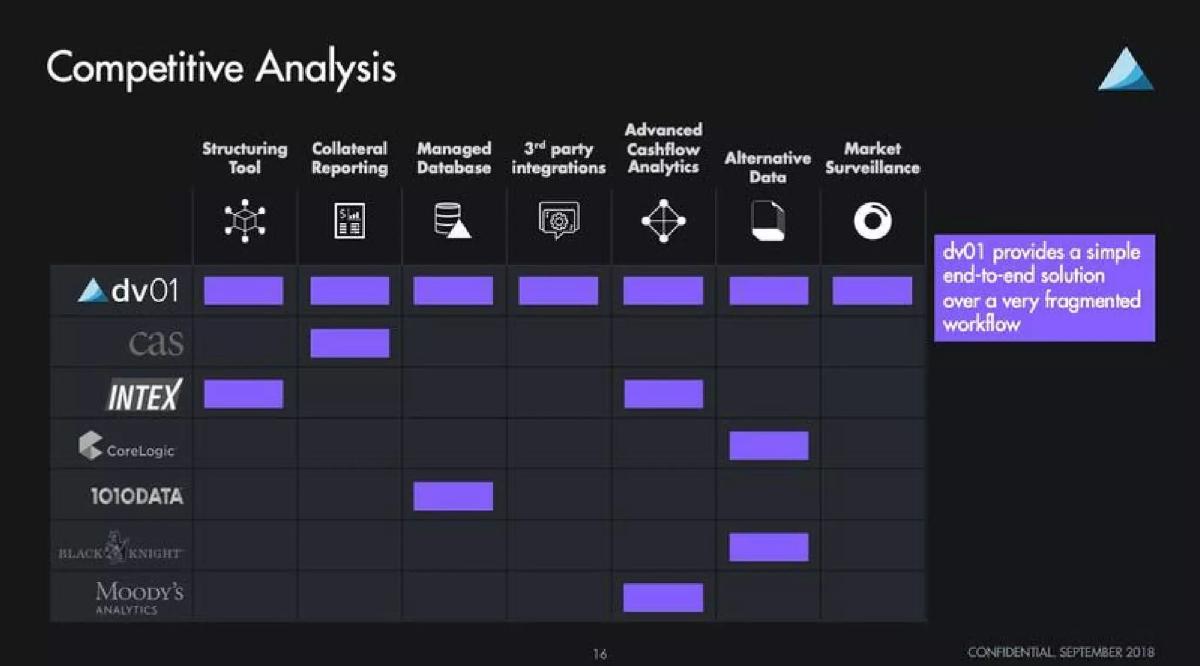
Data and analytics software for loan and structured-finance investors. A capability grid dated September 2018.
dv01 deck, slide 16. Exact stored slide matched to this analysis.
Our analysis: A consolidation position: the grid shows the buyer would otherwise need several vendors.
Evidence and limitation: dv01 has a bar in all seven columns. Intex has two (structuring, cashflow analytics); each other rival has one. No rival has a bar for third-party integrations or market surveillance. Bars are filled or empty, with no measure of depth.
What a founder can adapt: Keep the named grid, then add what the buyer spends on those vendors today, or one column where a specialist is still stronger.
Supporting analysis
What the deck claims: "Competitive Analysis." Columns: Structuring Tool, Collateral Reporting, Managed Database, 3rd party integrations, Advanced Cashflow Analytics, Alternative Data, Market Surveillance. Rows: dv01, cas, Intex, CoreLogic, 1010data, Black Knight, Moody's Analytics. "dv01 provides a simple end-to-end solution over a very fragmented workflow."
Presentation choice: It names the established vendors in each column, so an investor knows exactly who the buyer uses today.
When it does not fit: A single bar can hide that a specialist is much deeper in that column than you are. Winning all seven cells is the pattern investors trust least.
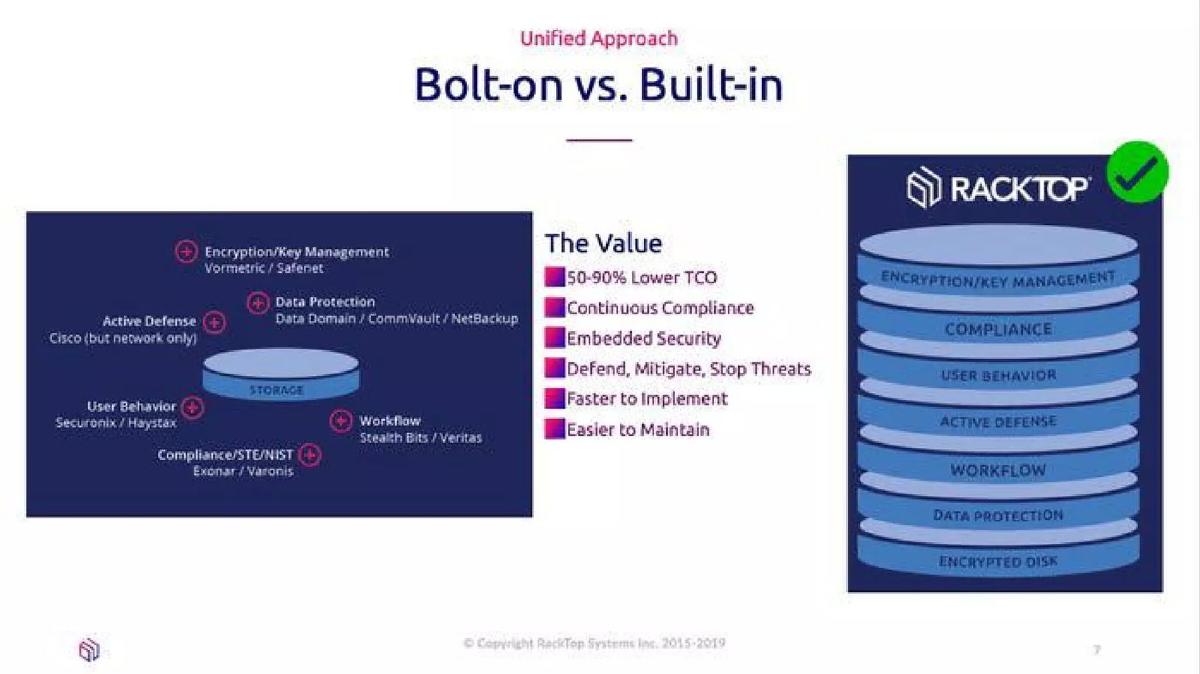
Secure data storage (BrickStor). A "bolt-on vs. built-in" comparison; the teardown numbers this slide 6.
RackTop Systems deck, slide 7. Exact stored slide matched to this analysis.
Our analysis: A consolidation position drawn as the buyer's current stack, which is the clearest picture in this set of what a buyer would drop.
Evidence and limitation: Twelve named vendors across six functions. The "50-90% Lower TCO" (total cost of ownership) range has no stated basis: no customer size, period or which products it was compared against.
What a founder can adapt: Draw the stack a customer runs today with vendor names, then back the saving with one worked case: what that customer paid before and after, and over what period.
Supporting analysis
What the deck claims: "Unified Approach. Bolt-on vs. Built-in." Left: storage surrounded by add-ons: Encryption/Key Management (Vormetric / Safenet), Data Protection (Data Domain / CommVault / NetBackup), Active Defense (Cisco, "but network only"), User Behavior (Securonix / Haystax), Workflow (Stealth Bits / Veritas), Compliance/STE/NIST (Exonar / Varonis). Right: a RackTop stack with the same layers built in. "The Value: 50-90% Lower TCO, Continuous Compliance, Embedded Security, Defend, Mitigate, Stop Threats, Faster to Implement, Easier to Maintain."
Presentation choice: Naming the vendor in each layer shows the investor the real budget being replaced.
When it does not fit: A cost range with no basis reads as a guess. Say what was compared, for whom, and over what period, or leave the range out.
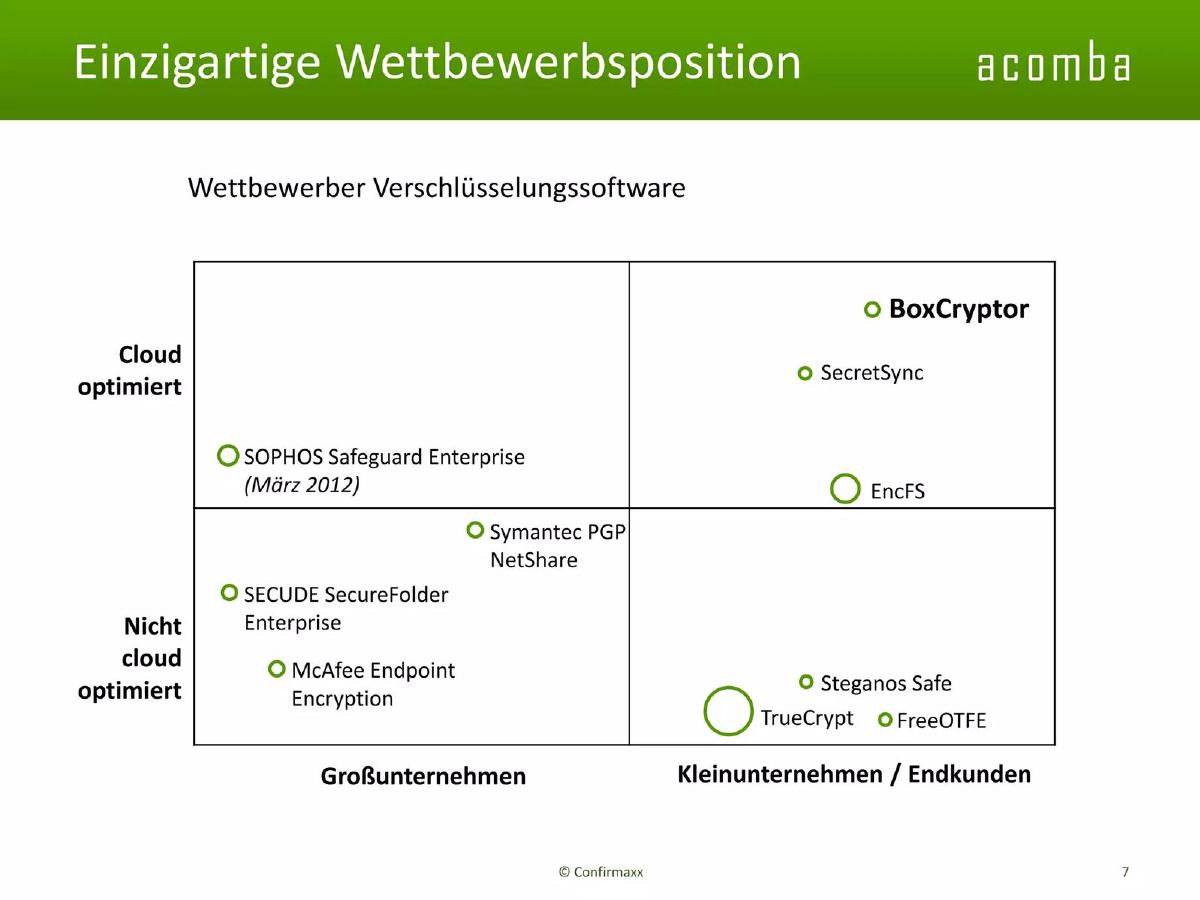
Encryption software for cloud storage. A German-language two-by-two chart.
Boxcryptor deck, slide 7. Exact stored slide matched to this analysis.
Our analysis: A segment position: the buyer axis explains why the large security vendors aren't head-on rivals, and the cloud axis separates Boxcryptor from older consumer tools.
Evidence and limitation: Bubble sizes differ with no legend. The March 2012 note beside Sophos suggests a large vendor had recently entered the cloud-optimised half, though the slide doesn't explain it.
What a founder can adapt: Use one axis for the buyer you serve and one for what they need. If an incumbent is moving toward you, say what you'll do about it.
Supporting analysis
What the deck claims: "Einzigartige Wettbewerbsposition" (unique competitive position), "Wettbewerber Verschlüsselungssoftware" (encryption software competitors). Axes: cloud-optimised or not; large enterprises, or small businesses and consumers. Top right: BoxCryptor, SecretSync, EncFS. Top left: SOPHOS Safeguard Enterprise, marked "(März 2012)". Bottom left: Symantec PGP NetShare, SECUDE SecureFolder Enterprise, McAfee Endpoint Encryption. Bottom right: Steganos Safe, TrueCrypt, FreeOTFE.
Presentation choice: It names both the enterprise incumbents and the small-business alternatives, and flags one incumbent moving toward its space.
When it does not fit: Explain bubble sizes or make them equal. Two rivals share Boxcryptor's quadrant, so "unique" needs a reason beyond the chart.
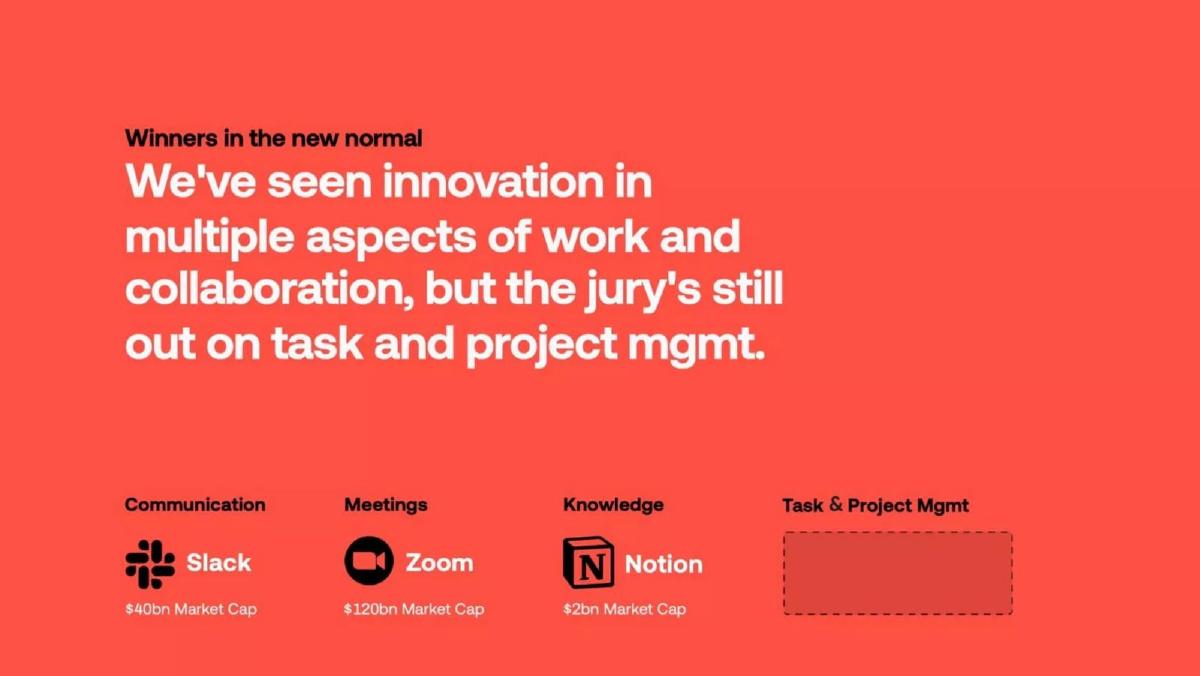
Task and project management app. Two consecutive slides framing an open category next to Slack, Zoom and Notion.
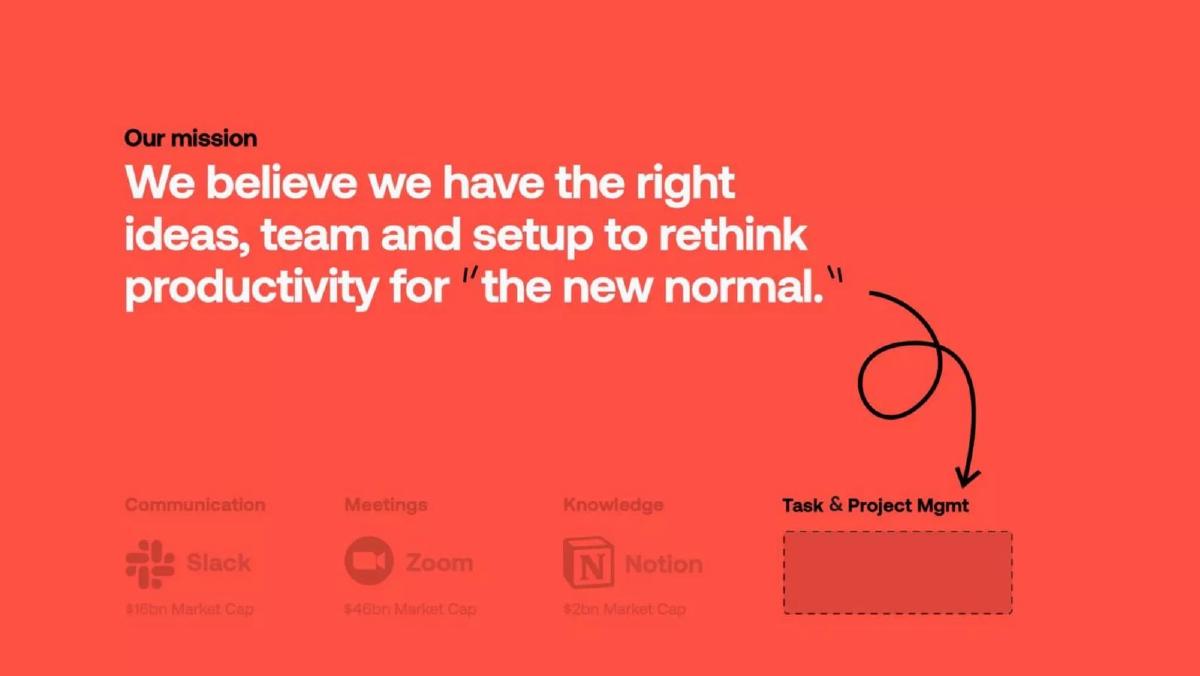
Superlist deck, slide 7. Exact stored slide matched to this analysis.Superlist deck, slide 8. Exact stored slide matched to this analysis.
Our analysis: A category-gap position: the empty box says no product has won task management, which is a claim about the market, not a comparison with rivals.
Evidence and limitation: The same two companies carry different figures on consecutive slides ($40bn vs $16bn for Slack; $120bn vs $46bn for Zoom), with no dates. Notion was privately held, so its figure is presumably a funding valuation rather than a market cap. Neither slide names an existing task or project management product.
What a founder can adapt: Keep the gap framing, then name the task tools buyers use today and say why none has won. Date every valuation and use one figure per company.
Supporting analysis
What the deck claims: Slide 7: "Winners in the new normal. We've seen innovation in multiple aspects of work and collaboration, but the jury's still out on task and project mgmt." Communication: Slack, "$40bn Market Cap"; Meetings: Zoom, "$120bn Market Cap"; Knowledge: Notion, "$2bn Market Cap"; Task & Project Mgmt: an empty dashed box. Slide 8 repeats the row with Slack "$16bn Market Cap" and Zoom "$46bn Market Cap".
Presentation choice: The picture is simple and memorable, and it tells the investor which category the company is betting on.
When it does not fit: An empty box next to a crowded category invites the investor to fill it in. Conflicting figures for the same company on consecutive slides undermine every other number.
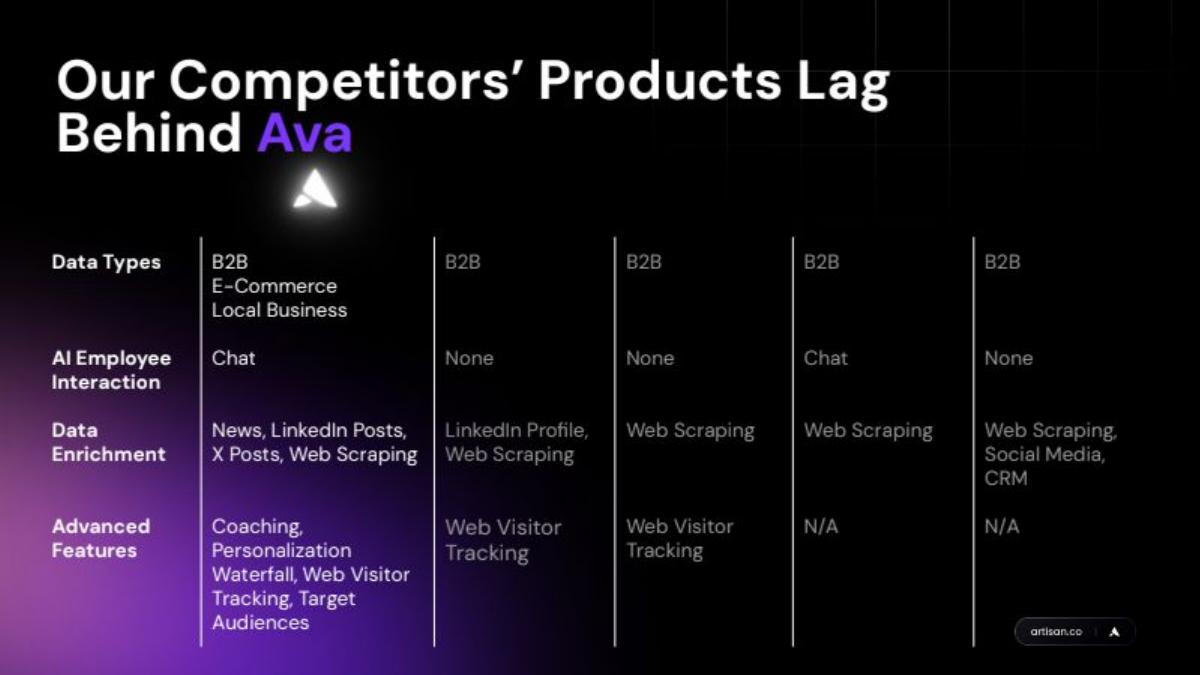
AI sales agent ("Ava"), Series A deck. A feature table against four unnamed products.
Artisan deck, slide 9. Exact stored slide matched to this analysis.
Our analysis: A replacement claim with no named rival, so the investor can't tell which products the buyer would otherwise choose.
Evidence and limitation: The third competitor column also shows "Chat", so Ava isn't the only one with that interaction. The fourth column lists CRM data as an enrichment source, which Ava's column doesn't. No competitor is named.
What a founder can adapt: Name the columns. If you can't name them publicly, name them in the meeting and group them on the slide by type.
Supporting analysis
What the deck claims: "Our Competitors' Products Lag Behind Ava." Rows: Data Types, AI Employee Interaction, Data Enrichment, Advanced Features. Ava: "B2B, E-Commerce, Local Business"; "Chat"; "News, LinkedIn Posts, X Posts, Web Scraping"; "Coaching, Personalization Waterfall, Web Visitor Tracking, Target Audiences". Competitor columns are unlabelled.
Presentation choice: The table does separate specific capabilities, and two of its cells show a rival matching or covering something Ava doesn't list.
When it does not fit: A title claiming every rival lags is contradicted by your own table when a rival matches you on a row.
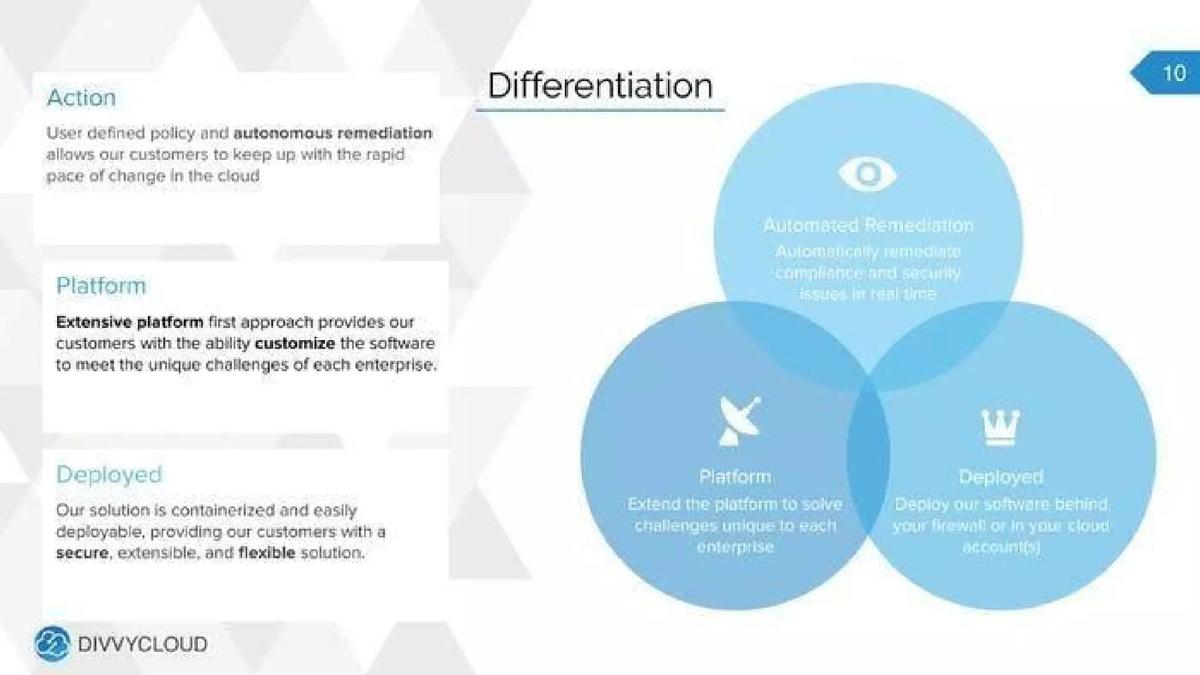
Cloud security and compliance automation. A differentiation slide with three overlapping circles.
DivvyCloud deck, slide 10. Exact stored slide matched to this analysis.
Our analysis: Three differentiators with nothing to differ from, so the investor has to supply the comparison.
Evidence and limitation: No competitor, category of competitor or current tool is named. An earlier slide (page 6) says "Today's infrastructure monitoring and reporting tools just don't cut it anymore", also without names.
What a founder can adapt: Attach each differentiator to the tool it beats: "Unlike [monitoring tool], which alerts, we fix the issue automatically."
Supporting analysis
What the deck claims: "Differentiation." "Action: User defined policy and autonomous remediation allows our customers to keep up with the rapid pace of change in the cloud." "Platform: Extensive platform first approach provides our customers with the ability to customize the software to meet the unique challenges of each enterprise." "Deployed: Our solution is containerized and easily deployable, providing our customers with a secure, extensible, and flexible solution."
Presentation choice: The three points are concrete product choices (automatic fixing, customisation, deployment behind the customer's firewall) a buyer would care about.
When it does not fit: A differentiation slide without named alternatives reads as a feature list.
Whether each slide states a stack position, names rivals, and gives something a reader could check.
Example
Position shown
Rivals named
Checkable basis
Vulcan Cyber
Layer (above scanners)
Categories only
Partly (workflow map; square counts unexplained)
Resgrid
Replace one tool
Yes (one)
Yes (testable limitations)
Trym
Unclear (consolidate or layer)
Yes (13)
Partly (3 rivals also integrations)
Gitpod
Neutral alternative to platforms
Yes
No (self-placed)
dv01
Consolidate
Yes (6)
Partly (binary bars)
RackTop Systems
Consolidate
Yes (12 vendors)
No (TCO range, no basis)
Boxcryptor
Segment
Yes (11)
No (unexplained bubbles)
Superlist
Category gap
No task tools
No (conflicting figures)
Artisan
Replace
No
Partly (cells contradict title)
DivvyCloud
Not stated
No
No
Key Takeaways
Pick one position: replace a named tool, consolidate several tools, or add a layer on top of tools the buyer keeps.
Map rivals against the buyer's workflow or stack, not against your own feature list.
Show the cells where you don't compete; an empty cell tells the investor what you rely on.
If a named competitor is also an integration, say which it is.
A consolidation claim needs a cost figure with its basis, not just a range.
Name competitors. An unnamed column can't be checked.
Build your SaaS competition slide
Start from the tools your buyer pays for today.
Current stack. Which tools does your buyer use today for this job? Name them.
Position. Do you replace one of them, replace several, or sit on top of them?
Workflow. What are the steps of the buyer's job, and which steps does each tool cover?
Rival or partner. Which named products do you integrate with, and do customers keep them?
Proof. What can a reader check: a limitation, a customer's before-and-after cost, a demo?
Copyable framework: Today [buyer] uses [tools] for [job]. [Product] [replaces X / replaces X and Y / works on top of X] and [difference a buyer can test]. [One customer]: [before] to [after] over [period].
Illustrative example 1 — written by us
Before: Our competitors' products lag behind ours. We are the only all-in-one platform.
After: Today, a 50-person sales team runs a data tool, a sequencing tool and a CRM plugin. We replace the first two and connect to the CRM. [Customer] cut its tool spend from [$X] to [$Y] a year after switching.
What improved: Our illustrative rewrite; the team size and bracketed figures are placeholders, not company facts. It states the position, names what is replaced and what is kept, and points to a checkable result.
What this guide adds
The general competition slide guide covers formats (lists, tables, two-by-two charts) and common mistakes for any business, and the stage guide covers how the slide changes from pre-seed to Series B. This guide covers a question specific to business software: where the product sits among the tools a buyer already pays for, and how the slide shows that.
The SaaS problem, solution, business model and traction guides cover other slides in software decks. Here we look only at how each deck handles rivals.
Three positions a software product can take
Replace one tool: the buyer drops a named product and uses yours (Resgrid against eDispatches).
Consolidate several tools: the buyer drops a set of point products for one system (dv01, RackTop Systems, and Trym's claim to combine compliance and cultivation controls).
Sit on top: the buyer keeps existing tools and adds yours to connect or act on them (Vulcan Cyber above vulnerability scanners; Trym's integrations with Metrc, Argus and TrolMaster).
Each position invites a different question. Replacement: why switch? Consolidation: is each part as good as the specialist it replaces? Layer: what stops the underlying tool, or a large platform, from adding your feature?
How we read each slide
We quote the text on the slide images and describe charts from what is drawn. We have not checked company claims, prices or cost figures. None of these slides was in our stored image set, so we rendered each one from the original deck file in our library; the pages shown are the ones quoted. Where a teardown's slide number differs from the deck page, we use the deck page.
Common mistakes
No stated position. Say whether you replace, consolidate or sit on top; each needs different proof.
Filling every cell. Show where you rely on other tools or where a specialist is deeper.
Rivals that are partners. Mark integrations; otherwise the investor can't tell who you displace.
Cost savings with no basis. Give the customer, the products compared and the period.
Unnamed columns. An anonymous competitor can't be checked.
Inconsistent numbers. Date every valuation and use the same figure throughout the deck.
Diagnostic checklist
States whether you replace, consolidate or add a layer.
Names the tools the buyer uses today.
Shows at least one cell where you don't compete.
Marks which named products are integrations.
Backs any cost claim with its basis.
Frequently asked questions
Who is the competitor for a SaaS startup?
The tools your buyer already pays for to do the same job, including spreadsheets or an in-house script. Name them and say whether you replace one, replace several, or work on top of them.
Should a SaaS competition slide be a feature checklist?
Only if the rows are steps of the buyer's job and some cells stay empty for you. Vulcan Cyber's grid follows the buyer's workflow and leaves its own first step empty; dv01's fills every cell, which is harder to believe.
What if my competitors are also integration partners?
Say so on the slide. Trym lists Metrc, Argus and TrolMaster as competitors and then as integrations; marking which ones customers keep makes the position clear.
How we chose these examples
Corpus: published pitch deck teardowns on StartupFundraising.com. Founder-uploaded private decks are excluded.
Selection (2026-09-26): we searched teardown slide headings for competition, landscape, alternatives, differentiation, positioning, status quo and "vs" in decks mentioning SaaS, B2B, software, subscription or enterprise, and excluded decks already used in the other competition guides. About 50 headings matched; many were consumer, marketplace or non-competition slides.
We inspected 14 slide images and kept ten companies (eleven images plus one extra Superlist page). Excluded: Evervault p9 (no rival named; same lesson as DivvyCloud), DivvyCloud p6 (status-quo image, no rivals), Superlist p6 (market-growth chart, not competition).
None of the chosen pages was in our stored image set; we rendered them from the original deck PDFs in our library and stored them with the existing slide-image workflow. RackTop's slide is deck page 7 (the teardown calls it slide 6).
Review: slide images were checked on 2026-09-26 and matched to company, deck and page (editorial model review). No person has yet completed an editorial review of this page. We make no claim that any slide caused a fundraising outcome.