Gitpod’s 11-slide Series A deck is a clinical example of how to pitch a developer-centric tool by focusing on 'friction' and 'automation.' The deck identifies a specific, time-wasting problem—engineers spending nearly 10 hours a week on non-coding tasks—and positions Gitpod as the 'missing piece' in the DevOps pipeline. What makes this deck particularly strong is its reliance on existing open-source credibility through Theia and a clear 'Why Now' slide that cites the maturation of container technology and the shift to remote work. While it lacks a specific financial 'Ask' slide and detailed u…
Key takeaways
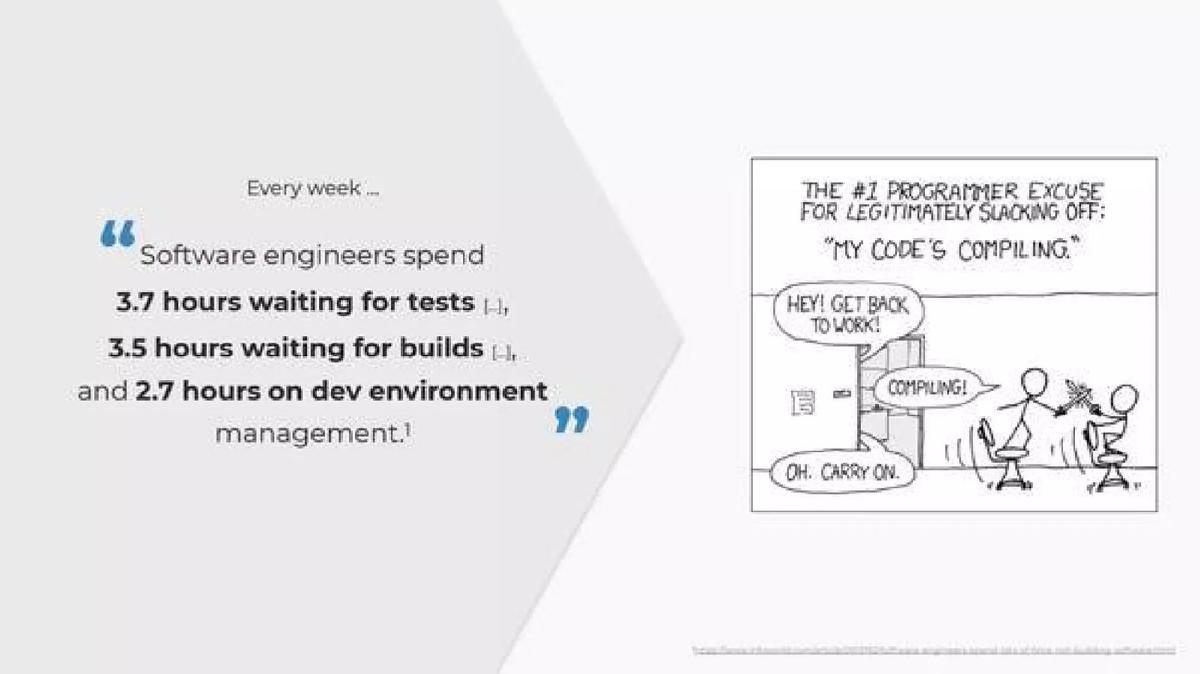
- Software engineers are shown to spend 9.9 hours per week on non-coding tasks like waiting for tests, builds, and dev environment management (Slide 2).
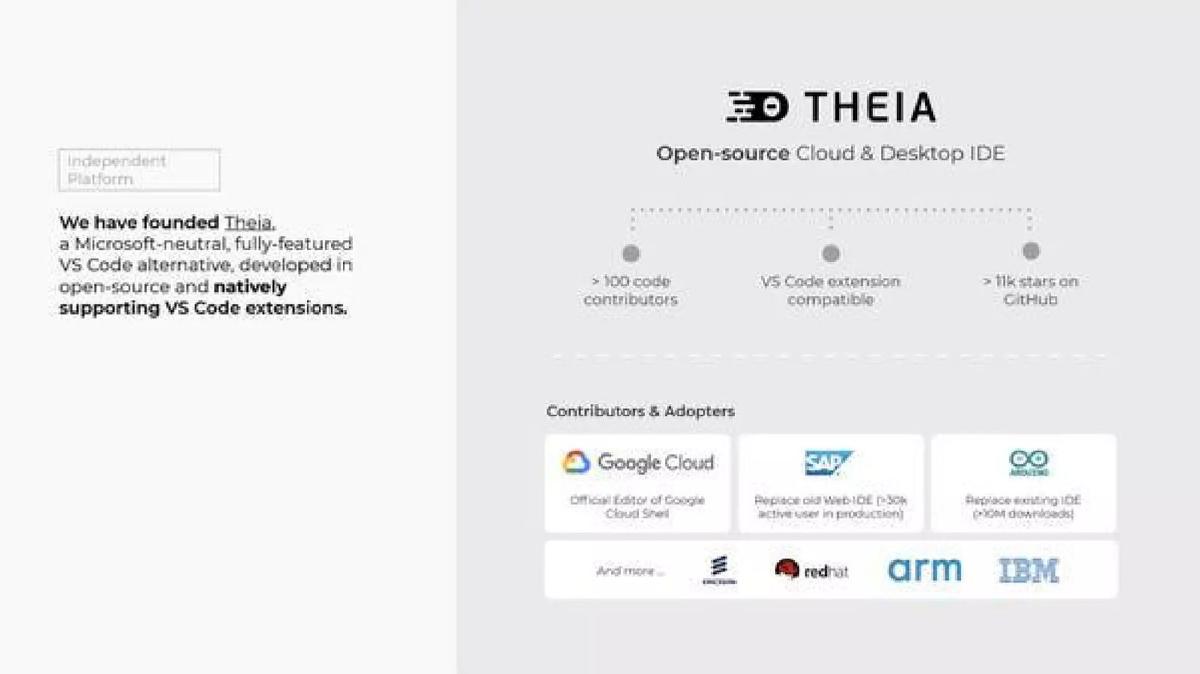
- The company leverages its role as the founder of Theia, an open-source IDE with over 11k GitHub stars and adoption by Google Cloud and SAP (Slide 6).
- Gitpod reports a user base of 200k registered users growing at 10% per month as of the time of the deck (Slide 10).
- The 'Why Now' slide attributes the market opportunity to the maturation of container/VM tech and the COVID-19 acceleration of remote work (Slide 7).
- The competitive landscape positions Gitpod as the leader in both 'Automation' and 'Cloud Vendor Neutrality' compared to Microsoft's Visual Studio Codespaces (Slide 8).
- The business model follows a 'Buyer-Based Open Core' strategy with tiers ranging from $0 to $990 per 10 users (Slide 9).
- Product-market fit is demonstrated via a survey where 52.2% of professional developers said they would be 'very disappointed' if they could no longer use the tool (Slide 10).
- The founding team highlights over ten years of working together on development tools and open-source communities (Slide 11).
Introduction: The Developer Productivity Play
Gitpod’s Series A deck is a masterclass in identifying a high-value 'pain point' within a specific, growing vertical. By 2019, the DevOps movement had automated testing and deployment, but the local development environment remained a manual, fragmented mess. This deck, consisting of 11 slides, successfully argues that the 'Dev Environments as Code' paradigm is the final frontier of the modern software development lifecycle. The following teardown examines how the founders leveraged their open-source pedigree and clear productivity metrics to secure $41 million in funding.
Slides 1-3: The Problem and the Cost of Friction
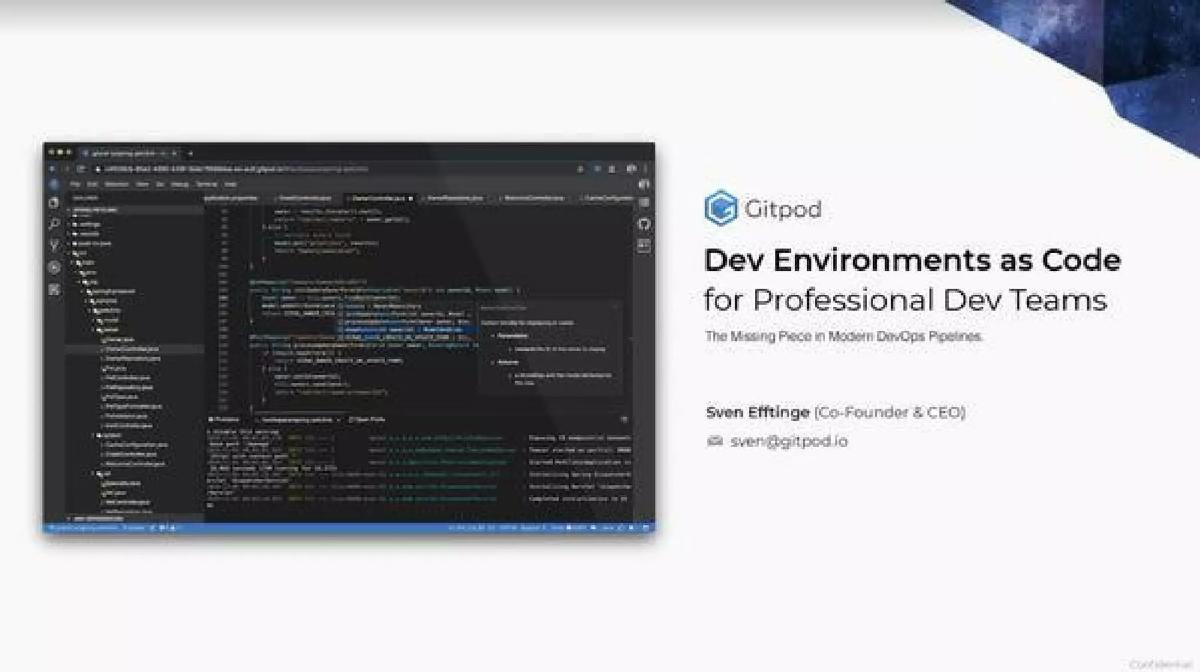
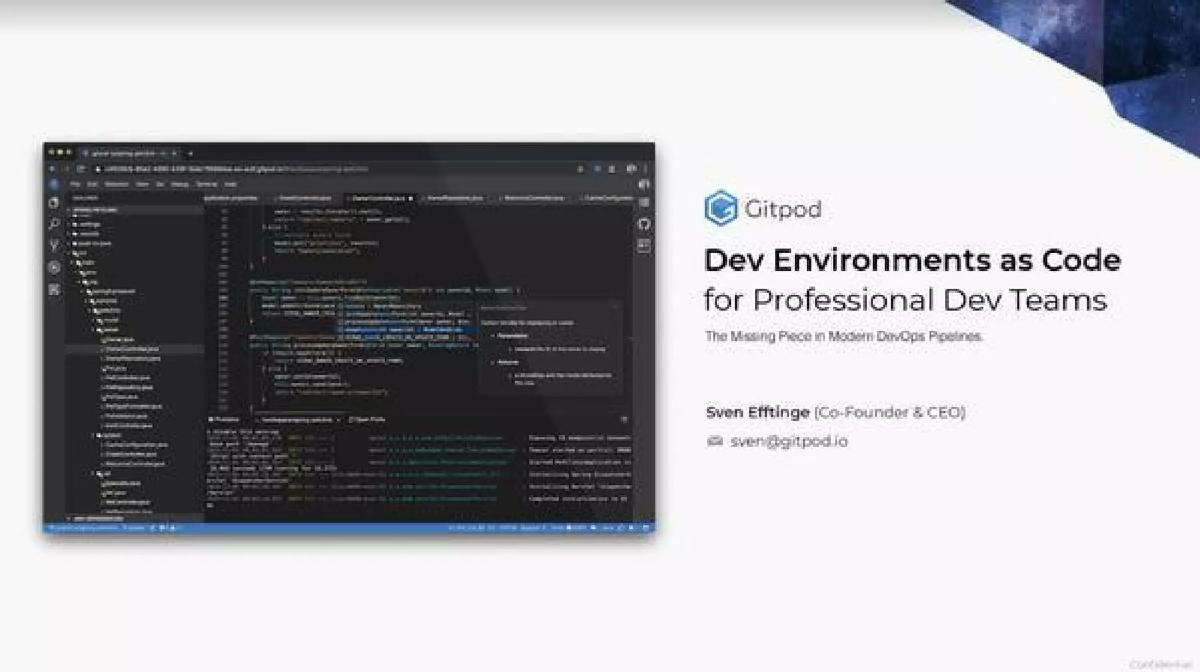
Slide 1: Title Slide The deck opens with a clear value proposition: 'Dev Environments as Code for Professional Dev Teams.' It immediately positions Gitpod as 'The Missing Piece in Modern DevOps Pipelines.' The inclusion of a screenshot showing a browser-based IDE (Theia/VS Code style) provides instant context for what the product looks like in practice.
Slide 2: The Quantified Problem This is one of the strongest slides in the deck. It uses a quote to highlight that software engineers spend 3.7 hours waiting for tests, 3.5 hours waiting for builds, and 2.7 hours on environment management every week. By totaling nearly 10 hours of wasted time per week per developer, Gitpod transforms a 'nice-to-have' tool into a massive cost-saving opportunity for engineering leaders. The inclusion of an XKCD comic about 'code compiling' adds a touch of developer culture that resonates with the target audience.
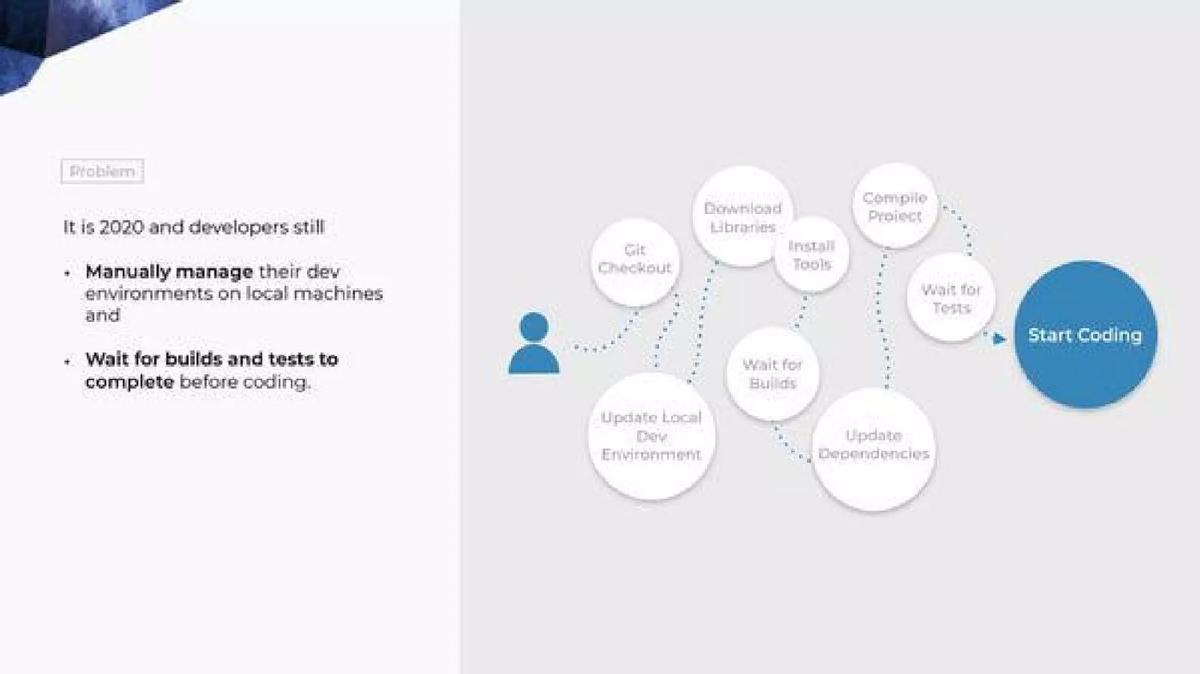
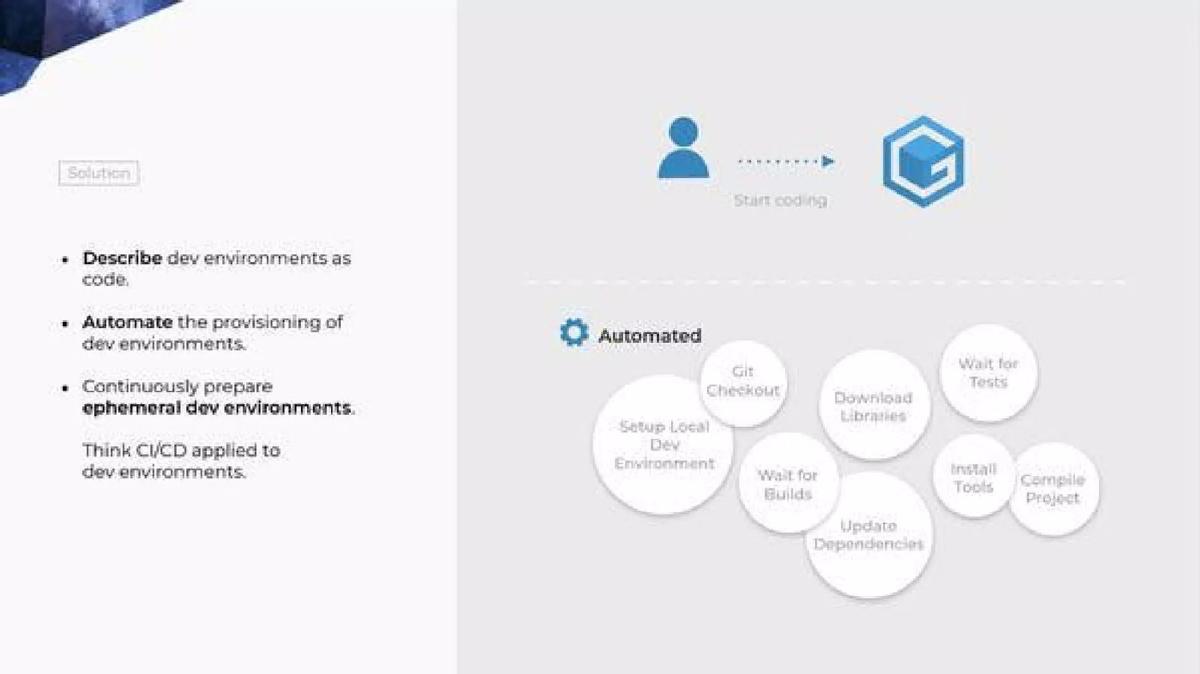
Slide 3: The Status Quo Slide 3 visualizes the 'Problem' by showing a convoluted path of white bubbles (Git Checkout, Download Libraries, Install Tools, etc.) that a developer must navigate before reaching the blue 'Start Coding' button. It explicitly states that in 2020, developers are still manually managing environments, framing the current industry standard as outdated and inefficient.
Slides 4-6: The Solution and Open Source Pedigree
Slide 4: The Solution The solution slide mirrors the problem slide but shows a direct, automated path to 'Start Coding.' The key pillars are 'Describe dev environments as code,' 'Automate provisioning,' and 'Continuously prepare ephemeral dev environments.' The phrase 'Think CI/CD applied to dev environments' is a powerful analogy that helps investors understand the category creation Gitpod is attempting.
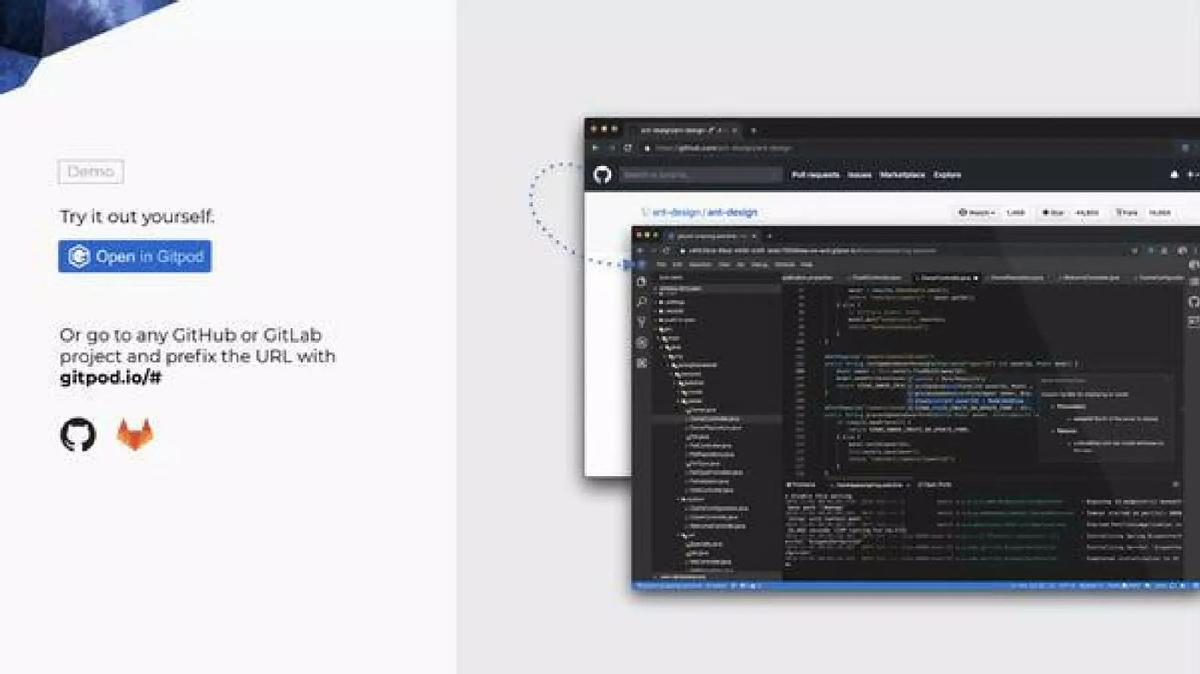
Slide 5: The Demo Rather than a video, slide 5 offers a 'Try it out yourself' call to action. It explains the simple prefixing of a URL (gitpod.io/#) to any GitHub or GitLab project. This demonstrates the product's low barrier to entry and its seamless integration with existing developer workflows.
Slide 6: Independent Platform (Theia) This slide establishes the team's 'right to win.' By highlighting that they founded Theia—an open-source IDE with 11k GitHub stars—they prove they aren't just building a wrapper, but are architects of the underlying technology. Listing contributors and adopters like Google Cloud, SAP, Red Hat, Arm, and IBM provides massive enterprise validation that is often missing in early-stage Series A decks.
Slides 7-9: Market Timing and Business Model
Slide 7: Timing (Why Now?) Gitpod identifies five tailwinds: the maturation of browser IDEs, advances in container/VM tech, the ubiquity of DevOps, increasing project complexity, and the shift to remote development. The mention of COVID-19 accelerating remote work provides a sense of urgency, suggesting that the market is at a tipping point.
Slide 8: Competition The competitive matrix uses two axes: 'Automation' and 'Cloud Vendor Neutrality.' Gitpod places itself in the top-right quadrant. Notably, it positions Visual Studio Codespaces (Microsoft) as high on automation but low on neutrality, while Replit is positioned as high on neutrality but lower on the 'professional' automation scale required by enterprise teams. This slide effectively argues that Gitpod is the only 'neutral' and 'fully automated' choice for professional teams.
Slide 9: Business Model Gitpod outlines a 'Buyer-Based Open Core Model.' They commit to open-sourcing Gitpod under an AGPL license by the end of July. The pricing tiers for their self-hosted version are clearly stated: $0 for Community, $200 for Team, $450 for Pro, and $990 for Ultimate (per 10 users). This transparency shows a clear path to monetization and enterprise sales, supported by distribution partnerships with GitLab and Bitbucket.
Slides 10-11: Traction and Team
Slide 10: Traction and Product-Market Fit The traction slide is dense with data. It shows a growth chart ending at 200k registered users with a 10% monthly growth rate. More importantly, it uses the 'Sean Ellis' survey method to prove product-market fit. 52.2% of professional developers and 62.5% of those working in teams said they would be 'very disappointed' if they could no longer use Gitpod. This is a high-signal metric that professional investors value over raw registration numbers.
Slide 11: Team The final slide introduces the four key leaders: Sven Efftinge (CEO), Dr. Jan Köhnlein (VP Engineering), Moritz Eysholdt (CTO), and Johannes Landgraf (CCO). The key takeaway here is that the founders have worked together for over ten years. The slide also notes a supporting team of 13 engineers, 1 marketer, and 1 accountant, showing a lean, engineering-heavy organization ready to scale.
What Works in the Gitpod Deck
Quantifiable Pain: By breaking down the specific hours lost to build and test cycles (Slide 2), Gitpod makes the ROI of their tool undeniable. They aren't just selling 'better dev tools'; they are selling '10 hours of reclaimed engineering time per week.'
Open Source Credibility: The deck leans heavily on Theia (Slide 6). For a Series A, proving that you can build a community and that tech giants like Google and SAP already use your core technology is a massive de-risking factor.
Clear Positioning: The competitive matrix (Slide 8) is honest. It acknowledges Microsoft as a competitor but carves out a specific niche (vendor neutrality) that is highly valued by the open-source community and large enterprises wary of cloud lock-in.
What is Missing from the Gitpod Deck
The Ask: There is no slide detailing the amount of capital being raised, the valuation target, or the specific milestones the Series A will fund. While this information is often shared in the meeting, its absence in the deck makes the presentation feel more like a product overview than a formal investment proposal.
Unit Economics: While the pricing tiers are listed (Slide 9), there is no mention of Customer Acquisition Cost (CAC), Lifetime Value (LTV), or current Annual Recurring Revenue (ARR). For a Series A, investors usually expect to see how the 'money machine' works, not just how much the product costs.
Roadmap: The deck focuses heavily on what Gitpod is today. It lacks a 'Future Vision' slide that explains where the company goes after dev environments are automated. Does it move into deployment? Security? The long-term strategic moat is implied but not explicitly mapped out.
What a Founder Should Copy
The 'Why Now' Logic: Slide 7 is a perfect example of how to align a product with macro trends. If you are building a tool that relies on a specific technology (like containers), you must show that the technology has reached a maturity level where your product is finally possible.
The PMF Survey: If you don't have millions in revenue yet, use the 'Very Disappointed' survey metric shown on Slide 10. It is a standardized way to prove that your users actually care about your product, which is often more convincing than a 'vanity' registration chart.
The 'Problem Visualization': The contrast between Slide 3 (the messy manual process) and Slide 4 (the automated straight line) is a classic but effective way to communicate a complex technical solution to non-technical investors. It makes the 'value add' visible at a glance.
Final Verdict: Gitpod’s deck succeeds because it speaks the language of its users (developers) while providing the metrics required by its buyers (investors). It is a lean, technically grounded presentation that prioritizes community traction and engineering reclaimed time over flashy marketing jargon. Although it lacks financial depth, its technical authority—backed by the Theia project—makes it a compelling case for a Series A lead.
Frequently asked questions
- What is the core problem Gitpod addresses in this deck?
- Gitpod addresses the 'friction' of manual developer environment setup. According to slide 2, engineers lose 3.7 hours to tests, 3.5 hours to builds, and 2.7 hours to environment management weekly. Slide 3 emphasizes that in 2020, developers were still manually managing environments on local machines, leading to significant downtime before actual coding could begin.
- How does Gitpod differentiate itself from competitors like Microsoft?
- On slide 8, Gitpod uses a 2x2 matrix to position itself against Visual Studio Codespaces, Replit, and Coder. Gitpod claims the high ground in both 'Automation' (specifically citing their 'prebuilds' feature) and 'Cloud Vendor Neutrality.' They position Microsoft's solution as being lower on the vendor neutrality scale, emphasizing Gitpod's open-source, multi-platform compatibility.
- What evidence of traction does the deck provide?
- Slide 10 provides two main data points: quantitative and qualitative. Quantitatively, they show a growth chart reaching 200k registered users with a 10% month-over-month growth rate. Qualitatively, they use the 'Sean Ellis' product-market fit metric, showing that 52.2% of surveyed professional developers would be 'very disappointed' without the tool, which is above the standard 40% benchmark.
- What is Gitpod's relationship to the Theia project?
- As detailed on slide 6, Gitpod's founders also founded Theia, a Microsoft-neutral, open-source alternative to VS Code. The deck uses Theia's success—11k GitHub stars and adoption by Google Cloud Shell and SAP—to prove the team's ability to build and scale foundational developer tools before asking for Series A capital for the Gitpod commercial entity.
- What is missing from this pitch deck that a typical Series A investor might expect?
- The deck is missing a 'Use of Funds' or 'Ask' slide, which usually details how much is being raised and what milestones that capital will hit. It also lacks detailed financial projections, churn rates, or CAC/LTV metrics. The focus is heavily on product, vision, and community traction rather than the specific mechanics of the Series A round itself.