Giraffe360’s 13-slide deck is a masterclass in presenting a Hardware-as-a-Service (HaaS) model to venture investors. By framing their robotic camera not as a one-off purchase but as the entry point for a recurring revenue subscription, they successfully bridged the gap between physical tech and SaaS scalability. The deck leads with aggressive traction—800% growth in 2019—and validates the product through high-tier logos like BNP Paribas and Knight Frank. While it lacks a specific 'Ask' slide and detailed unit economics, the clear progression from manual, expensive labor to automated, cloud-pr…
Key takeaways
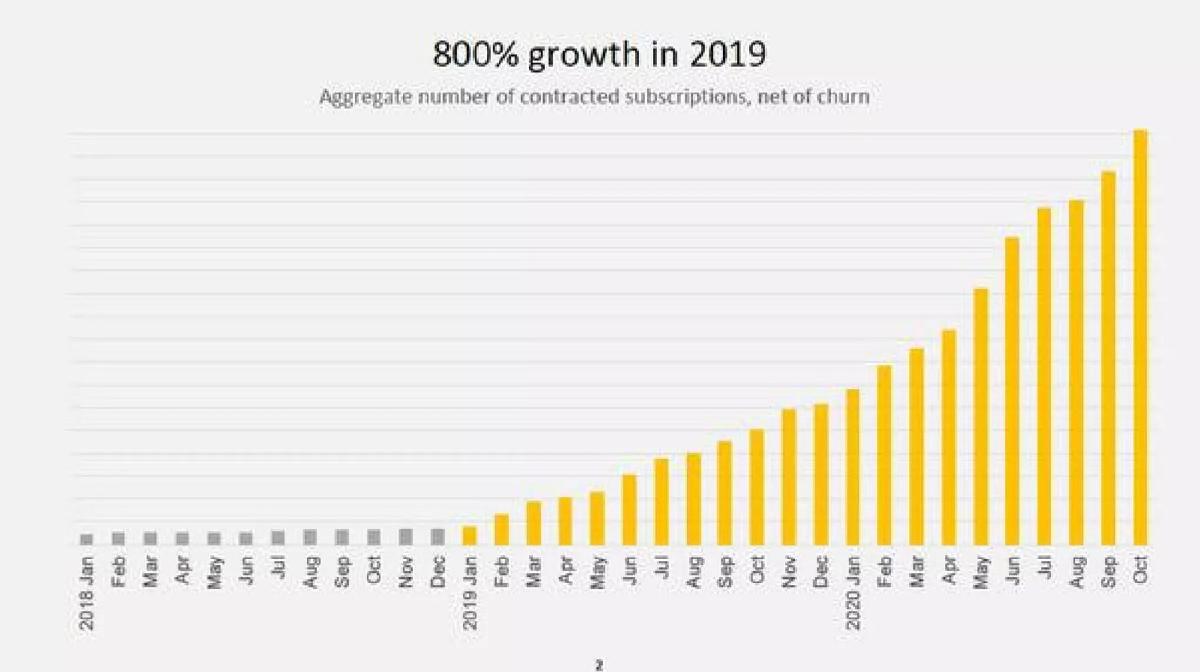
- The company reported 800% growth in contracted subscriptions net of churn throughout 2019 (Slide 2).
- Giraffe360 identifies a €10 billion market for professional real estate photography and presentation services (Slide 8).
- The business model is a fixed monthly subscription that includes the robotic camera, cloud processing, and all digital content (Slide 7).
- The deck claims the product creates a 'digital twin' including photos, floor plans, and 3D tours in one take (Slide 3).
- Traction is shown across 24 countries with major clients including RE/MAX, CBRE, and Knight Frank (Slide 9).
- The management team includes a CEO who has closed sales deals in the 'tens of millions of euros' (Slide 11).
- Funding history shows a progression from a €0.5M Pre-Seed in 2016 to a €3.7M Pre-Series A in 2020 (Slide 10).
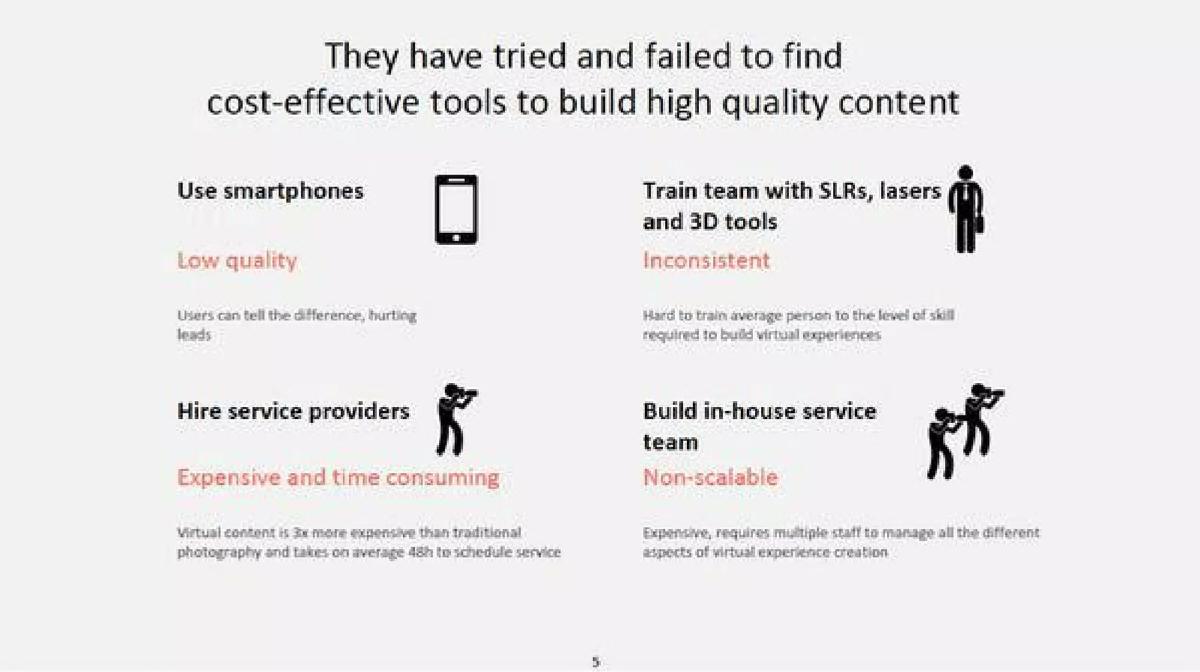
- The deck identifies that hiring service providers for virtual content is 3x more expensive than traditional photography (Slide 5).
Executive Summary: The Hardware-as-a-Service Pivot
Giraffe360’s pitch deck represents a sophisticated approach to the 'PropTech' sector, specifically targeting the digitization of physical spaces. The deck, used for their Seed and Pre-Series A efforts, centers on the concept of the 'digital twin.' By combining high-end robotics with a SaaS-style subscription model, the company positions itself as an infrastructure play for the real estate market rather than just a camera manufacturer. With a total of $6.3 million raised according to catalogue facts, this deck successfully navigated the difficult 'hardware is hard' stigma by emphasizing recurring revenue and massive growth metrics.
Slides 1-3: The Hook and Immediate Validation
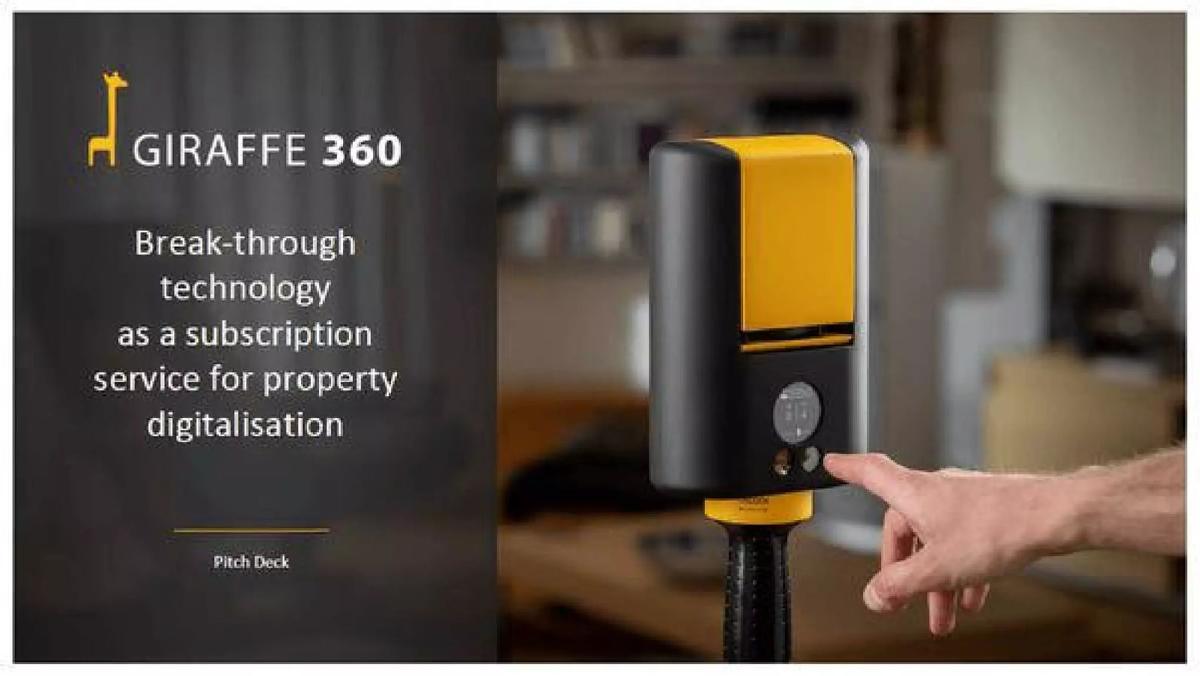
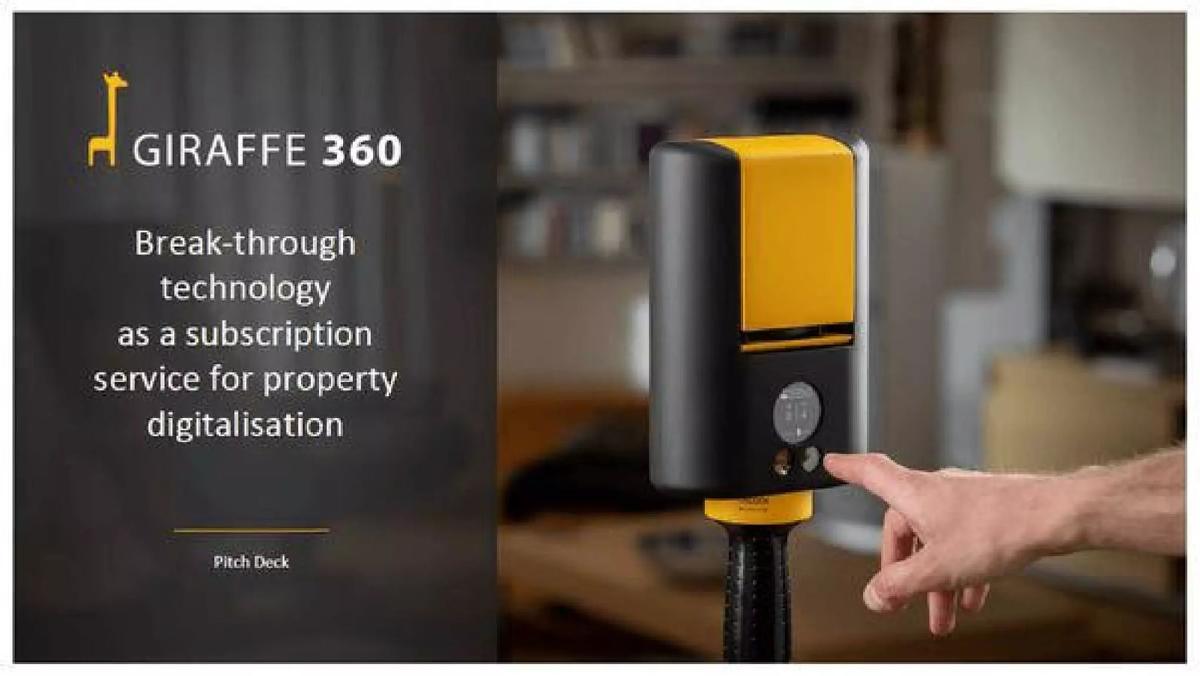
Slide 1: Title The deck opens with a high-resolution image of the Giraffe360 hardware. The tagline is explicit: 'Break-through technology as a subscription service for property digitalisation.' This immediately informs the investor that this is not a retail hardware play, but a service model.
Slide 2: Traction Giraffe360 makes a bold move by placing their traction slide second. It shows a bar chart titled '800% growth in 2019.' The Y-axis represents the 'Aggregate number of contracted subscriptions, net of churn.' The growth curve from January 2018 to October 2020 is nearly exponential, which serves to silence doubts about product-market fit before the problem is even fully explained.
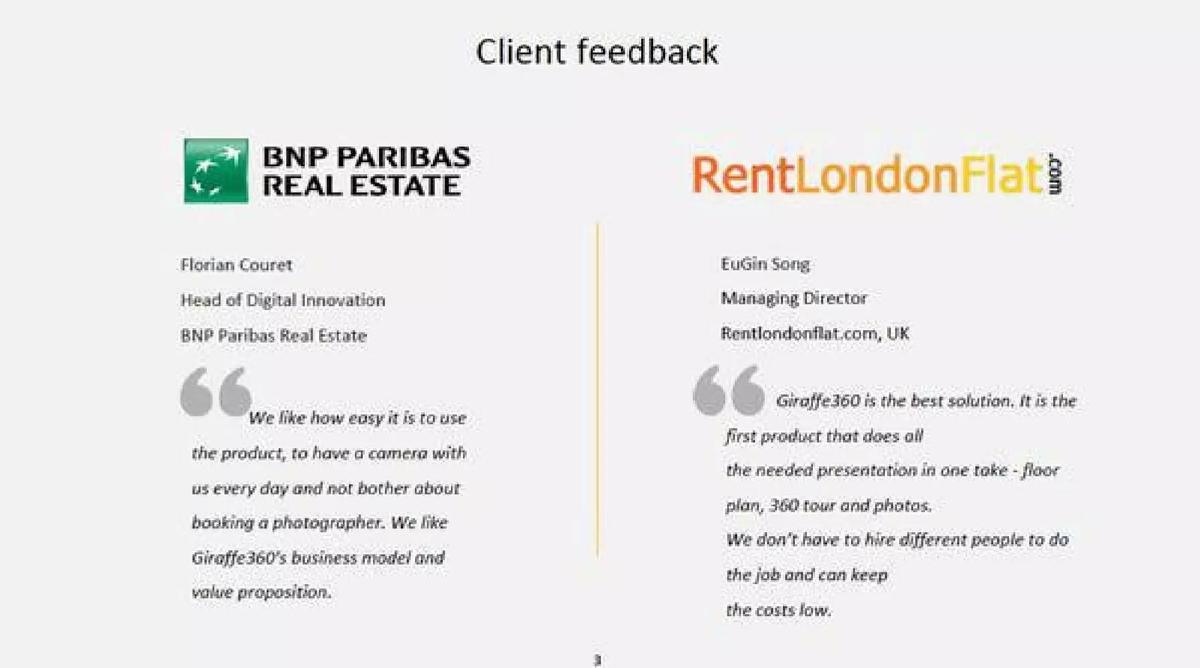
Slide 3: Client Feedback The validation continues with testimonials from BNP Paribas Real Estate and RentLondonFlat.com. Florian Couret of BNP Paribas emphasizes the 'business model and value proposition,' while EuGin Song of RentLondonFlat notes that it is the 'first product that does all the needed presentation in one take.' This slide establishes that the product works for both global enterprises and local agencies.
Slides 4-5: Defining the Problem and Current Failures
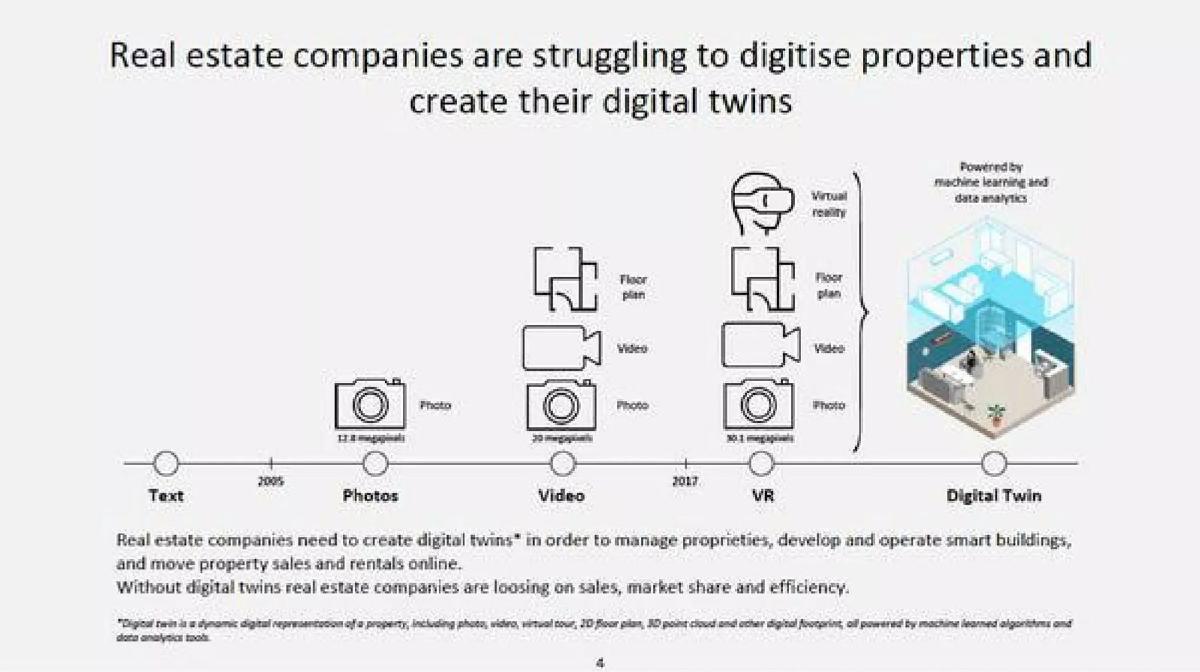
Slide 4: The Evolution of Property Digitalization This slide uses a timeline to show the progression of real estate marketing from 'Text' to 'Photos' (2005), 'Video,' 'VR' (2017), and finally 'Digital Twin.' It defines a digital twin as a dynamic representation including photos, floor plans, and 3D point clouds. The slide warns that without these, companies are 'loosing on sales, market share and efficiency.'
Slide 5: The Failure of Existing Solutions The deck categorizes current alternatives into four quadrants: smartphones (low quality), training teams with SLRs (inconsistent), hiring service providers (expensive/time-consuming), and building in-house teams (non-scalable). Specifically, it notes that virtual content is '3x more expensive than traditional photography' and takes 48 hours to schedule. This sets the stage for a faster, cheaper, automated alternative.
Slides 6-7: The Solution and Business Model
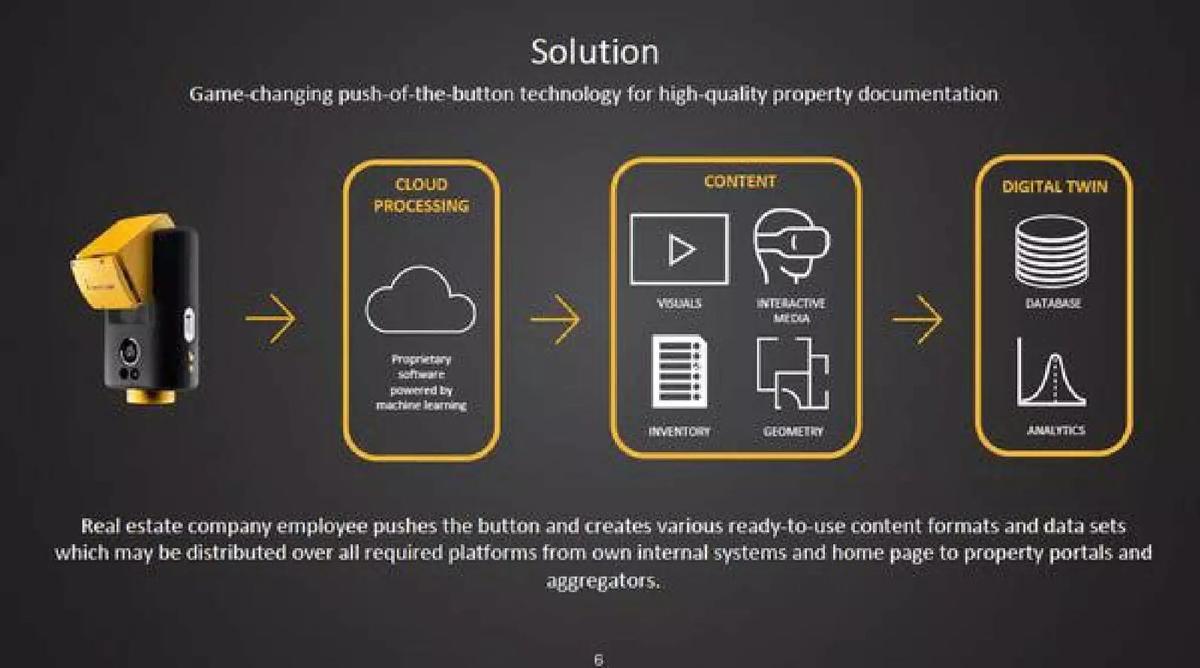
Slide 6: The Process The solution is presented as a linear workflow: The robotic camera captures data, proprietary software processes it in the cloud, and the output is a suite of content (visuals, interactive media, floor plans) and a 'Digital Twin' database for analytics. The 'push-of-the-button' simplicity is the core selling point.
Slide 7: Subscription-Based Business Model This is a critical slide for hardware startups. It uses an infinity loop graphic to show that the 'Robotic camera,' 'Cloud processing,' 'Content,' and 'Digital twin' are all bundled into a 'Fixed subscription fee per month.' It also mentions 'Additional fee applies to added-value services such as data analytics,' suggesting a path toward higher ARPU (Average Revenue Per User) over time.
Slides 8-9: Market Size and Global Reach
Slide 8: Immense Market Size The company estimates the professional real estate photography market at '€~10 bn' across the US, EU, Australia, and Canada. It provides granular data points: ~200,000 real estate agencies in Europe and 6,600 branches in London alone. By citing that 2,000 properties are listed online in London every 24 hours, they ground the macro numbers in daily activity.
Slide 9: Global Footprint A map of Europe shows subscribers in 24 countries. High-profile logos like Knight Frank, CBRE, RE/MAX, and Chestertons are displayed prominently. The slide also notes 'Subscriber requests in waiting list from US and Australia,' signaling clear paths for geographic expansion.
Slides 10-13: The Team, History, and Social Proof
Slide 10: Funding History This timeline shows a disciplined fundraising history: €0.5M Pre-Seed in 2016 (Koha Capital), €1.5M Seed in 2019 (Change Ventures, Hoxton Ventures, Plug and Play), and €3.7M Pre-Series A in 2020 (adding Launchub and Hardware Club). This transparency builds trust by showing that reputable VCs have already performed due diligence and followed their money.
Slide 11: Management Team The team slide highlights four individuals. CEO Mikus Opelts is noted for winning Swedish and German business awards and running B2B sales teams since age 19. CTO Einars Deksnis is described as the 'first ever foreigner to win Japan’s robotic sumo championship.' The inclusion of a CFO (Gints Sloka) with KPMG M&A experience suggests a level of financial maturity rare in early-stage startups.
Slide 12: Industry Recognition The deck includes a 'Real Estate Innovation Contest 2018: TOP 100' graphic, showing Giraffe360’s placement in a market map created by PwC and RE!N. This provides third-party validation of their standing within the PropTech ecosystem.
Slide 13: The Team and Contact The final slide shows a group photo of the team, emphasizing the human element behind the robotics. It provides direct email addresses for the CEO and CFO and lists a London headquarters address.
What Works in the Giraffe360 Deck
Traction-First Strategy: By leading with the 800% growth chart on Slide 2, the founders immediately frame the conversation around success. It forces the investor to view the subsequent 'Problem' and 'Solution' slides through the lens of a winning product rather than a theoretical one.
Clarity on the HaaS Model: Hardware startups often struggle to explain their revenue model. Slide 7 is exceptionally clear. It removes the friction of a high upfront purchase price by framing the camera as a component of a monthly subscription, which aligns perfectly with the budget cycles of real estate agencies.
Social Proof: The deck is heavy on logos. From the client list on Slide 9 to the investor list on Slide 10 and the industry awards on Slide 12, the company consistently demonstrates that they are vetted and respected by the market.
What is Missing from the Giraffe360 Deck
The Ask: There is no slide stating how much money the company is currently seeking or what the specific milestones for the next 18-24 months are. While the funding history is clear, the 'current round' details are absent.
Unit Economics: While they mention a subscription model, they do not provide the actual price points, Customer Acquisition Cost (CAC), or Lifetime Value (LTV). For a HaaS model, investors would typically want to see the payback period on the hardware manufacturing cost.
Competitive Landscape: The deck mentions 'service providers' generally but does not name specific competitors like Matterport. A direct comparison would help investors understand Giraffe360's specific technological or pricing advantage over established players.
What a Founder Should Copy
The 'Digital Twin' Narrative: Instead of selling a 'camera,' Giraffe360 sells a 'digital twin.' Founders should look at how they can elevate their product description from a tool to a strategic asset. This allows for higher pricing and a more compelling long-term vision.
Granular Market Data: Slide 8 is a great example of how to present market size. Instead of just saying 'it's a billion-dollar market,' they break it down by the number of agencies, the cost per photoshoot, and the daily volume of listings. This makes the TAM (Total Addressable Market) feel achievable and grounded in reality.
Visualizing the Process: Slide 6 does an excellent job of simplifying a complex technical process (robotics + cloud + ML + output) into a simple four-step visual. Founders with complex backend technology should use this 'black box' approach to keep the pitch focused on the value delivered rather than the code written.
Frequently asked questions
- What is the core problem Giraffe360 is solving?
- According to slide 4 and 5, real estate companies struggle to digitize properties efficiently. Traditional methods like hiring professional photographers are expensive and slow (taking 48 hours to schedule), while using smartphones results in low-quality content that hurts leads. Giraffe360 aims to automate the creation of 'digital twins'—high-quality photos, floor plans, and VR tours—using a single robotic device.
- How does the subscription model work for a hardware product?
- Slide 7 explains that Giraffe360 uses a Hardware-as-a-Service model. Clients pay a fixed monthly subscription fee which includes the robotic camera, cloud-based processing, and the resulting digital content. This creates a recurring revenue stream for the company while lowering the upfront cost and operational complexity for the real estate agency.
- What kind of traction did the company have at the time of this deck?
- The company demonstrated significant momentum, citing 800% growth in 2019 (Slide 2). By the time of the pitch, they had subscribers in 24 countries and a waiting list for the US and Australian markets (Slide 9). Their client list featured global real estate heavyweights such as BNP Paribas, Knight Frank, and CBRE.
- Who are the key members of the management team?
- Slide 11 highlights four key leaders: Mikus Opelts (CEO), a Swedish and German business award winner; Einars Deksnis (CTO), a robotics expert; Madars Opelts (VP Technology), formerly of SEB bank; and Gints Sloka (CFO), who has experience closing deals worth over €200 million at KPMG.
- What is missing from this pitch deck?
- The deck lacks a specific 'Ask' slide detailing how much capital is being raised in the current round and how those funds will be allocated. It also omits detailed unit economics (CAC, LTV) and a direct competitor comparison matrix, though it does contrast its solution against general alternatives like 'hiring service providers' or 'using smartphones.'