Softr’s 18-slide Series A deck is a clinical example of how to sell a horizontal platform by focusing on vertical success stories. Rather than getting bogged down in technical architecture, the deck prioritizes the 'Zero learning curve' value proposition (Slide 1) and validates it through six distinct use-case slides ranging from Client Portals to Marketplaces (Slides 5-10). The inclusion of high-signal testimonials from industry figures like Ryan Hoover (Slide 4) provides immediate credibility. While the deck is light on traditional financial metrics like CAC or LTV, it compensates with a cl…
Key takeaways
- The deck leads with a bold simplicity claim: 'Zero learning curve' on the very first slide.
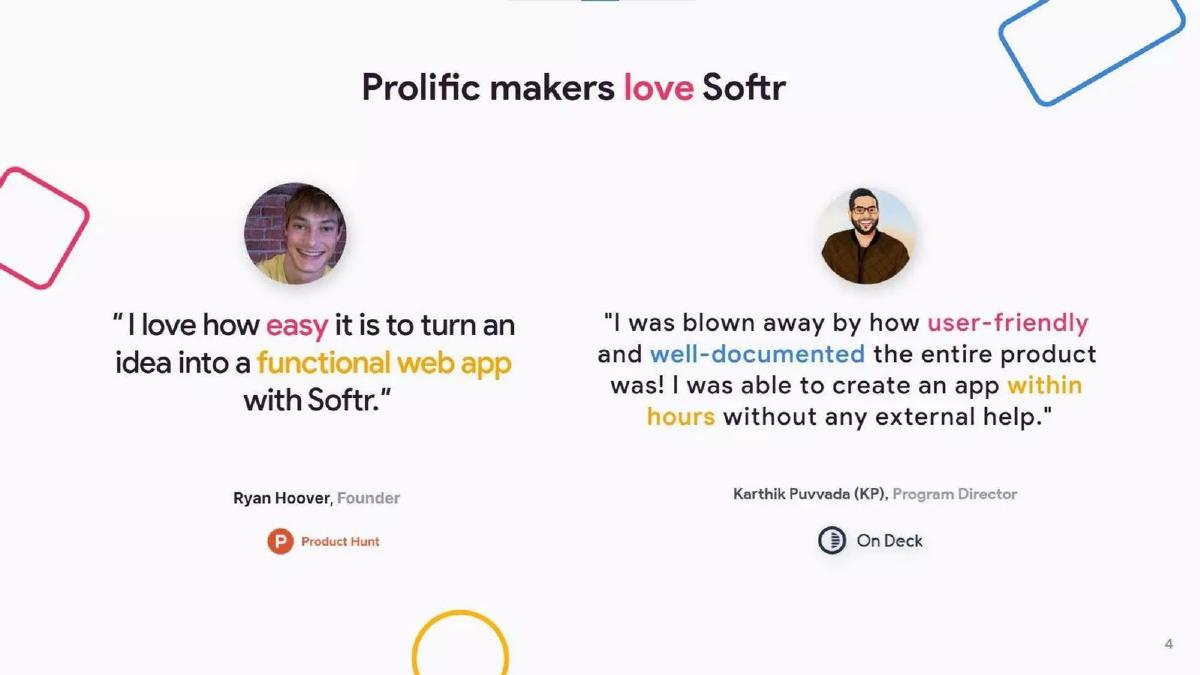
- Social proof is prioritized early, featuring a testimonial from Product Hunt founder Ryan Hoover on Slide 4.
- Six consecutive slides (5-10) are dedicated to specific customer archetypes, demonstrating the platform's versatility.
- The product is positioned as a bridge between data sources like Airtable and functional front-ends (Slide 3).
- Future growth is tied to an ecosystem play, including a 'Component store' and 'Template Marketplace' (Slide 14).
- The team slide (15) highlights deep experience at established tech firms like PayPal, Zalando, and TeamViewer.
- Pricing is transparently displayed across four tiers, from Freemium to a $165/m Business plan (Slide 16).
- The deck sets a concrete North Star metric: 1 million apps created by 2025 (Slide 17).
The Narrative: Simplicity as a Competitive Advantage
In the crowded no-code market of 2019-2021, most platforms competed on power and flexibility (often resulting in high complexity). Softr’s Series A deck takes the opposite approach. From the title slide onwards, the focus is on speed and the lack of a learning curve. This is a classic 'disruption from below' narrative: while competitors build tools for developers, Softr builds for the 'knowledge worker' who is already using Airtable or Google Sheets but needs a better interface.
Slides 1-4: The Hook and Social Proof
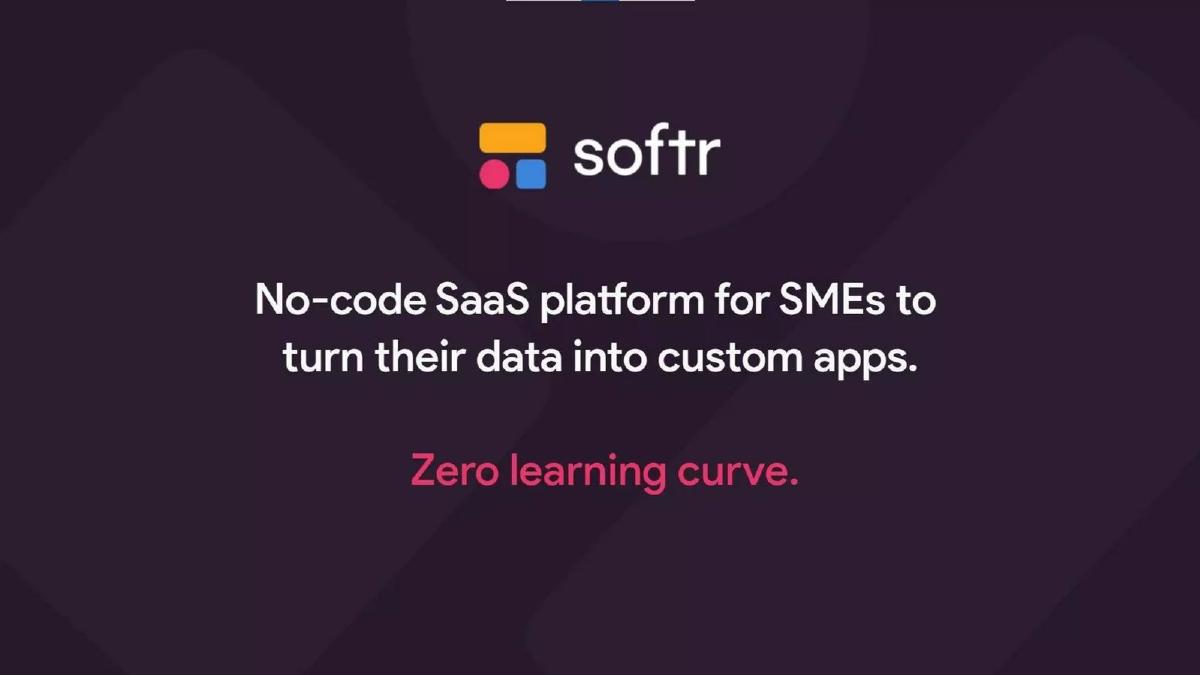
Slide 1 sets the stage immediately: 'No-code SaaS platform for SMEs to turn their data into custom apps.' The sub-headline 'Zero learning curve' is the primary differentiator. By targeting SMEs specifically, Softr carves out a niche away from enterprise-heavy competitors.
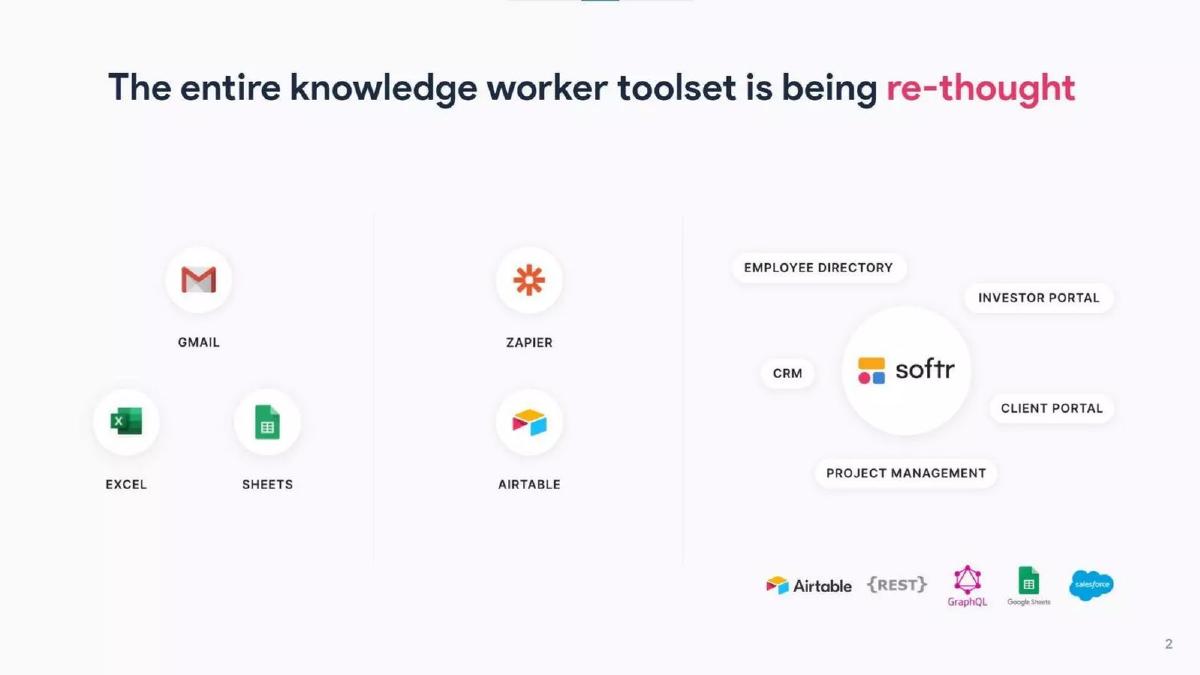
Slide 2 visualizes the market shift. It places Softr at the center of a new 'knowledge worker toolset,' connecting existing data silos (Excel, Sheets, Airtable) to functional outputs like Investor Portals and CRMs. This slide effectively communicates that Softr isn't asking users to move their data; it's asking to sit on top of it.
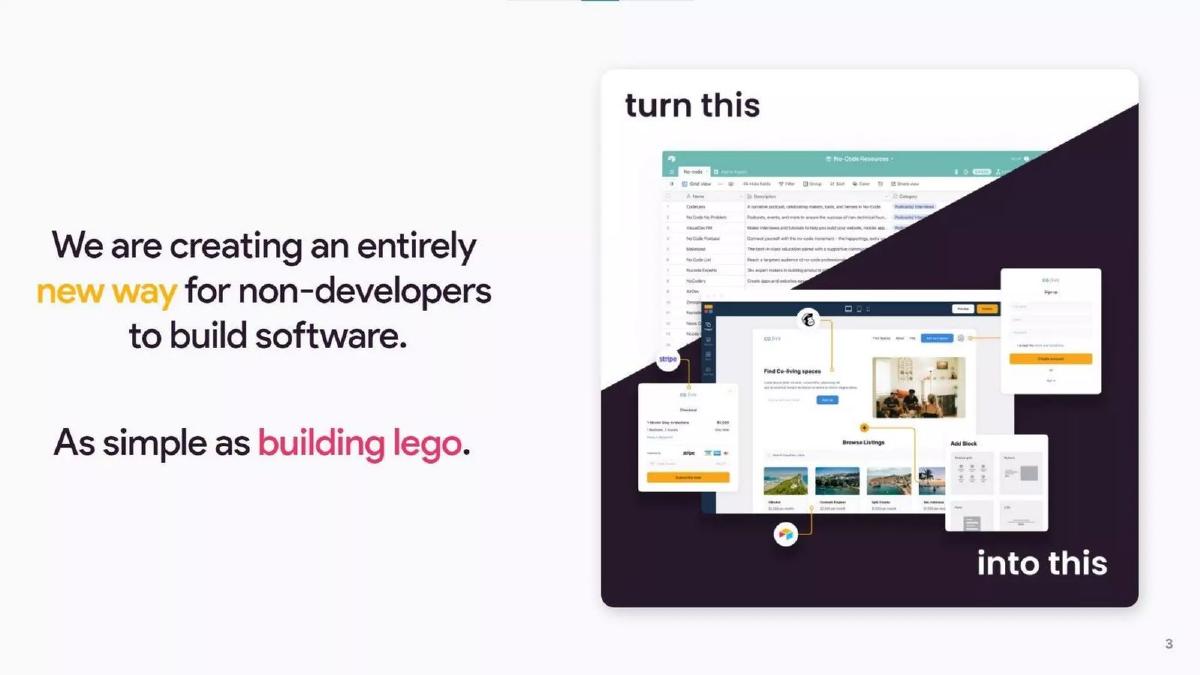
Slide 3 introduces the 'Lego' analogy. This is a powerful mental model for investors. It suggests that the product is modular, predictable, and easy to understand. The 'turn this (Airtable) into this (Web App)' visual is the clearest explanation of the product's function in the entire deck.
Slide 4 delivers high-impact social proof. Featuring Ryan Hoover (Founder of Product Hunt) and Karthik Puvvada (On Deck) isn't just about big names; it's about validation from the 'maker' community, which is the primary top-of-funnel driver for no-code tools.
Slides 5-11: The Use-Case Deep Dive
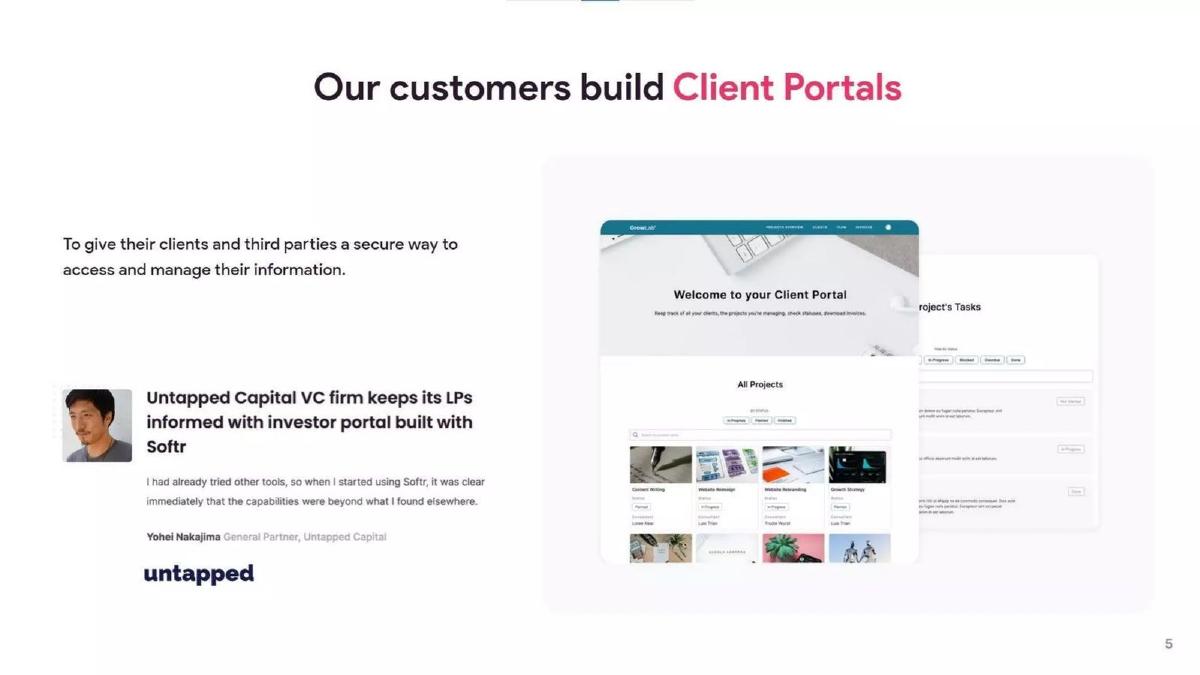
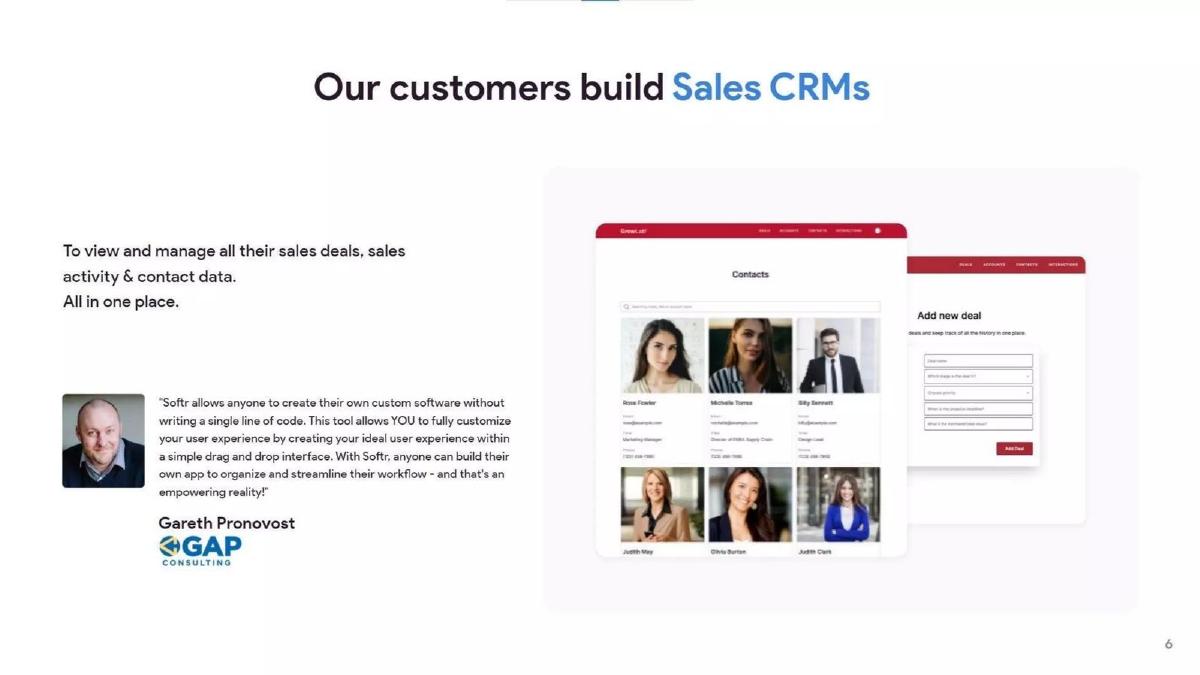
This section is the meat of the deck. Rather than showing a feature list, Softr shows outcomes. Each slide follows a consistent format: a headline, a brief 'why,' a customer testimonial, and a high-fidelity screenshot of the finished product.
Slide 5: Client Portals (featuring Untapped Capital). · Slide 6: Sales CRMs (featuring GAP Consulting). · Slide 7: Employee Directories (featuring DS Automotive). · Slide 8: Applicant Tracking Systems. · Slide 9: Marketplaces (featuring Nanny Network). · Slide 10: Online Communities (featuring 100DaysOfNoCode).
Slide 11 acts as a 'catch-all,' listing six more use cases and showing a series of tweets. This 'wall of love' strategy reinforces the idea that the product is already being used successfully in the wild, reducing the perceived risk for Series A investors.
Slides 12-14: Product Mechanics and Future Vision
Slide 12 finally breaks down the 'how.' It outlines a four-step process: Connect data, Build with blocks, Add auth/payments, and Publish. It highlights specific features like '1 click Stripe checkout' and 'user groups & permissions,' which are critical for building actual business applications rather than just static websites.
Slide 13 is a placeholder for a product demo video. In a live pitch, this is where the 'Zero learning curve' claim would be proven or debunked.
Slide 14 is the 'Vision' slide. It contrasts 'Today' (a tool with integrations) with 'Tomorrow' (an ecosystem). The mention of a 'Component store' and 'Template Marketplace' is crucial for a Series A deck. It shows the path to becoming a platform where the community generates content and value, which is a much more scalable business model than a pure SaaS builder.
Slides 15-18: Team, Business Model, and Goals
Slide 15 presents the team. Mariam Hakobyan (CEO) and Artur Mkrtchyan (CTO) highlight their backgrounds at companies like PayPal, Zalando, and TeamViewer. This suggests a balance of engineering rigor and experience in scaling consumer/business products.
Slide 16 details the pricing. The tiers ($0, $24, $65, $165) are standard for SaaS but the footnote is the most important part: 'Unique free plan with custom domain that encourages a bottom-up SaaS adoption strategy.' This explains their growth engine—letting users build for free on their own domains creates a 'powered by Softr' viral loop.
Slide 17 and 18 close the deck with a North Star metric: '1M apps created on Softr by 2025.' It’s a bold, simple goal that aligns with the 'biggest ecosystem' vision on the final slide.
What Works
Extreme Clarity: The 'Lego' analogy and the 'turn this into this' visuals make the product's value proposition instantly understandable. · Use-Case Breadth: By showing six different types of apps, Softr proves it is a horizontal platform without being vague. · Social Proof: The deck is saturated with testimonials from real users and recognizable industry names, which is vital for a Series A. · Ecosystem Strategy: Slide 14 successfully argues that Softr isn't just a tool, but a potential marketplace and platform.
What is Missing
Financial Metrics: There is no mention of MRR, ARR, or growth rates. While this might have been in a separate data room, its absence in the main deck is notable for a Series A. · Unit Economics: No data on CAC, LTV, or churn. Investors would want to know if the 'bottom-up' strategy is actually efficient. · Competitive Landscape: The deck doesn't explicitly mention competitors like Bubble, Glide, or Stacker. It relies on the 'simplicity' narrative to implicitly distance itself from them. · The Ask: The public version of this deck does not include a slide detailing how much they are raising or how the funds will be allocated.
What a Founder Should Copy
The 'Show, Don't Tell' Approach: If you have a horizontal product, don't just say it's 'flexible.' Show five different ways people are using it today. · Modular Social Proof: Don't just have one 'Testimonials' slide. Integrate customer quotes directly into the use-case slides to provide context. · The 'Mental Model' Slide: Use a simple analogy (like Legos) to help investors categorize your product quickly. · Vision vs. Reality: Clearly distinguish between what the product does today and the 'ecosystem' you are building for tomorrow.
Frequently asked questions
- What is the core value proposition of Softr according to the deck?
- Softr positions itself as the easiest way for non-technical business users to turn data into custom applications. The deck repeatedly uses the 'Lego' analogy (Slides 3 and 12) to emphasize that building software should be a matter of assembling pre-built blocks rather than writing code, specifically targeting SMEs who need internal tools and portals.
- How does Softr handle the 'horizontal platform' problem?
- Horizontal platforms often struggle to explain what they actually do. Softr solves this by dedicating Slides 5 through 10 to specific, high-value use cases: Client Portals, Sales CRMs, Employee Directories, Applicant Tracking Systems, Marketplaces, and Online Communities. This proves the platform's utility across different business functions without losing the 'simple' narrative.
- What data sources does Softr support according to the slides?
- Slide 2 and Slide 12 explicitly show integrations with Airtable, Google Sheets, Salesforce, and technical protocols like REST and GraphQL. The deck emphasizes that Softr acts as the presentation layer for data that already exists in these popular business tools.
- Is there any mention of financial performance or growth metrics?
- Interestingly, the deck is almost entirely devoid of historical financial data. There are no charts for MRR growth, churn, or customer acquisition costs. Instead, it relies on 'Product-Led Growth' signals, such as the mention of a 'bottom-up SaaS adoption strategy' on Slide 16 and a future goal of 1 million apps on Slide 17.
- What is the strategic significance of Slide 14 ('Tomorrow')?
- Slide 14 outlines Softr's transition from a tool to an ecosystem. By planning a 'Component store' and 'Template Marketplace,' Softr signals to investors that they are building a moat where third-party developers and 'Softr Experts' contribute to the platform's value, creating a network effect that is harder to disrupt than a simple builder tool.