Nereus presents a compelling case for AI-driven aquaculture by identifying a massive cost lever: fish feed, which accounts for 50-80% of total business costs. Their technical edge lies in using synthetic datasets and environmental simulations to train AI models, bypassing the slow and expensive manual annotation process typical in computer vision. With a $1.6M+ contract from SoftBank and a clear SaaS pricing model of $200 per month per cage, the company demonstrates both technical depth and commercial early-stage traction. However, the deck lacks a specific financial 'Ask' slide and detailed…
Key takeaways
- Feeding costs represent 50-80% of total business costs in aquaculture, providing a clear target for ROI-driven sales (Slide 2).
- The solution claims to reduce operating costs by 20% and pollution by 17% while increasing profit margins by 26% (Slide 3).
- Nereus uses synthetic datasets with bio/environment simulations to solve the 'painful' problem of manual data collection and annotation (Slide 5).
- The global aquaculture market is valued at $285B with a 4.5% CAGR, employing 20 million people (Slide 7).
- Pricing is structured as a SaaS model at $200/month per fish cage for cages smaller than 12x12m (Slide 8).
- The company has secured a $1.6M+ contract through a partnership with SoftBank in Japan (Slide 9).
- The CEO, Masaki Nakada, PhD, is a Forbes Next 1000 honoree and UCLA researcher specializing in computer vision and biomechanics (Slide 11).
- The deck omits a specific funding request, use of proceeds, or detailed financial projections (General observation).
Slide-by-Slide Analysis
Slide 1: Title Slide
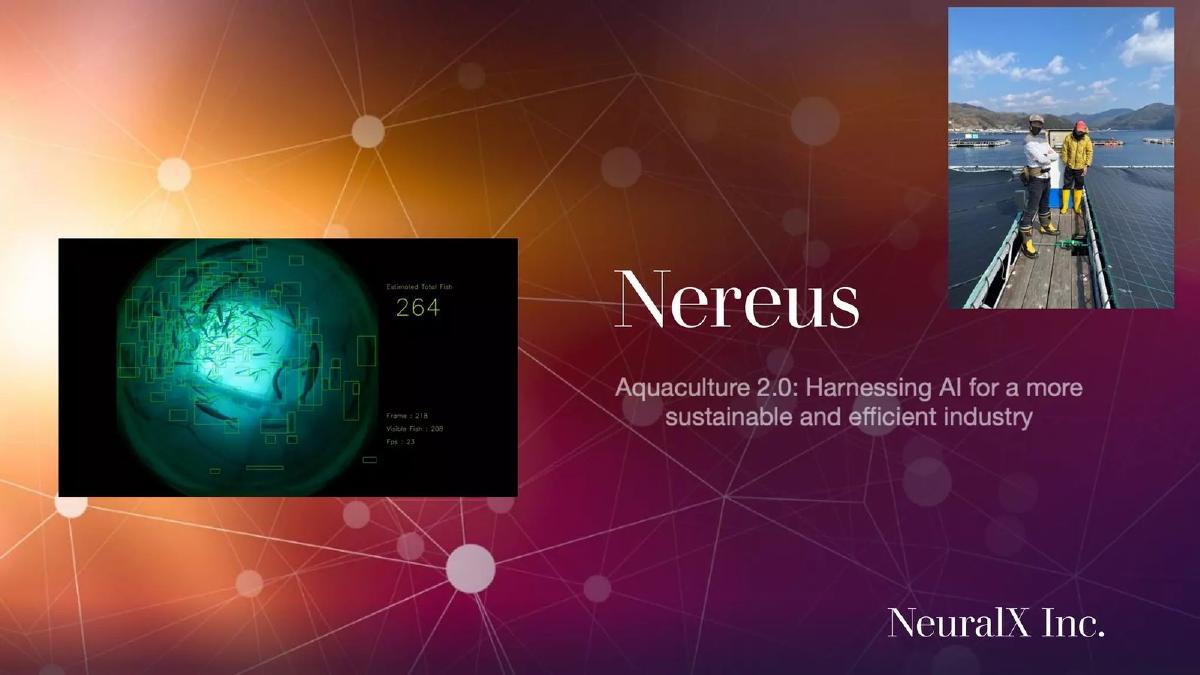
The deck opens with the brand name 'Nereus' and the subtitle 'Aquaculture 2.0: Harnessing AI for a more sustainable and efficient industry.' It identifies the parent company as NeuralX Inc. The imagery includes a technical visualization of fish counting and a real-world photo of a fish farm, immediately establishing the bridge between software and physical operations.
Slide 2: The Current Problem
This slide identifies the core economic driver for the business. It states that feeding cost equals 50-80% of total business cost . It highlights that current operations are manual, specifically noting that sizing and counting are done on an 'occasional basis' and feeding is 'non-optimal.' This is a strong problem slide because it attaches a specific, large percentage to the inefficiency.
Slide 3: The Solution and Impact
Nereus proposes automated AI fish counting, sizing, and hunger analysis. The slide lists four key performance indicators (KPIs) for their solution: reducing operation costs by 20% , reducing pollution by 17% , increasing profit margins by 26% , and accelerating production speed by 33% . The visual shows the AI interface identifying fish and labeling them as 'normal,' 'hungry,' or 'full.'
Slide 4: The AI Bottleneck
This slide pivots to a technical problem: manual data collection and annotation for AI training are 'too painful.' It shows a researcher manually labeling fish in a video frame, contrasting this slow process with the need for a full year of diverse data (weather, location, water clarity).
Slide 5: The Technical Edge - Synthetic Datasets
Nereus presents its 'unfair advantage': using synthetic datasets with biological and environmental simulations. By simulating fish behavior (alignment, cohesion, separation) and environmental factors (water temperature, light intensity), they can generate vast amounts of labeled training data without manual intervention. This is a sophisticated technical slide that explains how they scale their AI accuracy faster than competitors.
Slide 6: Platform Overview
This slide illustrates the workflow. Video feed from the fish farm goes to the Nereus management cloud, which sends frames to the 'Nereus AI.' Analytics are sent back to the cloud, enabling remote control and optimization. The output for the farmer includes automated feeding management and harvest timing optimization via a web dashboard.
Slide 7: Market Opportunity
The deck cites that the world now produces more seafood from fish farms than wild catch. It values the aquaculture market at $285B with a 4.5% CAGR . It also notes that 20 million people are employed globally in the sector and 3 billion people rely on seafood as a primary protein source, citing the FAO and World Bank as sources.
Slide 8: Pricing Model
Nereus utilizes a SaaS model. They charge $200/month per fish cage for cages smaller than 12x12m. They offer enterprise pricing for farms with more than 50 cages. The slide also mentions there are 1.5 million active fish farms globally, providing a sense of the Total Addressable Market (TAM) in terms of units.
Slide 9: Traction and Partnerships
This is a high-impact slide showing a $1.6M+ signed contract with SoftBank in Japan. It also mentions they have experimented with three fish farms. Leading with a major corporate name like SoftBank provides significant institutional validation for a startup in a traditional industry like aquaculture.
Slide 10: Competition
The competition is presented as a Venn diagram. Nereus positions itself at the intersection of 'Computer Vision' (competitors: Aquabyte, Tidal, Umitron) and 'Aquaculture Products' (competitors: AquaManager, Cermaq, eFishery, Esa-Robo). The claim is that Nereus uniquely combines these segments for a sustainable advantage.
Slide 11: Team
The team slide is strong on academic and research credentials. CEO Masaki Nakada, PhD, is highlighted for his UCLA background and awards (Forbes Next 1000, MIT Innovators U35). Bill Manci is listed as a Biz Dev Advisor with 45 years of experience. The rest of the team consists of five engineers, suggesting a product-heavy organization.
Slide 12: Contact and Conclusion
The final slide provides contact information and links to the company and service websites. It reiterates the mission: 'Empowering a sustainable aquatic food supply with A.I. and Artificial Life.'
What Works Well
Economic Focus: By identifying that feed is 50-80% of costs on Slide 2, Nereus makes a logical case for why their technology is a 'must-have' rather than a 'nice-to-have.' · Technical Differentiation: The explanation of synthetic data (Slide 5) addresses a common investor concern regarding how AI startups handle the high cost and slow speed of data labeling. · Clear Pricing: The SaaS model on Slide 8 is simple and easy to model for an analyst. · Validation: The SoftBank contract (Slide 9) is a massive proof point for a company at this stage.
What Is Missing
The Ask: There is no slide indicating how much money the company is looking to raise or what the valuation expectations are. · Use of Proceeds: Without an 'Ask,' there is also no breakdown of how new capital would be deployed (e.g., sales expansion, R&D, hardware manufacturing). · Financial Projections: The deck lacks a forward-looking revenue chart or a path to profitability. · Hardware Details: While the software is explained, the deck is vague about the cameras and sensors required. It is unclear if Nereus provides the hardware, if the farmer buys it separately, or how it is maintained in harsh marine environments.
Founder Takeaways
Quantify the Pain: If your product saves money, find the single largest cost line item in your customer's P&L and put it in big bold letters, as Nereus did with '50-80% of total biz cost.' · Explain the 'How': Don't just say you use AI. Explain why your AI is better or cheaper to build. The 'Synthetic Data' slide is a masterclass in explaining a technical moat to a non-technical audience. · Use Logos for Credibility: If you have a major partner or a founder with significant awards, use those logos (SoftBank, UCLA, Intel, Forbes) to build immediate trust.
Frequently asked questions
- What is the primary problem Nereus is solving?
- Nereus targets the inefficiency of manual fish farming. Currently, sizing and counting fish are done manually on an occasional basis, leading to non-optimal feeding timing and amounts. Since feed accounts for 50-80% of total costs, these inefficiencies significantly impact profitability and environmental sustainability.
- How does Nereus differentiate its AI training from competitors?
- Most AI companies rely on manual data annotation, which Nereus describes as 'too painful.' Instead, Nereus uses synthetic datasets generated through biological and environmental simulations. This allows them to train models on a full year of data (365 days) including variables like weather, water clarity, and fish species without manual labeling.
- What is the business model and target market?
- Nereus operates a SaaS model, charging $200 per month per fish cage. They offer enterprise pricing for farms with more than 50 cages. The target market is the 1.5 million active fish farms globally, within a $285 billion aquaculture industry.
- What traction has the company achieved so far?
- The most significant traction milestone is a partnership with SoftBank in Japan, which includes a signed contract worth over $1.6 million. They have also conducted experiments across three different fish farms to validate their technology.
- Who is behind the company?
- The company, NeuralX Inc., is led by CEO Masaki Nakada, a PhD from UCLA and a Forbes Next 1000 honoree. The team includes a business development advisor with 45 years of aquaculture experience and five engineers specializing in backend systems, simulation research, and computer vision.