Food & Beverage Product Slides: 7 Real Pitch Deck Examples
How food, drink and farm startups present their product: process loops, farm systems with sensors, software feature lists, customer steps and a single bottle.
Food & Beverage Product Slides: Real Pitch Deck Examples
Seven product slides from food, drink and farm decks (spirits, poultry housing, fish farming, indoor farms, home-cooked meals, mezcal and delivery-only restaurant brands), shown in full. The strongest ones show how the product is made or run step by step; the weakest list capabilities as headlines with no detail behind them.
TL;DR
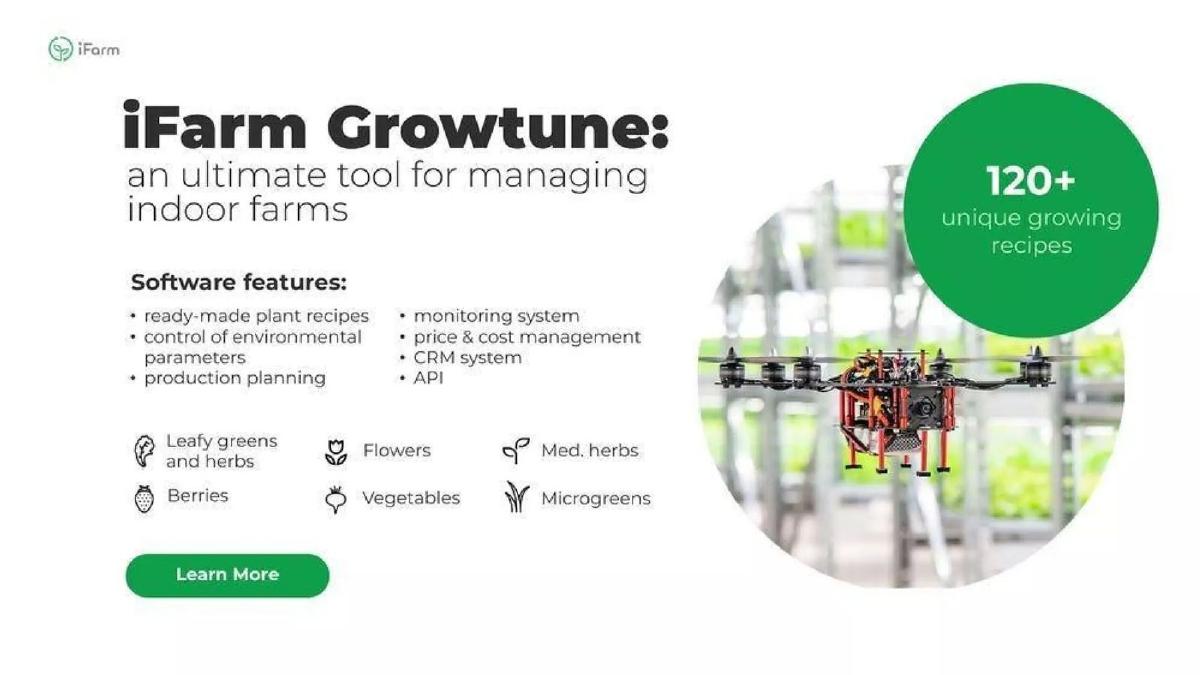
A food or beverage product slide should show how the product is made, grown or delivered, and what the customer gets. Bespoken Spirits shows five numbered steps from source spirit to finished product, with a data loop feeding back. Chick-in shows its poultry house, climate controller and phone app, linked by arrows. Nereus shows a fish farm's camera feed going to its cloud and AI and coming back as feeding and harvest advice. iFarm lists its software features with a figure ("120+ unique growing recipes"), and Homecooks shows an eater's four steps from order to reheating. Miel de Tierra shows one bottle with tasting notes, and Taster lists four capability headlines with little detail; these are the weaker examples here.
Food and beverage product slides
Each example shows the exact stored slide above its analysis and links to the full teardown. Stronger examples first. Claims and figures are as shown on the slides; we have not verified them.
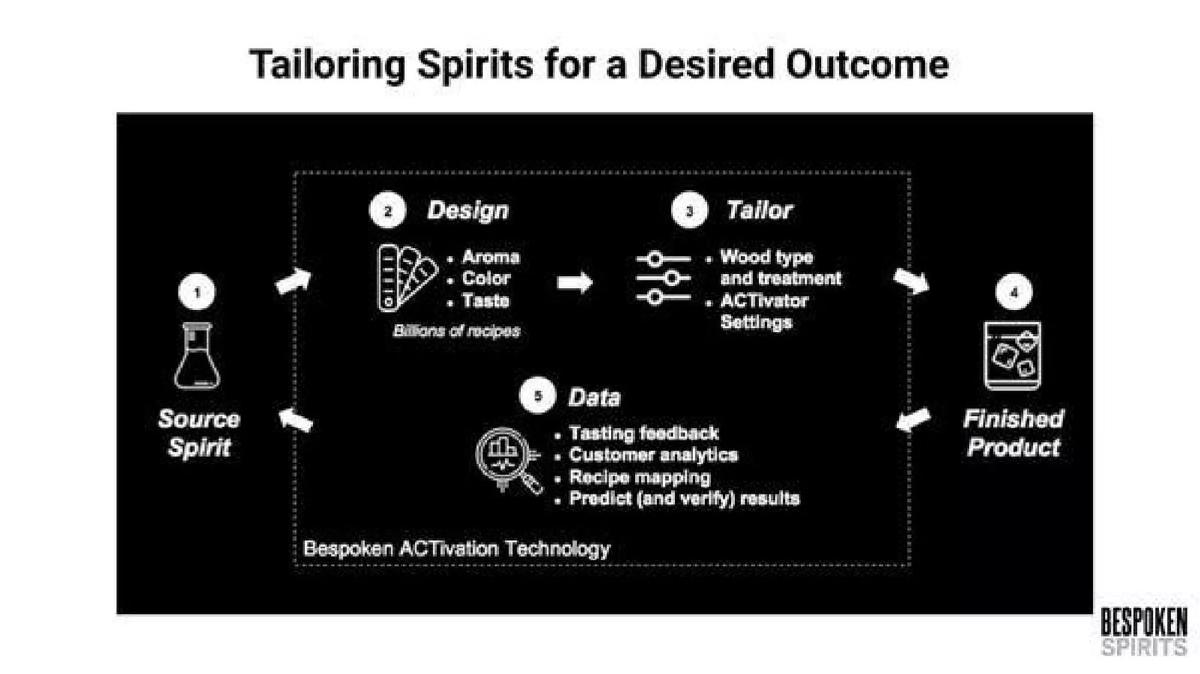
Bespoken Spirits product slide — slide 5
Seed stage. Spirits made with a fast-ageing process. Numbered process loop.
Bespoken Spirits deck, slide 5. Exact stored slide matched to this analysis.
Our analysis: The clearest food product slide here: five numbered steps show what the company controls and how data improves the next batch.
Evidence and limitation: How the process works; "billions of recipes" is a claim with no figure for batches made.
What a founder can adapt: Number the steps of how your product is made and show what you learn from each batch.
Supporting analysis
What the deck claims: "Tailoring Spirits for a Desired Outcome." "1 Source Spirit" → "2 Design: Aroma, Color, Taste" ("Billions of recipes") → "3 Tailor: Wood type and treatment, ACTivator Settings" → "4 Finished Product" → "5 Data: Tasting feedback, Customer analytics, Recipe mapping, Predict (and verify) results", looping back to the start. Labelled "Bespoken ACTivation Technology".
Presentation choice: The data step turns a drinks brand into a repeatable process, which is what an investor is being asked to fund.
When it does not fit: Add how long the process takes against traditional ageing; the core advantage isn't stated on the slide.
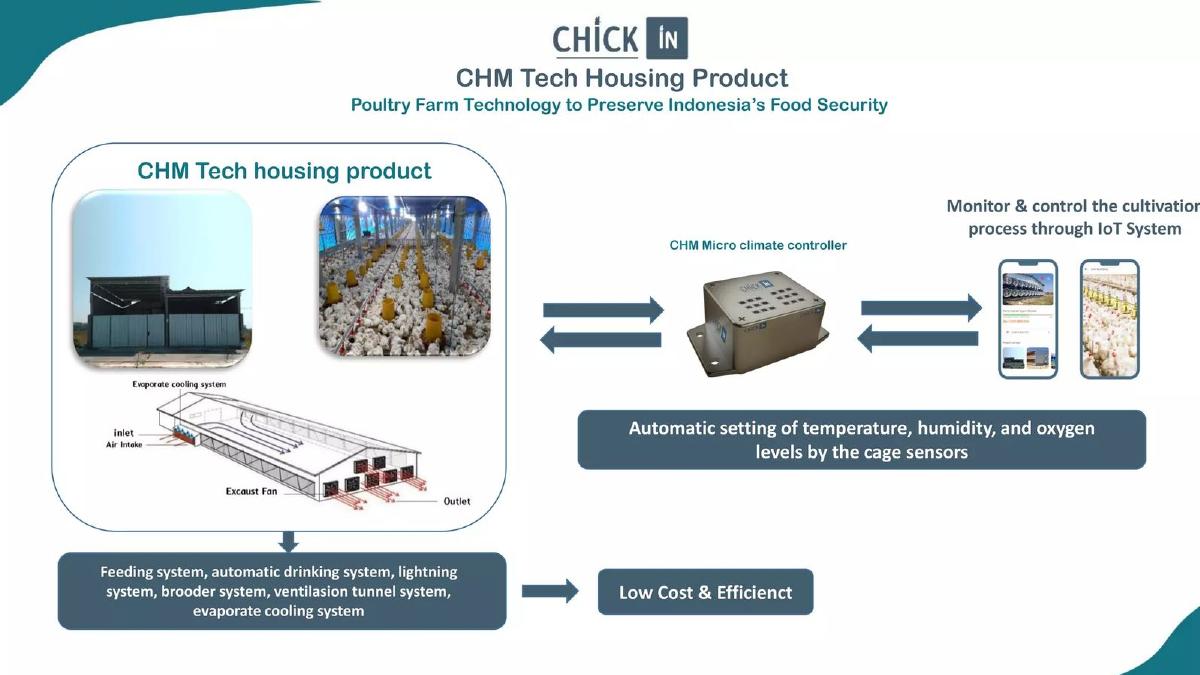
Poultry farm technology in Indonesia. Housing, controller and app.
Chick-in deck, slide 5. Exact stored slide matched to this analysis.
Our analysis: Shows every part of the product (building, controller and app) and how they connect.
Evidence and limitation: Photos of the real housing, device and app; no cost or yield figure.
What a founder can adapt: Show each part of your system with a real photo and arrows showing what passes between them.
Supporting analysis
What the deck claims: "CHM Tech Housing Product: Poultry Farm Technology to Preserve Indonesia's Food Security." Photos and a diagram of the housing ("Evaporate cooling system", "Air Intake", "Exhaust Fan"). "Feeding system, automatic drinking system, lightning system, brooder system, ventilasion tunnel system, evaporate cooling system" → "Low Cost & Efficient". "CHM Micro climate controller": "Automatic setting of temperature, humidity, and oxygen levels by the cage sensors." "Monitor & control the cultivation process through IoT System" with two phone screens.
Presentation choice: Real photos of a working farm show the product exists, not only a drawing.
When it does not fit: "Low Cost & Efficient" needs a number, such as cost per bird or mortality against a standard house.
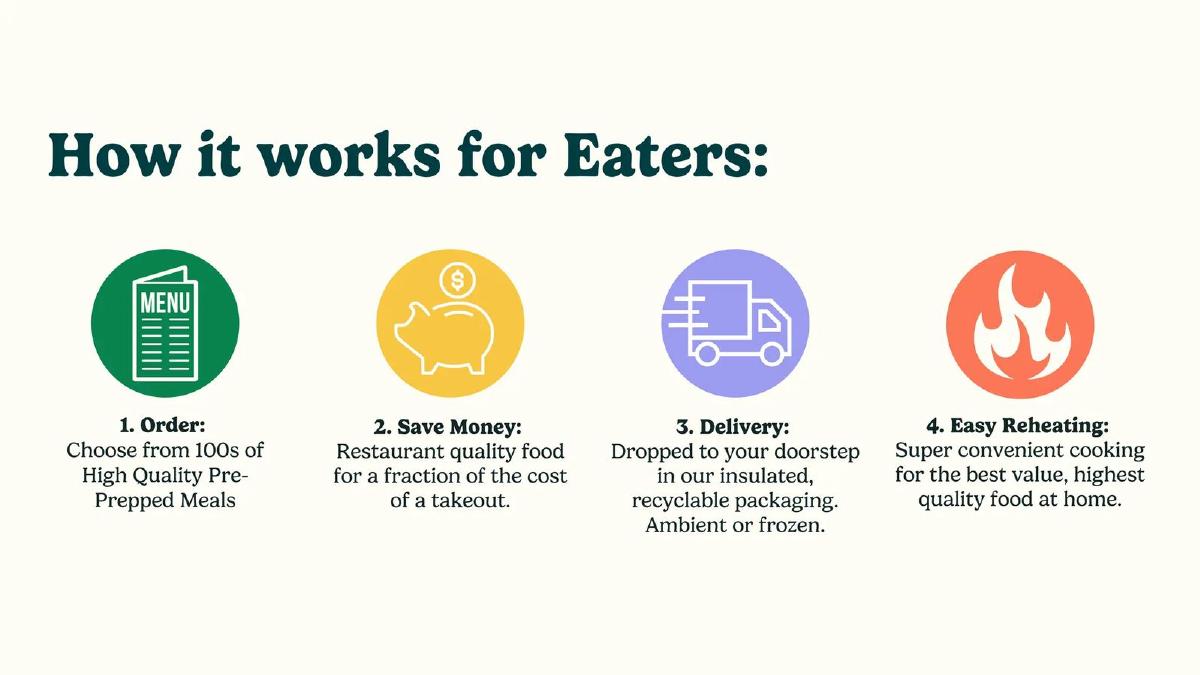
Seed stage. Home-cooked meal marketplace. Four customer steps.
Homecooks deck, slide 4. Exact stored slide matched to this analysis.
Our analysis: Four steps an eater takes, with a practical detail (ambient or frozen) that answers a delivery question.
Evidence and limitation: Customer steps; "fraction of the cost" has no price.
What a founder can adapt: For a marketplace, give each side its own four steps.
Supporting analysis
What the deck claims: "How it works for Eaters:" "1. Order: Choose from 100s of High Quality Pre-Prepped Meals." "2. Save Money: Restaurant quality food for a fraction of the cost of a takeout." "3. Delivery: Dropped to your doorstep in our insulated, recyclable packaging. Ambient or frozen." "4. Easy Reheating: Super convenient cooking for the best value, highest quality food at home."
Presentation choice: Paired with the creator slide in the same deck, it shows both sides of the marketplace.
When it does not fit: Give the average meal price against a takeout; "fraction of the cost" is left for the reader to guess.
Miel de Tierra deck, slide 6. Exact stored slide matched to this analysis.
Our analysis: A weaker example for investors: it reads like a shelf description. The sourcing detail is the only point of difference.
Evidence and limitation: Origin and tasting notes; no price, volume or sales.
What a founder can adapt: Keep the bottle and one origin line, then add the retail price and how much wild agave you can source.
Supporting analysis
What the deck claims: "The Wildcard." "Miel de Tierra Salmiana is made from wild Salmiana Agaves, which only grow in the secluded region of San Luis Potosí in Central Mexico. This craft mezcal features remarkable notes of pepper and fine spices." "A fine, exotic mezcal that englobes a wild, yet balanced, combination of spiced flavors and aromas that make this label immediately stand out from all the other Mezcal styles." Bottle label: "40% Alc. Vol.", "Cont. Net. 750 ml".
Presentation choice: Included for contrast: a drinks brand's product slide should add price, margin or supply, not only taste.
When it does not fit: "Stand out from all the other Mezcal styles" is a claim with no comparison.
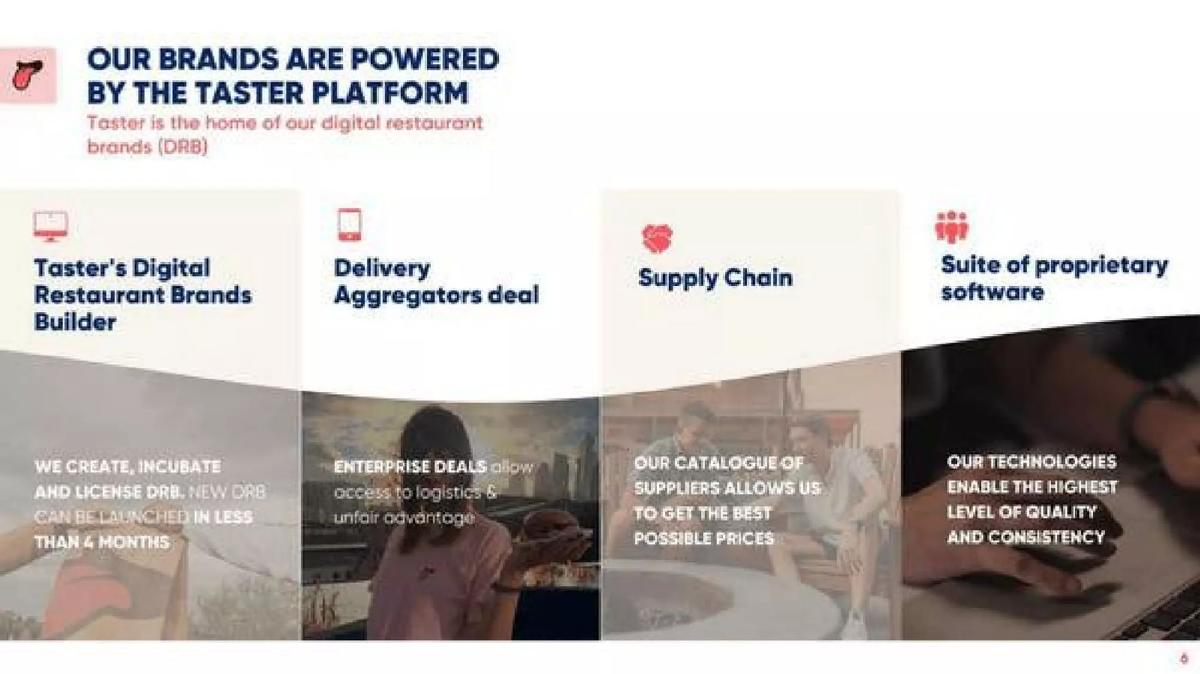
Series B. Delivery-only restaurant brands. Four capability headlines.
Taster deck, slide 6. Exact stored slide matched to this analysis.
Our analysis: A weaker example: four headlines over stock photos, with the only concrete detail being launch time.
Evidence and limitation: One figure (under 4 months to launch); the rest are claims.
What a founder can adapt: Show one brand's menu and the kitchen partner's order screen, and keep the 4-month launch figure.
Supporting analysis
What the deck claims: "Our brands are powered by the Taster platform." "Taster is the home of our digital restaurant brands (DRB)." "Taster's Digital Restaurant Brands Builder: We create, incubate and license DRB. New DRB can be launched in less than 4 months." "Delivery Aggregators deal: Enterprise deals allow access to logistics & unfair advantage." "Supply Chain: Our catalogue of suppliers allows us to get the best possible prices." "Suite of proprietary software: Our technologies enable the highest level of quality and consistency."
Presentation choice: Included for contrast: "proprietary software" with no screen or feature leaves the investor to take it on trust.
When it does not fit: Name the aggregators and what the deal gives you; "unfair advantage" alone is not evidence.
What improved: Our illustrative rewrite; not Taster's wording. Bracketed parts are placeholders to fill with real facts. It turns a claim into a count and a comparison.
What this guide adds
The library already has a general product slide guide, product slides by stage, and fintech, SaaS, healthcare, edtech and climate product guides, plus food problem, solution and market guides. This page looks only at food, drink and farm decks, where the product ranges from a bottle on a shelf to a system running a farm.
Sector labels come from the sector recorded for each published teardown (high confidence for Bespoken Spirits, Chick-in, iFarm, Miel de Tierra and Taster; medium for Nereus and Homecooks). None of these seven slides appears in another guide. Other slides from the Bespoken Spirits, Chick-in, iFarm and Homecooks decks are used elsewhere in the library; Homecooks' food-creator slide is in the general product guide, and this page uses its separate slide for eaters.
Four ways food decks show the product
Process loop (Bespoken Spirits): numbered steps of how the product is made, with data feeding back into the next batch.
System diagram (Chick-in, Nereus): farm, device, cloud and app linked by arrows showing what each sends to the next.
Features and customer steps (iFarm, Homecooks): a software feature list with a figure, or four steps the customer takes.
Product shot or headlines (Miel de Tierra, Taster): a single bottle with tasting notes, or capability headlines. Quick to read, but they leave out how the product is made or used.
Common mistakes
Tasting notes instead of a product case. Add price, margin or supply.
Headlines without detail. Give each capability one fact.
Photos that aren't the product. Use the real bottle, farm or screen.
"Low cost" with no number. Give cost per unit or saving.
Benefits listed, not measured. Add one result from a customer or farm.
Diagnostic checklist
Numbered steps of how it's made or delivered.
A real photo or screen of the product.
At least one figure.
Each capability backed by a detail.
Customer outcome stated.
Frequently asked questions
How we chose these examples
Corpus: published pitch deck teardowns on StartupFundraising.com. Founder-uploaded private decks are excluded.
Selection (2026-09-26): we took teardowns whose recorded sector is food and beverage (high or medium confidence) and whose slide is classified as a product slide, with a stored image and readable text. We read the candidates, left out slides that were not about the product (team, competition, market, customer and history slides filed under this type), slides already used in other guides, and large listed-company decks, and kept seven that show different ways of presenting a food product. Miel de Tierra and Taster are included as weaker examples for contrast.
Sector is the category recorded for each teardown (confidence given in the section above). Stages are shown only where recorded with high confidence (Bespoken Spirits, iFarm and Homecooks, seed; Taster, Series B).
Review: stored slide images were checked on 2026-09-26 and matched to company, deck and slide number, and quoted text was read from the images (editorial model review). No person has yet completed an editorial review of this page.
Claims and figures are as shown on the slides; we have not verified them. We make no claim that any slide caused a fundraising outcome.