Chick in presents a hybrid hardware-software solution to address inefficiencies in the Indonesian poultry industry. By deploying 'CHM Micro climate controllers' and automated housing systems, the company seeks to mitigate disease risks and optimize production for conventional farmers. Their business model relies on a partnership system with major integrators like Japfa and Charoen Pokphand, providing them with predictable supply while offering farmers better management tools. The deck outlines a clear path from production technology to a downstream 'Online Groceries' marketplace for hotels an…
Key takeaways
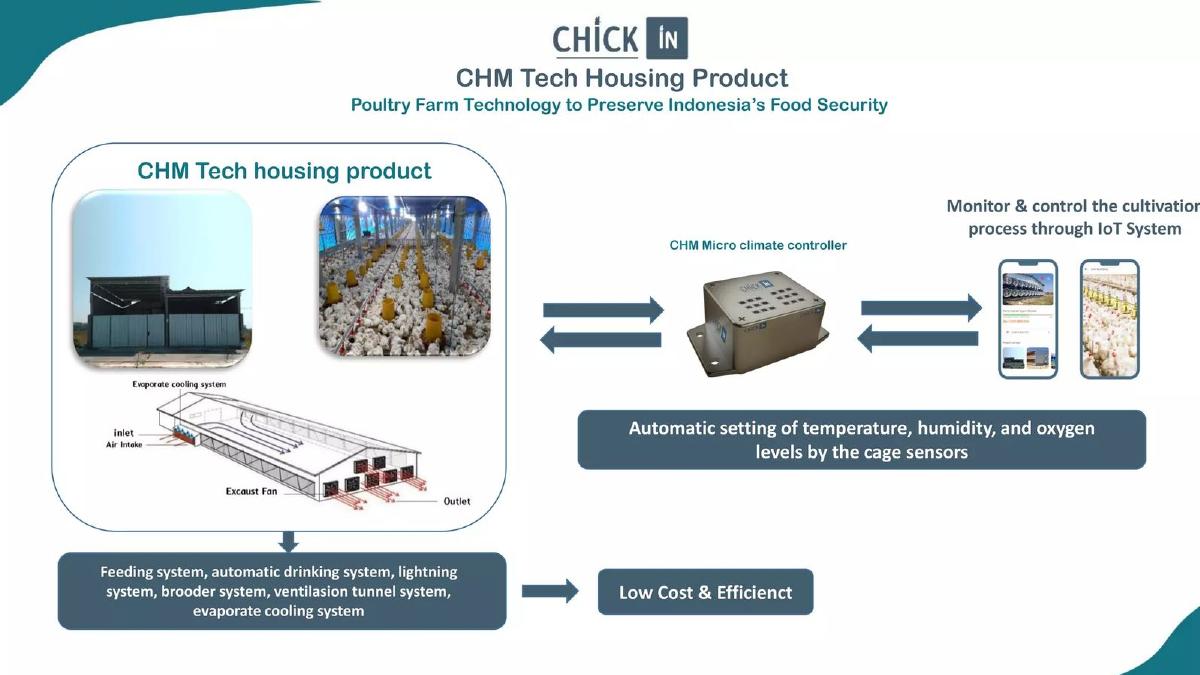
- The core product is the CHM Micro climate controller, an IoT system that automates temperature, humidity, and oxygen levels in poultry cages (Slide 3).
- Chick in identifies three primary pain points for conventional farmers: sub-optimal production capacity, high disease risk, and inefficient management (Slide 2).
- The business model utilizes a B2B partnership where integrator companies provide inputs (DOC, vaccines, feed) in exchange for live broilers at contract fixed prices (Slide 4).
- Financial projections target a total 5-year revenue of IDR 585 Billion (USD 39 Million) with a net income of IDR 58.5 Billion (Slide 5).
- The company plans to expand downstream in 2021 by launching an online grocery platform targeting hotels, restaurants, and households (Slide 6).
- The go-to-market strategy for the grocery segment relies on social media, SEO/SEM, and community relations through 'Check point partners' (Slide 7).
- The funding ask is IDR 10,000,000,000 (USD 671,000) for a 12-month runway, with 70% allocated to development costs like cage infrastructure (Slide 8).
- The deck claims a high return on investment (ROI) of 75% per year and a return on assets (ROA) of 25% per year for a moderate CHM unit (Slide 5).
Chick in Pitch Deck Analysis: Modernizing Poultry Through IoT
Chick in, operating under the legal entity PT. Sinergi Ketahanan Pangan, presents a solution to the fragmented and inefficient poultry farming industry in Indonesia. The deck focuses on the intersection of hardware (IoT controllers) and supply chain management to stabilize food security and improve farmer margins. By positioning themselves as a technology partner for both large integrators and small-scale farmers, Chick in attempts to solve the high mortality and low productivity rates common in tropical poultry cultivation.
Slide 1: Title and Branding
The cover slide introduces the company as 'Chick in' with the tagline 'Ketahanan Pangan Indonesia' (Indonesia's Food Security). It also lists the parent company name, PT. Sinergi Ketahanan Pangan. The branding is clean, though the slide lacks a specific mission statement or a high-level value proposition beyond the company name.
Slide 2: The Problem Statement
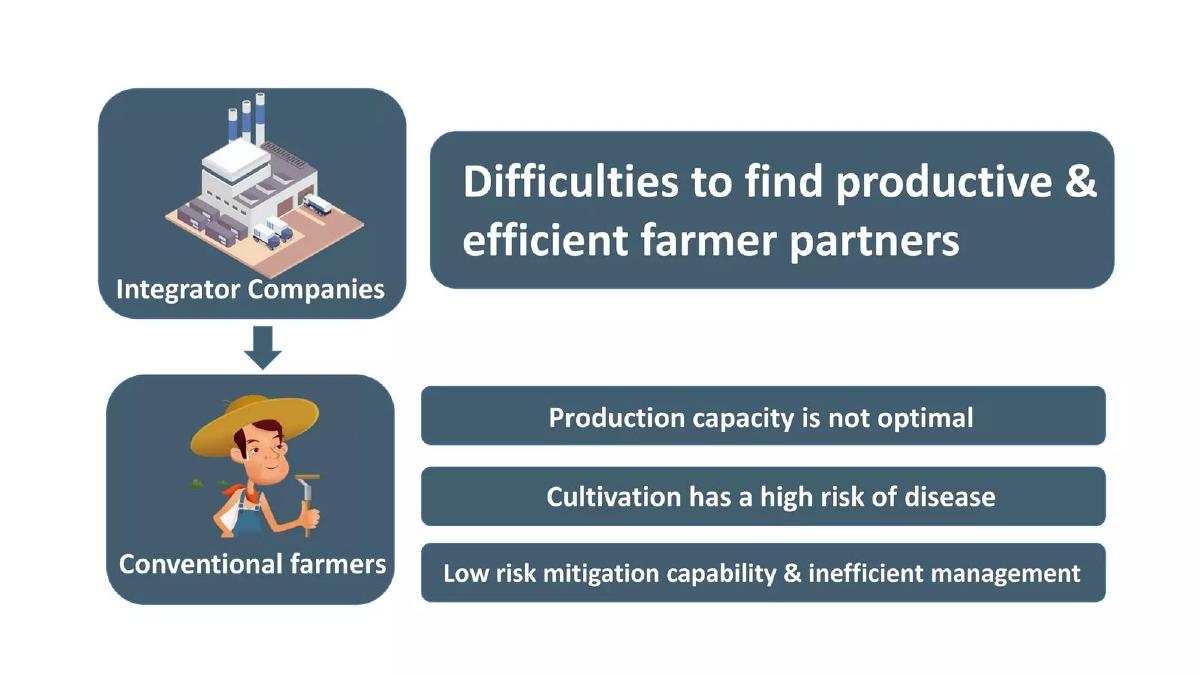
Slide 2 identifies the friction between 'Integrator Companies' and 'Conventional farmers.' The primary headline states there are 'Difficulties to find productive & efficient farmer partners.' For the farmers themselves, the deck lists three critical issues: Production capacity is not optimal , Cultivation has a high risk of disease , and Low risk mitigation capability & inefficient management . This slide effectively sets up the need for a technological intervention to bridge the gap between industrial standards and rural farming practices.
Slide 3: The Solution - CHM Tech Housing Product
This slide introduces the core product: the CHM Tech Housing Product. It describes a 'Poultry Farm Technology to Preserve Indonesia’s Food Security.' The hardware components include:
CHM Micro climate controller: An IoT device for automatic setting of temperature, humidity, and oxygen. · IoT System: A mobile interface to monitor and control the cultivation process. · Automated Infrastructure: Feeding systems, drinking systems, lightning, and evaporate cooling systems.
The slide claims these systems result in 'Low Cost & Efficient' operations, though it does not provide specific percentage improvements over traditional methods on this slide.
Slide 4: The B2B Business Model
Slide 4 outlines the operational flow. Chick in operates a 'Broiler CHM Unit' that interacts with 'Integrator Companies' and 'Slaughter Houses.' The flow is as follows:
Integrators (specifically naming JAPFA, Charoen Pokphand Indonesia, CJ, and PT. Trisula Bintang Utama) provide DOC (Day-Old Chicks), vaccines, and feed. · Chick in manages the production under 'Contract Fixed Prices.' · Chick in delivers 'Live bird Broilers' back to the integrators or slaughterhouses.
The slide highlights a 75% ROI/year and a 25% ROA/year , with a harvest period of 50-60 days. A footer note emphasizes that this fixed-price contract model provides stability even during a pandemic.
Slide 5: Net Income Projections
This slide presents a 5-year growth forecast. The company plans to scale the number of CHM units from 6 in Year 1 to 10, 17, 28, and finally 47 in Year 5. The financial totals are:
Total 5-year Revenue: IDR 585 Billion / USD 39 Million. · Total 5-year Net Income: IDR 58.5 Billion / USD 3.9 Million.
The net income chart shows an exponential curve, starting at 4.5 Billion IDR in Year 1 and reaching 32.3 Billion IDR in Year 5. This implies a consistent 10% net profit margin across the projection period.
Slide 6: Expansion - Online Groceries
Slide 6 shifts focus to the future, stating 'In 2021, we will launch Online Groceries For chicken broilers.' The goal is to 'create price stability on market.' The diagram shows a flow from the CHM production cage through 'Check point partners' to end users including hotels, restaurants, and households. This represents a move toward vertical integration, allowing the company to capture more margin by bypassing traditional middle-men.
Slide 7: Go-To-Market Strategy
The GTM strategy for the grocery segment is detailed on Slide 7. It utilizes two main channels:
Growth & Digital Marketing: Social Media, SEO & SEM, and Online Marketplaces to reach households. · Community & Direct Sales: Community relations and direct selling to reach traditional markets, hotels, and restaurants.
The slide also features a screenshot of a social media profile ('ambisibisnis.id') with 234,000 followers, suggesting an existing audience or partnership used for top-of-funnel awareness.
Slide 8: Fund Allocation
The final slide in the provided set is the 'Ask.' Chick in is seeking IDR 10,000,000,000 (USD 671,000) for a 12-month runway. The allocation is broken down as:
70% Development Cost: Cage infrastructure, live time supervision, maintenance, and smart climate controllers. · 25% Human Resources Cost: Payroll for directors, developers, IoT experts, and operations. · 5% Overhead Cost: Rent, supplies, and transportation.
What Works in the Chick in Deck
The deck is highly specific about the hardware-software integration. By showing the actual 'CHM Micro climate controller' and the mobile app interface (Slide 3), the founders demonstrate that the product is more than just a concept. The business model slide (Slide 4) is also a strength; it clearly identifies the major industry players they intend to partner with, which lends credibility to their market entry strategy. Furthermore, the focus on 'fixed price contracts' addresses a major pain point in agriculture: price volatility.
What is Missing from the Chick in Deck
The most notable omission in the provided slides is a Team Slide . For a seed-stage round involving IoT and complex supply chain logistics, the background of the founders and their technical expertise is critical. There is also a lack of Historical Traction . While the deck projects 6 units in Year 1, it does not explicitly state how many units are currently operational or what the results of any pilot programs were. Additionally, there is no Competitor Analysis . The poultry tech space in Southeast Asia is becoming crowded, and failing to acknowledge other agritech players is a missed opportunity to define their unique moat.
Founder Takeaways: Lessons from Chick in
1. Quantify the Unit Economics: Chick in does a good job of stating the ROI and ROA per unit (Slide 5). Founders should always include the 'per unit' or 'per customer' profitability to show how the business scales. 2. Visualize the Ecosystem: Slide 4 and Slide 6 use flowcharts to explain how the company fits into the existing value chain. This is much more effective than a wall of text for explaining complex B2B2C models. 3. Be Specific with Fund Allocation: Rather than just saying 'Product Development,' Chick in specifies 'Cage Infrastructure' and 'Smart Climate Controller' (Slide 8). This gives investors a clear picture of where the capital is physically going, which is especially important for hardware-heavy startups.
Frequently asked questions
- What is the primary technology Chick in is pitching?
- Chick in is pitching the 'CHM Tech Housing Product,' which centers on an IoT-based Micro climate controller. As shown on Slide 3, this hardware automates the regulation of temperature, humidity, and oxygen levels within poultry cages. It also includes automated feeding, drinking, and lighting systems, all of which can be monitored and controlled via a mobile application to increase efficiency and reduce costs.
- How does Chick in generate revenue according to the deck?
- The revenue model is a B2B partnership system detailed on Slide 4. Chick in acts as a bridge between large 'Integrator Companies' (like Japfa and CJ) and the production units. The integrators provide Day-Old Chicks (DOC), vaccines, and feed, while Chick in manages the broiler production using their technology. They sell the live birds back to integrators or slaughterhouses at fixed contract prices to ensure stability.
- What are the specific financial targets for the company?
- According to Slide 5, Chick in aims to scale from 6 CHM units in Year 1 to 47 units by Year 5. Over this five-year period, they project a cumulative revenue of IDR 585 Billion (approximately USD 39 Million) and a net income of IDR 58.5 Billion (USD 3.9 Million). This assumes a 10% net profit margin and a high annual ROI of 75% per unit.
- How much funding is the company seeking and for what purpose?
- Slide 8 specifies a funding requirement of IDR 10,000,000,000 (approximately USD 671,000) to cover a 12-month runway. The allocation is heavily weighted toward 'Development Cost' at 70%, which includes cage infrastructure and smart climate controllers. The remaining funds are split between Human Resources (25%) and Overhead Costs (5%).
- What is the 'Online Groceries' component of the business?
- Introduced on Slide 6, the 'Online Groceries' platform is a planned expansion to create price stability in the market. By partnering with 'Check point partners,' Chick in intends to sell chicken broilers directly to hotels, restaurants, and households. Slide 7 outlines a digital marketing strategy to support this, moving the company from a pure production play to a direct-to-consumer/B2B marketplace.