Cheesefree is a location-based marketing platform designed to help local businesses—such as restaurants, gyms, and salons—monetize their 'slow hours' by pushing real-time, targeted promotions to nearby users. The 13-slide deck, published in 2016, outlines a clear problem-solution fit, citing specific underutilized assets like empty gym floors and vacant salon chairs. With a modest $1,900 in early revenue and a user base of 9,000, the company sought a $300,000 seed round to expand beyond its initial Ukrainian footprint. While the deck provides a solid subscription-based business model and a de…
Key takeaways
- The company identifies a specific pain point: local businesses losing money during 'slow hours' due to unloaded capacities (Slide 2).
- Cheesefree reports early traction with $1,900 in revenue and 9,000 users at the time of the deck's creation (Slide 8).
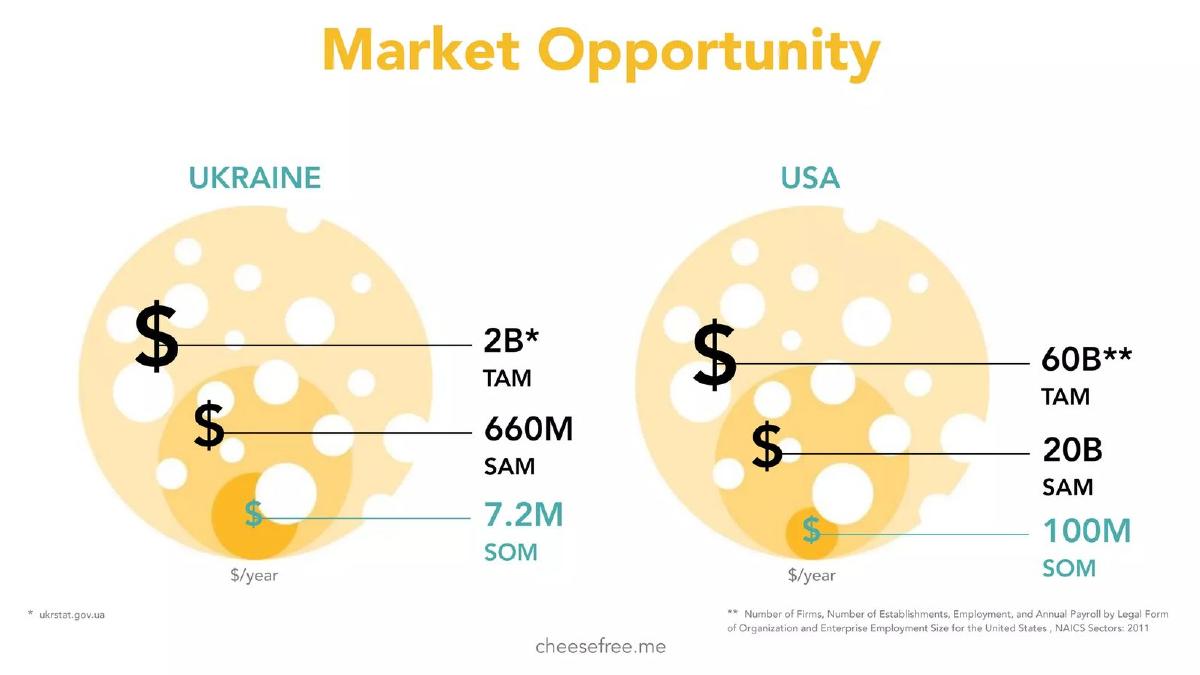
- The market opportunity is segmented by geography, projecting a $7.2M SOM in Ukraine and a $100M SOM in the USA (Slide 5).
- The business model relies on a tiered subscription plan ranging from $25 to $45 per month for businesses (Slide 9).
- The team includes two co-founders and three technical/design leads, with the CTO having 9+ years of development experience (Slide 11).
- The funding ask is split between a $50,000 pre-seed and a $300,000 seed round, with 43% of funds allocated to personnel (Slide 12).
- The product roadmap shows a long development cycle, starting in July 2014 and leading to a full launch in October 2016 (Slide 7).
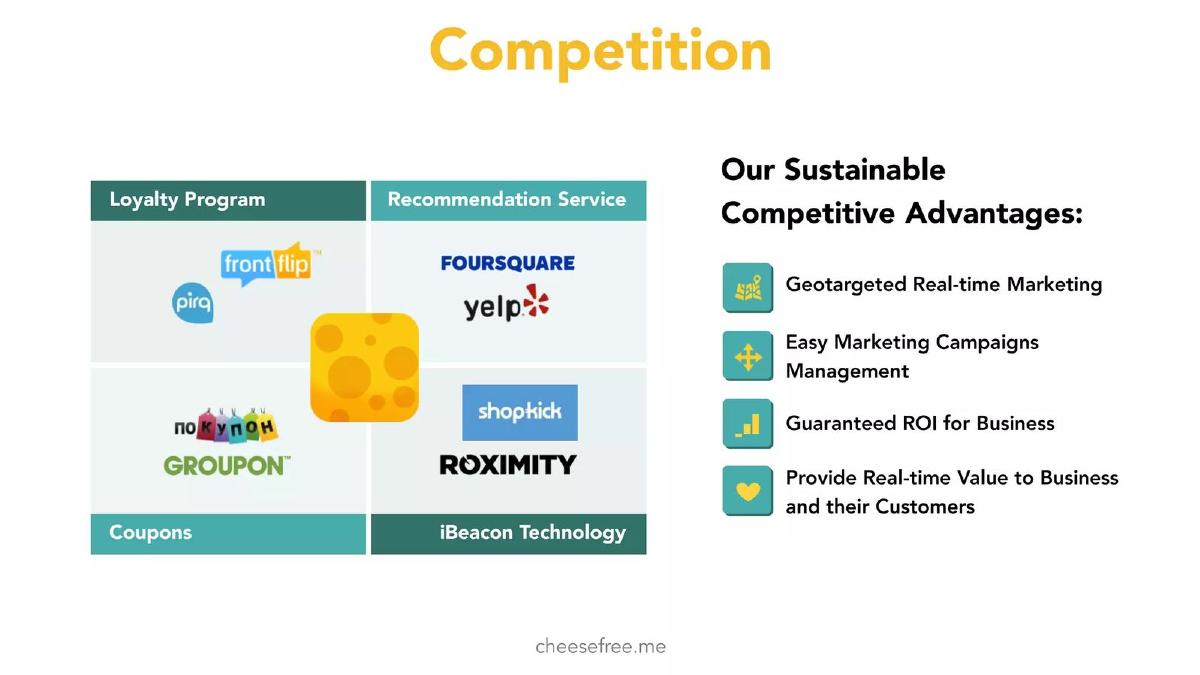
- Competitive advantages are framed around guaranteed ROI and real-time value, differentiating from legacy coupon sites like Groupon (Slide 6).
Cheesefree Pitch Deck Analysis
The Cheesefree pitch deck, dating from 2016, presents a classic hyper-local marketplace solution for a perennial problem in the service industry: perishable inventory. In this case, the 'inventory' is time. Whether it is a restaurant table at 3:00 PM or a gym floor at 10:00 AM, the company seeks to bridge the gap between idle capacity and nearby demand through mobile technology.
Slide 1: Title Slide
The deck opens with a clean, minimalist title slide featuring the Cheesefree logo—a yellow location pin styled to look like a piece of Swiss cheese. The background is a muted teal map, likely of Kyiv, Ukraine, which establishes the company's geographic origins and the location-based nature of the service.
Slide 2: Problem Definition
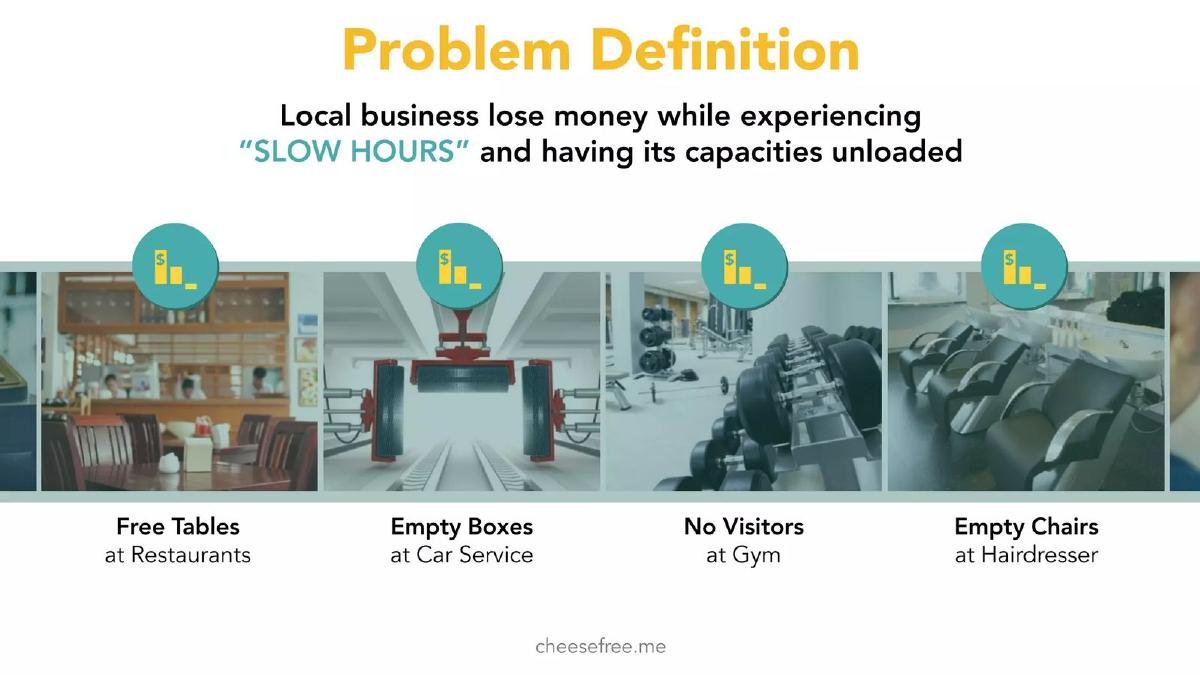
This slide identifies the core pain point: local businesses lose money during "SLOW HOURS." It uses four specific examples to illustrate the problem: free tables at restaurants, empty boxes at car services, no visitors at gyms, and empty chairs at hairdressers. By visualizing these idle assets, the deck successfully communicates the economic waste that the app intends to capture. The phrasing "having its capacities unloaded" is slightly awkward but effectively conveys the message of underutilization.
Slide 3: The Solution
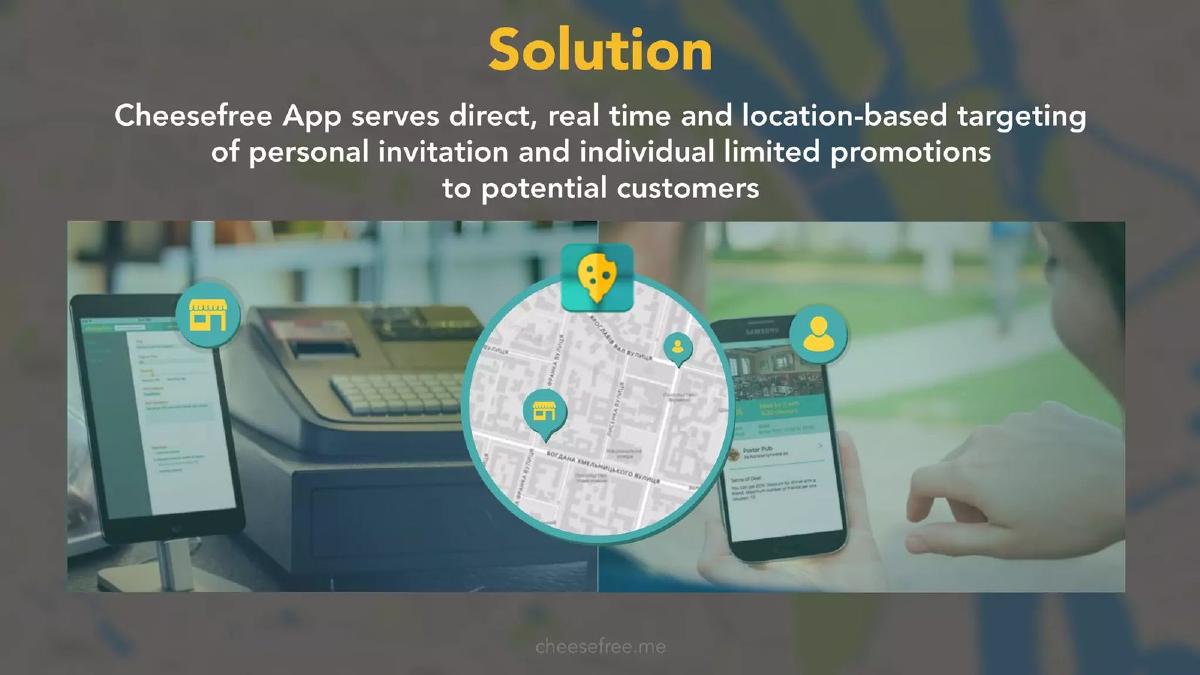
Cheesefree defines its solution as an app that serves "direct, real time and location-based targeting of personal invitation and individual limited promotions." The slide uses a split-screen graphic showing a business owner's tablet (the merchant side) and a customer's smartphone (the user side), with a map in the center showing the proximity between the two. This clearly illustrates the two-sided nature of the marketplace.
Slide 4: Market Opportunity - Current Customers
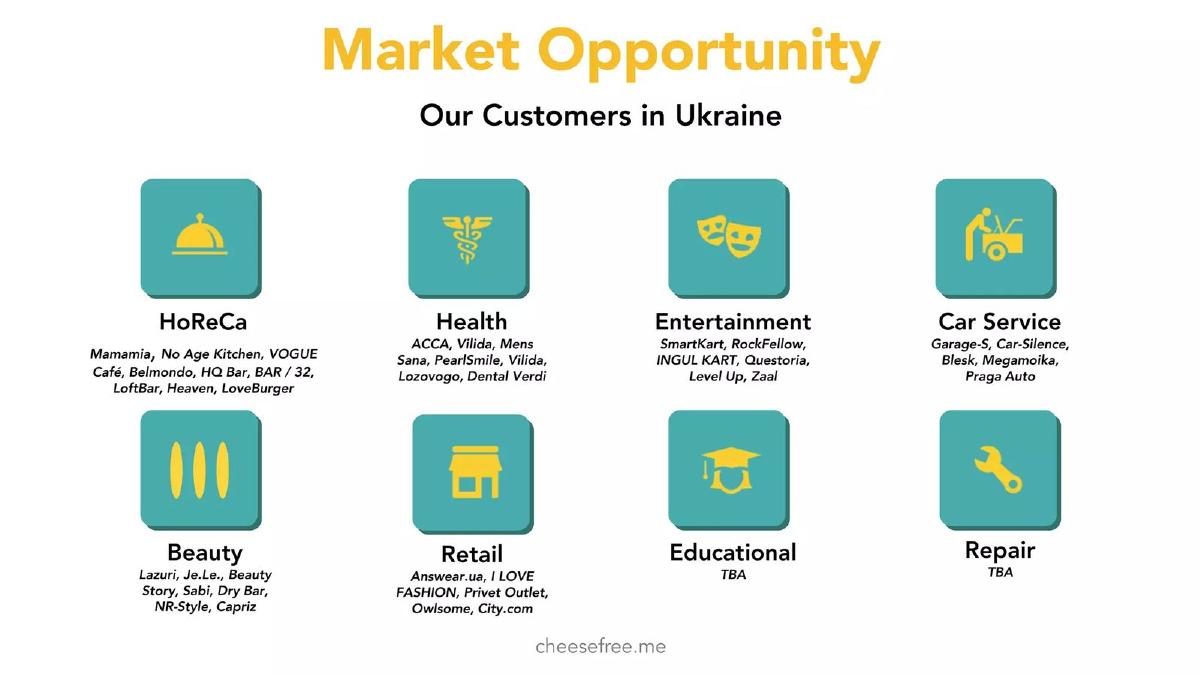
Rather than starting with abstract numbers, slide 4 lists actual customers in Ukraine across several sectors: HoReCa (hotels, restaurants, cafes), Health, Entertainment, Car Service, Beauty, and Retail. Notable names mentioned include Mamamia, VOGUE Café, and SmartKart. This provides immediate social proof and demonstrates that the product has utility across diverse industries. The Educational and Repair categories are marked as "TBA," suggesting future expansion plans.
Slide 5: Market Opportunity - TAM/SAM/SOM
Slide 5 provides the quantitative market sizing. The company compares two markets: Ukraine and the USA. For Ukraine, they cite a TAM of $2B, a SAM of $660M, and a SOM of $7.2M. For the USA, the numbers jump significantly to a $60B TAM, $20B SAM, and $100M SOM. The data for Ukraine is attributed to ukrstat.gov.ua, while the US data is based on NAICS sectors from 2011. The use of cheese-shaped circles for the Venn diagrams is a consistent, if somewhat literal, branding choice.
Slide 6: Competition
The competitive landscape is mapped on a four-quadrant grid. Cheesefree positions itself in the center, overlapping with Loyalty Programs (Front Flip, Pira), Recommendation Services (Foursquare, Yelp), Coupons (Groupon, Pokupon), and iBeacon Technology (Shopkick, Roximity). On the right, they list their "Sustainable Competitive Advantages," which include geotargeted real-time marketing, easy campaign management, and guaranteed ROI for businesses. The claim of "guaranteed ROI" is a bold one that usually requires significant data to back up, which is not fully detailed in the following slides.
Slide 7: Product Roadmap
This slide provides a timeline of the company's development from July 2014 to October 2016. It shows a relatively long gestation period: two years from the initial landing page and co-founder pairing to the full launch. The full launch in October 2016 includes web applications for both customers and users, as well as Android and iOS apps for users. This timeline suggests a methodical approach to building the tech stack before seeking significant scale.
Slide 8: Metrics
The metrics slide is the most critical for assessing current health. The company reports $1,900 in revenue, which is modest but proves the willingness of businesses to pay. Other key figures include 130 customers (merchants), 9,000 users, 670 promotions created, and 3,500 promo codes used. The slide also breaks down push notification engagement: while 1,139 users received a notification once, a small subset (13 users) received notifications 6 to 10 times. This level of transparency regarding user engagement is helpful for investors to see the frequency of use.
Slide 9: Business Model
Cheesefree uses a tiered subscription model. The "Base" plan is $25/month for one deal per day within a 1km radius. The "Optimum" plan is $35/month for two deals per day within a 2km radius. The "Full" plan is $45/month for three deals per day within a 3km radius, plus detailed analytics and customer preferences. This is a straightforward B2B SaaS model that avoids the complexities of taking a percentage of every transaction, which can be difficult to track in offline retail environments.
Slide 10: Milestones
The milestones slide looks forward into 2017. The primary goal is to reach 300 paying customers, 60,000 registered users, and $10,000 in sales. The "Next" phase includes reaching breakeven at the 14th month, achieving full coverage of big Ukrainian cities, and expanding into the EU and US markets. The jump from $10,000 in sales to US expansion is a significant leap that would likely require more than the $300,000 seed round requested later.
Slide 11: The Team
The team slide features five individuals. Sergey Kosyuk (CEO) and Oles Kosyuk (COO) are the founders, with backgrounds in operational management and finance respectively. The technical weight comes from Vadim Grek (CTO), who has 9+ years of experience, and Aleksey Mazurenko (iOS Developer), who claims 50+ apps in the store. Andrey Retinskiy (UX/UI Designer) rounds out the team. The team appears to be heavily weighted toward product and development, which aligns with the roadmap shown on slide 7.
Slide 12: Funding Requirements
The ask is clearly stated: $300,000 for a seed round and $50,000 for a pre-seed round. A donut chart shows the allocation: 43% for Personnel, 33% for Marketing & Sales, 13% for Product Development, and 11% for CapEx. This is a standard allocation for an early-stage software company, though the split between pre-seed and seed is unusual to see in a single slide without clarifying if the pre-seed has already been closed.
Slide 13: Contact Information
The final slide provides a Gmail address, a Ukrainian phone number, and the company website (cheesefree.me). The use of a Gmail address rather than a custom domain email is a minor point but can sometimes be seen as less professional in high-stakes fundraising environments.
What Cheesefree Does Well
The deck is exceptionally clear about the problem it is solving. By using specific examples like "empty chairs at hairdressers," the founders move away from abstract tech-speak and into the real-world economic pain felt by small business owners. The B2B subscription model is also well-defined and easy to understand, avoiding the friction of transaction-based fees which are notoriously hard to audit in local retail.
Furthermore, the inclusion of a list of actual customers in Ukraine (Slide 4) provides much-needed validation. Seeing that they have already onboarded restaurants, gyms, and car services across multiple categories proves that the value proposition isn't limited to just one niche.
What is Missing from the Deck
The most glaring omission is a detailed breakdown of Unit Economics. While we see the subscription prices ($25-$45), we don't see the Customer Acquisition Cost (CAC) for the businesses or the Lifetime Value (LTV). Given that the revenue is only $1,900 with 130 customers, the math suggests that many of these customers might be on free trials or very early in their subscription cycles.
Additionally, the "Guaranteed ROI" claim on Slide 6 is never explained. For a business owner, a guarantee is a powerful selling point, but for an investor, it represents a potential liability or an unsubstantiated marketing claim. The deck would benefit from a case study showing exactly how a specific merchant saw a return on their $35/month investment.
Finally, the strategy for US expansion is very thin. Moving from the Ukrainian market to the US market involves massive differences in consumer behavior, competition, and marketing costs. A $300,000 seed round is unlikely to be sufficient for a meaningful US market entry, and the deck does not explain how they will navigate this transition.
Lessons for Founders
1. Use Concrete Examples for Problem Statements: Cheesefree's use of "empty boxes at car service" and "free tables at restaurants" is a masterclass in making a problem feel tangible. Founders should always look for the physical manifestation of the problem they are solving.
2. Transparency in Engagement Metrics: Slide 8's breakdown of how many times users received notifications is excellent. It shows the difference between a one-time user and a power user. Investors appreciate this level of honesty over vanity metrics like "total downloads."
3. Align Branding with Content: The cheese theme is carried throughout the deck without being distracting. The Swiss cheese location pin and the cheese-shaped market circles create a cohesive visual identity that makes the deck memorable.
4. Be Realistic About Expansion: If you are planning to move from a smaller market (like Ukraine) to a major global market (like the USA), you must dedicate more than a bullet point to it. Investors will want to know why your success in one region will translate to another, especially when the competitive landscape is vastly different.
5. Professionalize Your Contact Info: While it seems small, using a company domain for your email (e.g., sergey@cheesefree.me) instead of a Gmail address adds a layer of perceived legitimacy to the operation. Regardless of the stage, these small details contribute to the overall impression of the brand's maturity.
Frequently asked questions
- What is the primary problem Cheesefree is trying to solve?
- Cheesefree addresses the issue of 'slow hours' for local businesses. According to slide 2, businesses like restaurants, car services, gyms, and hairdressers lose money when their capacities are unloaded (e.g., free tables or empty chairs). The app aims to fill these gaps by sending real-time, location-based invitations to potential customers who are currently in the immediate vicinity.
- How does Cheesefree make money?
- The company utilizes a B2B subscription model. Slide 9 details three tiers: Base ($25/month), Optimum ($35/month), and Full ($45/month). The tiers are differentiated by the frequency of deal delivery (1 to 3 per day), the delivery radius (1km to 3km), and the depth of analytics provided to the business owner through their dashboard.
- What is the company's current traction?
- As of slide 8, Cheesefree had generated $1,900 in revenue. Their user base consisted of 130 business customers and 9,000 individual users. They had delivered 240,000 push notifications and facilitated the use of 3,500 promo codes. The slide also notes a Monthly Active User (MAU) count of approximately 2,000, representing 25-30% of their total audience.
- Who are the key members of the Cheesefree team?
- The team is led by Sergey Kosyuk (CEO/Founder) and Oles Kosyuk (COO/Founder). Technical leadership is provided by Vadim Grek (CTO), who has over 9 years of experience in PHP, Javascript, and Python. The team also includes Aleksey Mazurenko as the iOS Developer and Andrey Retinskiy as the UX/UI Designer, who was a finalist in a Badoo design contest (Slide 11).
- What are the funding requirements and how will the money be spent?
- Cheesefree is seeking a $300,000 seed round and a $50,000 pre-seed round. Slide 12 breaks down the allocation: 43% for Personnel, 33% for Marketing & Sales, 13% for Product Development, and 11% for CapEx. Their milestone slide (Slide 10) indicates they aim to reach breakeven by the 14th month following this investment.