The Chatter Research deck is a masterclass in visual storytelling and restraint. Rather than overwhelming investors with technical specifications of their AI-powered conversation engine, the founders focused on the visceral pain of the 'receipt survey' and the massive efficiency gains of real-time mobile engagement. With a lean 17 slides, the deck moves from a clear problem—the friction-filled legacy survey process—to a compelling solution that boasts a 90% engagement rate. The inclusion of high-tier enterprise logos like Chase and McDonald's, paired with a founder who has a $100M exit under…
Key takeaways
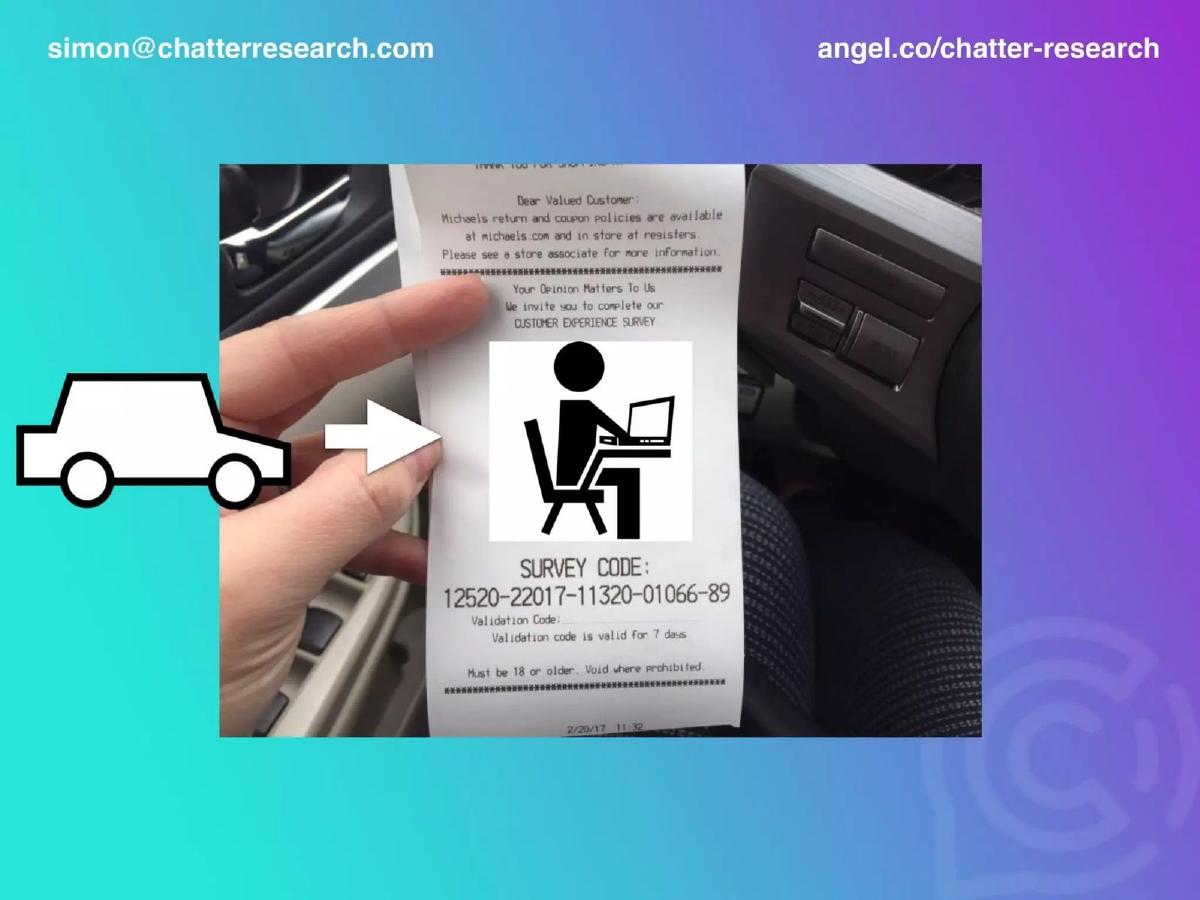
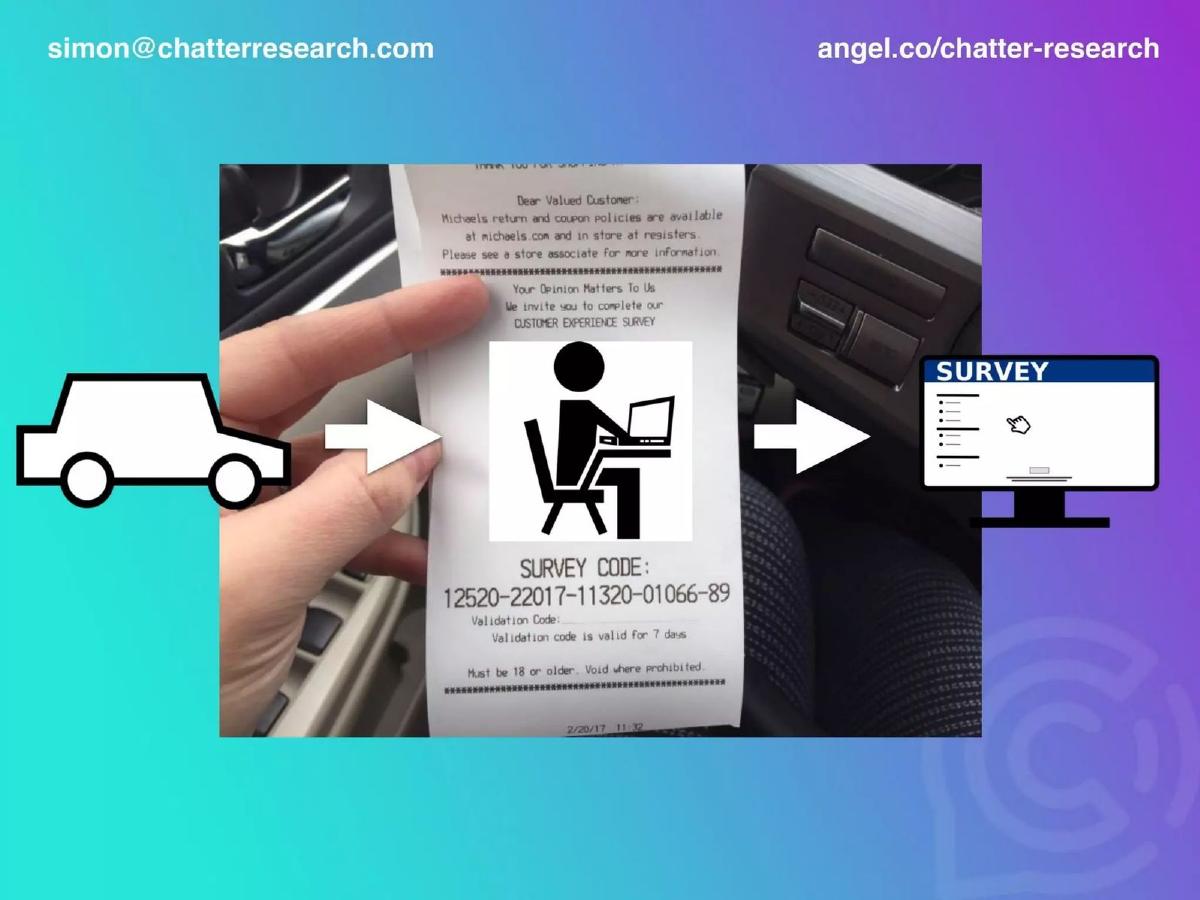
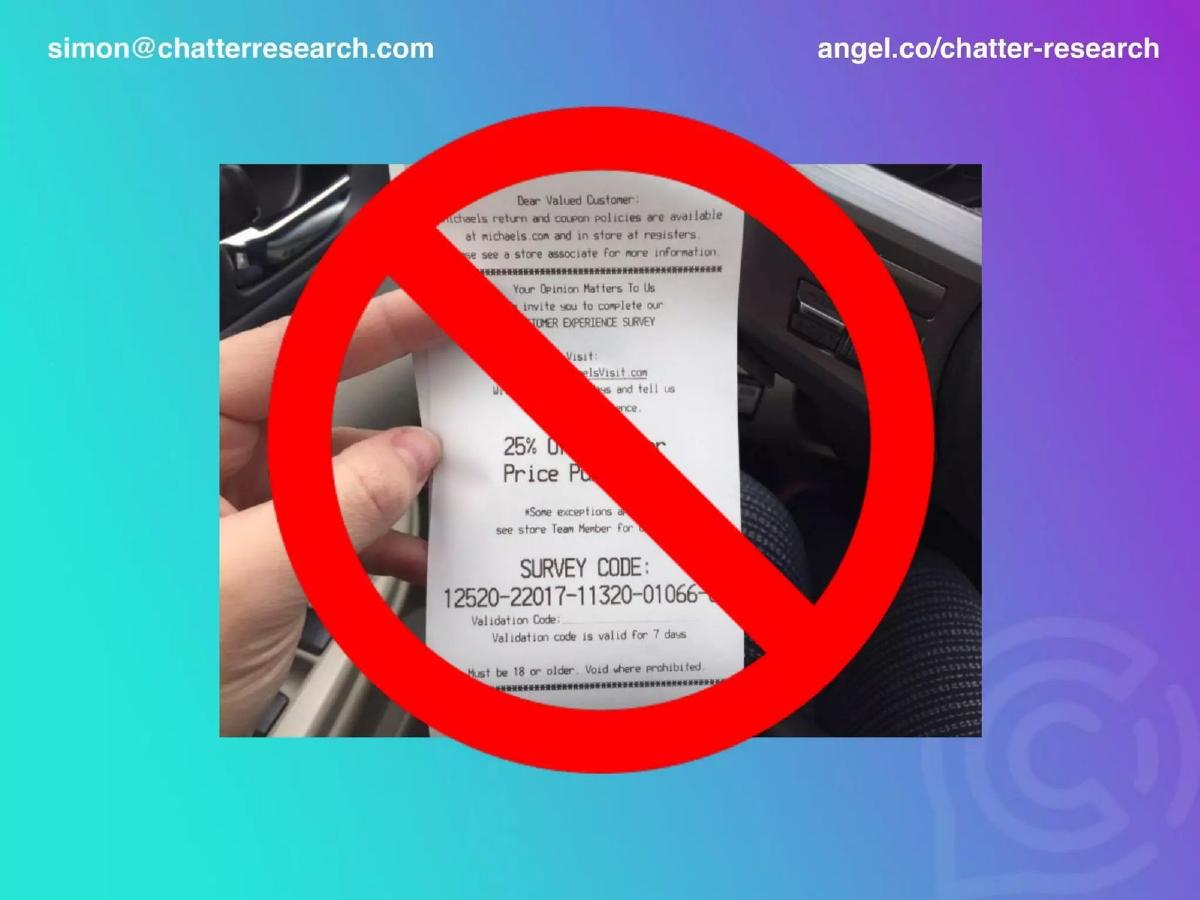
- The deck uses a five-slide sequence (Slides 2-6) to visually demonstrate the friction of traditional receipt-based surveys without using a single word of body text.
- Chatter identifies a massive $44B annual spend on Customer Intelligence on Slide 7, establishing a high-ceiling market opportunity.
- A 90% engagement rate is highlighted on Slide 10, contrasting sharply with traditional low-response methods.
- The '1 Month to 1 Minute' metric on Slide 11 serves as the deck's primary value proposition for enterprise speed.
- Slide 13 showcases an impressive roster of Enterprise SaaS customers including Chase, McDonald's, RBC, and LUSH.
- The deck provides a clear path to revenue on Slide 14, showing how 50 units at $22k can scale to $2,160,000 in ARR through 'Pilot Success'.
- Founder Simon Foster's previous $100M exit and $200M revenue track record (Slide 15) significantly de-risks the investment.
- The deck is backed by notable institutional investors including Relay Ventures, Manulife, and BDC (Slide 16).
The Power of Visual Minimalism
The Chatter Research pitch deck from 2016 is a notable example of 'show, don't tell.' In an era where many SaaS decks are cluttered with feature lists and complex architecture diagrams, Chatter opted for a narrative-driven approach that focuses almost entirely on the user experience and the resulting business value. By the time an investor reaches the halfway point of the deck, they have a visceral understanding of the problem without having read more than twenty words of body copy.
The Problem: The Friction of the Receipt Survey
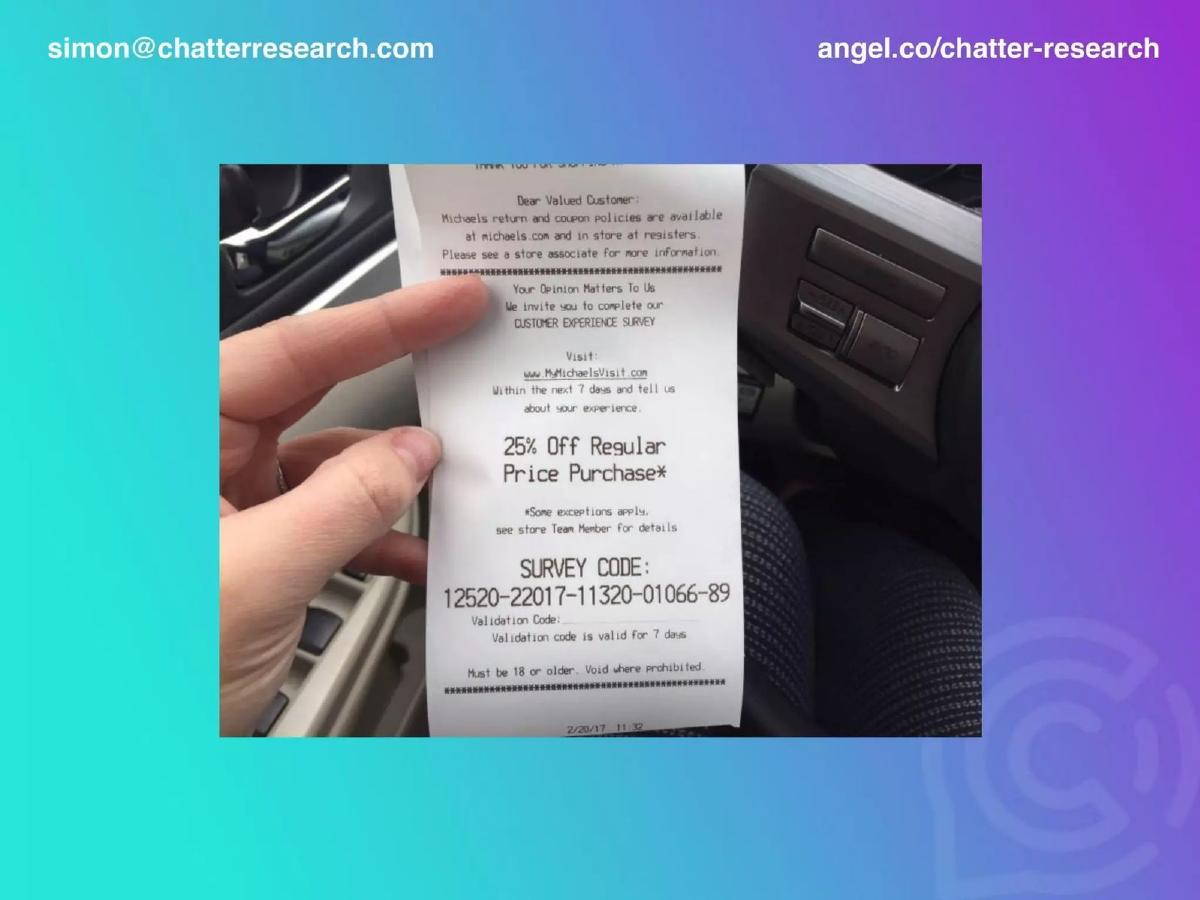
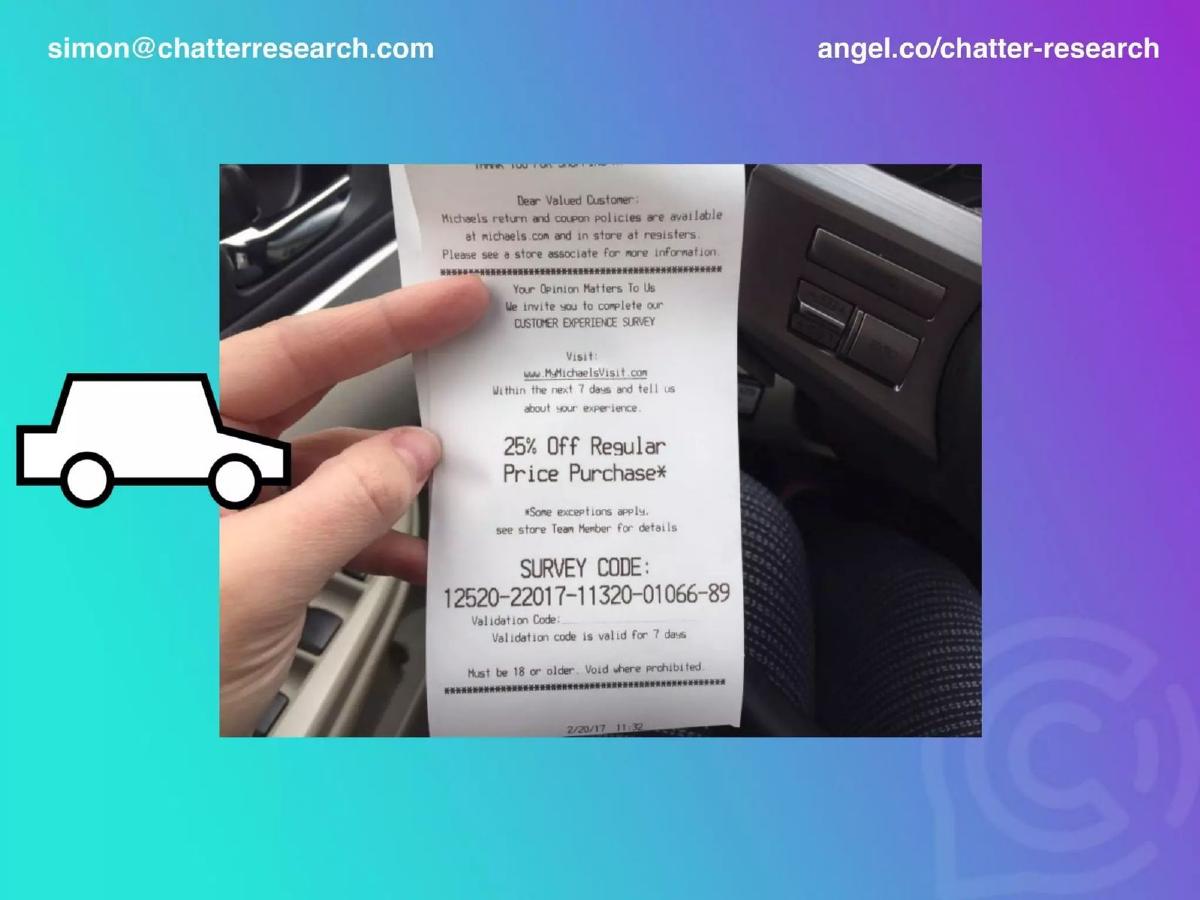
Slides 2 through 6 function as a wordless storyboard. Slide 2 shows a photo of a standard retail receipt from Michaels, highlighting a 'Survey Code' that is 22 digits long. Slides 3, 4, and 5 use simple icons to depict the arduous journey a customer must take: driving home, sitting at a computer, and manually navigating to a website to enter that code. Slide 6 places a large red 'prohibited' sign over the receipt, effectively killing the old way of doing things. This sequence is highly effective because it taps into a universal frustration that every investor has experienced personally.
Market Opportunity and the Solution
Slide 7 introduces the scale of the opportunity: a $44B annual spend on Customer Intelligence. This provides the 'Why Now' and 'Why This' context. Immediately following this, Slide 8 introduces the solution with the headline 'Engage in a Conversation.' It shows a mobile interface that looks like a standard SMS or chat app, making the feedback process feel natural rather than clinical.
Slides 9, 10, and 11 provide the 'magic numbers' that justify the shift to Chatter. Slide 9 uses an '8X' icon to suggest a massive increase in volume. Slide 10 highlights a 90% engagement rate—a figure that would be unheard of in traditional email or receipt-based surveys. Slide 11 delivers the knockout punch: '1 Month to 1 Minute.' This slide perfectly encapsulates the transition from batch-processed, delayed data to real-time, actionable insights.
Enterprise Validation and Business Model
Slide 12 uses a simple 'Customer Experience Kings' headline to transition into the traction section. Slide 13 is perhaps the most important slide for a 'Later' stage deck (as categorized in the catalogue). It displays the logos of Chase, McDonald's, RBC, LUSH, and others. For a startup in the retail/hospitality space, having both a global bank and the world's largest fast-food chain as customers is a massive signal of product-market fit.
Slide 14 addresses the 'Unit Economics' and scalability. It shows a small circle representing 50 units (likely individual store locations or a pilot phase) generating $22,000, which then scales into a large circle representing 'Pilot Success' at $2,160,000 ARR. This slide is crucial because it shows investors exactly how a small foot-in-the-door pilot with a company like McDonald's can explode into a multi-million dollar contract once rolled out across all locations.
The Team and Backers
Slide 15 introduces the team. The pedigree here is high: Simon Foster is credited with a $100M exit and $200M in revenue. In the world of fundraising, a founder who has already 'returned the fund' for previous investors is the ultimate de-risking factor. Wesley Nelson and Greg MacCharles round out the technical and domain expertise, with MacCharles bringing specific experience from blue-chip brands like Ford and Home Depot.
Slide 16 lists the institutional backing: Relay Ventures, Manulife, and BDC. This confirms that Chatter is not just a bootstrapped project but a venture-backed entity with professional oversight. The deck then ends on Slide 17 with the logo and the 'Customer Experience Kings' crown icon again.
What Works in the Chatter Research Deck
The most successful element of this deck is its pacing . The first six slides move very quickly, building a sense of momentum. By the time the viewer gets to the data-heavy slides (9-11), they are already convinced that the current system is broken. Another strength is the focus on outcomes . Chatter doesn't explain how their AI works or what their tech stack looks like; they focus entirely on the fact that they get 90% engagement and turn a month-long process into a one-minute process. This is what enterprise buyers and investors actually care about.
What is Missing from the Chatter Research Deck
While the deck is visually compelling, it leaves several critical questions unanswered for a formal due diligence process:
The Ask: There is no slide indicating how much money is being raised or what the milestones for the next 18 months are. · Competition: The deck ignores the competitive landscape. While it shows why they are better than 'paper receipts,' it doesn't explain how they differ from other digital feedback tools like Medallia or Qualtrics. · Product Depth: We see a chat interface, but we don't see the 'AI-powered' backend mentioned in the company description. Investors might want to see the dashboard where retailers actually view and act on this real-time data. · Financials: Beyond the ARR projection on Slide 14, there is no mention of burn rate, margins, or historical revenue growth.
What a Founder Should Copy
Founders should emulate the visual storytelling used in the problem section. If your product solves a process-heavy or friction-filled problem, use icons and photos to show the 'before' state rather than bullet points. Additionally, the 'Pilot to ARR' visualization on Slide 14 is a brilliant way to show the path to $100M+ revenue without needing a complex spreadsheet. It clearly communicates the 'land and expand' strategy that is central to Enterprise SaaS success. Finally, keep the text to a minimum . This deck is designed to be presented, not just read, which forces the audience to listen to the founder's narrative rather than getting lost in slide copy.
Frequently asked questions
- What is the primary problem Chatter Research is solving?
- Chatter Research targets the inefficiency and friction of traditional retail customer feedback. As shown in Slides 2 through 6, legacy systems rely on long survey codes printed on paper receipts that require customers to manually enter URLs and codes at home. This leads to low response rates and delayed data. Chatter replaces this with real-time, AI-powered mobile conversations that happen immediately after the shopping experience.
- How does Chatter Research prove its market traction?
- The deck uses two primary methods to prove traction: logos and conversion metrics. Slide 13 lists major enterprise clients like McDonald's, Chase, and LUSH. Slide 14 then translates this into financial potential, showing that a successful pilot transition can lead to over $2.1M in ARR. This demonstrates that the product is already being tested and valued by top-tier global brands.
- What are the key performance indicators (KPIs) mentioned in the deck?
- The deck focuses on three main KPIs: engagement, speed, and scale. Slide 10 claims a 90% engagement rate for their conversational interface. Slide 11 highlights the reduction in feedback loops from '1 Month' to '1 Minute.' Finally, Slide 9 mentions an '8X' improvement, presumably in response volume or efficiency compared to traditional methods.
- Is there a clear investment ask in this pitch deck?
- No. The 17-slide deck concludes with a 'Backed by' slide and a closing logo slide. It does not specify the amount of capital being raised, the valuation, or the intended use of funds. This suggests the deck may have been used as a high-level teaser or a presentation for a demo day where the specific terms were discussed in person.
- Who are the founders and what is their background?
- The team slide (Slide 15) features three key members: Simon Foster (CEO & Founder), who has a history of a $100M exit; Wesley Nelson (CTO), with experience in four startups and real-time data; and Greg MacCharles (Head of Research), who previously provided consumer insights for Home Depot, Ford, and Mazda. This combination of exit experience, technical depth, and industry-specific research expertise is a strong selling point.