Chatterbot’s 10-slide deck is a textbook example of a 'market-first' pitch that fails to establish company-specific credibility. The presentation relies almost entirely on third-party research from McKinsey, BI Intelligence, and Technavio to justify its existence, rather than showcasing unique IP or user growth. While it clearly outlines a tiered SaaS pricing model ranging from $0 to $50 per month, it omits a team slide, a specific funding ask, and any evidence of current traction. The deck positions the product as a low-cost, convenient alternative to enterprise giants like Alexa and Siri, y…
Key takeaways
- The deck relies on external data to project a $62.5M revenue capture by 2025 based on a 5% market share assumption (Slide 7).
- Chatterbot utilizes a standard SaaS tiered pricing model with four levels: Free, Basic ($10/mo), Premium ($30/mo), and Business ($50/mo) (Slide 7).
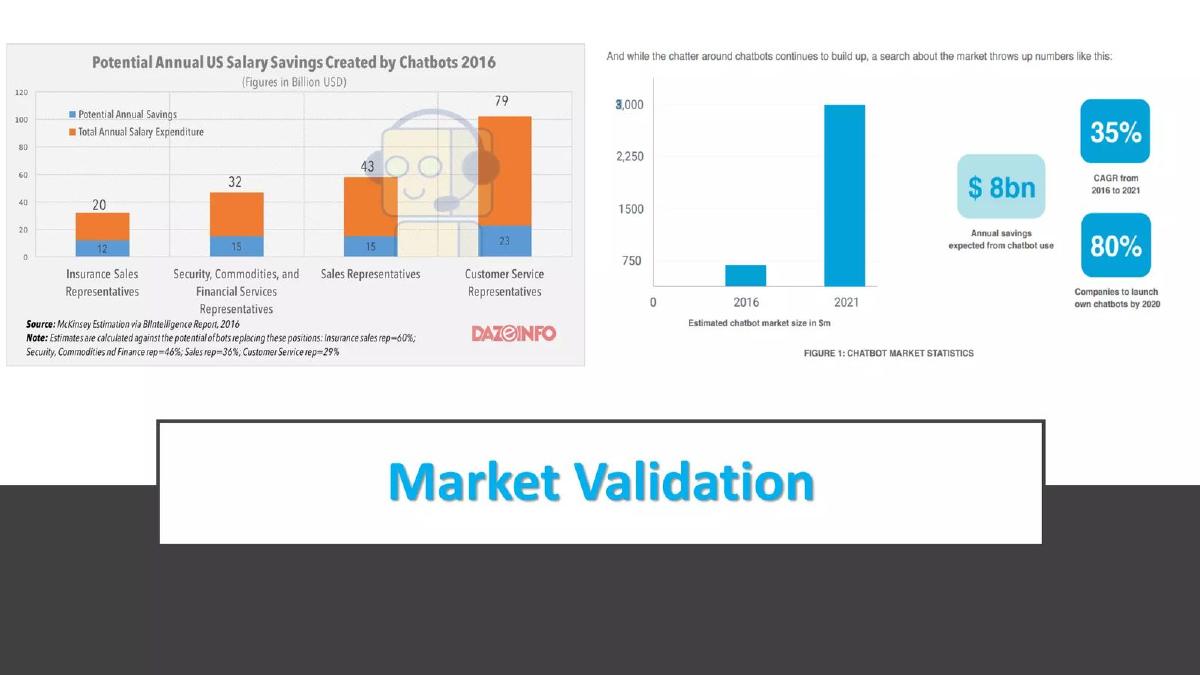
- Market validation is built on 2016-era data, citing potential annual US salary savings of $79 billion in customer service (Slide 4).
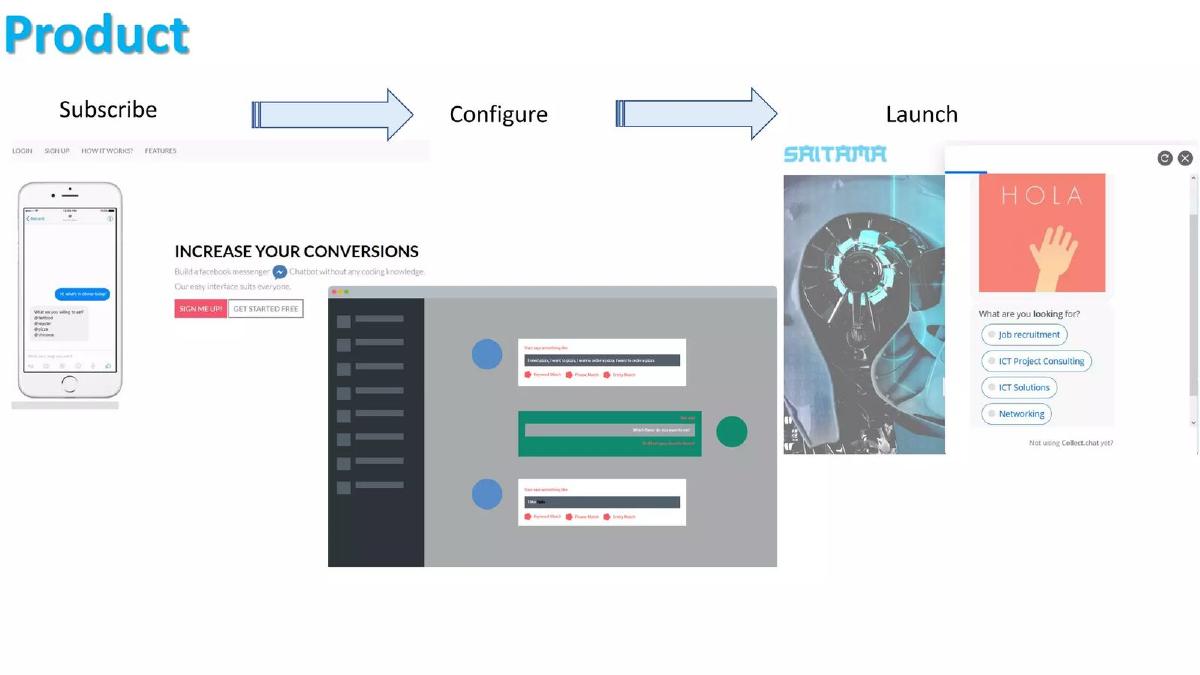
- The product workflow is simplified into three stages: Subscribe, Configure, and Launch, emphasizing a no-code interface (Slide 6).
- The competitive landscape is mapped on a convenience vs. expense axis, positioning Chatterbot as more convenient and less expensive than Siri or Alexa (Slide 9).
- There is a total absence of a team slide, meaning the founders' backgrounds and technical capabilities are never disclosed.
- The deck lacks a specific 'Ask' slide, leaving potential investors without a target funding amount or use-of-funds breakdown.
- Strategic adoption plans involve deploying on top of existing channels like Slack, Telegram, and Office 365 (Slide 8).
Chatterbot Pitch Deck: A Deep Dive into Market-Driven Narratives
The Chatterbot pitch deck is a 10-slide presentation that prioritizes market opportunity over operational reality. It is a product of its time, likely created around 2016 or 2017, given the heavy reliance on data from that period. The deck follows a traditional structure—Problem, Solution, Market, Product, Business Model, and Competition—but it falters by omitting the human element (the team) and the financial requirement (the ask).
Slide 1: Title Slide
The deck opens with a simple title slide featuring the brand name 'CHATTERBOT' and the tagline 'Improve your customer experiences.' The visual identity is established with a blue robot icon inside a speech bubble and a soundwave graphic. It is a functional, if generic, introduction to the company's focus area.
Slide 2: Problem Statement
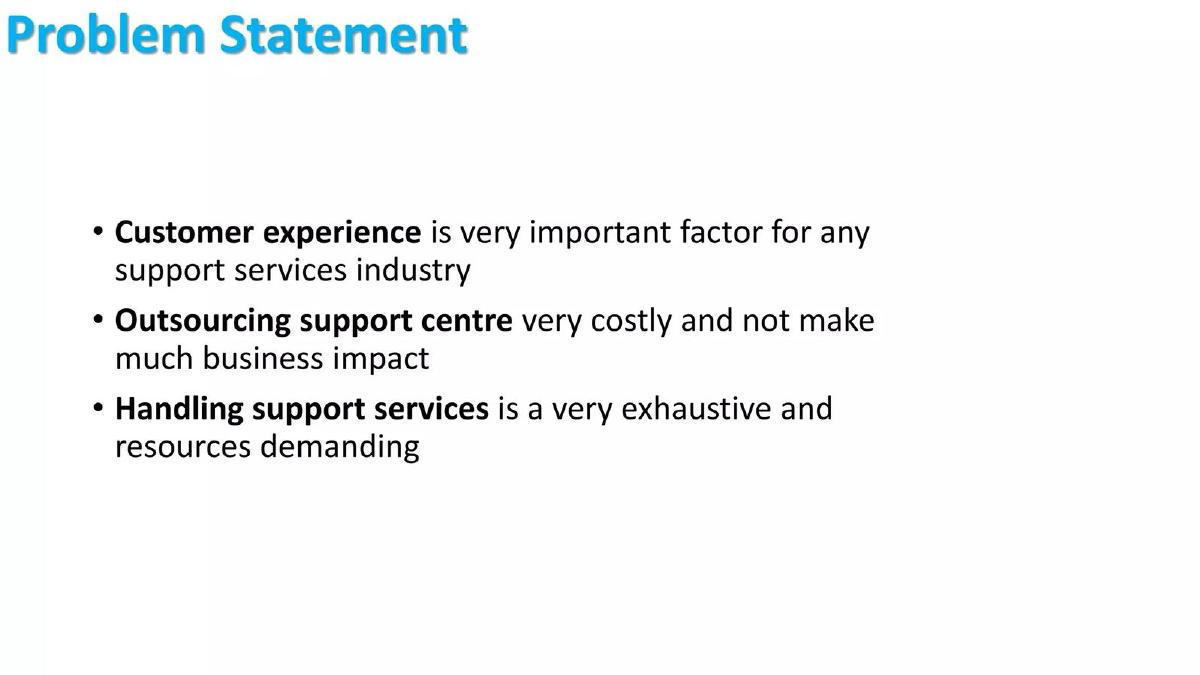
The problem is framed through three bullet points. First, it asserts that customer experience is vital for support industries. Second, it claims that outsourcing support centers is 'very costly' and fails to make a significant 'business impact.' Third, it notes that handling support services internally is 'exhaustive and resources demanding.' This slide identifies a clear pain point—cost and complexity—but lacks specific data points to quantify these losses for a typical customer.
Slide 3: Solution
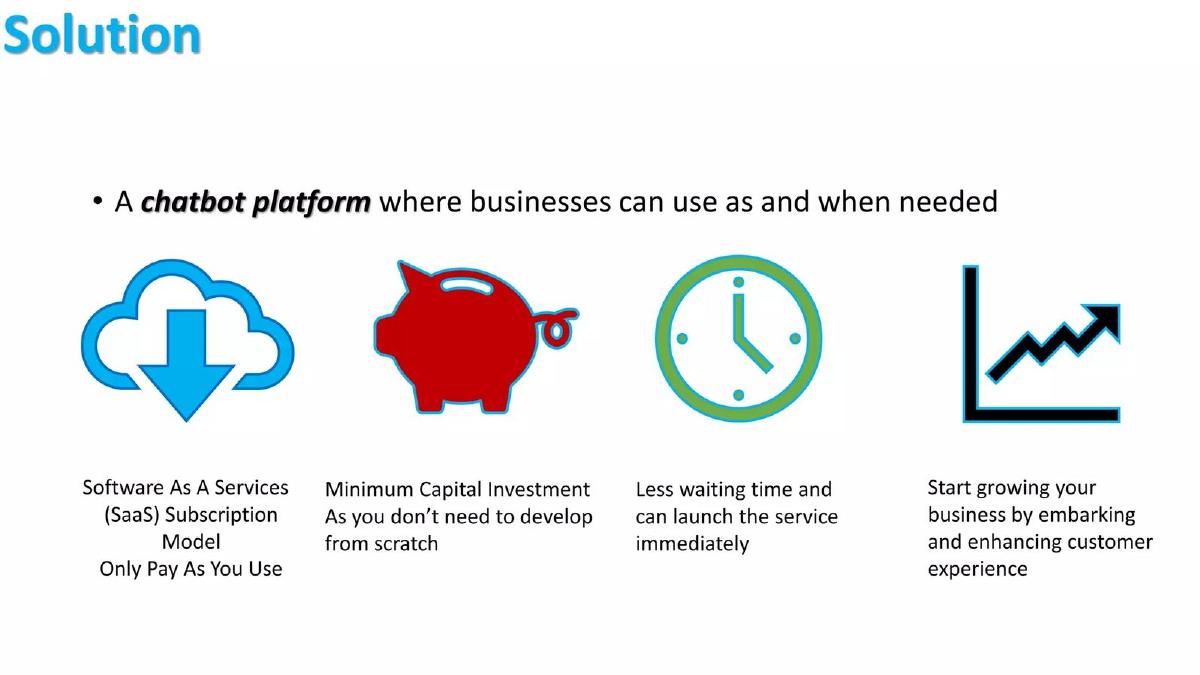
The solution is defined as a 'chatbot platform where businesses can use as and when needed.' The slide highlights four benefits: a SaaS subscription model (Pay As You Use), minimum capital investment (no need to develop from scratch), immediate launch capabilities, and business growth through enhanced customer experience. This slide effectively counters the problems listed on the previous slide by emphasizing speed and cost-efficiency.
Slide 4: Market Validation
This slide is a collage of external research. It cites a McKinsey estimation via a 2016 BI Intelligence Report, claiming that chatbots could create $79 billion in annual US salary savings for customer service representatives. It also includes a chart showing the chatbot market size growing from roughly $750 million in 2016 to over $3,000 million by 2021. While the numbers are impressive, they validate the industry rather than Chatterbot’s specific approach.
Slide 5: Market Size
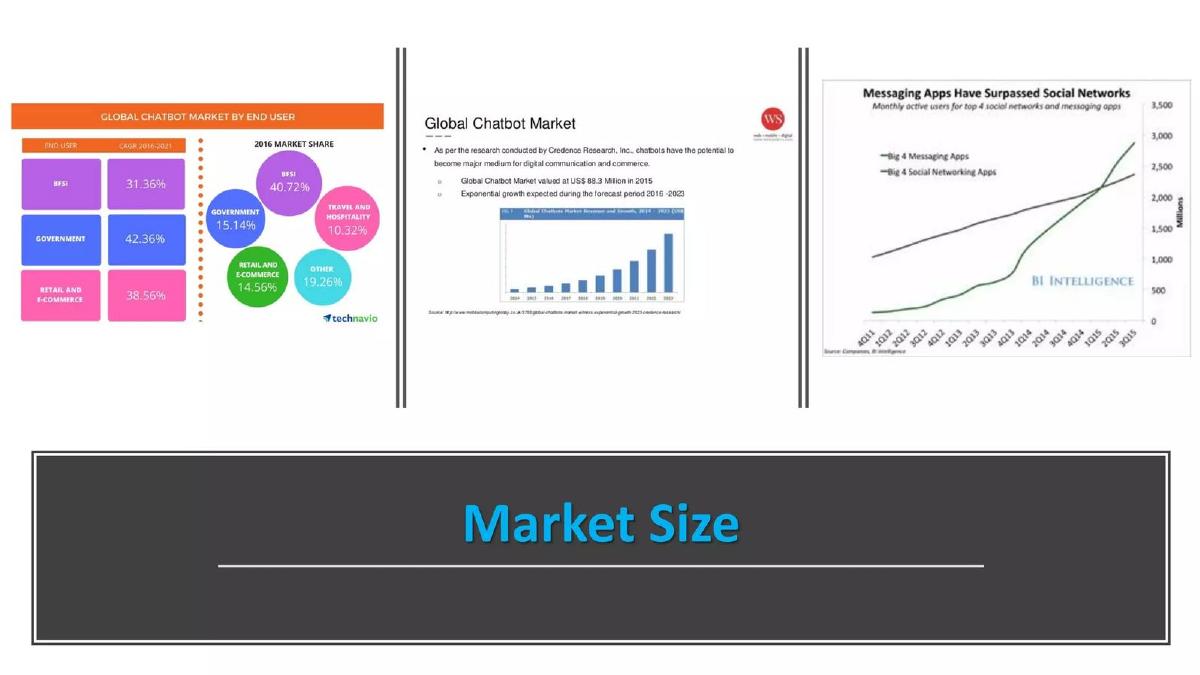
Continuing the reliance on third-party data, Slide 5 uses charts from Technavio and Credence Research. It breaks down the market by end-user, showing that BFSI (Banking, Financial Services, and Insurance) holds a 40.72% market share, followed by Retail and E-commerce at 14.56%. Another chart shows messaging apps surpassing social networks in monthly active users. This slide successfully identifies where the customers are, but again, it provides no information on Chatterbot's current penetration into these sectors.
Slide 6: Product
The product slide uses a 'Subscribe -> Configure -> Launch' flow. It features screenshots of a mobile interface, a web-based configuration dashboard, and a live chat widget. The dashboard shows options for 'Keyword Match,' 'Phrase Match,' and 'Entity Match,' suggesting a rules-based or NLP-lite approach to bot building. The visual evidence suggests a functional MVP (Minimum Viable Product), but there are no details on the underlying technology stack.
Slide 7: Business Model
This is one of the most concrete slides in the deck. It presents a clear pricing table: Free ($0), Basic ($10/mo), Premium ($30/mo), and Business ($50/mo). Below the pricing, the company projects capturing 5% of a $1.25 billion market growth by 2025, resulting in an estimated revenue capture of $62.5 million. The 5% market share assumption is a common 'bottom-up' forecasting trope that often draws skepticism from investors without a clear customer acquisition strategy to back it up.
Slide 8: Market Adoption
This slide outlines the distribution strategy. Chatterbot intends to 'Leverage and Deploy On top of Existing Messaging Channels' like Slack and Facebook Messenger. It also lists 'Technology Enablers' like IBM Watson and Shopify. It is unclear if these are active partnerships or merely platforms the software is compatible with. In the context of a pitch deck, listing logos without context often implies a deeper relationship than may actually exist.
Slide 9: Competition
The competition is mapped on a standard 2x2 matrix. Chatterbot positions itself in the 'more convenient' and 'less expensive' quadrant. It places high-end voice assistants like Siri, Alexa, and Cortana in the 'more expensive' and 'less convenient' (or 'more expensive' and 'more convenient') categories. Direct competitors like Botsify and KeyReply are shown as similar in convenience but slightly more expensive. This is a subjective mapping that lacks a feature-by-feature comparison.
Slide 10: Competitive Advantages
The final slide lists six advantages: easy deployment, easy to customize, easy to train bot, less hardcoding, can be rapidly trained, and API integration. These are standard claims for a no-code platform. The phrase 'less hardcoding' is the most specific technical claim, but the deck ends here without explaining how their engine achieves this or what the 'rapid training' looks like in practice.
What Works in This Deck
Clear Pricing: The inclusion of a specific tiered pricing model (Slide 7) removes ambiguity about how the company intends to make money. · Market Context: The deck does an excellent job of proving that the chatbot market is large and growing, using reputable sources like McKinsey and Technavio. · Simplicity: The product workflow (Subscribe, Configure, Launch) is easy to understand for non-technical investors.
What Is Missing
The Team: There is no mention of who is building this. In early-stage fundraising, the team is often more important than the product. The absence of founder bios is a significant red flag. · The Ask: The deck does not state how much money the company is looking to raise, what the valuation is, or how the funds will be spent. · Traction Metrics: There are no numbers regarding current users, churn, customer acquisition cost (CAC), or even a list of current pilot programs. · Technical Moat: While the deck claims 'less hardcoding,' it doesn't explain if they have proprietary NLP (Natural Language Processing) algorithms or if they are simply a wrapper for third-party APIs like IBM Watson.
What a Founder Should Copy
Visualizing the Workflow: The three-step process on Slide 6 is a great way to demystify a technical product for a general audience. · Segmenting the Market: Using the Technavio data on Slide 5 to show which industries (BFSI, Retail) are the biggest spenders helps focus the sales narrative. · Competitive Axis: Using 'Convenience' vs. 'Expense' is a smart way to frame the conversation if you are building a low-cost alternative to enterprise solutions.
Frequently asked questions
- What is Chatterbot's primary value proposition?
- According to Slide 3, Chatterbot offers a 'Software As A Service (SaaS) Subscription Model' that requires 'Minimum Capital Investment' because businesses do not need to develop bots from scratch. The focus is on reducing the high costs and resource demands of traditional outsourced support centers, as highlighted in the problem statement on Slide 2.
- How does the company plan to generate revenue?
- Chatterbot outlines a clear four-tier subscription model on Slide 7. This includes a Free tier, a Basic tier at $10 per month, a Premium tier at $30 per month, and a Business tier at $50 per month. The company aims to capture 5% of a projected $1.25 billion market growth by 2025.
- Which platforms does Chatterbot integrate with?
- Slide 8, titled 'Market Adoption,' shows logos for several major messaging and productivity platforms. These include Facebook Messenger, Telegram, Kik, Skype, Office 365, and Slack. It also mentions partnering with 'Technology Enablers' such as IBM Watson, Shopify, Nuance, Botsify, and Pandorabots.
- What are the claimed technical advantages of the platform?
- Slide 10 lists six competitive advantages: easy deployment, easy customization, easy bot training, 'less hardcoding,' rapid training capabilities, and API integration. However, the deck does not provide technical documentation or architectural diagrams to explain how these advantages are realized compared to competitors.
- Is there any evidence of existing customers or traction in the deck?
- No. The deck is entirely forward-looking and theoretical. It uses screenshots of what appear to be a generic interface and a Facebook Messenger bot (Slide 6), but it does not list current user counts, monthly recurring revenue (MRR), or case studies from active clients.