Olist’s 2015 pitch deck is a rare example of 'less is more.' Spanning only eight slides, the deck eschews traditional long-form explanations of market pain points or technical architecture in favor of raw traction data. At the time of this deck, Olist was reporting a $6 million GMV run rate and a staggering 19% week-over-week growth rate sustained over 12 months. The company positioned itself as the 'World’s distribution plugin,' connecting merchants to major marketplaces like Walmart and Mercado Livre. This teardown examines how Olist leveraged high-velocity growth metrics and a simple two-p…
Key takeaways
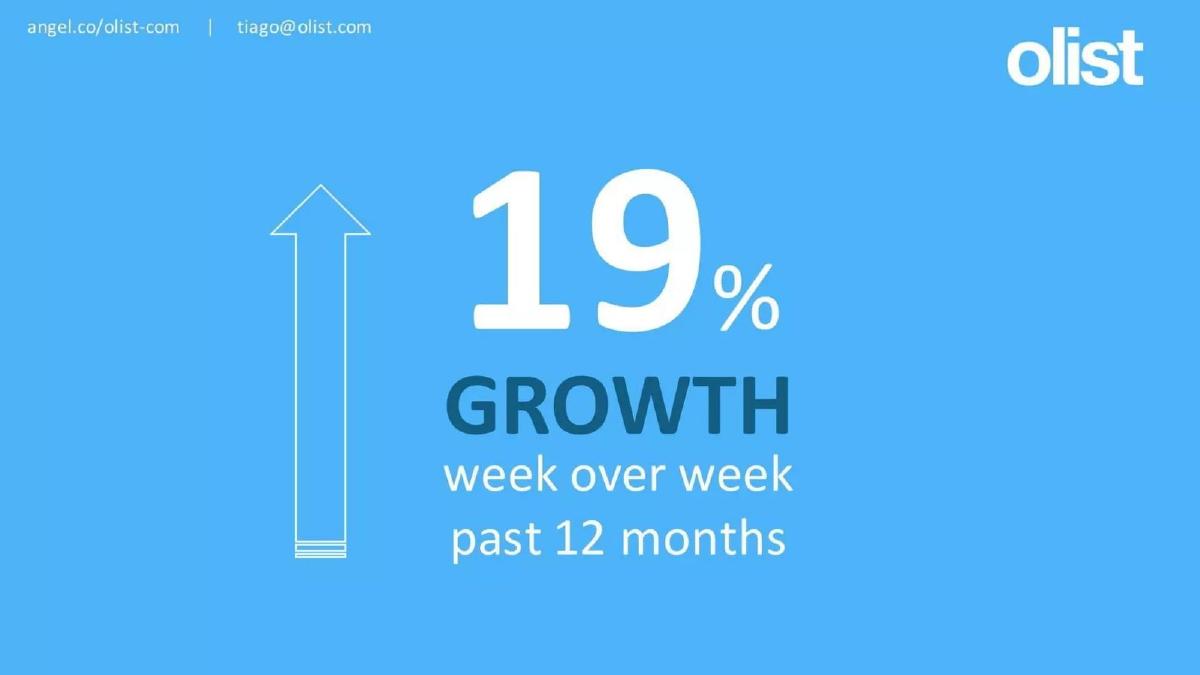
- The deck leads with a 19% week-over-week growth rate sustained over the past 12 months on slide 2.
- Olist achieved a $6 million Gross Merchandise Volume (GMV) run rate at the time of the pitch, as shown on slide 3.
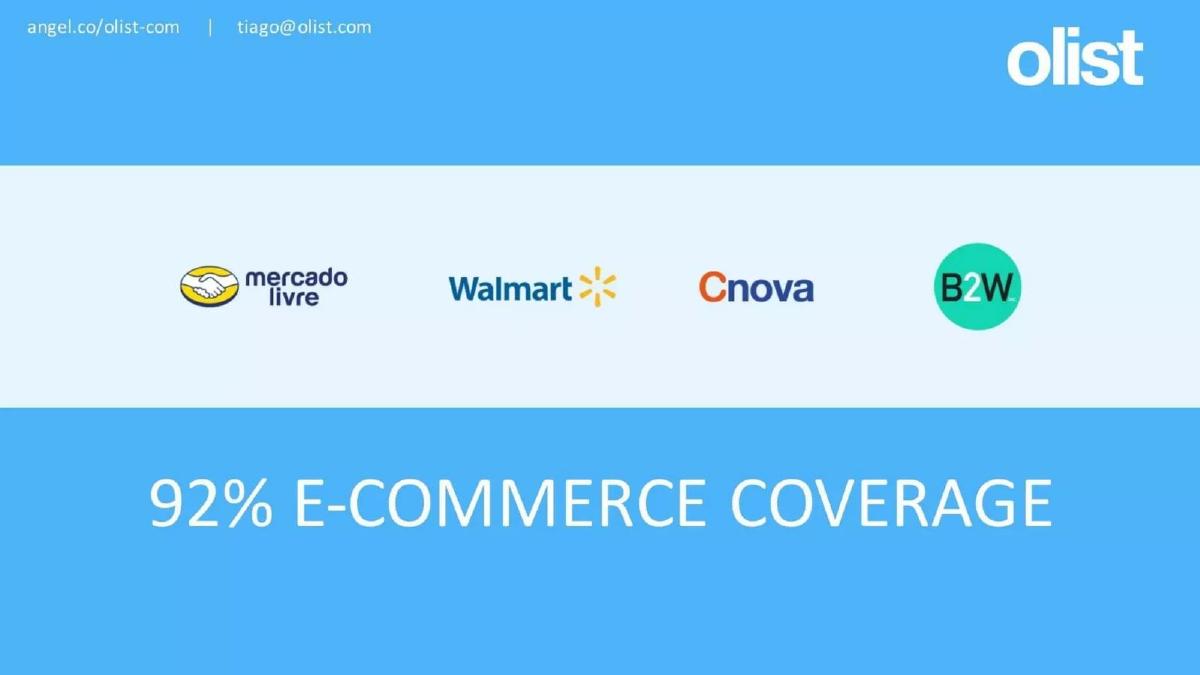
- The platform claims 92% e-commerce coverage through integrations with Mercado Livre, Walmart, Cnova, and B2W on slide 4.
- The revenue model is a hybrid of a 20% commission plus a subscription fee, detailed on slide 5.
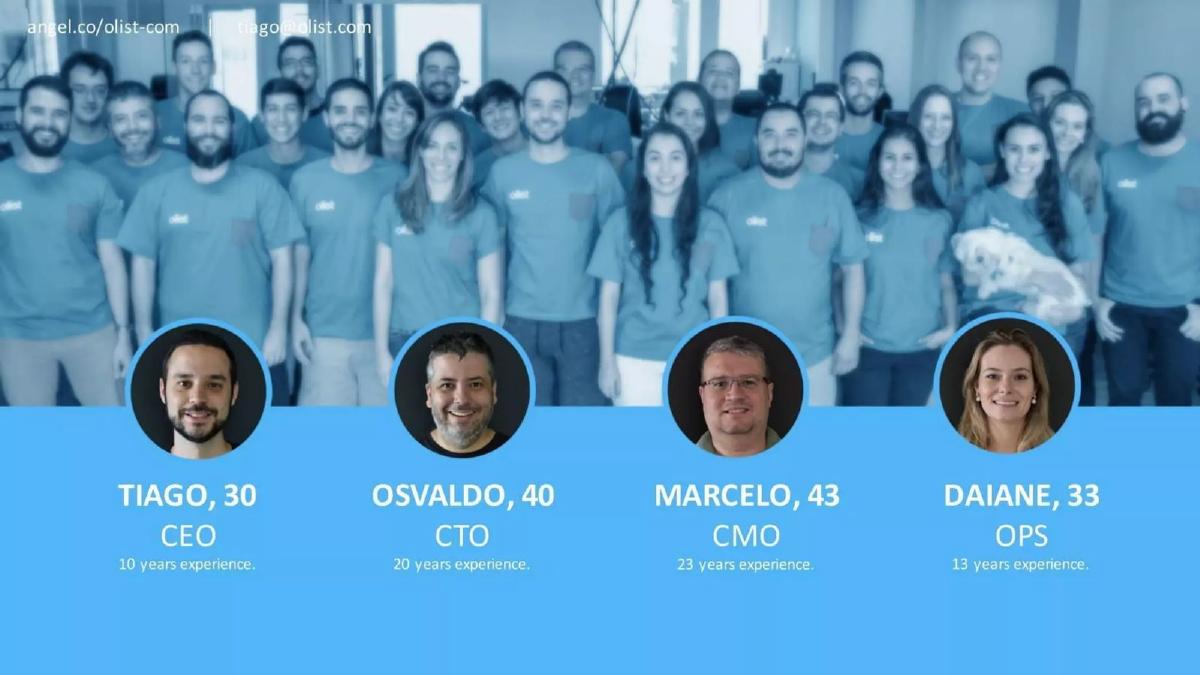
- The founding team is highly experienced, with the CTO and CMO having 20 and 23 years of experience respectively, as cited on slide 6.
- The deck completely omits a traditional 'Problem' slide, assuming the investor understands the friction in marketplace selling.
- There is no specific 'Ask' slide detailing the amount of capital being raised or the intended use of funds within these 8 slides.
- The company vision is distilled into a single three-word phrase: 'World’s distribution plugin' on slide 7.
The Power of Traction: Olist’s 8-Slide Blitz
The Olist pitch deck from 2015 is a masterclass in minimalist fundraising. While many founders labor over 20-slide decks detailing the intricacies of their technology, Olist took the opposite approach. They leaned entirely on their momentum. In the world of venture capital, growth solves all problems, and Olist had growth in spades. By focusing on a few key metrics—GMV run rate and week-over-week growth—they created a deck that is almost impossible to say 'no' to if you believe in the e-commerce sector.
The Hook: Connection and Velocity (Slides 1-2)
Slide 1: Title and Concept The deck opens with a simple illustration of a 'merchant' and a 'buyer' connected by the Olist logo. The imagery is friendly and consumer-facing, despite Olist being a B2B2C enabler. It establishes the core function of the business immediately: Olist is the bridge. Notably, the slide includes contact information for the CEO at the top, a practice that makes the deck feel like a direct communication rather than a generic marketing asset.
Slide 2: The Growth Metric Olist does not wait to show off. Slide 2 features a massive '19%' in the center of the frame. The text below specifies 'GROWTH week over week past 12 months.' This is an extraordinary claim. Sustaining nearly 20% weekly growth for a full year is the kind of 'up and to the right' trajectory that defines unicorn potential. By placing this as the second slide, Olist effectively ends the debate about product-market fit before it even begins.
The Scale: GMV and Market Dominance (Slides 3-4)
Slide 3: GMV Run Rate Following the growth percentage, Slide 3 provides the absolute numbers. It states a '$6 MILLION GMV Runrate.' The slide uses a stylized graph where the current point is marked by a location pin, showing the company is at the base of a massive upward curve. This slide validates that the 19% growth isn't coming from a base of zero; they are moving significant volume through the platform.
Slide 4: E-commerce Coverage This slide is the 'moat' slide. It displays the logos of Mercado Livre, Walmart, Cnova, and B2W. The headline reads '92% E-COMMERCE COVERAGE.' For an investor, this slide explains the 'how.' Olist isn't just another store; it is a gateway to the entire Brazilian e-commerce market. By showing they have already integrated with the giants, they demonstrate a level of business development and technical integration that would be difficult for a competitor to replicate quickly.
The Business: Revenue and People (Slides 5-6)
Slide 5: Business Model Olist keeps the revenue model incredibly simple: '20% COMMISSION + SUBSCRIPTION.' There are no complex tiers or 'contact us for pricing' obfuscations. This transparency suggests a high-margin business that benefits directly from the success of its merchants. The 20% take rate is substantial, indicating that Olist provides significant value-add beyond simple listing software.
Slide 6: The Team The team slide is a departure from the minimalist icons used elsewhere. It features a group photo of the entire staff in the background, with four key executives highlighted in the foreground. The slide lists their ages and years of experience: Tiago (CEO, 30, 10 years exp), Osvaldo (CTO, 40, 20 years exp), Marcelo (CMO, 43, 23 years exp), and Daiane (OPS, 33, 13 years exp). The emphasis here is clearly on maturity and 'been-there-done-that' expertise, which balances the 'young startup' energy of the growth slides.
The Vision and The Backing (Slides 7-8)
Slide 7: The Vision Slide 7 features an illustration of a toggle switch and the phrase 'World’s distribution plugin.' This is the only 'vision' statement in the deck. It suggests that while they are currently dominant in Brazil (as implied by the logos on slide 4), the technology is a modular 'plugin' that can be flipped on in any market globally. It frames Olist as a scalable infrastructure play rather than a local retail play.
Slide 8: The Summary and Social Proof The final slide repeats the core metrics: '$6 million GMV RUN RATE' and '19% growth W-o-W.' It also includes the logos of Redpoint Eventures and 500 Startups at the bottom. Including these logos provides immediate social proof, telling new investors that reputable firms have already vetted the business and the founders. The contact info is repeated, ending the deck on a call to action.
What Works in the Olist Deck
Extreme Focus on Traction The decision to lead with 19% week-over-week growth is brilliant. In venture capital, traction is the ultimate signal. By making this the centerpiece, Olist forces the investor to look at the deck through a lens of 'how do I get in on this?' rather than 'does this work?'
Clarity of Value Proposition The phrase 'World’s distribution plugin' is one of the most effective one-sentence descriptions in the e-commerce space. It perfectly describes what the product does (distribution), how it works (a plugin), and the scale of the ambition (world).
Seniority of the Team Highlighting the 20+ years of experience for the CTO and CMO is a strategic move. It reassures investors that the '19% WoW growth' won't break the company's technical or operational backbone because the people at the helm have seen scale before.
What is Missing from the Olist Deck
The Problem Statement Most decks start with a 'Problem' slide. Olist skips this entirely. While the traction suggests the problem is being solved, a new investor unfamiliar with the friction of selling on multiple marketplaces might need more context on why merchants are willing to pay a 20% commission.
Competitive Landscape There is no mention of competitors. While Olist claims 92% coverage, they don't address other enablers or the risk of marketplaces building their own direct-to-merchant tools that might bypass Olist.
The Ask The deck does not state how much money they are raising or what they plan to do with it. While this information is often shared in a follow-up email or a data room, its absence in the primary deck makes this feel more like a 'teaser' than a complete pitch.
What Founders Should Copy
The 'Metric First' Approach If your numbers are exceptional, do not hide them on slide 12. Olist puts their best foot forward immediately. If you have 20% WoW growth or a massive GMV, that is your story. Everything else is just supporting detail.
Visual Simplicity Olist uses very little text. They use large fonts for numbers and simple icons for concepts. This makes the deck extremely readable on a mobile device or during a quick 2-minute skim, which is how most investors first consume a deck.
Experience over Pedigree Instead of just listing schools or past companies, Olist listed 'Years of Experience.' This is a powerful way to demonstrate 'Founder-Market Fit,' especially in complex industries like logistics and e-commerce where operational scars are more valuable than a prestigious degree.
Final Thoughts
Olist’s 2015 deck is a reminder that you don't need a 30-page document to raise millions of dollars. You need a massive market, a clear product, and undeniable evidence that you are winning. By stripping away the fluff, Olist created a sense of urgency and inevitability that clearly resonated with the market, leading to their eventual status as a major player in the global commerce ecosystem.
Frequently asked questions
- Why is the Olist deck so short compared to other startups?
- Olist’s deck is short because its traction metrics—specifically 19% week-over-week growth—are so compelling that they serve as the primary argument for investment. When a company demonstrates that level of velocity and a $6M GMV run rate, investors require less convincing on the 'why' and focus more on the 'how fast.' The brevity suggests a high-demand round where the founders let the data do the talking.
- What does '92% e-commerce coverage' mean in this context?
- On slide 4, Olist lists logos for Mercado Livre, Walmart, Cnova, and B2W. In the Brazilian market in 2015, these four entities controlled the vast majority of online retail traffic. By integrating with them, Olist could effectively promise merchants that their products would be visible to nearly the entire digital shopping population of the country, creating a powerful 'one-stop-shop' value proposition.
- Is a 20% commission sustainable for an e-commerce enabler?
- A 20% commission, as stated on slide 5, is relatively high for pure software but standard for managed marketplaces or 'store-within-a-store' models where the enabler handles significant logistics, customer service, or listing optimization. Combined with a subscription fee, this model suggests Olist was capturing a significant portion of the value chain, not just providing a technical bridge.
- How does the team slide contribute to the deck's strength?
- Slide 6 highlights a very 'senior' founding team. While CEO Tiago was 30, his CTO and CMO were 40 and 43 respectively, with a combined 43 years of experience between them. For a later-stage or high-growth bridge round, this seniority provides investors with confidence that the infrastructure can scale to meet the 19% WoW growth mentioned earlier in the deck.
- What is missing from this deck that a typical founder should include?
- This deck is missing a 'Problem' slide, a 'Competition' slide, a 'Use of Funds' slide, and a 'Market Size' (TAM) slide. While Olist succeeded without them, most founders need these to build a logical case. Olist likely omitted them because they were pitching to investors who already knew the Brazilian e-commerce landscape and were focused purely on Olist's dominant execution.