Oliva’s 2021 pre-seed deck is a masterclass in establishing credibility in a crowded market. By raising $2.9M, the team demonstrated that investors were hungry for more than just 'meditation apps' for the workplace. The deck leans heavily into clinical outcomes, featuring a Chief Clinical Officer prominently and detailing a 'Step Care Model' that ranges from everyday support to severe intervention. While it lacks traditional venture metrics like CAC, LTV, or a detailed financial forecast, it compensates with a high-pedigree founding team—including a co-founder of TravelPerk—and a clear, empat…
Key takeaways
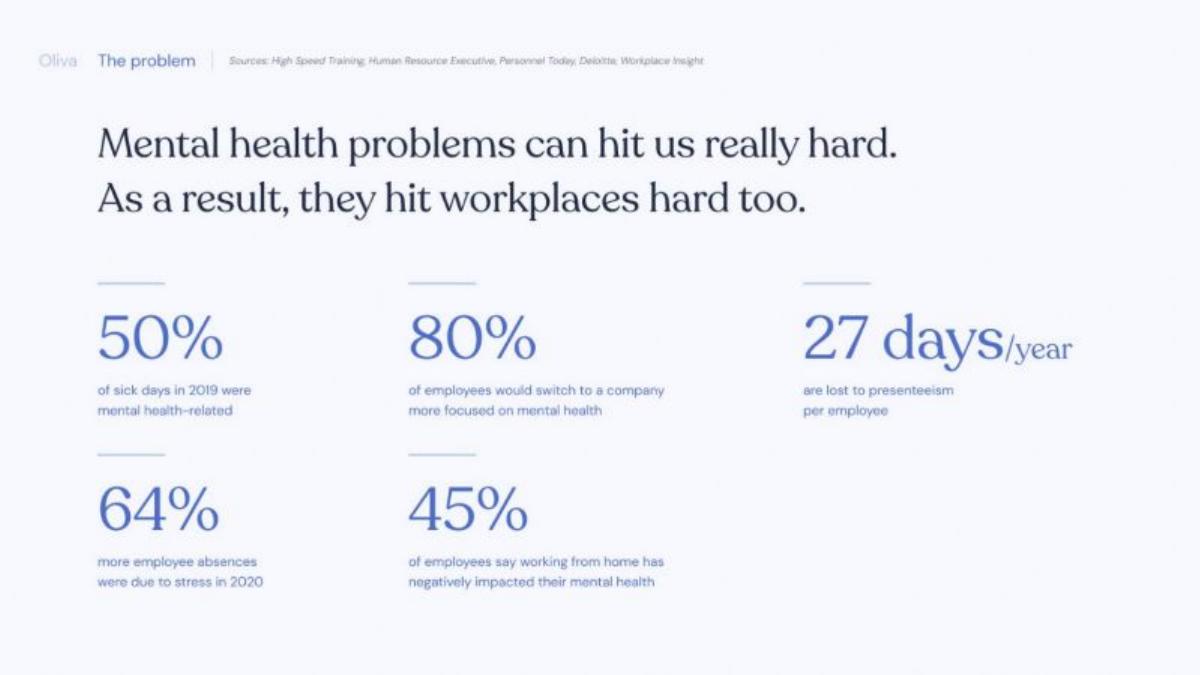
- The deck identifies a massive productivity leak, citing 27 days lost per year to presenteeism per employee on slide 4.
- Oliva claims a 98% matching success rate between employees and therapists on slide 8.
- The product utilizes a 'Care Navigator'—a trained professional who guides the employee journey, as detailed on slide 9.
- The 'Step Care Model' on slide 12 differentiates the service by offering up to 25 sessions for severe cases, moving beyond simple digital check-ins.
- Manager training is a core feature, with slide 14 noting that 63% of managers desire better training for dealing with employee depression.
- Integration is key to their 'Platform' slide (16), which highlights a 10-minute setup and Slack connectivity.
- The team slide (18) leverages significant past success, noting CEO Javier Suarez previously co-founded TravelPerk.
- The deck completely omits a specific 'Ask' slide, valuation, or use of funds breakdown within the 19-slide sequence.
The Narrative: From Burnout to Clinical Rigor
Oliva’s pitch deck is a study in empathy-led B2B sales. In a sector often criticized for 'wellness washing,' Oliva positions itself as a clinical heavyweight. The deck, used to raise a $2.9M pre-seed round in 2021, avoids the typical tech-heavy jargon of SaaS and instead focuses on the human and economic cost of mental health neglect in the workplace. The design is intentional: soft blues, muted tones, and hand-drawn illustrations that signal safety and professionalism.
Slides 1-2: The Hook
The deck opens with a minimalist title slide featuring the brand name and an illustration of a hand on a computer mouse surrounded by greenery. Slide 2 sets the mission: 'For employers that want to make a real impact on their people’s wellbeing.' This immediately qualifies the target audience—not just any employer, but those focused on 'real impact,' a subtle jab at superficial wellness perks.
Slides 3-6: Quantifying the Pain
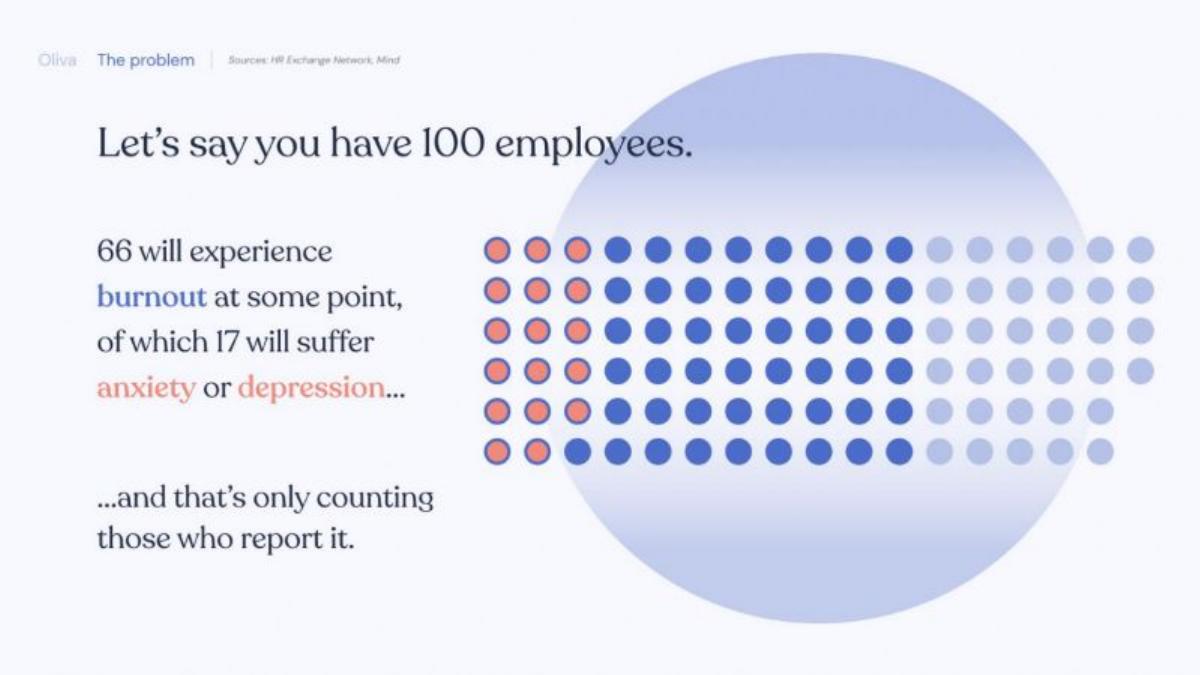
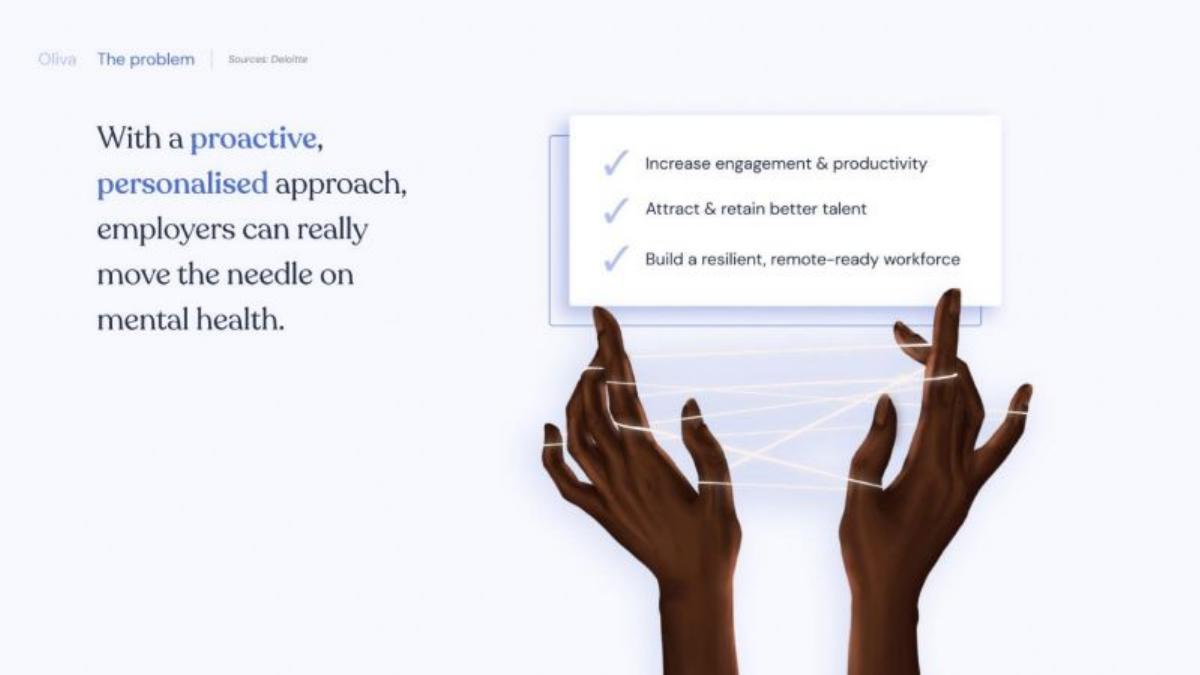
The 'Problem' section is data-heavy. Slide 4 cites sources like Deloitte and High Speed Training to establish that 50% of sick days are mental health-related and, crucially, that 27 days per year are lost to 'presenteeism' per employee. This is a vital metric for B2B sales; it transforms a 'soft' benefit into a hard bottom-line issue. Slide 5 uses a visualization to show that in a group of 100 employees, 66 will experience burnout. Slide 6 concludes the problem section by promising that a proactive approach can 'move the needle' on engagement and retention.
Slides 7-10: The Solution and User Journey
Slide 8 introduces 'How Oliva works for your employees,' boasting a 98% matching success rate. The flow is simple: digital drop-ins, a matching process, and a chat with a 'Care Navigator.' Slide 9 introduces the concept of the Care Navigator in detail. By featuring Dr. Sarah Bateup (Chief Clinical Officer) on this slide, Oliva reinforces that their 'navigators' are not just customer support agents, but trained mental health professionals. This is a key differentiator in the crowded EAP (Employee Assistance Program) space.
Slides 11-13: The Clinical Model
Slide 12 is perhaps the most important slide for an investor concerned about efficacy. It outlines the 'Step Care Model.' It categorizes needs into Everyday, Mild, Moderate, and Severe. For 'Severe' cases (estimated at 2% of a team), Oliva offers up to 25 sessions plus specialist referrals. This demonstrates that Oliva is a comprehensive healthcare solution, not just a meditation app. Slide 13 highlights their 'Curated care team,' noting they are BACP (or equivalent) accredited, further leaning into clinical credibility.
Slides 14-16: The Manager and The Platform
Oliva recognizes that managers are the front line of workplace mental health. Slide 14 notes that 63% of managers want better training. The solution includes workshops and 1-to-1 support for managers. Slide 16 finally shows the 'Platform.' It emphasizes a '10-minute' setup for benefits managers and Slack integration for employees. This addresses the 'friction' objection—employers won't buy a platform that is hard to deploy.
Slides 17-18: The Team
The deck closes with a very strong team slide. Javier Suarez’s background as a co-founder of TravelPerk (a unicorn in the travel space) provides immediate 'founder-market fit' for B2B scaling. Sançar Sahin brings high-growth marketing experience from Typeform and Hotjar. Dr. Sarah Bateup provides the clinical 'alpha.' This combination of B2B scaling expertise and clinical authority is likely what secured the $2.9M round.
What Oliva Got Right
Clinical Authority: By putting their Chief Clinical Officer front and center and detailing a 'Step Care Model,' they avoid being categorized as a 'lite' wellness app. · Economic Argument: They didn't just say mental health is good; they used the '27 days lost to presenteeism' stat to prove it's a financial necessity for the employer. · Founder Pedigree: Leveraging the TravelPerk and Typeform names early in a pre-seed deck is a shortcut to investor trust. · Visual Identity: The deck looks and feels like a healthcare product—calm, professional, and modern.
What is Missing from the Deck
The Ask: There is no slide detailing how much they are raising, the valuation, or the specific milestones they intend to hit with the capital. · Traction Metrics: While it is a pre-seed deck, there is no mention of pilot programs, early design partners, or a waitlist. · Unit Economics: There is no mention of the pricing model (e.g., PEPM - Per Employee Per Month) or the expected LTV of a corporate contract. · Competitive Landscape: The deck does not acknowledge competitors like Lyra Health, Modern Health, or Unmind, nor does it explain why Oliva wins against them.
Founder Lessons
Sell the 'Hard' ROI of 'Soft' Benefits: If you are building in the wellness or HR space, follow Oliva’s lead. Don't just talk about happiness; talk about presenteeism, sick days, and retention. Use third-party data (Deloitte, etc.) to make the problem feel urgent and expensive.
The 'Step' Model for Services: If your product involves human services (like therapy or coaching), show how you scale that service. Oliva’s 'Step Care Model' is a great way to show that you have a plan for both the 'worried well' and those in crisis without breaking your margins.
Integrations as a Feature: For B2B tools, '10-minute setup' and 'Slack integration' are not just technical details; they are core value propositions. Oliva highlighted these to show that their product wouldn't add to the HR manager's workload.
Focus on the 'Navigator': In any complex user journey (like healthcare), having a 'navigator' or 'concierge' role helps investors understand how you prevent user churn and ensure successful outcomes. Oliva’s emphasis on the Care Navigator makes the technology feel more human and effective.
Frequently asked questions
- What is the primary business model for Oliva?
- Oliva operates on a B2B model, selling mental healthcare solutions directly to employers. According to the deck, the platform integrates with workplace tools like Slack to allow employees to book therapy sessions, chat with care navigators, and access clinical support, all funded by the employer to improve organizational performance.
- How does Oliva differentiate itself from other mental health apps?
- Unlike self-guided apps, Oliva emphasizes a 'Step Care Model' (Slide 12) that includes human-led clinical interventions. This ranges from digital drop-in sessions for everyday stress to personalized therapy courses of up to 25 sessions for severe mental health issues, overseen by an in-house clinical team led by a Chief Clinical Officer.
- Who are the founders of Oliva and what is their background?
- The leadership team includes CEO Javier Suarez, who previously co-founded TravelPerk; CMO Sançar Sahin, who led marketing at Typeform and Hotjar; and Dr. Sarah Bateup, the Chief Clinical Officer, who is described on Slide 18 as a top 50 female leader in UK healthcare with experience scaling digital CBT services.
- What specific problem is Oliva trying to solve for employers?
- Slide 4 highlights that 50% of sick days in 2019 were mental health-related and 64% of absences in 2020 were due to stress. Oliva aims to reduce 'presenteeism' (27 days lost per employee per year) by providing proactive, personalized care that increases productivity and helps attract and retain talent.
- Does the deck include financial projections or an investment ask?
- No. The 19-slide deck provided does not include a financial slide, a cap table, or a specific 'Ask' slide detailing how much capital is being raised or how it will be spent. It focuses almost entirely on the problem, the clinical solution, and the strength of the founding team.