Okteto’s Series A deck is a masterclass in category definition and social proof. By 2022, the company had already secured high-profile logos like LaunchDarkly and Monday.com, which it used to anchor its narrative about the growing divergence between modern production environments and antiquated local development. The deck successfully argues that the 'laptop-first' development model is a bottleneck, costing companies a 30% increase in engineering time. While the deck is light on specific financial metrics—redacting its ARR goals and omitting a historical growth chart—it compensates with a str…
Key takeaways
- The deck leads with immediate social proof, showcasing LaunchDarkly, Replicated, and Monday.com on slide 2.
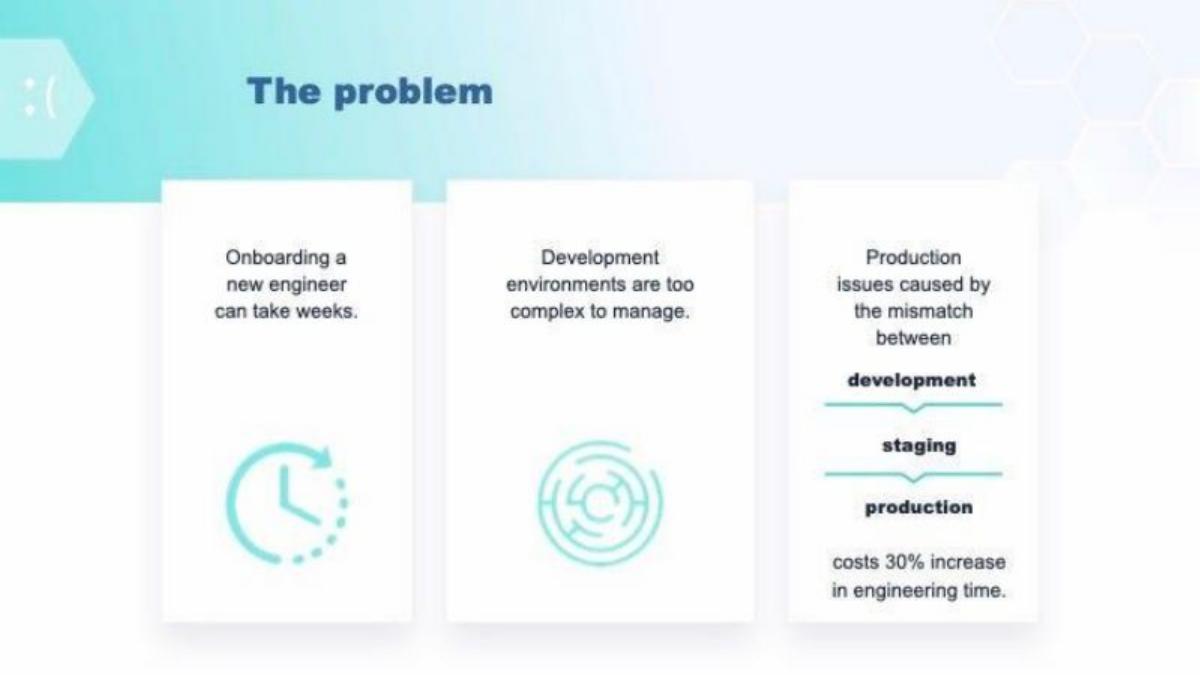
- Okteto quantifies the problem by stating that environment mismatches cause a 30% increase in engineering time on slide 4.
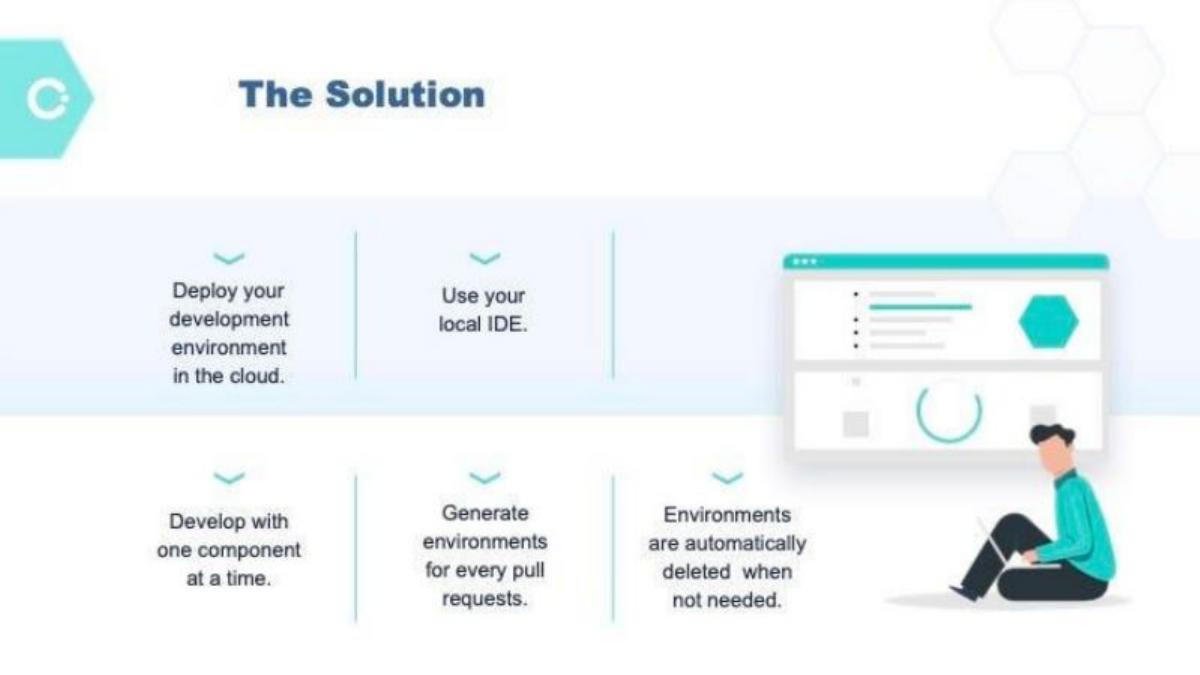
- The solution is framed as a shift from hand-configured laptops to cloud-based, ephemeral environments on slides 6 and 7.
- The company positions itself as a category creator for 'Remote Development Environments' (RDE) on slide 9.
- The team slide (slide 12) highlights deep domain expertise, citing experience at Atlassian, Microsoft Azure, Google, and Docker.
- The deck outlines a clear expansion strategy, moving from platform teams to the broader engineering organization on slide 10.
- A 'Buy vs. Build' slide (slide 17) proactively addresses a common enterprise objection regarding internal engineering resources.
- The 'Ask' slide (slide 14) is specific about the 18-24 month roadmap but redacts the specific ARR target.
The Narrative: Bridging the Gap Between Laptop and Cloud
Okteto’s pitch deck is built on a fundamental tension in modern software engineering: production environments have become incredibly sophisticated (distributed, automated, cloud-native), while development still largely happens on a single laptop. This 'mismatch' is the villain of the story. By framing their solution as a necessary evolution rather than just a tool, Okteto positions itself as the leader of a new category: Remote Development Environments (RDE).
Slides 1-2: The Hook and Immediate Validation
Slide 1 is a standard title slide, but it immediately defines the value proposition: 'Remote development environments and previews for teams developing modern applications.' It targets 'teams,' not just individual developers, hinting at the enterprise scale of the Series A round.
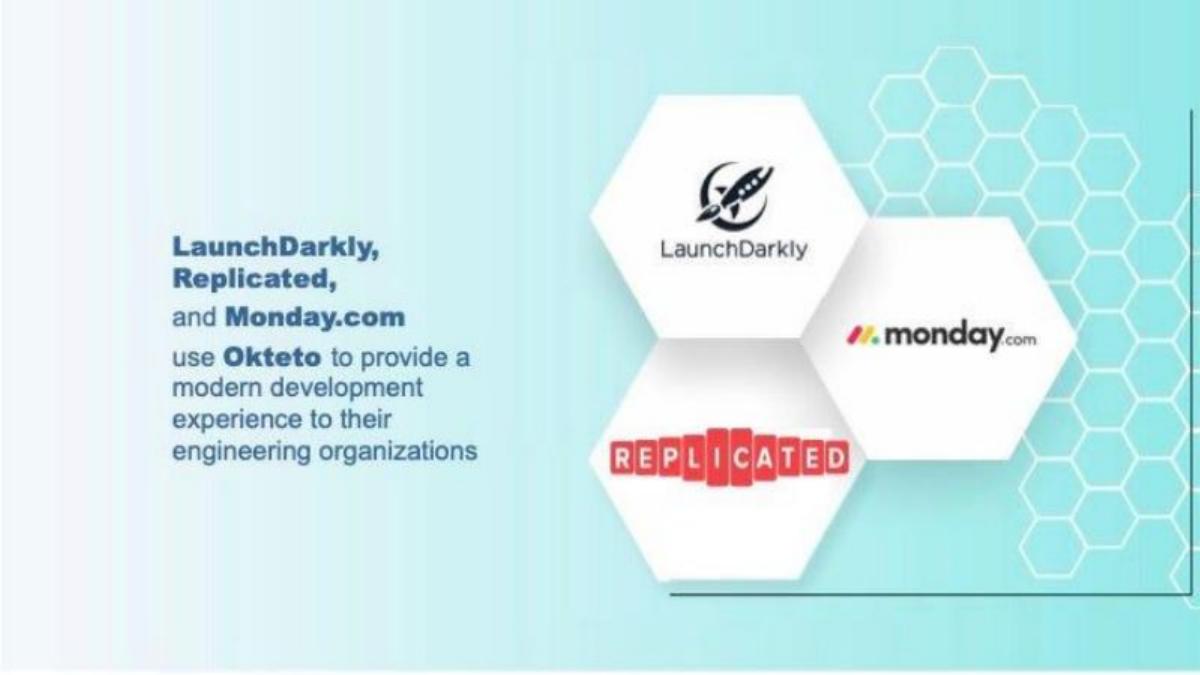
Slide 2 is a 'Why listen to us' slide. Instead of waiting for the end of the deck to show traction, Okteto leads with three heavy-hitting logos: LaunchDarkly , Replicated , and Monday.com . This establishes that the product is already being used by 'engineering organizations' at scale, which is critical for a Series A pitch.
Slides 3-5: Defining the Problem and the Market Need
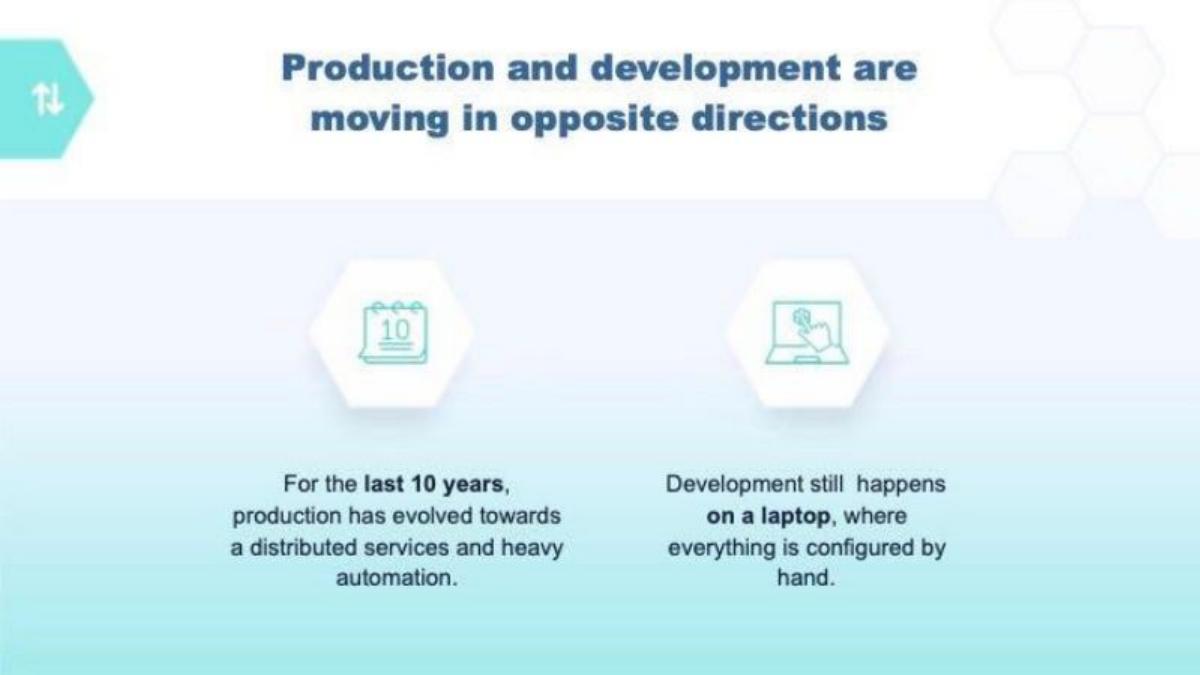
Slide 3 visualizes the core thesis: 'Production and development are moving in opposite directions.' It notes that for the last 10 years, production has evolved toward distributed services, while development still happens on a laptop, configured by hand. This sets up the 'why now'—the gap has finally become too wide to ignore.
Slide 4 quantifies the pain. It lists three primary issues: onboarding taking weeks, complex environment management, and a 30% increase in engineering time caused by the mismatch between development, staging, and production. This 30% figure is the 'money metric' that justifies the investment in a new platform.
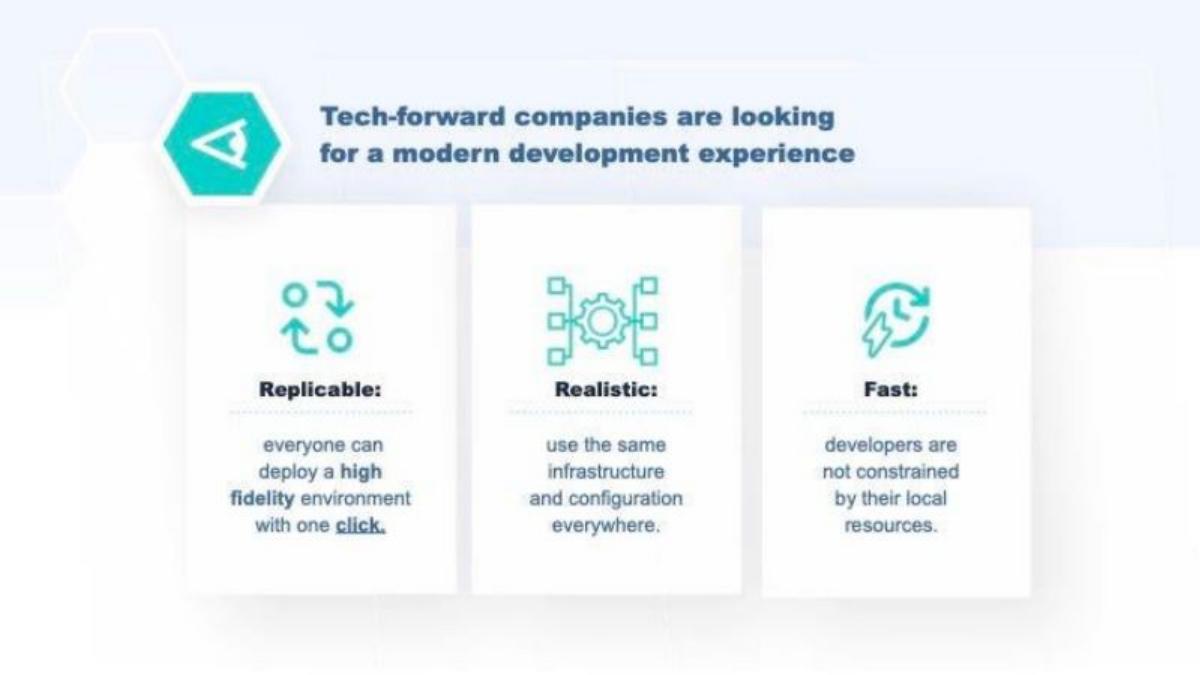
Slide 5 defines what 'tech-forward companies' are looking for: environments that are Replicable (one-click deployment), Realistic (same infrastructure as production), and Fast (not constrained by local laptop resources).
Slides 6-8: The Solution and User Personas
Slide 6 introduces the Okteto solution. The key features highlighted are cloud-based deployment, use of local IDEs, component-based development, and automatic deletion of unused environments. The illustration of a developer sitting comfortably while the 'heavy lifting' happens in a browser/cloud window reinforces the 'Fast' value prop from the previous slide.
Slide 7 focuses on the developer experience. It emphasizes that developers can use their 'favorite IDE' and that their code 'works in production' because the environments look and feel identical. This addresses the 'works on my machine' syndrome directly.
Slide 8 pivots to the Platform Team . This is a crucial distinction for an enterprise sale. While developers use the tool, platform teams (DevOps/SREs) are often the buyers. Okteto promises them automatic onboarding, enforced security policies, and automatic cleanup of unused resources to save costs.
Slides 9-11: Category Leadership and Expansion
Slide 9 is a bold claim: 'We are helping define the remote development environment category.' It outlines their strategy: focusing on early adopters, building an open-source community, and investing in content. This shows a sophisticated go-to-market (GTM) approach beyond just 'building a better mousetrap.'
Slide 10 explains the 'Land and Expand' motion. Okteto starts with the platform team and then expands to the rest of the engineering organization. This is a classic SaaS growth playbook, suggesting that as more teams join, 'development velocity and confidence increases, while error rates diminish.'
Slide 11 provides a 'wall of logos' to show that Okteto is 'top of mind' in the RDE category. While some logos are redacted in this version of the deck, visible names like Sonar , Sirona , and Pulsar suggest a diverse customer base across different verticals.
Slide 12: The 'Developer Experience DNA' Team
Slide 12 is one of the strongest in the deck. The founders have an impeccable pedigree for this specific problem. Ramiro Berrelleza (CEO) was a Principal Engineer at Atlassian and worked on Azure. Pablo Chico de Guzmán (CTO) was the first engineer at ElasticBox and worked at Docker. Ramon Lamana (CPO) worked at Google and helped build EyeOS. This 'DNA' slide proves they have the technical authority to build infrastructure that other engineers will trust.
Slides 13-14: The Roadmap and The Ask
Slide 13 looks forward, detailing how they are expanding the platform. Goals include simplifying project onboarding, strengthening the open-source offering, and achieving 'Enterprise readiness and compliance.' This signals to investors that the Series A capital will be used to move upmarket.
Slide 14 is the 'Ask.' It specifies a 18-24 month window to build marketing and customer success organizations and support the RDE community. Interestingly, the target ARR figure is redacted , but the goal is clearly stated as hitting a specific revenue milestone to prepare for a Series B.
Slides 15-20: Appendix and Defensibility
Slide 15 marks the start of the Appendix. Slide 16 provides a deep-dive testimonial from Lior Rabin at Monday.com . It reinforces the earlier claim about onboarding, stating that it used to take 'a couple of days' but with Okteto, environments are ready 'almost instantly.'
Slide 17 is a 'Why buy vs. build' slide. This is a common hurdle in developer tools where companies think they can script their own solution. Okteto argues that most companies don't have the resources and that Okteto provides a more 'integrated experience' with existing security and deployment systems.
Slide 18 lists specific features for 2022, including Preview Environments for every PR and Single Sign-On (SSO) , which are essential for enterprise adoption. Slide 19 shows their current cap table, featuring Y Combinator , Haystack , Root Ventures , and Uncorrelated , providing further institutional validation.
What Works in This Deck
The Problem/Solution Gap: The deck does an excellent job of explaining why the status quo (laptops) is no longer sufficient for modern cloud-native development. · Dual-Persona Targeting: By having separate slides for 'Developers' and 'Platform Teams,' Okteto shows they understand both the user and the buyer. · Pedigree: The team slide is a 'who's who' of infrastructure engineering, which is highly persuasive for a technical product. · Proactive Objection Handling: The 'Buy vs. Build' slide addresses the most likely reason a deal stalls in the enterprise sector.
What Is Missing
Financial Specifics: While this is a Series A deck, there is a total lack of historical revenue growth, churn rates, or net dollar retention (NDR). Even if redacted for public viewing, the absence of charts suggests the narrative was more focused on category vision than raw numbers. · Competitive Landscape: The deck claims to 'define the category' but doesn't mention other players in the space (like GitHub Codespaces or Gitpod). Investors would likely ask how Okteto differentiates from these platform-native offerings. · Unit Economics: There is no mention of Customer Acquisition Cost (CAC) or Lifetime Value (LTV), which are standard for Series A discussions.
What a Founder Should Copy
The 'Money Metric': Finding a figure like '30% increase in engineering time' (Slide 4) gives investors a clear ROI to latch onto. · Social Proof Early: Don't wait until the end of the deck to show your best customers. If you have big names, put them on Slide 2. · The 'DNA' Framing: If your team has worked at relevant industry giants, don't just list the logos—frame it as 'DNA' (Slide 12) to show a deep, inherent understanding of the problem space. · Persona-Based Value Props: If your user is different from your buyer, create specific slides for each to show you have a complete GTM strategy.
Frequently asked questions
- How much did Okteto raise with this deck?
- According to the catalogue facts, Okteto raised $15M in a Series A round in 2022. The deck itself mentions the intent to raise funds to fuel growth over the next 18-24 months on slide 14, though it does not specify the dollar amount on that slide.
- Who are Okteto's key customers mentioned in the deck?
- The deck prominently features LaunchDarkly, Replicated, and Monday.com as early adopters on slide 2. Slide 11 adds logos for Sonar, Sirona, Privacy Dynamics, and Pulsar, indicating a broad base of tech-forward customers.
- What is the core problem Okteto is solving?
- Okteto addresses the 'mismatch' between local development on laptops and distributed production environments. Slide 4 notes that this mismatch increases engineering time by 30% and causes onboarding for new engineers to take weeks.
- What is the background of the founding team?
- The team has significant enterprise and infrastructure experience. CEO Ramiro Berrelleza was a Principal Engineer at Atlassian and worked on Azure; CTO Pablo Chico de Guzmán was the first engineer at ElasticBox; and CPO Ramon Lamana worked at Google and helped build EyeOS (slide 12).
- What are the key product features planned for 2022?
- Slide 18 lists major features including on-demand remote environments, preview environments for every pull request, garbage collection for unused environments, and integrations with GitHub, GitLab, Okta, and VS Code.