Ohos targets the enterprise HR tech space with a platform that replaces periodic reviews with continuous, peer-based feedback. The deck is notable for its aggressive market sizing, projecting a $364.5 million annual revenue opportunity in the enterprise segment alone based on an 8% market capture. While it provides specific financial terms—including a $1.2 million ask at a $4 million cap—the deck lacks biographical details for the five team members shown. The competitive matrix is a highlight, positioning Ohos as the only player offering 'B2C Portable' feedback and industry comparisons. Howev…
Key takeaways
- The company identifies a specific pain point where 51% of managers claim they lack the time to conduct performance reviews well (Slide 2).
- Ohos projects a total US market size of 1.775 million companies with 50+ employees, representing 101.25 million potential users (Slide 4).
- The financial model targets an 8% enterprise market capture to reach $364.5 million in annual revenue at a $60/user price point (Slide 4).
- The deck claims a unique advantage through 'B2C Portable' options and searchable databases, features absent in incumbents like Workday or Oracle (Slide 5).
- Exit potential is supported by a list of notable HR tech acquisitions, including SuccessFactors for $3.4B and Taleo for $1.9B (Slide 6).
- The investment ask is explicitly stated as $1,200,000 with a $4,000,000 value cap (Slide 7).
- The founders project a terminal value of $450,000,000 by the fifth year based on a 9x P/E multiple (Slide 7).
- The team slide features five headshots but omits names, titles, and professional backgrounds (Slide 8).
Slide-by-Slide Analysis
Slide 1: Title and Vision
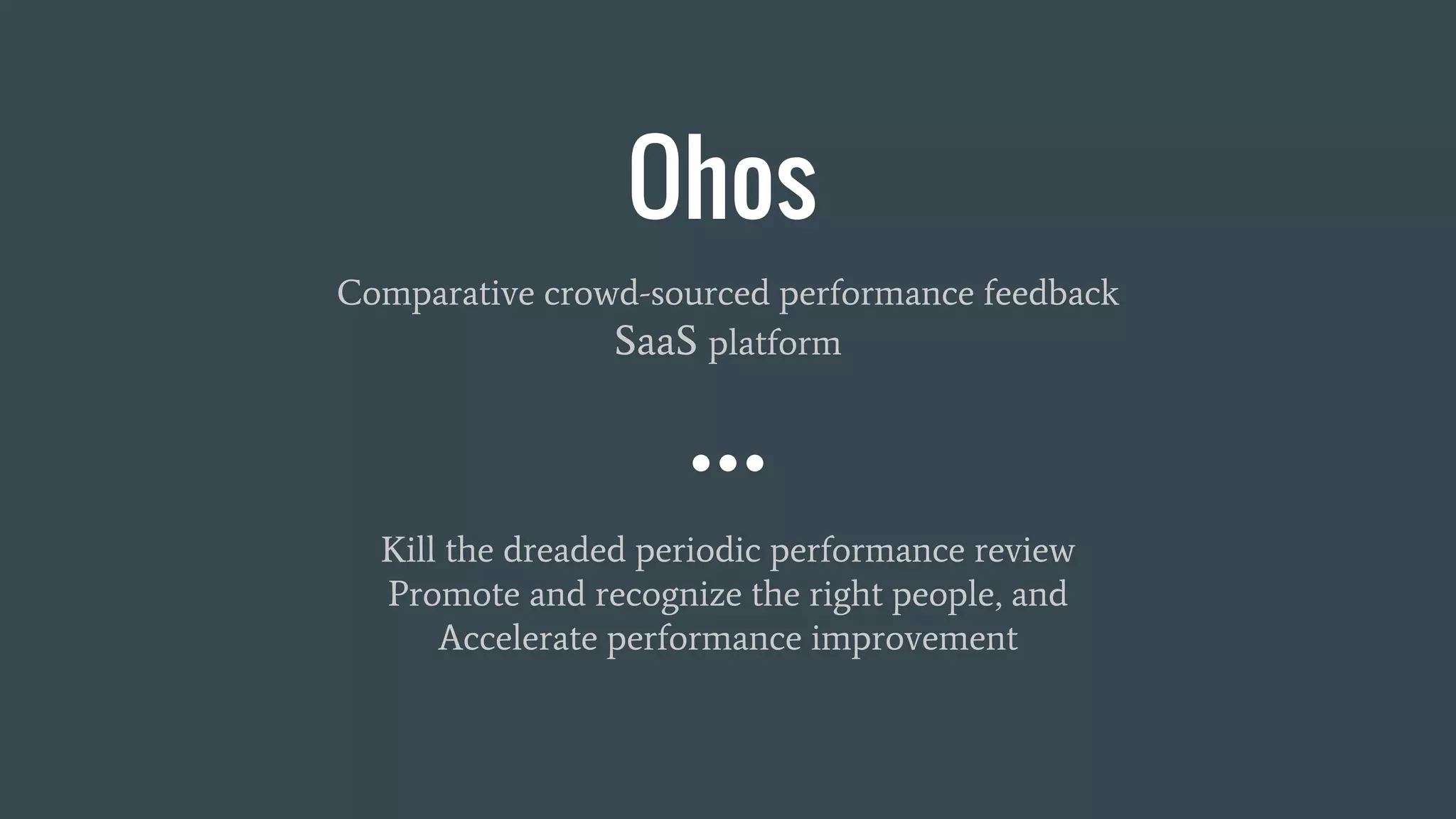
The cover slide introduces Ohos as a 'Comparative crowd-sourced performance feedback SaaS platform.' It sets a bold mission: to 'Kill the dreaded periodic performance review.' The subtext focuses on three outcomes: promoting the right people, recognizing talent, and accelerating performance improvement. The branding is minimalist, using a dark slate background that persists throughout the deck.
Slide 2: The Problem
Labeled 'Problem 2,' this slide focuses on the lack of regular feedback for individuals. It identifies three causes: the use of periodic processes over ongoing tools, a lack of normative peer comparison, and infrequent feedback disconnected from improvement resources. The slide uses third-party data from Discovery Surveys, Inc. (2015) to validate the pain: 60% of employees want more feedback, 56% lack regular feedback, and 51% of managers say they don't have time to do it well.
Slide 3: Product Highlights
This slide showcases the user interface, though a footer note clarifies these are 'actual screenshots from our conceptual site.' Features include real-time performance trends by rater group (Leadership, Peer, Team, Customer), a directory to find experts by competency (e.g., Adaptability, Conflict Resolution), and a leadership recognition tool. A URL for a demo video is provided, though the 'conceptual' nature of the screenshots suggests the product was in the design or early development phase.
Slide 4: Market Opportunity and Size
Ohos presents a massive TAM (Total Addressable Market). It notes that 10% of Fortune 500 companies (including Microsoft, Dell, and GE) have ditched traditional reviews. The 'Market Size' section identifies 1.775 million US companies with 50+ employees, totaling 101.25 million users. The 'Market Potential' table is highly specific, projecting $364.5 million in enterprise revenue based on an 8% capture rate at $60 per user, and $48 million in individual revenue at $24 per user.
Slide 5: Unique Advantage (Competitive Matrix)
This is a comprehensive competitive landscape. It pits Ohos against 20+ competitors, ranging from legacy giants (IBM, Oracle) to newer players (Workday, Impraise). Ohos claims to be the only platform offering 'Innovative' features like Peer Comparison, B2C Portable Options, Searchable Databases, and Industry Comparisons. The slide effectively visualizes the 'feature gap' between traditional single-rater systems and Ohos’s multi-rater, portable model.
Slide 6: Notable Recent HR Tech Exits
To prove the sector's liquidity, Ohos lists six major exits. These include SuccessFactors ($3.4B at 10x multiple), Taleo ($1.9B at 6x), and Workday ($4.49B valuation at IPO). The inclusion of Rypple (acquired by Salesforce for $60M at a 20x multiple) serves to show that even smaller acquisitions in this space can yield high multiples for early investors.
Slide 7: Valuation and Ask
This slide is unusually transparent for a seed deck. It asks for $1,200,000 at a $4,000,000 value cap. It also includes a 'Fifth Year' projection: $50,000,000 in EBIT and a 9x P/E multiple, leading to a $450,000,000 terminal value. Stating a pre-money valuation of $4,200,000 directly on the slide is a definitive stance that leaves little room for initial negotiation but provides clarity on the founders' expectations.
Slide 8: Summary and Team
The final slide summarizes the pitch into six 'Rights': Team, Time, Advantage, Terms, Investors, and Exit. It reiterates the $1.2M ask and the 9x multiple. However, the 'Right Team' section is the deck's weakest point; it shows five photos but provides no names, roles, or evidence of past success. The slide ends with a call to action: 'Care to join us?'
What Ohos Does Well
The deck excels at market quantification. Rather than using vague 'billions of dollars' figures, Slide 4 breaks down the US market by company size and employee count, then applies a specific capture percentage (8%) and a specific price point ($60/user) to arrive at a revenue target. This level of granularity helps investors understand the logic behind the numbers.
The competitive matrix on Slide 5 is also a standout. By categorizing features into 'Traditional,' 'More Progressive,' and 'Innovative,' the founders create a clear narrative of evolution. They position Ohos not just as a better tool, but as the next logical step in the industry's progression toward 'portable' and 'comparative' data.
What is Missing from the Deck
The most glaring omission is the lack of founder pedigree. In seed-stage investing, the team is often more important than the product. By omitting names and backgrounds on Slide 8, the founders miss the opportunity to prove they have the technical or HR domain expertise to execute this vision.
Furthermore, there is no mention of unit economics beyond the base pricing. While we see the 'Annual Base Pricing' of $60/user, there is no information on Customer Acquisition Cost (CAC) or Lifetime Value (LTV). Given the crowded nature of the HR tech space shown on Slide 5, an investor would want to know how Ohos plans to acquire those 8.1 million enterprise users efficiently.
What a Founder Should Copy
Founders should emulate the 'Notable Recent HR Tech Exits' slide (Slide 6). It doesn't just list companies; it lists the path (Acquisition vs. IPO), the amount, and the revenue multiple. This provides a 'reality check' for the valuation and shows that the founders understand how their sector is valued by the public and private markets.
The 'Valuation and Ask' slide (Slide 7) is also a bold model to follow. While many founders prefer to discuss valuation in person, putting a specific value cap and a projected terminal value in the deck signals a high level of confidence and financial literacy. It forces the conversation toward the math of the deal immediately.
Final Thoughts on the Ohos Deck
The Ohos deck is a data-heavy, professional presentation that makes a strong case for the 'Why Now?' of HR tech. It identifies a clear shift in how Fortune 500 companies view performance management and positions the product as the solution to manager burnout and employee feedback gaps. While the 'conceptual' nature of the product and the anonymous team slide are significant hurdles, the clarity of the financial ask and the depth of the competitive analysis make it a compelling document for a seed-stage round.
Frequently asked questions
- What is the core product offering of Ohos?
- Ohos is a SaaS platform for 'comparative crowd-sourced performance feedback.' According to Slide 1, it aims to eliminate periodic performance reviews by providing real-time trends, peer comparisons, and skill-based expert discovery. Slide 3 notes that the platform allows users to see performance trends by rater groups such as leadership, peers, team, and customers.
- How does Ohos justify its market opportunity?
- The deck cites that 10% of Fortune 500 companies have already ditched traditional reviews, and another 70% are looking for alternatives (Slide 4). By combining these, Ohos claims an 80% market appetite. They further break this down into a target capture of 8.1 million enterprise users and 8 million individual users.
- What are the specific terms of the seed round?
- Slide 7 outlines an investment ask of $1,200,000. The deal is structured with a $4,000,000 value cap and a stated pre-money valuation of $4,200,000. The deck also includes a projected exit in the fifth year, aiming for a terminal value of $450 million.
- Who are the primary competitors identified in the deck?
- Slide 5 categorizes competitors into 'Top Established players' like IBM-Kenexa, Oracle-Taleo, and SuccessFactors, and 'Newer' players like Workday and Cornerstone. It also mentions 'Startups' like Impraise. Ohos distinguishes itself by offering industry comparisons and portable feedback profiles that employees can take with them.
- What is missing from the Ohos pitch deck?
- The most significant omission is the lack of team biographies; Slide 8 shows photos but provides no context on founder expertise. Additionally, Slide 3 admits that the product visuals are 'actual screenshots from our conceptual site,' implying the software may not have been fully functional or deployed at scale during the presentation.