Azowo’s 14-slide Series A deck is a masterclass in positioning a complex technical product as a streamlined enterprise solution. By focusing on the 'no-code' nature of their mobility platform and providing concrete evidence through customer use cases like Swiss E-Car and Munich Airport, the company successfully raised $10M in 2022. The deck effectively balances technical architecture—highlighting over 50 data sources and 100 service modules—with clear business outcomes like 100% EV transition and CO2 neutrality. While the deck lacks a traditional competition slide and detailed unit economics,…
Key takeaways
- The deck positions Azowo as an 'enterprise cloud for connected mobility' targeting the Series A stage (Slide 1).
- Azowo emphasizes a 'no-code' approach for enterprises to build e-mobility applications, lowering the barrier to entry for EV transition (Slide 3).
- The technology stack is built on a 'Data Connect' layer that pulls from over 50 sources, including any vehicle manufactured after 2004 (Slide 5).
- The platform is highly modular, offering over 100 service modules including booking engines, CO2 tracking, and payment validation (Slide 5).
- Real-world validation is provided through a Munich Airport use case involving a multi-modal platform for 2,000+ employees (Slide 9).
- The company raised €10M with 35% already committed by existing investors at the time of the pitch (Slide 11).
- A strategic shift in capital allocation is noted, moving from 75% product focus to 70% sales and marketing focus (Slide 11).
- The leadership team brings a combined 37 years of SaaS, automotive, and technical experience to the table (Slide 13).
Azowo Series A Pitch Deck Analysis
Azowo, a German-based mobility startup, successfully raised a $10M Series A in 2022. The transportation sector, particularly the intersection of software and electric vehicle (EV) fleets, is notoriously capital-intensive and technically complex. Azowo’s deck addresses these challenges by framing their software as an 'enterprise cloud' that simplifies the transition to electric mobility. The 14-slide presentation focuses heavily on the modularity of the technology and the tangible success of existing enterprise clients.
Slide 1-2: The Vision and Positioning
The deck opens with a clean, high-tech aesthetic. Slide 1 introduces Azowo as the 'Leading enterprise cloud for connected mobility.' This is a critical positioning choice. By using the term 'enterprise cloud,' they are signaling a SaaS-first business model rather than a hardware or service-heavy logistics model. The mention of 'Series A' immediately sets the context for the investor conversation.
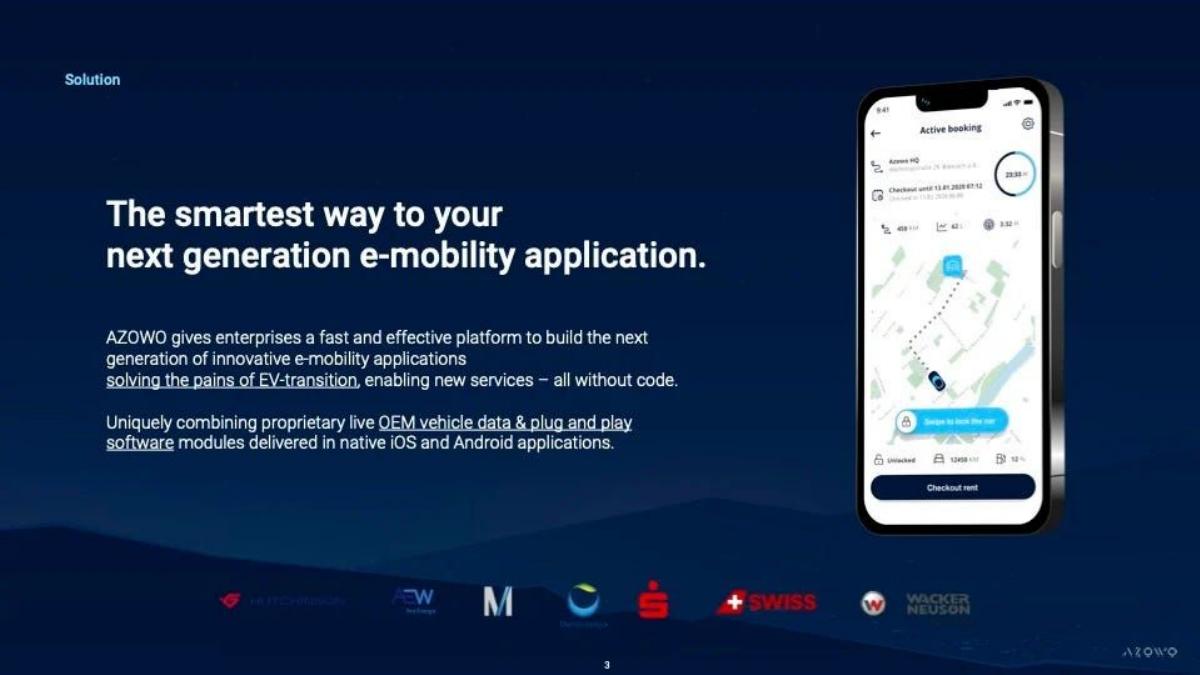
Slide 3: The Solution and No-Code Value Prop
Slide 3 is the core value proposition slide. It claims Azowo is the 'smartest way to your next generation e-mobility application.' The most important detail here is the phrase 'all without code.' For large enterprises (represented by the logos at the bottom including Swiss, Wacker Neuson, and Munich Airport), the ability to deploy complex mobility solutions without a massive internal engineering lift is a significant selling point. The slide also highlights the combination of 'proprietary live OEM vehicle data' and 'plug and play software modules,' which suggests a bridge between raw hardware data and user-facing applications.
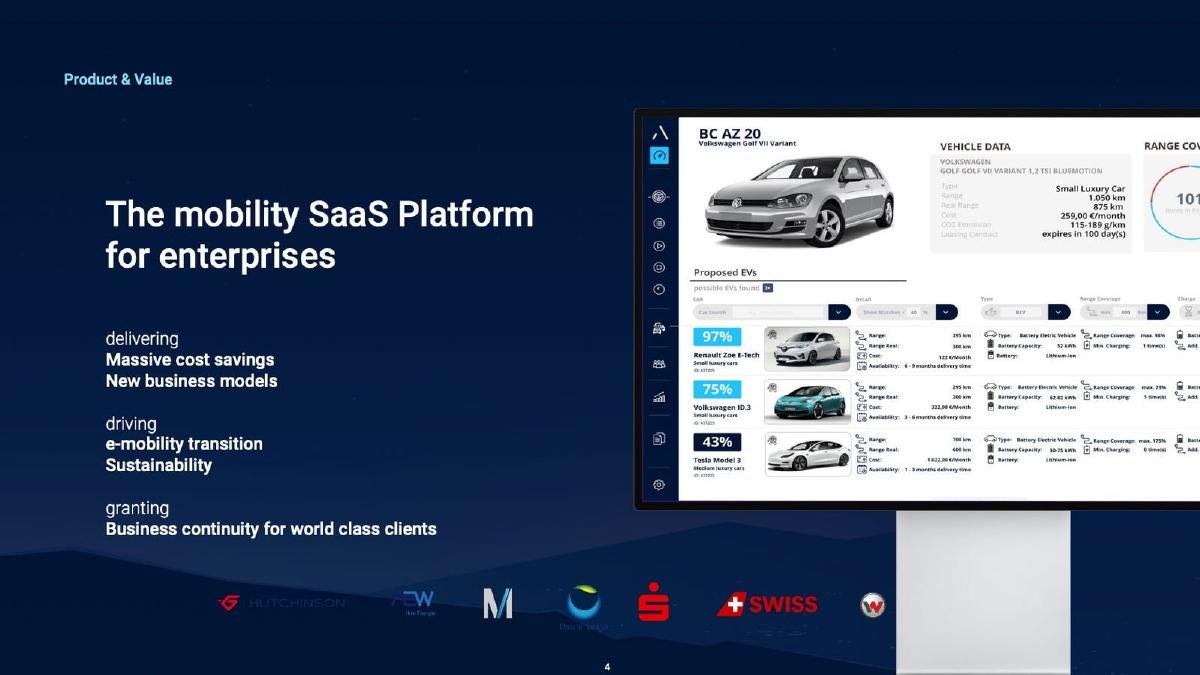
Slide 4-5: Technical Architecture and Modularity
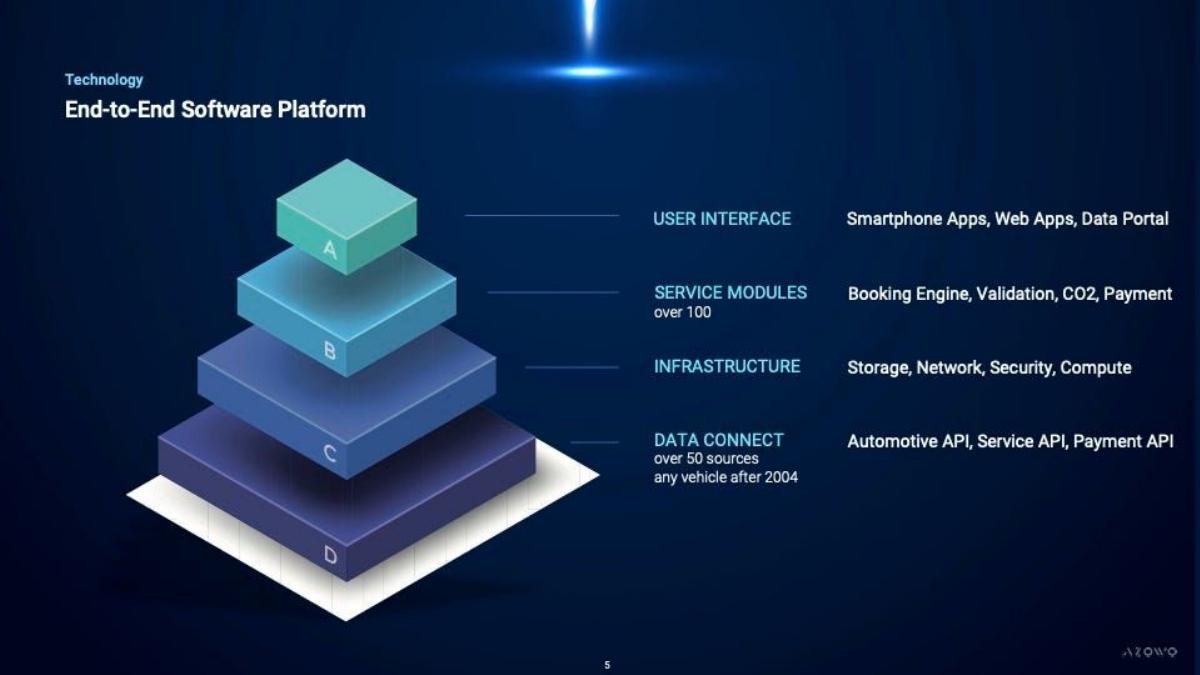
Slide 5 provides a visual breakdown of the 'End-to-End Software Platform' using a four-tier pyramid model. This is an effective way to communicate technical depth without overwhelming the reader. The tiers are:
User Interface: Smartphone apps, web apps, and data portals. · Service Modules: Over 100 modules including booking engines, CO2 tracking, and payments. · Infrastructure: Storage, network, security, and compute. · Data Connect: Over 50 sources, compatible with any vehicle after 2004.
The fact that they can connect to vehicles dating back to 2004 is a vital metric. It proves the platform isn't just for brand-new EVs but can manage legacy fleets during a phased transition.
Slide 6-9: Customer Use Cases and Proof of Concept
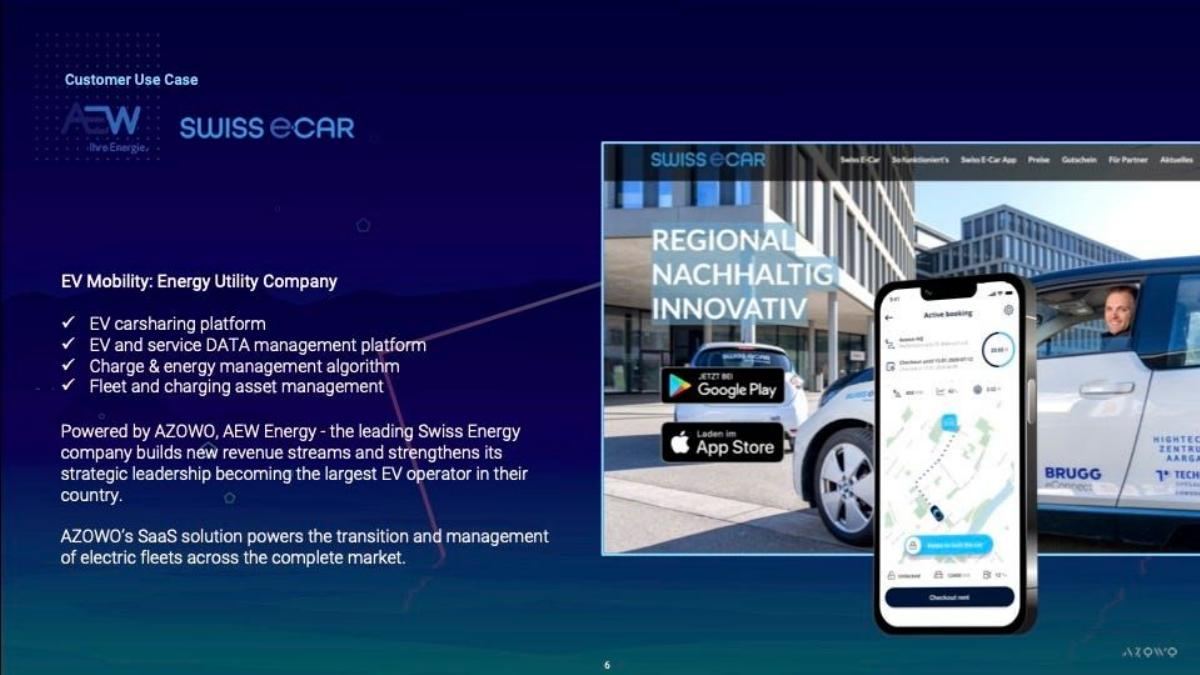
Slides 7 and 9 are dedicated to 'Customer Use Cases,' which serve as the deck's primary evidence of product-market fit. Slide 7 features 'Swiss E-Car,' showing a branded app and physical charging infrastructure. Slide 9 focuses on Munich Airport (Flughafen München), which is a high-value enterprise client. The slide lists specific achievements: a multi-modal platform for 2,000+ employees, real-time data connection, and a 5-year plan for zero-emission mobility. These slides move the deck from theoretical software to practical, large-scale implementation.
Slide 10-11: The Ask and Financial Strategy
Slide 11 is the 'Financials' and investment plan slide. It explicitly states a '€10m Series A' target for 'H2 22.' A key piece of information for new investors is that '35% [is] Committed by Existing Investors.' This creates a sense of momentum and internal validation. The slide also details a significant strategic pivot: Azowo plans to shift its focus from 75% product development to 70% sales and marketing. This is a classic Series A narrative—the product is built and validated; now it is time to scale the go-to-market engine.
Slide 12-13: The Team and Advisory Board
Slide 13 introduces the leadership. The team is presented as a 'paramount combination of management and product experience.' The bios are concise, focusing on years of experience: Albert Pescheck (15 years SaaS), Patric Schneider (12 years automotive), and Dr. Jan Balazia (10 years dev team leadership). The inclusion of Uwe Horstman from Project A Ventures and Andreas von Lochow (Ex-BCG/Rocket Internet) as advisors adds institutional credibility to the startup.
Slide 14: Closing
The deck concludes with a standard contact slide, maintaining the visual theme established in the opening.
What Azowo Does Well
The Azowo deck excels at modularizing a complex technical offering . By breaking the platform down into 'Service Modules' and 'Data Connect' layers, they make a sophisticated data-ingestion engine feel like a simple 'plug and play' tool for enterprises. This is essential when selling to non-technical stakeholders in large corporations or traditional transportation companies.
Furthermore, the use of high-profile logos and detailed case studies (Slides 7 and 9) provides the 'social proof' necessary for a $10M round. Showing a 2,000-employee deployment at a major international airport proves that the software can handle enterprise-grade scale and security requirements.
Finally, the transparency regarding the shift in capital allocation (Slide 11) is a strong signal to investors. It shows the founders understand that the Series A is about scaling revenue, not just continuing R&D in a vacuum.
What is Missing from the Azowo Deck
Despite its strengths, there are notable omissions in the Azowo deck that a rigorous investor would likely question in a follow-up meeting:
Competition: There is no slide addressing the competitive landscape. The mobility software space is crowded, with players ranging from legacy fleet management providers to other well-funded startups like Ridecell or Vulog. Azowo does not explicitly state how their 'proprietary live OEM data' differs from competitors. · Unit Economics and Revenue: While the deck mentions a shift toward sales and marketing, it does not provide specific revenue figures, CAC (Customer Acquisition Cost), LTV (Lifetime Value), or churn rates. For a Series A, investors usually expect to see these SaaS metrics to justify a $10M check. · Market Size (TAM/SAM/SOM): The deck assumes the investor already understands the massive shift toward EVs. It lacks a dedicated slide quantifying the total addressable market for mobility-as-a-service (MaaS) software in Europe or globally. · Roadmap: While Slide 11 mentions 'geographical expansion,' there is no visual roadmap showing which markets are next or what specific features are being developed in the 20% product allocation.
Founder Takeaways
1. Sell the 'No-Code' Dream: If your product is technically dense, follow Azowo’s lead by emphasizing how easy it is for the customer to use. The 'no-code' and 'plug-and-play' labels (Slide 3) are powerful tools for overcoming enterprise sales friction.
2. Use 'Committed Capital' to Build Urgency: If you have existing investors following on, highlight the percentage of the round already committed (Slide 11). It reduces the perceived risk for new lead investors.
3. Prove Scale with Specifics: Don't just say you have customers; show the scale. Azowo’s mention of '2,000 employees' and '100% EV transition' (Slide 9) makes the success of their Munich Airport partnership quantifiable and impressive.
4. Define the Pivot from R&D to Sales: A Series A deck should clearly signal that the company is ready to grow. Explicitly stating that you are shifting your budget from product-heavy to sales-heavy (Slide 11) shows maturity and alignment with venture capital goals.
Frequently asked questions
- What is Azowo's core value proposition for enterprises?
- Azowo provides a fast, effective, and no-code platform for enterprises to build e-mobility applications. According to Slide 3, it uniquely combines proprietary live OEM vehicle data with plug-and-play software modules delivered via native iOS and Android applications, specifically designed to solve the pains of EV transition.
- How does Azowo handle vehicle data compatibility?
- Slide 5 details their 'Data Connect' layer, which can interface with over 50 sources. Crucially, the platform claims compatibility with any vehicle manufactured after 2004, utilizing automotive, service, and payment APIs to ensure broad fleet coverage regardless of the vehicle's age or manufacturer.
- What specific use cases does the deck highlight?
- The deck highlights two primary use cases: Swiss E-Car (Slide 7) and Munich Airport (Slide 9). The Munich Airport case study demonstrates a multi-modal mobility platform for over 2,000 employees, integrating car sharing, ride pooling, and public transport to achieve a 100% EV and CO2-neutral strategy.
- How did Azowo plan to use the $10M Series A funding?
- As shown on Slide 11, the majority of the funds (55%) were earmarked for sales and marketing. The remaining budget was split between product development (20%), geographical expansion (15%), and strategic partnerships or acquisitions (10%). This represented a major shift from their previous 75% focus on product development.
- Who are the key members of the Azowo leadership team?
- The team (Slide 13) is led by CEO Albert Pescheck (15 years SaaS experience) and COO Patric Schneider (12 years automotive product experience). They are supported by CTO Dr. Jan Balazia and Senior Sales Manager Tanja Glocker, alongside advisors from Project A Ventures and Rocket Internet.