The Azumi pitch deck, likely produced around 2015 based on its internal data, presents a solution for the 'lost decade' of music industry revenues by shifting from physical sales to artist-led subscriptions. The platform, described as 'Culture’s Playground,' aimed to provide a sophisticated web app where artists could control pricing and perks. While the deck successfully identifies the macro trend toward decentralization and the growing willingness of fans to pay for subscriptions—citing 41 million paid music subscribers in 2014—it lacks critical financial projections and a specific funding…
Key takeaways
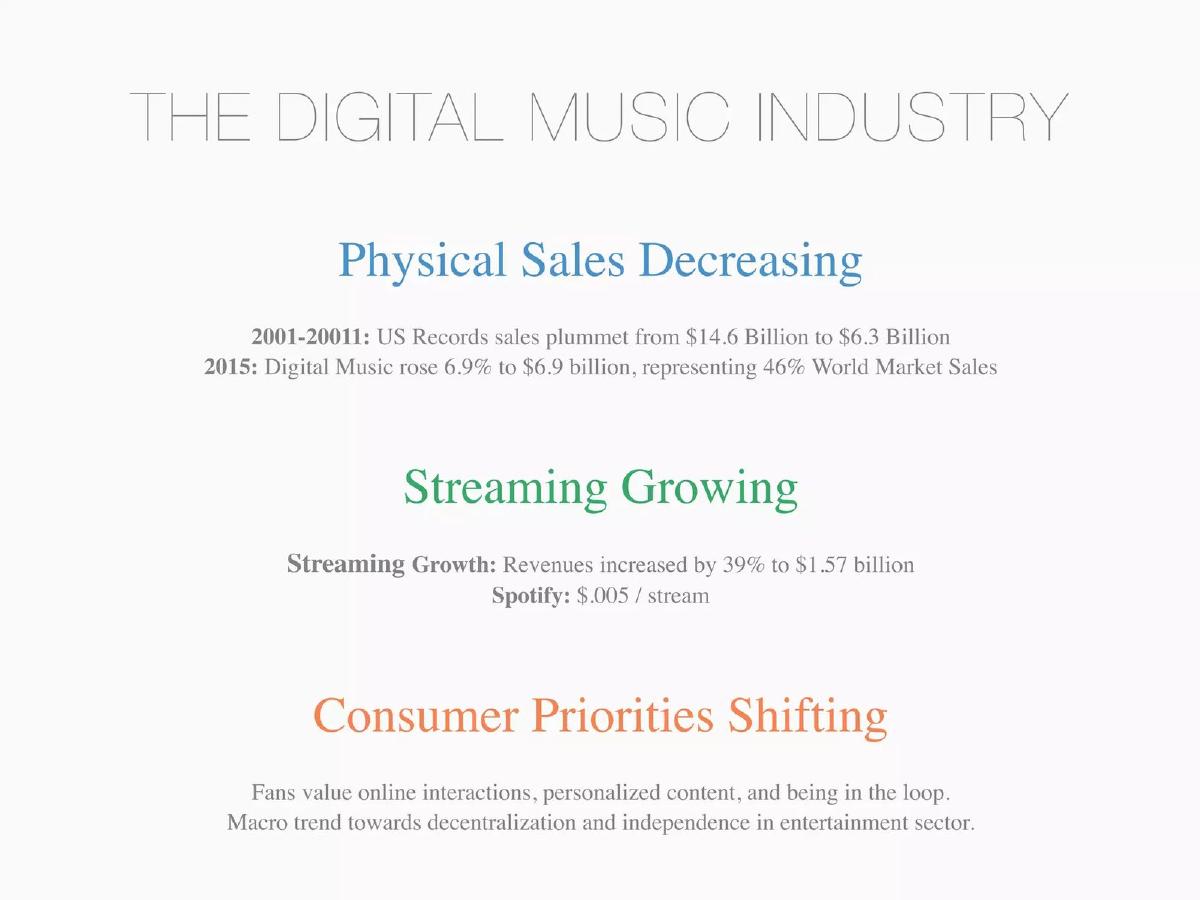
- The deck identifies a massive decline in US record sales from $14.6 billion in 2001 to $6.3 billion in 2011 (Slide 2).
- Azumi defines its core value proposition as 'Privatizing Social Media' through a subscription fee model for exclusive content (Slide 4).
- Market data cites that 41 million people paid for music subscriptions in 2014, a 5x increase from 2010 (Slide 3).
- The platform positions itself against Patreon and Drip.fm, targeting a price range of $15-$100 per year (Slide 7).
- The team includes six members and two advisors, with backgrounds spanning Tesla, Columbia Records, and The Fader (Slide 6).
- A competitive 'Matrix' slide notes that Bandcamp's planned entry into the subscription space was a primary concern for the founders (Slide 7 and 8).
- The product vision includes 'Tribes' which are free to join, while artists retain control over brand sponsorships (Slide 5).
- The deck concludes with a 'Sources' slide, referencing Nielsen, SXSW, and the New York Times to validate market trends (Slide 9).
Executive Summary: The Pivot to the Creator Economy
The Azumi pitch deck is a time capsule from the mid-2010s music tech scene. It captures the moment when the industry realized that streaming, while a savior for labels, was not providing a livable wage for the average artist. Azumi’s solution—privatized social media—predates the massive explosion of the 'creator economy' but identifies the exact levers (exclusivity and community) that would later make platforms like OnlyFans or Substack successful. However, as a fundraising tool, the deck relies heavily on macro trends and design aesthetics while omitting the hard numbers investors usually require.
Slide 1: Title and Vision
The deck opens with a minimalist aesthetic. The tagline "CULTURE’S PLAYGROUND" and the statement "Music needed a new model. We built it." set a bold, if somewhat vague, tone. The contact information for Max Lawrence is provided, establishing the founder as the primary point of contact. The logo, a simple wave inside a circle, suggests a focus on audio or frequency, fitting for a music-centric platform.
Slide 2: The Digital Music Industry Landscape
This slide serves as the 'Problem' slide, though it frames it as a market shift. It cites that US Records sales plummeted from $14.6 Billion to $6.3 Billion between 2001 and 2011. It also highlights the meager $0.005 per stream payout from Spotify. By contrasting the 6.9% rise in digital music sales against the decline of physical media, the deck argues that the appetite for music is there, but the monetization method is broken. The mention of a "Macro trend towards decentralization" shows early alignment with what we now call Web3 or direct-to-fan movements.
Slide 3: Subscription Growth Validation
To prove the viability of a paid model, Slide 3 notes that 41 million people paid for music subscription services in 2014 , which was five times the level of 2010. This is a crucial piece of evidence for the 'Solution' that follows; it proves that the consumer behavior of paying for access (rather than ownership) has already been mainstreamed by platforms like Spotify and Rhapsody.
Slide 4: The Azumi Solution
Azumi defines its solution as "Privatizing Social Media." The core mechanic is simple: "anyone with a following can provide core fans exclusive content and interaction for a subscription fee." This is a clear, jargon-free explanation of the product. It moves the artist-fan relationship away from public platforms like Twitter or Instagram and into a gated environment where the artist captures the value.
Slide 5: Value Proposition for Artists
This slide focuses on the 'Why' for the supply side of the marketplace. It promises a "Sophisticated WebApp" and "Independence." The deck claims that artists will be in "complete control of price, perks, and brand sponsorships." The use of the term "Tribes" suggests a community-centric architecture where fans aren't just consumers but members of a specific artist's ecosystem.
Slide 6: The Team
The team slide is strong on pedigree but leans heavily on academic credentials. With four members linked to New York University (NYU) and one to Parsons , it is clearly a group of young, design-forward founders. The inclusion of Leonard Truong , with experience at Tesla Motors , provides technical credibility, while advisors from Cantora Labs and MAC Presents suggest the team has the necessary industry connections to navigate the complex world of music licensing and artist management.
Slide 7: Competitive Matrix
The 'Matrix' slide is one of the most informative in the deck. It compares Azumi to Patreon, Drip.fm, Bandcamp, and Individual Fan Clubs . Azumi positions itself as a "Subscription based marketplace" with a price range of "$15-$100/year." Interestingly, it notes that Bandcamp’s subscription service was 'planned' at the time, and Drip.fm was limited to 'Labels only.' This positioning shows Azumi aiming for a middle ground: more structured than a fan club, but more music-focused than Patreon.
Slide 8: Risks & Considerations
It is rare to see a 'Risks' slide in a seed-stage deck, but Azumi includes one. They address three questions: "Will fans pay for this?" (Research says yes), "When to go to market?" (Bandcamp’s entry is concerning), and "Entrepreneurship vs Employment." The latter is an unusually honest admission of the founders' personal stakes, weighing "Shorts vs. Long Term Gain." While honest, this might signal a lack of total commitment to some institutional investors.
Slide 9: Sources
The deck concludes its narrative with a list of sources, including Nielsen/SXSW, Money.CNN, and The New York Times . This adds a layer of professionalism and proves that the founders have done their homework regarding the 'Lost Decade' of music and the decline of downloads.
Slide 10: Product Mockup
The final slide provided is a high-fidelity mockup of the Azumi interface, featuring Daft Punk as the example artist. The UI is grid-based, resembling a mix of Tumblr and a modern dashboard. It shows a "Crate," "Tribes," and "Playground" navigation, along with a social feed and a music player. The design is clean and supports the 'Sophisticated WebApp' claim made on Slide 5.
What Works in the Azumi Deck
The deck excels at market timing and problem identification . By 2015, the 'starving artist' narrative in the streaming era was reaching a fever pitch, and Azumi’s focus on 'privatizing social media' was a prescient take on what would become a multi-billion dollar industry. The design aesthetic is consistent and professional, which is vital for a company claiming to build a 'sophisticated' product for the creative class. Furthermore, the Competitive Matrix (Slide 7) is well-researched and clearly defines where the company fits in the existing ecosystem.
What is Missing from the Azumi Deck
The most glaring omission is the Fundraising Ask . There is no mention of how much money is being raised, the valuation, or the milestones the team intends to hit with the capital. Additionally, there are no Unit Economics . While they mention a price range for fans, they do not disclose Azumi’s take rate or how they plan to handle payment processing and music licensing costs—two notoriously difficult hurdles in music tech. Finally, the Go-To-Market (GTM) strategy is absent. Identifying that fans will pay is one thing; explaining how you will acquire the first 100 artists and their respective 'Tribes' is another.
Founder's Playbook: What to Copy
Founders should look to Slide 2 and 3 as examples of how to use third-party data to validate a shift in consumer behavior . Instead of just saying 'people like music,' Azumi uses specific dollar amounts and growth multiples to create a sense of urgency. The Product Mockup on Slide 10 is also a 'gold standard' for early-stage decks; it uses a recognizable, high-status brand (Daft Punk) to help investors visualize the platform's potential 'cool factor.' Lastly, the Team Slide (Slide 6) effectively uses logos (Tesla, Columbia Records, The Fader) to provide instant social proof, even if the team members were in junior or intern roles at those organizations.
Frequently asked questions
- What is the primary problem Azumi is trying to solve?
- Azumi addresses the decline of traditional music revenue models. According to Slide 2, physical sales plummeted by over 50% between 2001 and 2011. The deck argues that while streaming is growing, the payout of $0.005 per stream on Spotify is insufficient for artists, necessitating a new model based on direct-to-fan subscriptions and 'privatized' social interactions.
- How does Azumi plan to differentiate itself from Patreon?
- Per the 'Matrix' on Slide 7, Azumi differentiates by sector and psychological drivers. While Patreon is categorized under 'The Arts' with a 'Donor Gratification' driver, Azumi focuses on 'Entertainment' with drivers of 'Exclusive Access, Interaction, and Membership.' Azumi also planned a specific price range of $15-$100/year, whereas Patreon uses per-project or tiered donation models.
- Who are the key members of the Azumi team?
- The team is led by Founder Max Lawrence, who studied Music Entrepreneurship at NYU. Technical leadership includes Leonard Truong (Head Engineer, formerly of Tesla) and Johnny Shankman (Engineer). The team is supported by advisors Nick Panama (Cantora Labs) and Marcie Allen (MAC Presents), providing a mix of technical execution and music industry connections as shown on Slide 6.
- What are the biggest risks identified by the founders?
- Slide 8 explicitly lists three risks: fan willingness to pay, go-to-market timing, and the personal trade-off of 'Entrepreneurship vs Employment.' Notably, they cite Bandcamp's potential entry into the subscription market as a concerning competitive threat, indicating they were aware of larger incumbents moving into their specific niche.
- What is missing from this pitch deck?
- The deck is missing several standard fundraising components. There is no 'Ask' slide detailing how much capital is being raised or how it will be used. It also lacks a business model slide explaining the company's take rate, a marketing/growth strategy, and any financial projections or current traction metrics beyond general market research.