Axon’s MAP16 Demo Day deck is a minimalist, visual-heavy presentation designed to highlight the operational inefficiencies within hospital environments. By quantifying the '178 tasks' and '700 possible clinical pathways' involved in patient care, the deck establishes a clear problem of complexity. The solution is hinted at through a mobile interface mockup showing clinical communication via WhatsApp, suggesting a need for a more formal, secure alternative. While the deck succeeds in problem identification and showcases a team with strong medical credentials, it lacks critical financial data,…
Key takeaways
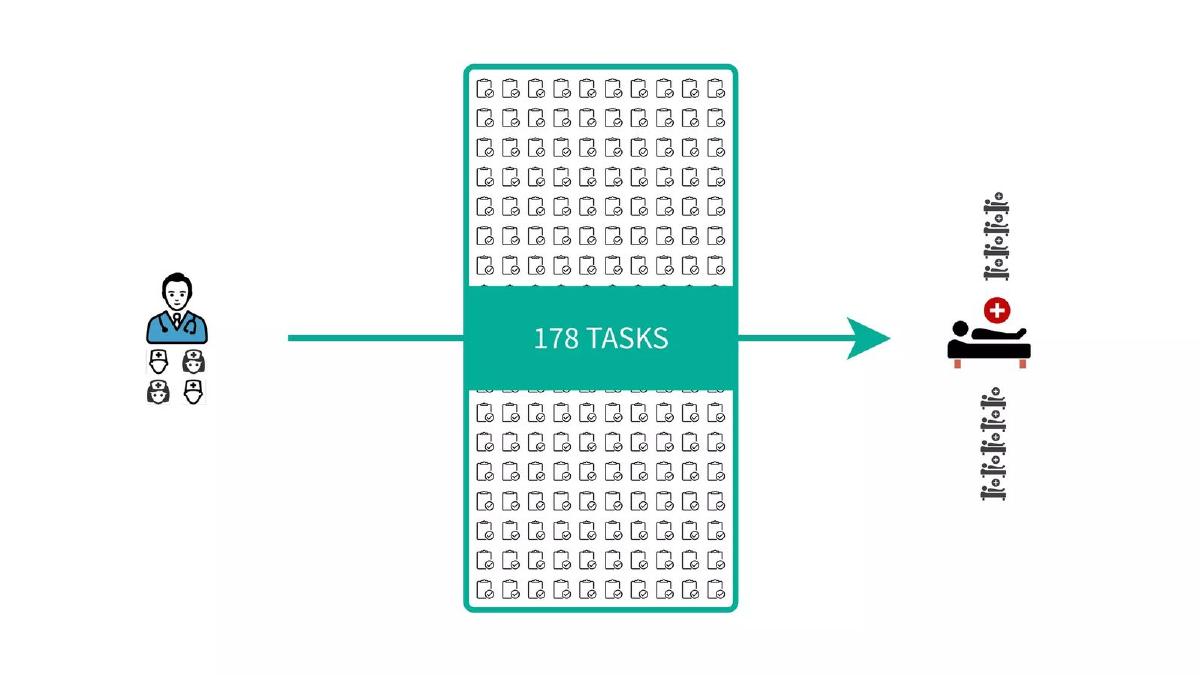
- The deck identifies a high-friction environment where a single medical team manages 178 discrete tasks for a patient (Slide 3).
- Complexity is further emphasized by the claim of 700 possible clinical pathways between staff and patients (Slide 4).
- The current 'shadow IT' problem is illustrated with a WhatsApp notification mockup regarding a wound photo and antibiotic request (Slide 5).
- The founding team features two medical doctors, including Dr. Chandrashan Perera (CEO) and Dr. Paul Paddle (CMO), providing high domain authority (Slide 6).
- The roadmap targets a transition from a 'Hospital Departmental Approach' in 2016 to full 'International' expansion by 2019 (Slide 7).
- Early traction is indicated by the presence of Austin Health and Monash Health logos on the roadmap slide (Slide 7).
- The deck completely omits a business model, pricing strategy, or competitive analysis within the provided slides.
- There is no specific funding 'Ask' or breakdown of how capital would be deployed to reach the 2019 international goal.
Slide-by-Slide Analysis
Slide 1: Title Slide
The deck opens with a minimalist dark grey background featuring the company name 'AXON' in white, sans-serif capital letters. A small, dashed green line sits beneath the text. There is no tagline, industry categorization, or date. This is a standard 'blind' title slide common in high-pressure Demo Day environments where the speaker provides the context verbally.
Slide 2: The Persona
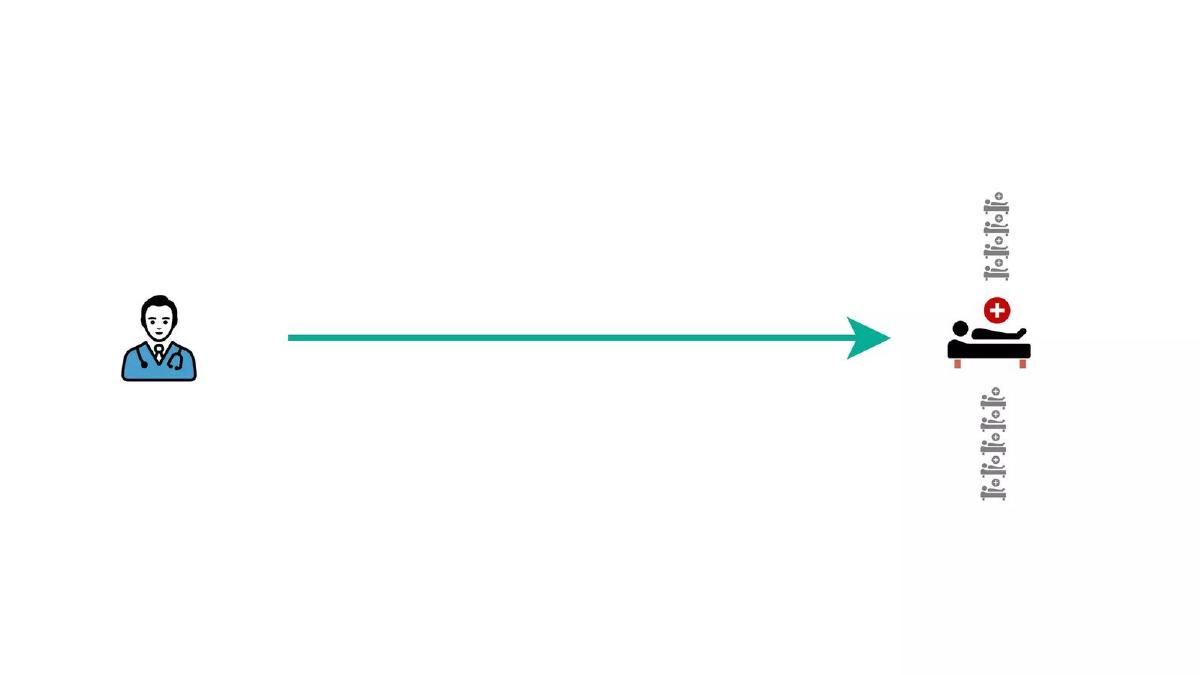
This slide contains only a single icon of a doctor in a blue coat with a stethoscope. There is no text. In a live pitch, this slide likely serves as the introduction to the 'user' or 'customer' profile, establishing the human element of the healthcare problem before moving into data-heavy slides.
Slide 3: Task Volume
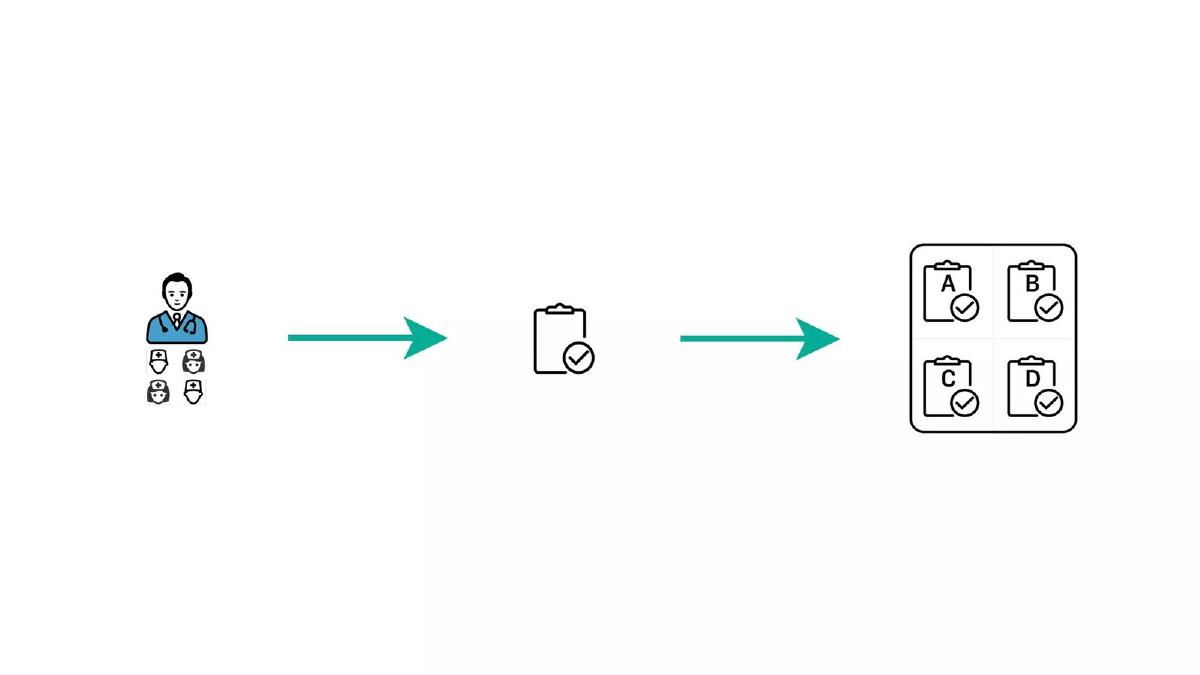
Axon begins to quantify the problem here. The slide shows a medical team (one lead doctor and four staff icons) on the left, an arrow pointing to a central green box, and a patient icon on the right. The central box contains the figure '178 TASKS' and is surrounded by dozens of clipboard icons. This slide effectively visualizes the administrative and clinical burden placed on a single team for a single patient interaction.
Slide 4: Pathway Complexity
Building on the previous slide, this visual replaces the tasks with '700 POSSIBLE CLINICAL PATHWAYS.' The background of the central box is filled with a chaotic web of colored lines (blue, green, red) connecting the medical team to the patient. This slide is designed to provoke a sense of 'complexity fatigue' in the audience, justifying the need for a software solution to manage these variables.
Slide 5: The Status Quo (Shadow IT)
This slide features a smartphone lock screen mockup. It shows two WhatsApp notifications. The text in the notification reads: 'Here is a wound photo from Mr. [Name Blurred] in Bed 22. Should he have antibiotics?' The use of WhatsApp—a consumer messaging app—in a clinical setting highlights a major compliance and security gap. It implies that because official systems are too complex, doctors resort to insecure, informal tools to get work done.
Slide 6: The Team
The team slide introduces four key members: Dr. Chandrashan Perera (CEO) , Dr. Paul Paddle (CMO) , Sanji Kanagalingam (COO) , and Julian Kelabora (CTO) . The inclusion of two medical doctors (CEO and CMO) is a significant credibility marker for a HealthTech startup, suggesting the product is designed by practitioners who understand the 700 pathways mentioned earlier.
Slide 7: Roadmap and Traction
The final slide in this set is a horizontal timeline. It lists two partner logos at the top left: Austin Health and Monash Health . The timeline outlines the following goals:
2016: Hospital Departmental Approach · 2017: Australian Hospitals · 2018: US Hospitals · 2019: International
This slide serves as both a traction proof-point (via the hospital logos) and a growth projection, though it lacks specific metrics for what 'International' or 'US Hospitals' entails in terms of seat count or revenue.
What Axon Does Well
Axon excels at visual storytelling . Instead of using bulleted lists to describe hospital inefficiency, they use specific numbers—178 and 700—to anchor the scale of the problem. The transition from Slide 3 to Slide 4 creates a logical escalation: first, there are too many tasks; second, the relationship between those tasks is too complex to manage manually.
The 'WhatsApp Slide' (Slide 5) is a masterclass in identifying a 'hair-on-fire' problem. Every hospital administrator knows that staff use personal messaging apps for clinical work, creating massive legal and security liabilities. By showing a real-world (albeit blurred) example of a doctor asking for antibiotic orders over WhatsApp, Axon makes the risk visceral to the investor.
Finally, the Team Slide is balanced. Having a CEO who is also a doctor (Dr. Chandrashan Perera) reduces the 'founder-market fit' risk that often plagues tech-heavy healthcare startups. The presence of a dedicated CTO and COO suggests the company has the operational and technical scaffolding to support the medical vision.
What Is Missing from the Deck
As a Demo Day pitch, this deck is intentionally light on text, but it leaves several critical investor questions unanswered. Most notably, there is no Business Model slide . It is unclear if Axon is a SaaS platform charging per clinician, a per-bed enterprise license, or a value-based care play. Without knowing how they capture value from the '700 pathways,' it is difficult to assess the venture's scalability.
There is also a complete absence of competitive analysis . The clinical communication space is crowded with players like Epic (Canto/Haiku), TigerConnect, and Vocera. Axon does not explain how its 'pathway' approach differs from these established incumbents or how they plan to integrate with existing Electronic Health Records (EHR) systems.
The Ask is missing . While this may have been delivered verbally or on a final slide not included in this set, a teardown must note that the capital requirement is not stated. An investor doesn't know if they are raising $500k for a pilot or $5M for the US expansion mentioned in the roadmap.
Lessons for Founders
1. Use 'Anchor Numbers' for Problem Slides: Axon didn't just say 'hospitals are busy.' They said there are '178 tasks.' Specificity creates authority. When pitching a complex industry, find a metric that represents the friction you are solving and make it the centerpiece of your slide.
2. Show the 'Dirty' Reality: Slide 5 (the WhatsApp notification) is effective because it shows the 'workaround' users have created. If your target customers are using a broken or insecure tool to solve a problem, show a screenshot of that tool. It proves that the demand for a solution already exists, even if the current solution is suboptimal.
3. Roadmap Alignment: Axon’s roadmap (Slide 7) is clean and follows a logical geographic progression. However, founders should ensure that their traction (the logos at the top) matches the current stage of the roadmap. Axon successfully places Austin Health and Monash Health next to the 2016 'Departmental' phase, which validates their starting point.
4. Iconography over Text: For a stage presentation, less is more. Axon’s use of simple icons for doctors and patients allows the audience to listen to the speaker rather than reading the screen. If you are designing a deck for a live pitch, aim for the 'one big idea per slide' rule demonstrated here.
Frequently asked questions
- What problem is Axon trying to solve?
- Axon targets the overwhelming complexity of clinical workflows. According to slides 3 and 4, medical teams are burdened by 178 tasks and 700 potential clinical pathways. The deck suggests that current communication often happens over insecure channels like WhatsApp (Slide 5), which creates risks for patient data and hospital efficiency.
- Who are the founders of Axon?
- The leadership team consists of Dr. Chandrashan Perera (CEO), Dr. Paul Paddle (CMO), Sanji Kanagalingam (COO), and Julian Kelabora (CTO). Having two doctors in the C-suite suggests the company is built on deep clinical insight rather than just technical capability.
- What is Axon's geographic expansion strategy?
- As shown on Slide 7, the company started with a departmental approach in 2016, aiming for broader Australian hospital adoption in 2017. They planned to enter the US hospital market in 2018 and achieve international scale by 2019.
- Does the deck show a working product?
- The deck shows a conceptual mockup of a mobile notification on Slide 5, but it does not provide a detailed walkthrough of a proprietary interface. It uses a blurred WhatsApp message to demonstrate the 'current state' of hospital communication rather than the 'future state' of the Axon product.
- What financial information is included in the pitch?
- The provided slides contain no financial information. There are no mentions of revenue, burn rate, customer acquisition costs, or the size of the investment they are seeking. It is a purely narrative and vision-based Demo Day deck.