Azoma’s 19-slide deck serves as a strategic manifesto for the post-SEO world. By framing the problem through the lens of changing consumer behavior—specifically that 58% of consumers have replaced traditional search with Gen AI tools—Azoma positions itself as the essential infrastructure for brands to remain visible. The deck is notable for its inclusion of a technical patent diagram (US12169850) and a direct case study showing a 3x traffic increase from ChatGPT for Winn-Dixie. While it lacks explicit financial projections or a detailed breakdown of the $4M ask, it succeeds by proving that AI…
Key takeaways
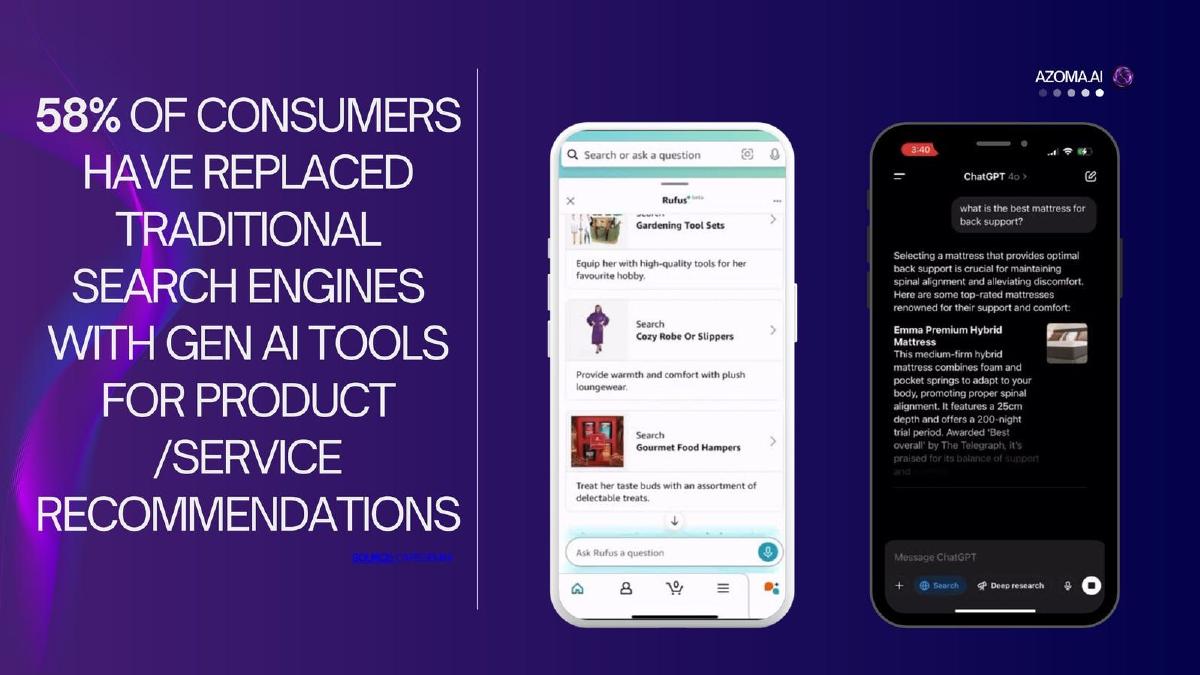
- 58% of consumers have already replaced traditional search engines with Gen AI tools for product recommendations (Slide 3).
- ChatGPT traffic converts at 14%, nearly five times the 3% conversion rate of traditional Google search traffic (Slide 5).
- The company holds a specific patent, US12169850, for content optimization and layout control within generative systems (Slide 7).
- Azoma demonstrated a 3x increase in traffic from ChatGPT during a pilot for Winn-Dixie (Slide 8).
- Wikipedia remains the dominant citation source for ChatGPT at 43%, while Google AI Overviews are more fragmented with Reddit at 20% (Slide 9).
- The company positions itself as a 'Verticalized workflow solution' for Enterprise, contrasting with horizontal analytics tools like Semrush (Slide 10).
- ChatGPT receives 18 billion messages weekly from 700 million users, with 1 in 4 conversations being brand-relevant (Slide 4).
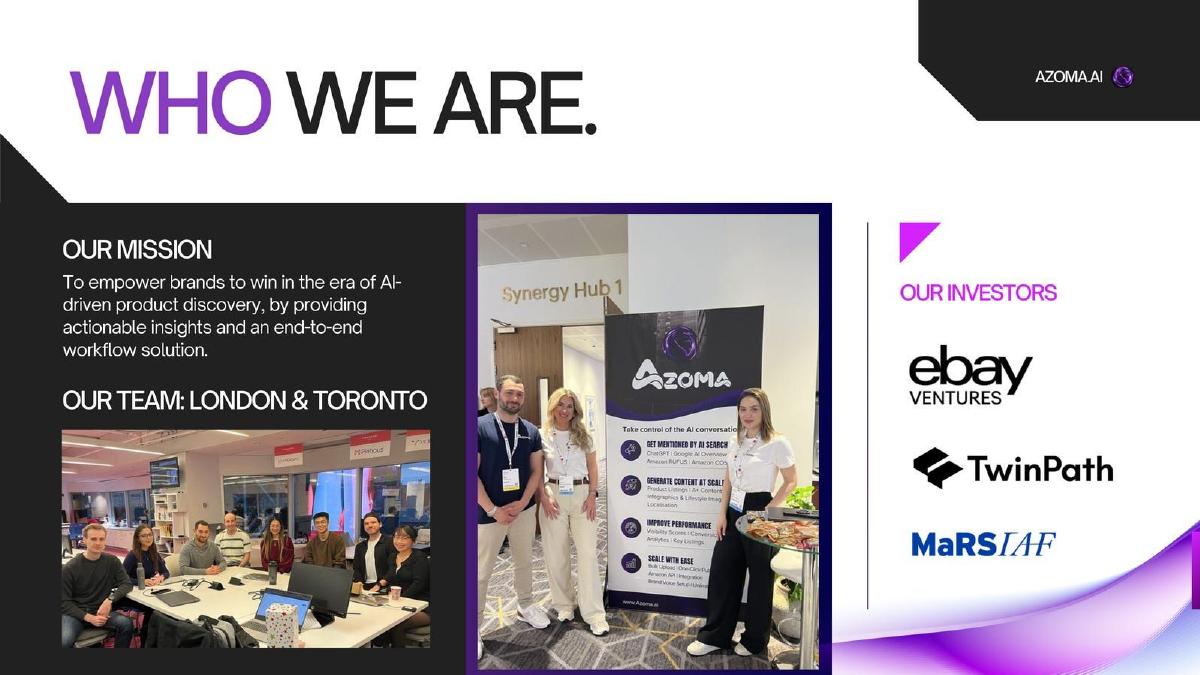
- The team is distributed across London and Toronto, supported by investors including eBay Ventures and TwinPath (Slide 2).
The Shift from Search to Answers
Azoma’s pitch deck is a masterclass in category creation. Operating in the rapidly evolving space of Generative Engine Optimization (GEO), the company uses its 19 slides to argue that the traditional search paradigm is dead. The narrative is built on the premise that if brands do not optimize for AI chatbots, they will become invisible to the next generation of consumers. The deck balances high-level market shifts with granular technical proof, including patent filings and specific conversion data.
Slide 1-2: Mission and Backing
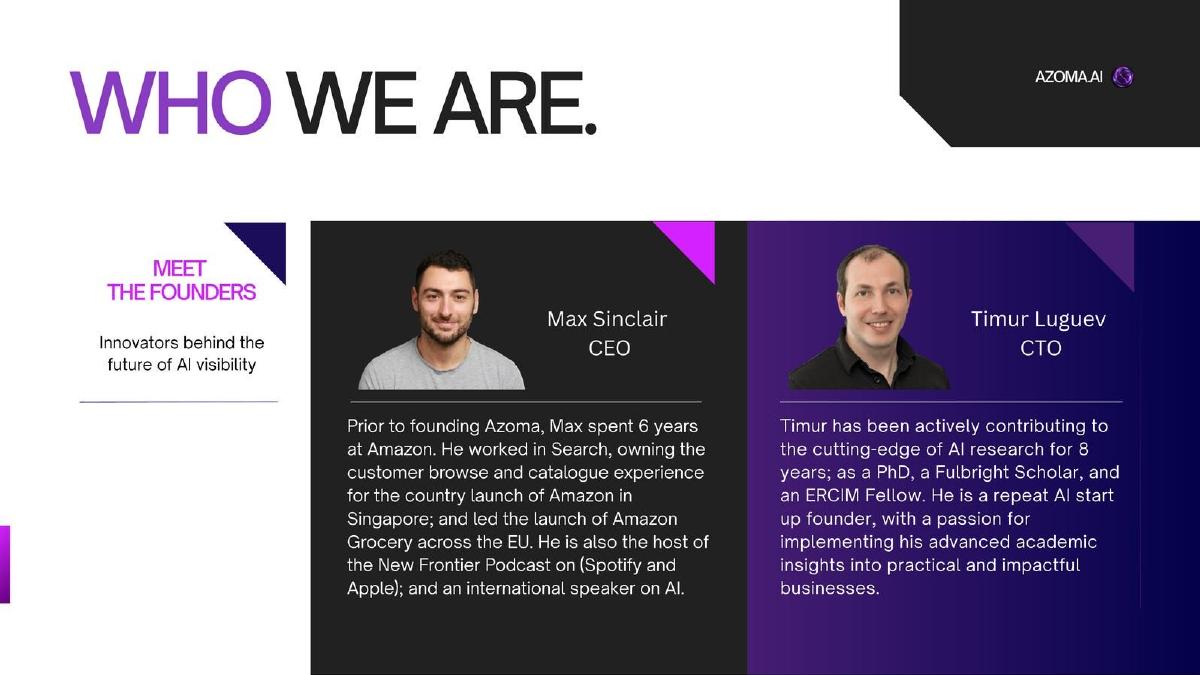
The deck opens with a clean brand identity and quickly moves to the 'Who We Are' slide. Azoma defines its mission as empowering brands to win in the era of AI-driven product discovery through actionable insights and end-to-end workflows. Notably, the team is split between London and Toronto, suggesting a transatlantic operational footprint. The investor section is high-signal, featuring eBay Ventures, TwinPath, and MaRS IAF. Including a photo of the team at a trade show booth adds a layer of 'real-world' presence that many pure-software decks lack.
Slide 3-4: The Macro Problem
Slide 3 presents the 'hook': 58% of consumers have replaced traditional search engines with Gen AI tools for product and service recommendations. This is a massive claim that justifies the existence of a new marketing category. Slide 4 supports this by quantifying the scale of the opportunity, noting that ChatGPT receives 18 billion messages weekly from 700 million users. The deck highlights that '1 in 4' of these conversations are potentially relevant for brands, specifically calling out sectors like Health, Beauty, and Purchasable Products. This narrows the focus from 'general AI' to 'e-commerce and brand utility.'
Slide 5: The Value Proposition (Conversion)
Perhaps the most compelling slide for a growth investor is Slide 5, which compares conversion rates by traffic source. Using data from Azoma client GA4 accounts, the slide shows that ChatGPT traffic converts at 14%, followed by Perplexity at 11.2%. This is contrasted against Google’s 3% conversion rate. The takeaway is clear: AI traffic isn't just new; it is higher intent and more valuable. This justifies why a brand would pay for a specialized GEO tool rather than just sticking with traditional SEO.
Slide 6-7: The Solution and The Moat
Slide 6 outlines a three-step process: understanding customer questions, identifying AI citation sources, and tracking share of voice. This transitions into Slide 7, which is the most technical in the deck. It showcases 'Our Patented Technology' (Patent US12169850). The slide includes a complex flow diagram detailing how the system imports product data, predicts conversion rates, calculates multimodal vector embeddings, and generates lifestyle images using diffusion models. For a Pre-Series A round, having a granted or pending patent in the AI space is a significant differentiator against 'wrappers' that simply call the OpenAI API.
Slide 8-9: Proof of Concept and Data Depth
Slide 8 provides a concrete case study for Winn-Dixie. It shows a 3x increase in ChatGPT traffic, claiming that the AI tool went from being a minor source to driving more organic traffic than Facebook, Instagram, and Yelp combined. Slide 9 demonstrates Azoma’s data moat by showing an analysis of 'tens of millions' of AI citations. It reveals that Wikipedia accounts for 43% of ChatGPT citations, while Google AI Overviews are more reliant on Reddit (20%) and YouTube (19%). This data suggests that Azoma understands the underlying 'source of truth' for different models, which is critical for optimization.
Slide 10: The Competitive Landscape
The 'AEO Landscape' slide uses a standard four-quadrant map but with specific pricing data for competitors. Azoma positions itself in the top-right quadrant: Enterprise-focused and Verticalized. By listing competitors like Perci ($15/listing), Jungle Scout ($29/mo), and Semrush ($150/mo), Azoma highlights the 'cheap' nature of horizontal tools compared to their own 'Custom Pricing' model. This signals to investors that Azoma is chasing high-ACV (Annual Contract Value) enterprise deals rather than high-churn SMB customers.
What Works in the Azoma Deck
Hard Data on Conversion: The comparison of conversion rates (14% vs 3%) is the strongest argument in the deck. It moves the conversation from 'AI is cool' to 'AI is a better sales channel.' Founders should always look for ways to prove that their new category delivers better ROI than the status quo.
Intellectual Property: Including the patent number and a detailed technical schematic provides a 'moat' narrative. In a market flooded with AI startups, showing that you own the underlying process for 'loss-guided attention control' suggests a level of engineering depth that is hard to replicate.
Platform Specificity: The deck doesn't treat 'AI' as a monolith. By showing different citation sources for ChatGPT versus Google AI Overviews, Azoma proves they have a granular understanding of the technical differences between LLMs. This builds credibility with technical investors.
What Is Missing from the Azoma Deck
The Financial Ask: While publisher reports state they raised $4M, the slides provided do not include a 'The Ask' slide. There is no mention of how the funds will be allocated (e.g., 50% engineering, 30% sales) or what milestones the company expects to hit with this capital.
Unit Economics: While the deck mentions 'Custom Pricing' for Enterprise, it lacks information on LTV (Lifetime Value), CAC (Customer Acquisition Cost), or current ARR (Annual Recurring Revenue). For a Pre-Series A deck, investors usually expect to see the beginnings of a repeatable sales motion.
Roadmap: The deck focuses heavily on the 'now' and the 'how.' It lacks a forward-looking roadmap slide that explains where the product goes next. Does it expand into video AI? Does it integrate directly with e-commerce platforms like Shopify or Amazon beyond just API connections?
Founder Takeaways
Quantify the Shift: If you are building in a new category, use a slide like Azoma’s Slide 3 to show that the world has already changed. Use third-party stats (in this case, Capgemini) to validate the problem. · Show, Don't Just Tell: The Winn-Dixie case study is effective because it uses a recognizable brand and a screenshot of a standard tool (GA4). It makes the results feel tangible and verifiable. · Price for Your Segment: By explicitly listing the low prices of competitors, Azoma makes its 'Custom Pricing' feel like a premium, white-glove necessity for enterprises rather than an expensive alternative. · Leverage Technical Moats: If you have a patent, put it front and center. It transforms a 'software tool' into 'proprietary technology' in the eyes of a VC.
Frequently asked questions
- What is Generative Engine Optimization (GEO)?
- GEO, also referred to as AEO (Answer Engine Optimization) in the deck, is the practice of optimizing digital content so that AI models like ChatGPT, Claude, and Google AI Overviews cite and recommend a specific brand. Azoma focuses on understanding customer questions, identifying AI citation sources, and tracking 'share of voice' rather than just traditional clicks.
- How does Azoma's technology differ from standard SEO tools?
- Unlike standard SEO tools that focus on keyword density for search algorithms, Azoma uses a patented system (Slide 7) to analyze embeddings of top-selling listings. It generates optimized titles, lifestyle images, and infographics using diffusion models with loss-guided attention control to ensure the content is specifically tailored for how generative AI 'perceives' and retrieves information.
- Who are Azoma's primary investors?
- According to Slide 2, the company is backed by eBay Ventures, TwinPath, and MaRS IAF. Publisher-reported data indicates they raised $4M in a Pre-Series A round in 2024 to further develop their SaaS platform.
- What evidence does Azoma provide for their product's efficacy?
- Azoma includes a specific case study for the retailer Winn-Dixie on Slide 8. The slide shows a Google Analytics 4 (GA4) screenshot demonstrating that ChatGPT traffic increased 3x during a pilot, eventually driving more organic traffic than Instagram, Facebook, and Yelp combined.
- What is the competitive landscape for AI search optimization?
- Slide 10 maps the landscape, placing Azoma in the 'Enterprise' and 'Verticalized workflow' quadrant. Competitors include Perci and Jungle Scout (SMB-focused), Semrush (Horizontal analytics), and Jasper (Horizontal content generation). Azoma differentiates by offering custom enterprise pricing and a specialized workflow for product discovery.