Axle Health’s Series A deck is a masterclass in identifying a massive, macro-driven market pain point and presenting a surgical solution. By focusing on the 'clinical capacity gap'—where demand for home health is growing at 8% CAGR while supply grows at only 1%—Axle positions itself as an essential efficiency layer rather than a luxury. The deck excels by showing, not just telling, the impact: citing a 17% increase in clinician productivity and a 121% Net Revenue Retention (NRR). While it lacks a traditional biographical team slide, it compensates with a powerful 'logo wall' of previous emplo…
Key takeaways
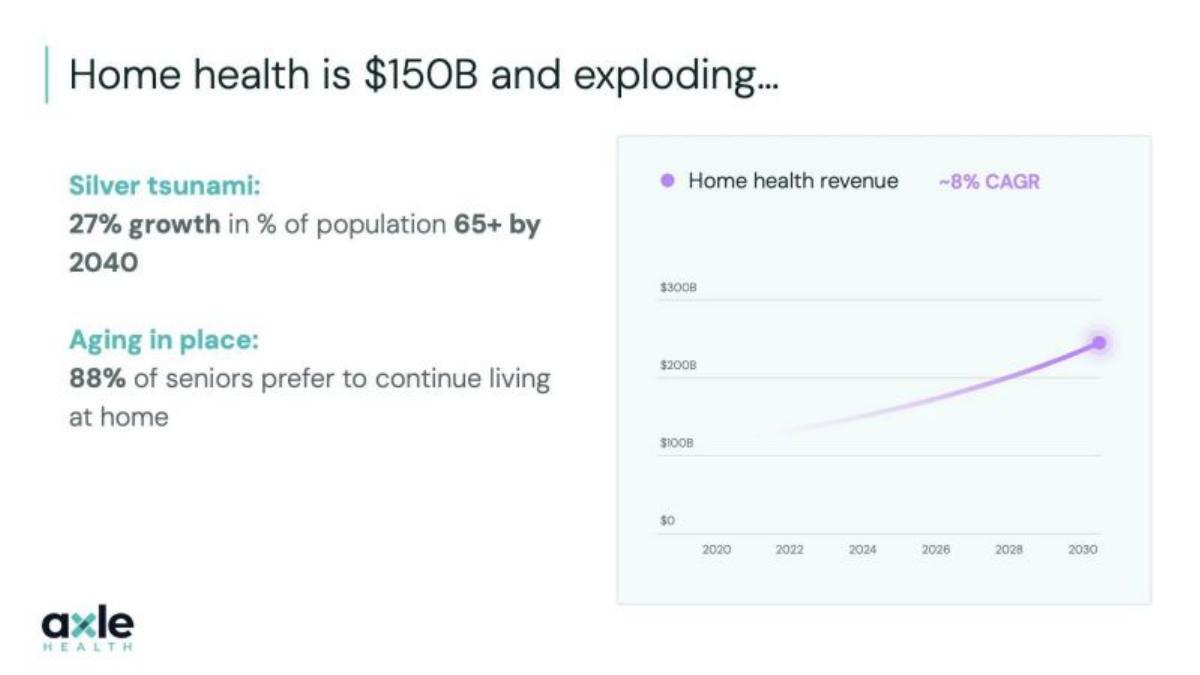
- The home health market is valued at $150B with an 8% CAGR, driven by a 27% growth in the 65+ population by 2040 (Slide 2).
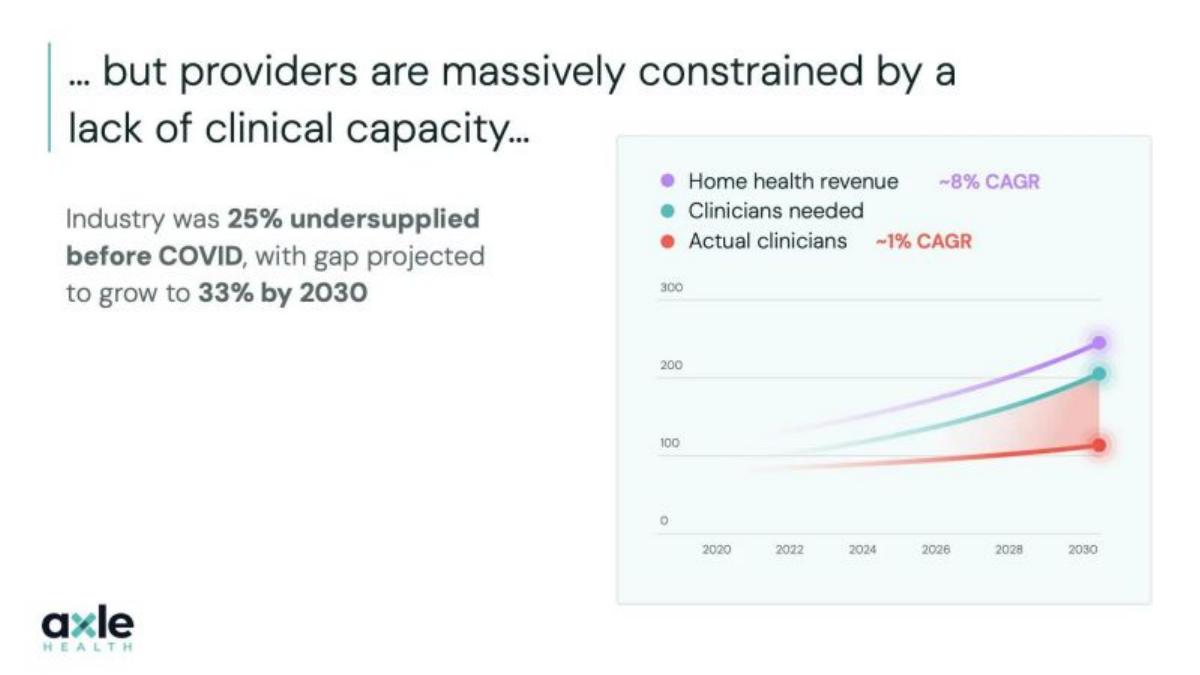
- A critical labor gap exists: the industry was 25% undersupplied before COVID, projected to reach 33% by 2030 (Slide 3).
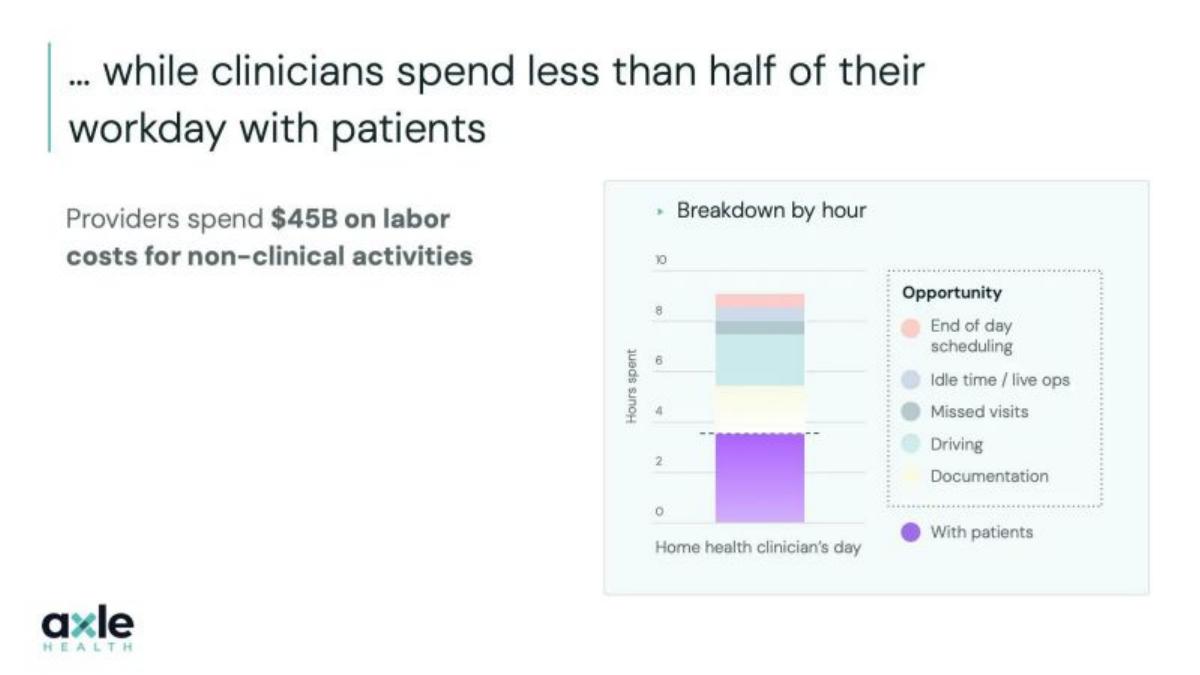
- Clinicians currently spend less than half of their workday with patients, with $45B spent by providers on non-clinical labor costs (Slide 4).
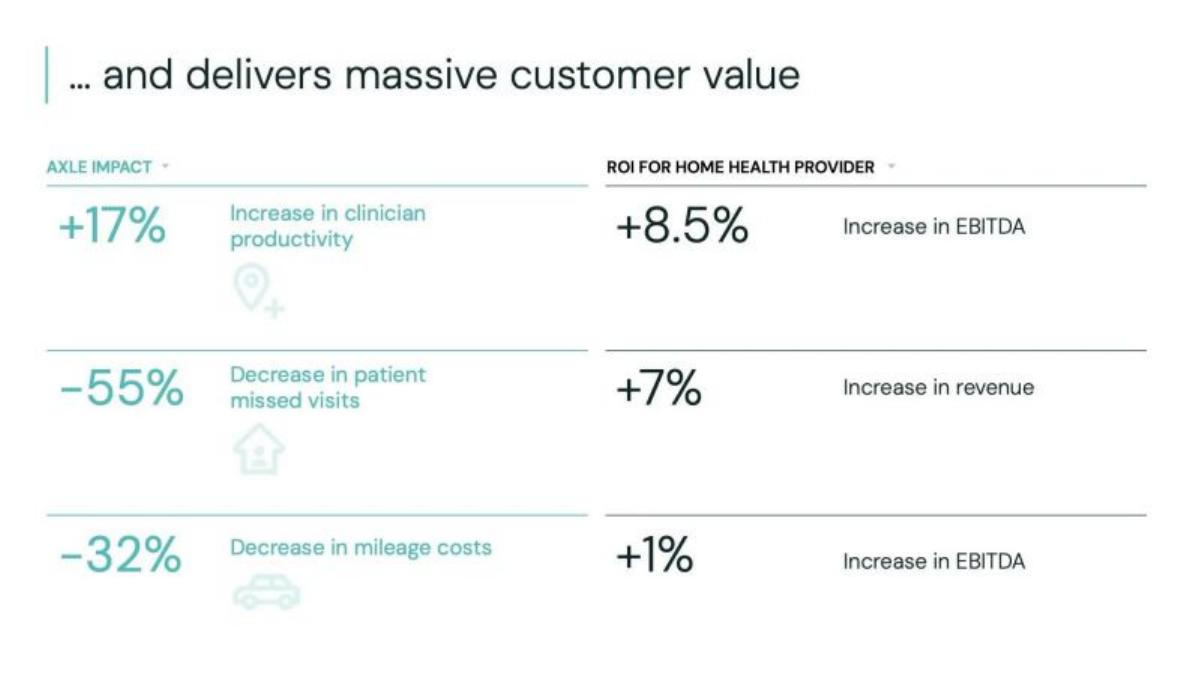
- Axle claims a 17% increase in clinician productivity, leading to an 8.5% increase in EBITDA for home health providers (Slide 6).
- The company demonstrates strong product-market fit with an annual Net Revenue Retention (NRR) of 121% (Slide 7).
- The 'Why Now' is driven by CURES Act interoperability regulations and AI advancements enabling EMR integrations via RPA (Slide 8).
- The $10M Series A raise is allocated as $7M for R&D, $2M for Sales & Marketing, and $1M for G&A (Slide 10).
- The product integrates directly with existing Electronic Medical Records (EMR) to automate scheduling without disrupting current workflows (Slide 14).
Executive Summary: The Efficiency Play for an Aging Population
Axle Health’s Series A deck is a clinical, data-driven argument for why the home healthcare industry must adopt AI-driven logistics. The narrative follows a classic problem-solution-traction arc, but with a specific focus on the 'labor gap' that makes their software a necessity rather than a 'nice-to-have.' By raising $10M from top-tier investors like F-Prime Capital and Y Combinator, Axle is positioning itself as the infrastructure layer for the 'Silver Tsunami.'
The Macro Opportunity (Slides 1-4)
Slide 1: Title The deck opens with a clear, functional subtitle: 'AI workforce management for home health and hospice.' It immediately identifies the target sector and the technology used.
Slide 2: Market Growth The 'Silver Tsunami' is quantified here. Axle notes a 27% growth in the population aged 65+ by 2040 and highlights that 88% of seniors prefer to live at home. The market is valued at $150B with an ~8% CAGR through 2030.
Slide 3: The Labor Constraint This is the 'crux' slide. It contrasts the 8% revenue growth with a stagnant ~1% CAGR for actual clinicians. The industry was 25% undersupplied before COVID, and that gap is widening to 33% by 2030. This creates a massive demand for efficiency tools.
Slide 4: The Inefficiency Axle breaks down a clinician's day to show that less than half of their time is spent with patients. The rest is consumed by documentation, driving, missed visits, and scheduling. Providers are spending $45B on labor costs for these non-clinical activities.
The Solution and Value Proposition (Slides 5-6)
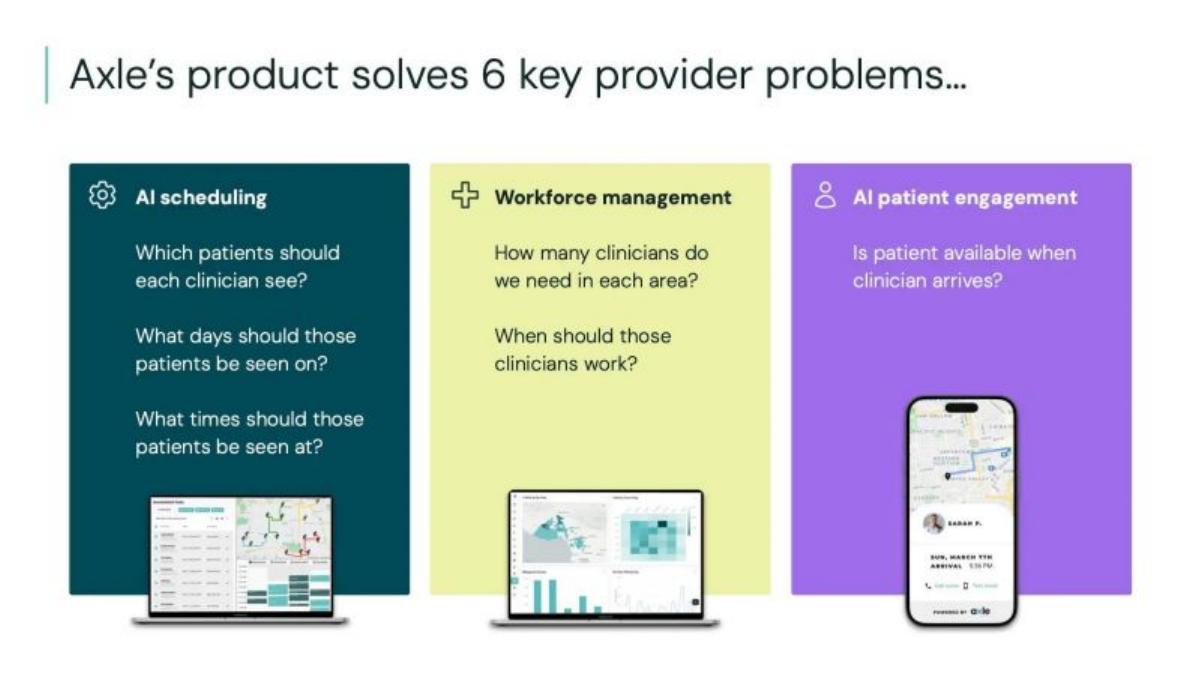
Slide 5: Product Pillars The product is divided into three buckets: AI scheduling (who, when, and what day), Workforce management (capacity planning), and AI patient engagement (availability and reminders). This slide uses clean mockups to show the interface across mobile and desktop.
Slide 6: Customer Value and ROI This is a high-impact slide for investors. It links product metrics to financial outcomes. A 17% increase in productivity leads to an 8.5% increase in EBITDA. A 55% decrease in missed visits leads to a 7% increase in revenue. These are the numbers that sell to enterprise healthcare CFOs.
Traction and Market Timing (Slides 7-8)
Slide 7: Cohort Analysis Axle displays a cohort table showing 121% NRR. The color-coded cells show that as cohorts age, they consistently spend more. A testimonial from Grand Care Health Services reinforces the 'product love' mentioned in the headline.
Slide 8: Why Now? The company cites three tailwinds: 1) Interoperability regulations (CURES Act) allowing for modular software, 2) The widening labor gap, and 3) AI advancements that enable EMR integrations via Robotic Process Automation (RPA).
The Team and The Ask (Slides 9-10)
Slide 9: The Right Team Instead of headshots, Axle uses a 'logo wall.' It’s impressive, featuring Big Tech (Google, Uber, Amazon), Healthcare (Kaiser, Philips), and elite Universities (MIT, Stanford, Penn). It also lists their existing backers, including Y Combinator and Pear.
Slide 10: The Raise The $10M Series A is broken down visually. The largest portion, $7M, is dedicated to R&D. $2M goes to Sales & Marketing, and $1M to G&A. This suggests a company still heavily focused on building out its technical moat.
The Appendix: Deep Dive into Operations (Slides 11-18)
Slide 12: Product Market Positioning Reiterates the core features: Smart Scheduling, Route Optimization, Advanced Analytics, and Patient Engagement.
Slide 13: Implementation Process For enterprise software, the 'how' is as important as the 'what.' Axle outlines a five-step 'white glove' onboarding process, from technical scoping to full rollout. This is designed to de-risk the sales process for large providers.
Slide 14: Workflow Automation This slide compares the 'Current State' (manual scheduling and phone calls) with the 'Future State' (Axle-automated). Crucially, it shows that documentation still happens in the EMR, meaning Axle doesn't require clinicians to learn an entirely new documentation system.
Slide 15: Smart Scheduling Details Focuses on reducing drive time and mileage costs while increasing clinician satisfaction by simplifying the routing process.
Slide 16: Advanced Analytics Shows heatmap visualizations for utilization projections and geographic demand. This is the 'management' side of workforce management.
Slide 17: Patient Engagement Highlights features like automated ETA messages and the ability to detect if a patient uses a landline versus a mobile phone to ensure reminders are received.
Slide 18: EMR Integration Diagram A technical flow chart showing how data moves between the Client EMR and the Axle Dashboard. It specifies that Axle reads demographics and plans of care, and writes back appointment dates and assignees.
What Works in This Deck
The 'Gap' Narrative: By framing the problem as a supply-demand mismatch (Slide 3), Axle makes their product feel inevitable. If you can't hire more people, you must make the people you have more productive.
Hard ROI: Slide 6 is the strongest in the deck. It doesn't just say 'we save time'; it says 'we increase EBITDA by 8.5%.' This is the language of Series A investing.
Expansion Proof: The cohort table on Slide 7 is a powerful way to show that the product is 'sticky' and that customers are willing to pay more over time.
What is Missing
Individual Team Bios: While the logo wall is impressive, investors usually want to see the actual founders and their specific roles. The lack of names or faces makes the team feel a bit anonymous.
Competitive Landscape: There is no slide addressing competitors. In a crowded healthcare IT space, explaining how Axle differs from legacy scheduling software or other AI startups would have been beneficial.
Unit Economics: While NRR is shown, there is no mention of Customer Acquisition Cost (CAC) or LTV/CAC ratios, which are standard for a Series A SaaS deck.
What a Founder Should Copy
The ROI Slide: Every B2B founder should have a slide like Slide 6 that connects product features to the customer's bottom line.
The Integration Diagram: If your product sits on top of a legacy system (like an EMR or Salesforce), use a diagram like Slide 18 to show exactly how data flows. It answers the 'how does this actually work?' question before it’s asked.
The 'Why Now' Slide: Using specific regulations (like the CURES Act) as a catalyst for your business is a great way to create a sense of urgency for investors.
Frequently asked questions
- What is the primary problem Axle Health is solving?
- Axle Health addresses the 'clinical capacity gap' in home healthcare. As shown on Slide 3, demand for home health is growing at 8% annually while the supply of clinicians is only growing at 1%. By using AI to optimize scheduling and routing, Axle helps existing clinicians spend more time with patients and less time on administrative tasks like driving and documentation.
- How does Axle Health prove its value proposition to providers?
- The deck provides specific ROI metrics on Slide 6. It claims to increase clinician productivity by 17%, decrease patient missed visits by 55%, and reduce mileage costs by 32%. These efficiencies translate directly to the bottom line, with a reported 8.5% increase in EBITDA for the home health provider.
- What does the company's traction look like?
- Axle demonstrates high-quality growth through its cohort analysis on Slide 7. The company reports a 121% annual Net Revenue Retention (NRR), meaning existing customers are expanding their use of the platform over time. The slide also includes a testimonial from the Director of Operations at Grand Care Health Services.
- How does Axle Health handle technical integration with healthcare systems?
- Slide 14 and Slide 18 detail the EMR integration. Axle uses a modular strategy enabled by the CURES Act to read patient demographics and plans of care from the client's EMR, then writes back the scheduled appointment data. This ensures that the AI-driven scheduling happens without disrupting the provider's established documentation workflow.
- What is the team's background?
- While the deck does not list individual names or titles, Slide 9 features a dense collection of logos from former employers and universities. The team includes alumni from Uber, Apple, Amazon, Google, and Microsoft, as well as healthcare organizations like Kaiser Permanente and Mass General Brigham, and graduates from Yale, Harvard, and Stanford.