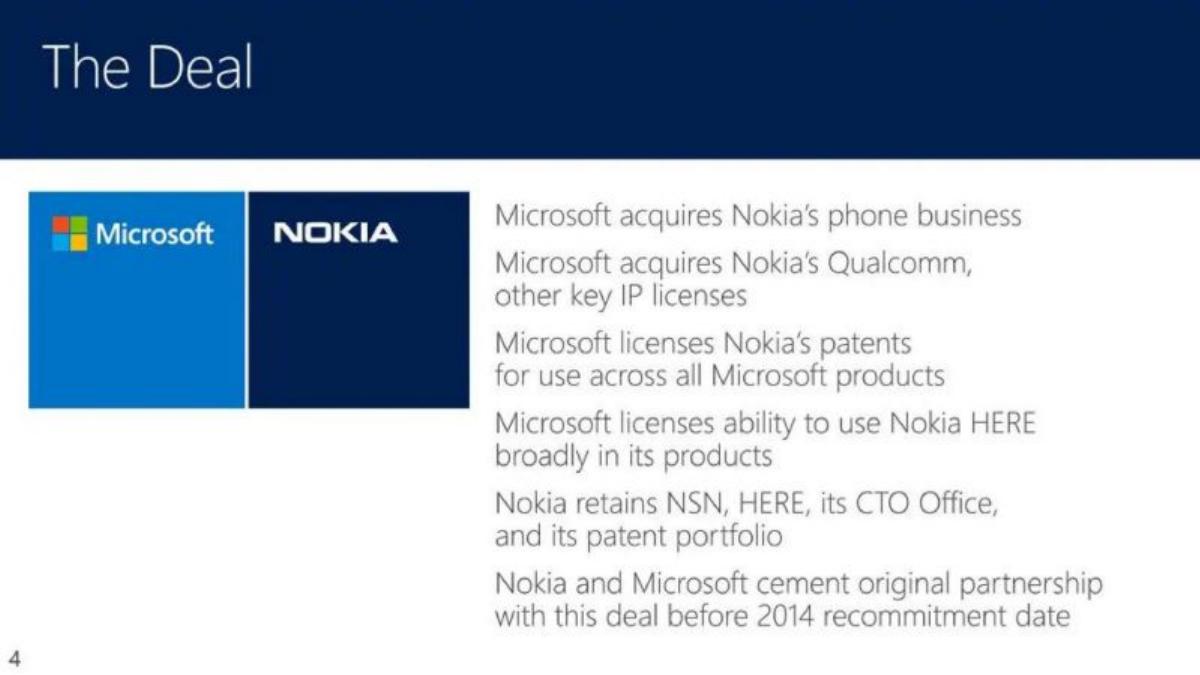
The Microsoft-Nokia acquisition deck represents a pivotal moment in mobile history, where Microsoft sought to replicate the vertically integrated success of Apple. The presentation outlines a €5.4 billion transaction, split between €3.79 billion for Nokia’s hardware business and €1.65 billion for patent licensing. Microsoft argued that owning the hardware would 'accelerate phone share' and protect their ecosystem from being 'foreclosed' by Google or Apple. Despite projections of $600 million in annual cost synergies and becoming accretive to EPS by FY15, the deal ultimately failed, leading to…
Key takeaways
- The total deal value was €5.44 billion, comprising €3.79B for the business and €1.65B for IP licenses (Slide 19).
- Microsoft aimed to protect its ecosystem, stating they could not risk Google or Apple 'foreclosing' app innovation (Slide 15).
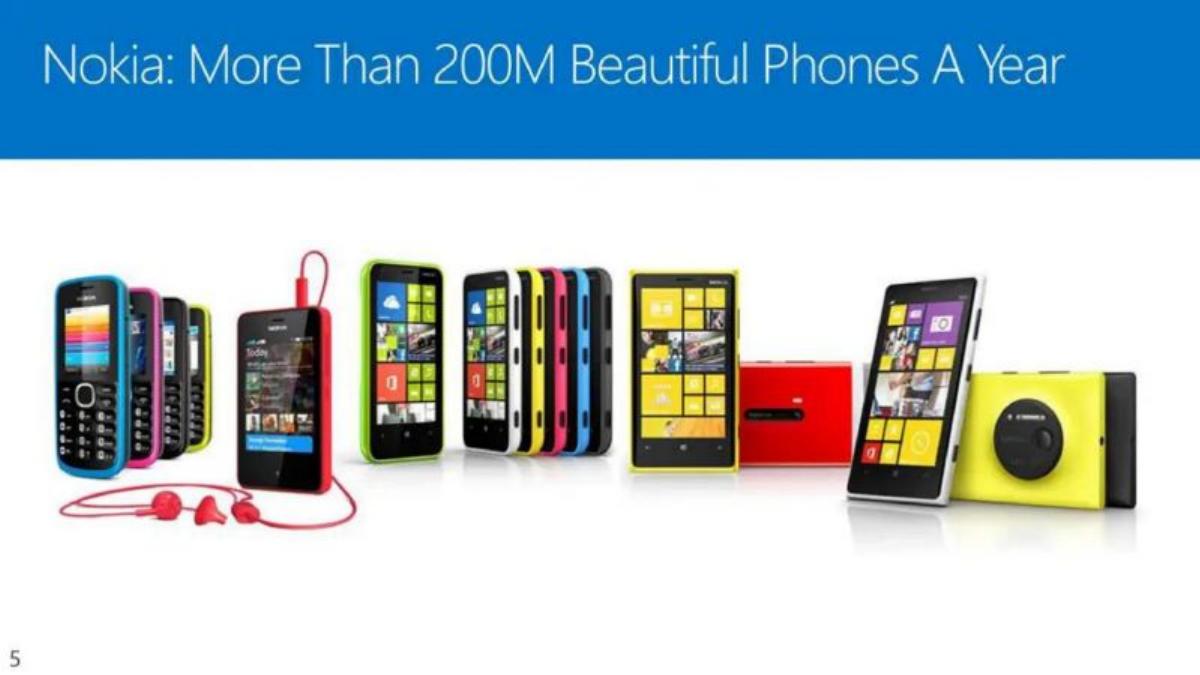
- Nokia was shipping over 200 million phones annually at the time of the deal (Slide 5).
- The Windows Phone ecosystem claimed over 10% market share in 9 markets and was outselling Blackberry in 34 markets (Slide 9).
- Microsoft projected $600 million in annual cost synergies within 18 months of closing (Slide 21).
- The acquisition included over 8,500 design patents and a 10-year license for the Nokia brand on feature phones (Slide 23).
- Financial models predicted the deal would be accretive to Non-GAAP EPS by FY15 and GAAP EPS by FY16 (Slide 21).
- The strategy relied on a 'family of devices' vision where phone success would strengthen tablets and PCs (Slide 15).
The Strategic Rationale for a €5.4 Billion Gamble
The Microsoft acquisition of Nokia’s Devices and Services division in 2013 remains one of the most analyzed failures in corporate history. This pitch deck, titled "Accelerating Growth," was the internal and investor-facing document used to justify the €5.44 billion price tag. At its core, the deck argues that Microsoft could no longer afford to be a software-only player in a world where hardware and software were becoming inextricably linked. The following teardown examines the 16 slides provided from the original 31-slide presentation.
Slide 1: Title and Rationale
The cover slide sets a tone of optimism with the headline "Accelerating Growth." It explicitly states the purpose: "Microsoft’s strategic rationale for deal announced with Nokia on September 3, 2013." The imagery is consumer-focused, featuring a person using a mobile device, signaling Microsoft's intent to move deeper into the B2C hardware space.
Slide 3: The Leadership Team
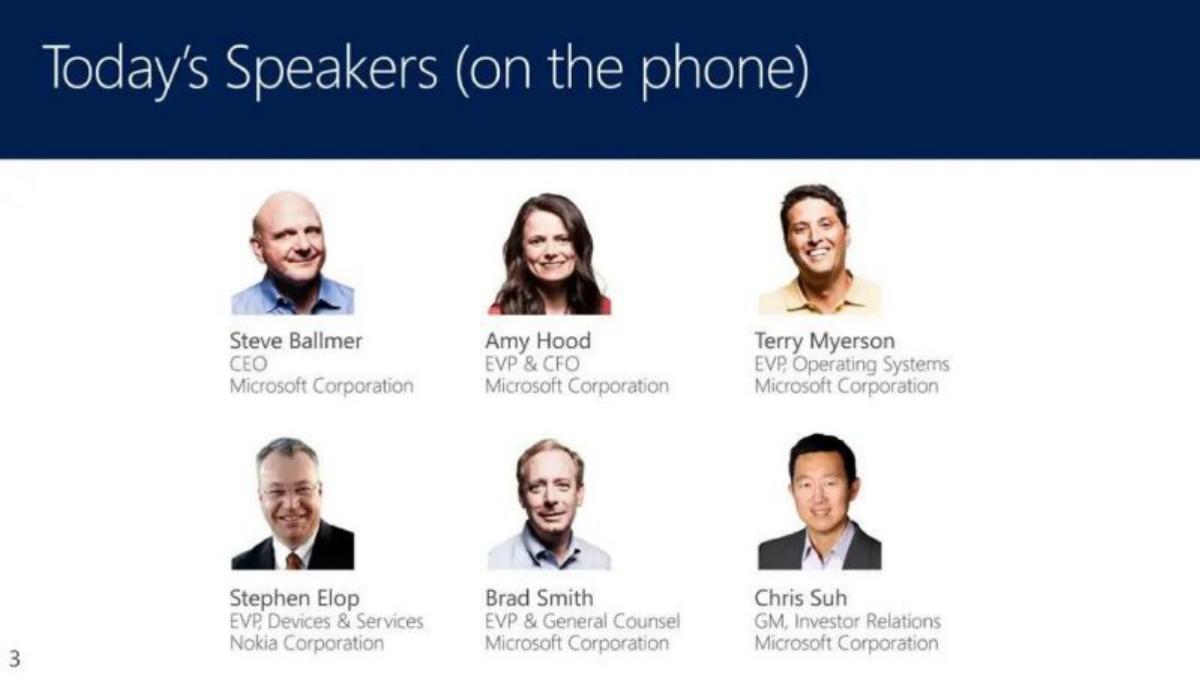
This slide introduces the key players involved in the transition. Notably, it features Steve Ballmer (CEO) and Amy Hood (CFO) , alongside Stephen Elop , who was the EVP of Devices & Services at Nokia at the time. Elop’s presence is significant; as a former Microsoft executive who moved to Nokia and then back to Microsoft via this deal, he was a central figure in the "Trojan Horse" theories that circulated in the media at the time. The inclusion of General Counsel Brad Smith underscores the heavy emphasis on intellectual property that appears later in the deck.
Slide 5: Nokia’s Scale
Microsoft uses Slide 5 to establish Nokia’s manufacturing prowess. The headline, "Nokia: More Than 200M Beautiful Phones A Year," highlights the sheer volume of the operation. The visual array of devices—ranging from basic feature phones to the high-end Lumia smartphones—demonstrates that Microsoft wasn't just buying a smartphone brand; they were buying a global distribution and manufacturing engine that touched hundreds of millions of users.
Slide 7 & 9: Market Momentum
Slide 7 serves as a transition to the "Accelerate Phone Share" section. Slide 9 provides the data to back up the claim of "Momentum." It cites ">10% share in 9 markets" and "78% YOY growth." Perhaps most telling of the era is the boast that they were "Outselling Blackberry in 34 markets." By 2013, Blackberry was already in a death spiral, so this comparison was a low bar, yet it was used to position Windows Phone as the viable third ecosystem behind iOS and Android. The bar chart shows Nokia Windows Phone shipments growing from roughly 3 million units in Q3 2012 to over 7 million in Q2 2013.
Slide 11: Innovation Roadmap
Under the banner of "Accelerating Innovation," Slide 11 uses a grid to show where Microsoft intended to push the envelope. Categories include "Next billion people online," "Imaging," "Personal assistant," and "New form factors." The "Imaging" tile refers to Nokia’s PureView technology, which was a market leader at the time. The "Personal assistant" tile hints at the early stages of Cortana, suggesting that hardware integration would be the key to making these services competitive.
Slide 13 & 15: The "Why Phones?" Argument
Slide 13, "Transformation: Beyond Software and PCs," is the thesis statement of the Ballmer era. It argues for a "family of devices with integrated services." Slide 15 goes deeper into the defensive logic. It explicitly states: "We cannot risk having Google or Apple foreclose app innovation, integration, distribution, or economics." This reveals the fear that drove the deal: if Microsoft didn't own the phone, they could be blocked from the most important screen in the consumer's life. It also notes that "Success in phones is important to success in tablets," which in turn helps PCs.
Slide 17: Operational Capabilities
This slide lists what Nokia brings to the table: Device design and engineering, globally scaled supply chain, and operator sales and support. Microsoft was a software company struggling to make its own hardware (the early Surface tablets had recently launched to mixed results). Buying Nokia was a shortcut to acquiring a world-class hardware culture and the relationships with telecom carriers (operators) that Microsoft lacked.
Slide 19: The Deal Overview
This is the "Ask" slide of the acquisition. The deal is broken down into two main components:
€3.79 billion for Nokia’s Devices and Services business. · €1.65 billion for a broad intellectual property license.
The total of €5.44 billion was funded using offshore cash, which Microsoft noted would have "no impact on ability to return capital to shareholders." This was a strategic move to utilize cash that was otherwise trapped abroad due to US tax laws.
Slide 21: Financial Projections
Microsoft projected that the transaction would be "accretive to FY15 Non-GAAP EPS." The chart shows a dip in FY14 (a loss of $0.12 per share) followed by a recovery to $0.08 profit by FY16. They also promised "Annual cost synergies of $600M within 18 months after close." These projections were incredibly optimistic and failed to account for the rapid decline in Nokia’s feature phone business and the stagnant growth of the Lumia line.
Slide 23: Intellectual Property Strategy
Slide 23 is one of the most detailed in the deck, focusing on IP. Microsoft acquired 8,500 design patents and a 10-year license for the Nokia brand. They also paid for a license to 30,000 utility patents. The deck notes that patent royalties can add "over 10 percent to the costs of a smartphone," so owning or licensing these patents was framed as a massive cost-saving measure for the Windows Phone ecosystem.
Slide 25 & 27: Execution and Regulation
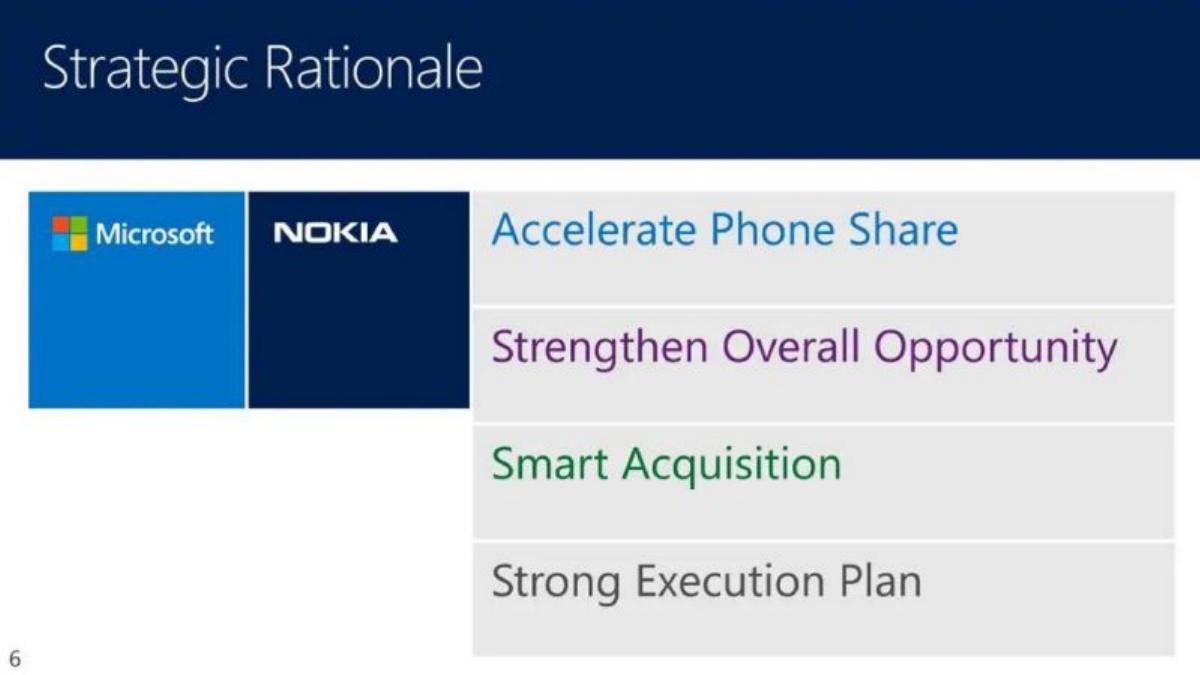
Slide 25 is a simple transition for the "Strong Execution Plan." Slide 27 addresses the regulatory hurdles, expressing confidence in approval from the EU, U.S., China, India, and others. The argument for regulators was that the deal would "promote competition" by providing a "competitive alternative to Google and Apple." This is a classic antitrust defense: we need to merge to survive against the incumbents.
Slide 29: GAAP vs. Non-GAAP Reconciliation
The final substantive slide provides the accounting details. It shows the "Estimated impact of acquisition (GAAP)" as a $1.005 billion loss in 2014, narrowing to a $299 million profit in 2016. By stripping out "acquisition-related amortization and integration expenses," they were able to show a much rosier "Non-GAAP" profit of $709 million by 2016. This is standard corporate accounting, but in hindsight, the GAAP numbers were much closer to the eventual reality of the business's performance.
What Works in This Deck
Clear Strategic Rationale: The deck does an excellent job of explaining why the deal is happening. The "foreclosure" argument on Slide 15 is a powerful motivator for a board of directors. It frames the acquisition not just as a growth opportunity, but as an existential necessity to protect the broader Windows ecosystem.
IP Valuation: By breaking out the €1.65 billion for patent licensing, Microsoft justified a significant portion of the purchase price as a defensive asset that would have value even if the hardware business struggled. This was a sophisticated way to de-risk the sticker price in the eyes of investors.
Synergy Targets: The $600 million synergy target was specific and time-bound. It gave analysts a clear metric to track the success of the integration, even if that metric was eventually overshadowed by larger losses.
What is Missing
The App Gap: The deck completely ignores the biggest problem facing Windows Phone: the lack of third-party apps. While it mentions "app innovation" on Slide 15, it provides no plan for how owning Nokia would suddenly convince developers to build for Windows instead of iOS or Android. This was the fatal flaw of the strategy.
Competitive Response: There is no slide analyzing what Apple or Samsung (the primary Android hardware leader) would do in response. The deck assumes Microsoft can grow in a vacuum, ignoring the fact that the mobile market was already reaching a point of saturation in developed markets.
Cultural Integration: While Slide 17 mentions "Mature operational processes," it says nothing about how a software-centric culture in Redmond would merge with a hardware-centric culture in Finland. History shows this was one of the deal's greatest friction points.
Founder Lessons
Vertical Integration is a Double-Edged Sword: Founders should look at Slide 15 and realize that while owning the stack provides control, it also provides all the risk. Microsoft thought they were securing their future; instead, they were anchoring themselves to a sinking ship. If you are a software founder considering a hardware play, ensure your "app ecosystem" or user base is strong enough to support the hardware, not the other way around.
Beware of "Momentum" Metrics: Slide 9 is a warning. 78% YOY growth looks great on a slide, but if you are starting from a tiny base in a market with massive network effects, that growth can be deceptive. Always look at absolute market share and developer engagement alongside percentage growth.
IP is a Hedge, Not a Strategy: Microsoft leaned heavily on Nokia’s 30,000 patents to justify the deal. While patents have value, they cannot save a product that consumers don't want to buy. Never let the value of your secondary assets (IP, real estate, etc.) blind you to the failing unit economics of your primary product.
Frequently asked questions
- What was the primary strategic reason for Microsoft to buy Nokia?
- Microsoft’s primary rationale was vertical integration. As stated on Slide 15, they believed 'devices help services and services help devices.' They specifically feared that without their own hardware, Google and Apple could 'foreclose' Microsoft’s ability to innovate, distribute, or profit from mobile apps. They viewed owning the hardware as essential to securing the future of the Windows ecosystem across PCs and tablets.
- How did Microsoft justify the financial cost of the acquisition?
- The justification was built on 'Smart Acquisition' principles (Slide 19). Microsoft used offshore cash to avoid domestic tax hits and projected $600 million in annual cost synergies. They also highlighted the massive value of Nokia’s IP portfolio, which included 30,000 utility patents. They projected the deal would be profitable on a Non-GAAP basis within two years (Slide 21).
- What specific Nokia assets did Microsoft acquire?
- Microsoft acquired the 'Devices and Services' business, which included the Lumia and Asha brands. They also secured a 10-year license to use the Nokia brand on feature phones and a 10-year license (with an option for perpetual conversion) for Nokia’s utility patents. They did not buy the entire Nokia corporation, only the handset and services division (Slide 23).
- What was the status of Windows Phone market share at the time of the deal?
- According to Slide 9, Windows Phone was experiencing 'momentum.' It had over 10% share in 9 markets and was growing at 78% year-over-year. The deck emphasized that they were outselling Blackberry in 34 markets, positioning Windows Phone as the clear third-place contender in the 'three-horse race' for mobile OS dominance.
- Why did the deal eventually fail despite these projections?
- While the deck focuses on internal synergies and IP, it failed to account for the 'app gap' and the speed of Android's market capture. The 'momentum' cited on Slide 9 was insufficient to reach critical mass for developers. By 2015, Microsoft wrote down $7.6 billion related to the acquisition, essentially admitting the hardware business was worth less than zero under their management.