Miche's nine-slide deck, published in August 2021 by Indonesian founder Andrea Wiwandhana, pitches an online contact directory for the MICE events industry. Slide 2 is genuinely excellent — four bullets covering product, customer, gap and differentiator. Slide 3 then repeats it in unreadable white-on-orange type and contradicts it on the differentiator, the company is called a directory on one slide and a marketplace on another, the market slide quotes four unsourced global numbers in pounds sterling for an Indonesian business, and the deck closes with no business model, no traction, no compe…
Key takeaways
- Miche's nine-slide deck, published in August 2021 by founder Andrea Wiwandhana, pitches an online contact directory for Indonesia's MICE industry — meetings, incentives, conventions and exhibitions — connecting event organisers with venues, destinations and suppliers.
- The deck contains no funding ask, no valuation, no business model, no traction and no product screenshots, which makes it an idea-stage founder deck rather than a fundraising document.
- Slides 2 and 3 repeat the same four-bullet summary, and the two versions contradict each other on the differentiator: one says industry knowledge plus up-to-date contacts, the other says an easy-to-use interface.
- The company is described three different ways across four slides — a contact directory, an Event Marketplace and a bridge between millennials and seasoned practitioners — which implies three different revenue models.
- The market slide gives four unsourced global figures, including a GBP150 billion global MICE value quoted in pounds sterling for an Indonesian business, with no Indonesian slice and no bottom-up path to revenue.
- The strongest and most under-used line in the deck is the safety caption — 'no secret additional cost to scam either user or customer' — a specific local insight buried in grey nine-point type.
- The team slide lists genuine founder-market fit (agency-side MICE experience, a 120,000-like consumer audience) then undercuts it with the bullets 'currently unemployed' and 'no social media'.
- The transferable lesson: the slides a founder skips — pricing, competition, traction, the ask — are exactly the questions investors discuss after the meeting ends.
What this deck actually is
This is a nine-slide PowerPoint titled "A Pitch Deck", authored by Andrea Wiwandhana and published in August 2021. It pitches Miche — described on the logo slide as an "Event Marketplace" and in the body copy as "an online contact directory for event organisers to share and search for expertise on destinations, venues, and suppliers" — aimed at Indonesia's MICE sector (Meetings, Incentives, Conventions, Exhibitions).
It is important to classify this honestly before analysing it. This is not a funded company's Series A deck. There is no round, no ask, no valuation, no financials, no product screenshots, no traction and no company entity named anywhere in the file. The founder's own team slide states he is "currently unemployed, focus on his business". Two of the nine slides are duplicates of the same summary text, and one of those two is set in white type on an orange block that is close to unreadable.
What you are looking at is an idea-stage founder deck — closer to a personal introduction with a concept attached than to a fundraising document. That does not make it useless. It makes it one of the most instructive artefacts in this series, because almost every founder's first deck looks like this, and almost nobody publishes theirs. Nine slides is enough to show exactly where a first draft stops being a pitch.
Slide-by-slide walkthrough
Slide 1 — Title
The Miche wordmark with a cartoon mouse, then "A Pitch Deck", then "By Andrea Wiwandhana". No date, no tagline, no one-line description of the business, no round name.
"A Pitch Deck" is a document type, not a title. A reader who receives this file and opens the first page still does not know what Miche does, where it operates, or what stage it is at. The cover is the single most-viewed slide in any deck — it is the one that survives being screenshotted and forwarded — and this one spends it on the word "deck".
Slide 2 — The summary
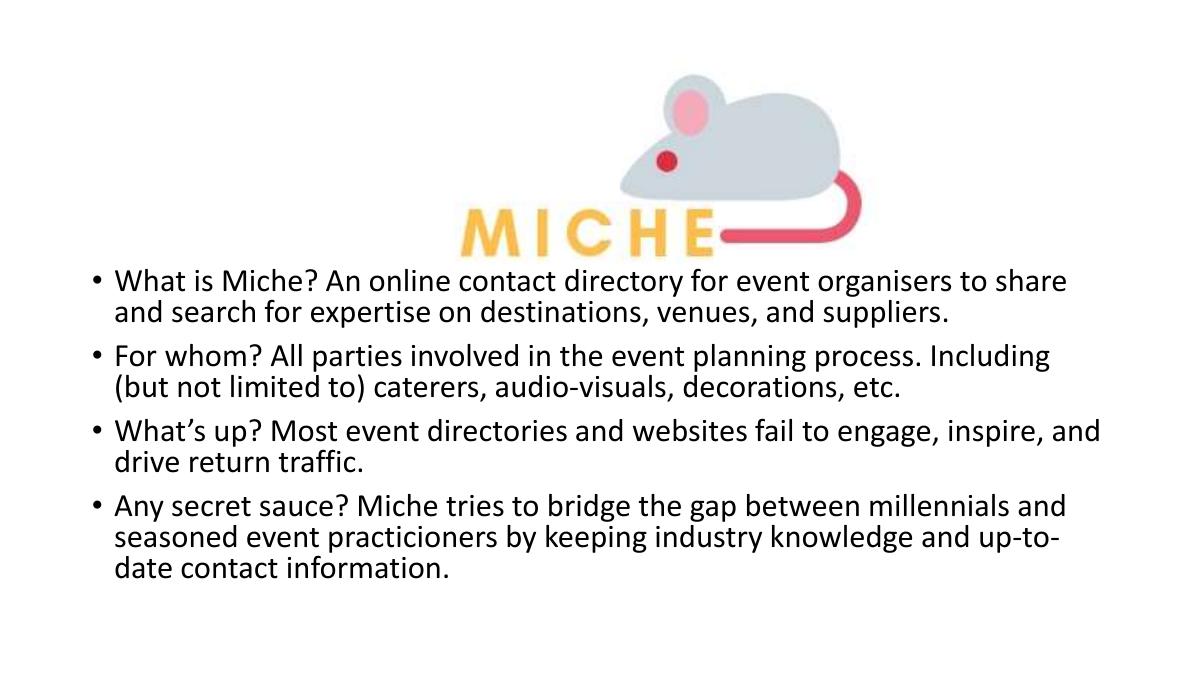
Four self-asked questions in bullet form: "What is Miche?" — an online contact directory for event organisers to share and search for expertise on destinations, venues and suppliers. "For whom?" — all parties involved in the event planning process, including but not limited to caterers, audio-visuals and decorations. "What's up?" — most event directories and websites fail to engage, inspire and drive return traffic. "Any secret sauce?" — Miche tries to bridge the gap between millennials and seasoned event practitioners by keeping industry knowledge and up-to-date contact information.
This is genuinely the best slide in the deck and it is the second one. In four bullets a reader learns the product, the customer, the wedge and the claimed differentiator. Most nine-slide decks never get this specific. The problem is what comes next.
Slide 3 — The same summary, again
The identical four bullets, very slightly reworded ("event planners" instead of "event organisers", "create an easy to use interface" instead of "keeping industry knowledge"), now rendered in white text on a mustard block with the text overflowing the block and colliding with itself. The Miche logo sits to the right.
Two things happen here at once. First, a ninth of the deck is spent repeating the eighth. Second — and this is the more damaging one — the two versions do not say the same thing. Slide 2's differentiator is industry knowledge plus up-to-date contacts . Slide 3's differentiator is an easy-to-use interface plus up-to-date contacts . Those are different companies. One is a knowledge network, the other is a UX play on a directory. A reader now has to guess which one the founder believes.
Slide 4 — Logo and contact
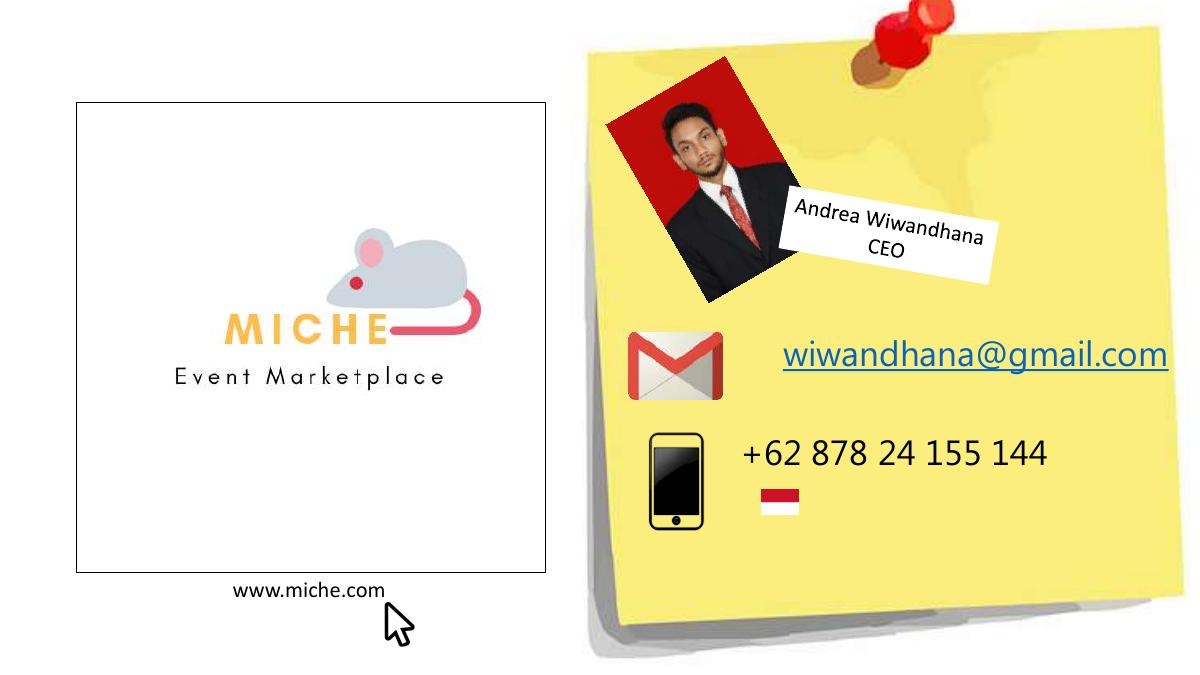
The Miche mouse with "Event Marketplace" underneath and www.miche.com below it, next to a sticky-note graphic carrying a headshot labelled "Andrea Wiwandhana, CEO", a Gmail address, an Indonesian mobile number and an Indonesian flag.
Note the third name for the business in four slides: slide 2 calls Miche a contact directory , slide 4's lockup calls it an Event Marketplace . A directory and a marketplace are different products with different revenue models — a directory sells listings or subscriptions, a marketplace takes a cut of a transaction. Nothing in the deck resolves which one Miche is, and the business model slide that would settle it does not exist.
The contact block itself is right in spirit — a named human, a real phone number, a country — but it uses a personal Gmail address and sits at slide 4 rather than the close, so the deck ends on the team rather than on a way to respond.
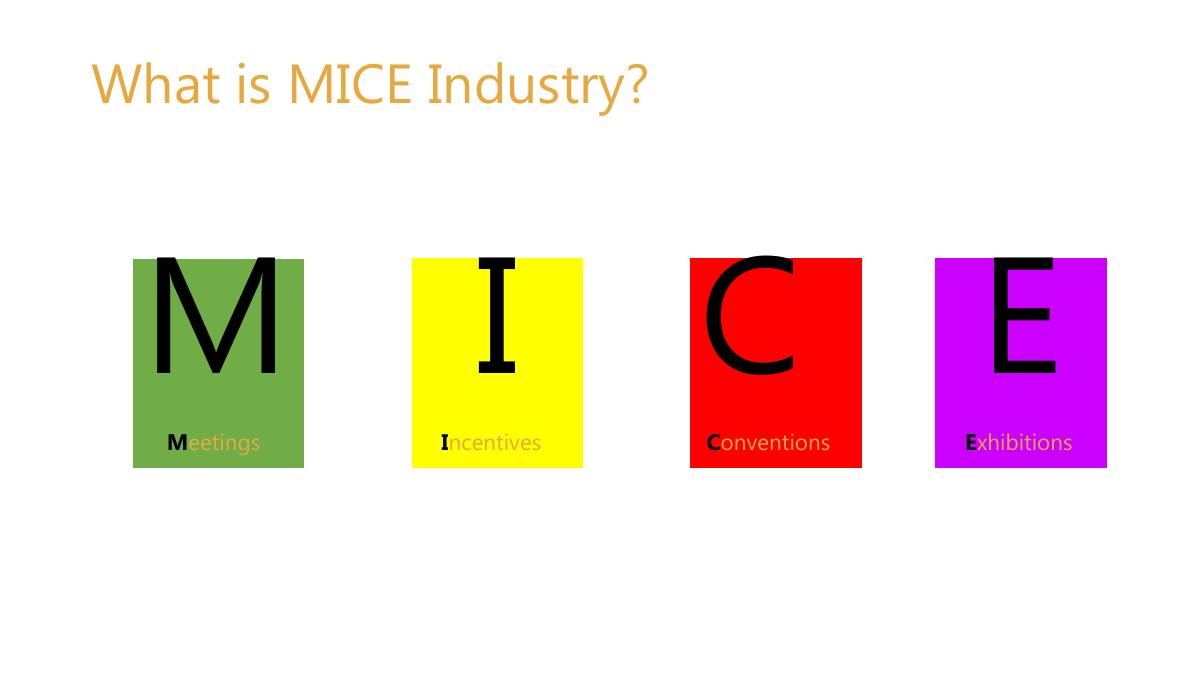
Slide 5 — "What is MICE Industry?"
Four coloured squares spelling out M-I-C-E with the words Meetings, Incentives, Conventions, Exhibitions in tiny type at the base of each.
This is an acronym-expansion slide. It defines a term rather than making an argument, and it burns one of nine slides doing so. The useful version of this slide states how large Indonesia's MICE segment is, how many events run per year, and what an organiser currently spends assembling a supplier list — the facts that make the acronym matter. Instead the labels are set so small against saturated backgrounds that they are hard to read at presentation distance.
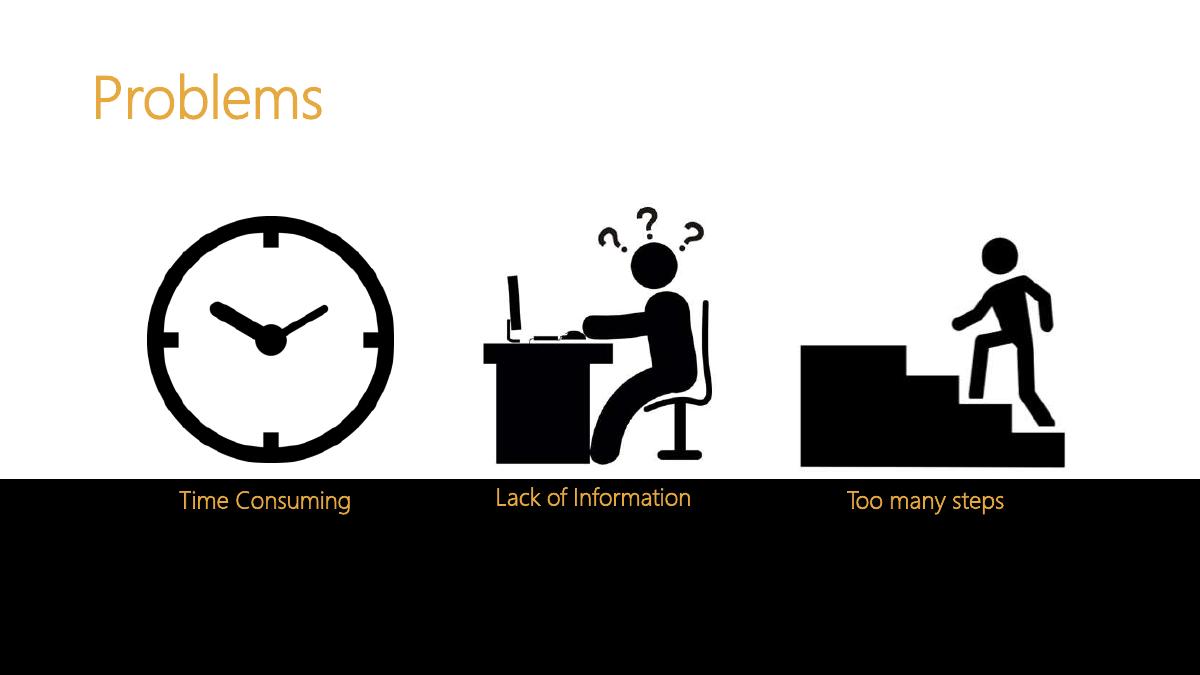
Slide 6 — Problems
Three black clip-art icons — a clock, a person at a desk with question marks, a figure climbing stairs — captioned "Time Consuming", "Lack of Information", "Too many steps".
Three plausible problems, zero evidence. There is no number of hours an organiser loses, no count of vendors they have to contact, no quote from a planner, no survey of even ten people. These are the three problems any observer would guess about any directory-shaped market, which is exactly why they persuade nobody. "Too many steps" and "Time consuming" are also close to the same problem stated twice.
Slide 7 — Solutions
Three more icons — refresh arrows, a check mark, a shield — captioned "Up-to-date: Data of all the vendors updated daily", "Filtered: Information to fill the needs of every user" and "Safety: No secret additional cost to scam either user or customer". The caption text is grey on black and the smallest type in the deck.
The third solution is the most interesting sentence in the entire file and it is buried in nine-point grey. "No secret additional cost to scam either user or customer" tells you that hidden mark-ups are a real, felt problem in Indonesian event supply chains — that is a native insight an outsider would never have. It deserves its own slide with a worked example. Instead it is a caption.
The first solution creates an unanswered operational question: "data of all the vendors updated daily" is a promise of continuous data maintenance across an entire industry, and nothing in the deck explains who does that updating, whether it is scraped, crowdsourced or manual, or what it costs. Directory businesses live or die on exactly that question.
Slide 8 — Market
A black band with four figures: "£150 Billion — value of MICE market globally", "309,500 — people with 'event' in job title on LinkedIn", "25,000 — no. of agencies globally", "200,000 — no. of suppliers globally". Beneath it, a collage of stock photography: a Santorini pool, an Emirates A380, a rooftop restaurant, a couple with a camera, canapés.
Four problems with one slide. There is no source for any of the four numbers. The currency is pounds sterling for an Indonesian business pitching an Indonesian market — a straight lift from a UK-authored source. Every figure is global, and none is narrowed to Indonesia or Southeast Asia, so the deck never states its own addressable market. And there is no bottom-up path from any of these numbers to revenue: 25,000 agencies and 200,000 suppliers only becomes a business once you say what each pays and how many you can reach.
The 309,500 LinkedIn job titles figure is the most defensible on the slide, because it is at least a countable population rather than an analyst's estimate. It is also the one that most needs an Indonesian filter, which it does not have.
Slide 9 — The Team
A street photograph on the left. On the right: "Andrea Wiwandhana, Founder & Chief Travel Itinerary Maker" with six bullets — working on music events since college; previously an account executive at an activation agency, giving a good understanding of the MICE industry; a creative event planner for his agency and freelance; runs an online shop with more than 120,000 Facebook likes (tablet.co.id); currently unemployed, focused on his business; no social media, focused on his life.
Three of those bullets are real founder-market fit — years inside event activation, agency-side experience of the exact buyer, and an audience-building result of 120,000 likes on a side venture. That is a credible operator for this specific problem, and the deck states it plainly.
The last two bullets undo it. "Currently unemployed" is an honest statement of full-time commitment written in the least favourable available wording; the same fact reads as strength when phrased as full-time on Miche since a date. "No social media, focus on his life" is a personal aside in a document asking a stranger for money to build a network product — and a reader will notice the tension between a founder who has opted out of social platforms and a product whose value is people connecting on a platform.
The deck ends here. There is no ask, no use of funds, no roadmap, no next step and no repeat of the contact details.
What this deck does better than most startup pitch decks
It answers "what is this" in four bullets. Slide 2's question-and-answer format — what is it, for whom, what's wrong today, what's the edge — is a better opening summary than most professionally designed decks manage. · It is short. Nine slides respects the reader. The problem is not length; it is which nine. · The founder is a real operator in the exact market. Agency-side MICE experience, years of event work and a 120,000-like audience is genuine founder-market fit, not a résumé stretch. · It names a native insight. Hidden supplier mark-ups scamming both sides is a specific, local, hard-to-fake observation about how the industry actually works. · Contact details are real and human. A named CEO, a photo, a working email and a mobile number with a country code — no anonymous info@ address. · The market slide uses countable proxies. LinkedIn job titles, agency counts and supplier counts are at least the right type of number for a directory business, even unsourced. · It is honest to the point of discomfort. Unemployment and the absence of social media both stay in the file. Naïve, but the instinct behind it — do not misrepresent yourself to investors — is the correct one.
Where this deck would fail in an investor meeting
There is no ask. Nine slides and not one number attached to a raise: no amount, no runway, no valuation, no use of funds. The meeting cannot progress to a decision because nothing has been requested. · There is no business model. The deck never says how Miche makes money — listings, subscriptions, take rate, leads, advertising. For a directory-versus-marketplace ambiguity, that is the first question asked and the deck has no page to turn to. · The company is described three different ways. Contact directory, event marketplace, and a knowledge bridge between millennials and seasoned practitioners. Each implies a different product and a different buyer. · There is no traction of any kind. No users, no vendors signed, no waitlist, no pilot, no letters of intent — and no statement that the product does not exist yet either, which leaves the reader unable to place the company on a timeline. · There is no product. Not a screenshot, not a wireframe, not a user flow. www.miche.com appears on slide 4 with nothing said about whether anything is live behind it. · No competition slide. Event supplier directories, wedding and venue marketplaces and vertical B2B listings all exist in Indonesia and regionally. Naming none of them reads as unawareness. · The market is entirely global and unsourced. A £150bn global figure with no citation, no Indonesian slice and no bottom-up build is not a market slide; it is a mood. · The currency is wrong for the market. Pounds sterling in a deck aimed at Indonesian MICE signals the number was copied rather than researched. · A whole slide is duplicated — and the duplicate contradicts the original on the differentiator. · Legibility fails in three places. White-on-orange overflowing text on slide 3, grey-on-black captions on slide 7, small labels on saturated blocks on slide 5. · The daily-update promise is unexplained. "All vendors updated daily" is the core operating cost of the business and there is no page on how it happens. · "Currently unemployed" as a team bullet. The underlying fact is fine; the wording converts commitment into a liability. · The deck ends on the team, not on a next step. The last thing a reader sees is a biography, not a request or a way to reply.
Idea-stage founder deck vs a deck that can raise
Identity Directory, marketplace and knowledge bridge, interchangeably One sentence, used identically on every slide
Problem Three icons and three adjectives One quantified pain with a source or a founder-run sample
Market Four global, unsourced, GBP figures Bottom-up: Indonesian vendors x price x reachable share
Business model Absent Who pays, how much, how often, and the take rate
Traction Absent Anything countable — waitlist, vendors signed, pilot events
Product A domain name on the contact slide Three screenshots of the core flow, even in Figma
Competition Absent Named regional alternatives and why they lose here
Team Real experience, undermined by phrasing The same facts framed as commitment and domain depth
How you would rebuild this deck at the same length
Keep nine slides. Change which nine. Cover with a one-line description, problem with one number, product with three screenshots, business model, market built bottom-up for Indonesia, competition, traction or first pilot, team, ask and contact. · Delete slide 3 outright. It repeats slide 2 and contradicts it. Reclaiming that slot for a business model page is the single highest-value edit available. · Pick one word for the company and never deviate. If suppliers pay to be listed, it is a directory. If Miche touches the booking, it is a marketplace. Write that sentence once and copy-paste it. · Rebuild the market from the bottom. Number of Indonesian event agencies and suppliers, the annual fee you believe each will pay, and the share reachable in three years. A defensible small number beats £150 billion with no citation. · Promote the scam insight to its own slide. One worked example of an organiser paying a hidden mark-up, the rupiah amount, and how Miche's transparency removes it. That is the story an investor repeats to their partner. · Answer the maintenance question. Who updates the vendor data daily, at what cost, and why does it stay accurate at 1,000 vendors? Directory businesses die of stale data, so pre-empt it. · Replace icon-only problem and solution slides with evidence. Ten interviews with event planners, three quotes, one statistic each. A weekend of work outperforms every piece of clip art in the file. · Reframe the team bullets. "Full-time on Miche since [month]. Eight years in event activation, agency-side. Built a consumer audience of 120,000 on a previous venture." Same facts, no liability. · Add the ask and end on it. The amount, what it buys — 500 verified vendors and a live booking flow, say — and the timeframe. Then repeat email and phone on the final slide. · Fix contrast everywhere. Dark text on light, or light on dark, at a size readable from three metres. Nothing in the deck needs mustard-on-mustard.
The transferable lesson
Miche's deck is not bad because it is early. It is incomplete because it answers the questions the founder found easy and skips the ones he found hard. The four bullets on slide 2 are sharp because he genuinely knows this industry. The market slide is generic because he did not have Indonesian data to hand and reached for the first global figure available. The business model and the ask are absent, not because they were forgotten, but because deciding what Miche charges and how much money he needs are the two decisions that require commitment — and an unfinished deck lets a founder keep both options open.
Investors read that gap accurately, every time. A missing business model is not read as "we haven't decided yet"; it is read as "we have not thought about who pays". A missing ask is not read as modesty; it is read as an absence of a plan. The slides you skip tell a reader precisely where your thinking runs out, and they are the only slides in the deck that get discussed after you leave the room.
So go through your own deck and mark every question you avoided answering: what you charge, who you beat, what you have proven, what you want and what it buys. Those five answers, even when they are small, are what turn a description of an idea into a document someone can act on. A nine-slide deck that answers them will always beat a twenty-slide deck that does not.
Frequently asked questions
- What is Miche and what does the company do?
- Miche is an early-stage Indonesian concept pitched by founder Andrea Wiwandhana in 2021 as an online contact directory and event marketplace for the MICE industry — meetings, incentives, conventions and exhibitions. It aims to let event organisers search for and share verified, up-to-date contacts for destinations, venues, caterers, audio-visual providers, decorators and other suppliers, with transparent pricing and no hidden mark-ups.
- Is the Miche pitch deck a real investor deck?
- It is a real founder-authored deck, but not a fundraising deck in the usual sense. The file is literally titled 'A Pitch Deck', runs nine slides, was published in August 2021, and contains no funding ask, no valuation, no financial projections and no business model. It reads as an idea-stage introduction to a concept and its founder rather than a document asking for a specific investment.
- How much was Miche raising in this deck?
- Nothing is stated. Across all nine slides there is no funding amount, no round name, no valuation, no runway and no use of funds. This is the deck's single biggest structural gap: an investor who reads the whole file has no request to accept or decline, which means the document cannot move a conversation toward a decision.
- What is the biggest weakness in the Miche pitch deck?
- The absence of a business model, compounded by an inconsistent description of the company. Miche is called a contact directory on one slide and an Event Marketplace on another — a directory typically sells listings or subscriptions while a marketplace takes a cut of transactions — and the deck never states who pays, how much or how often, so the revenue question is left entirely to the reader.
- Which slides from the Miche deck should founders copy?
- Slide 2. Its four-question format — what is it, for whom, what's wrong with today's options, what's the edge — delivers a complete positioning summary in about sixty words, which most professionally designed decks fail to do. The contact approach is also worth copying: a named founder with a photo, a working email and a real phone number rather than an anonymous inbox.
- What should an early-stage founder put in a nine-slide deck?
- Cover with a one-line description, a problem backed by one real number, the product in three screenshots, the business model, a bottom-up market built from your own geography, named competitors, whatever traction exists even if it is a waitlist, the team framed around domain depth, and the ask with what it buys. Nine slides is enough — but only if every skipped question is a deliberate choice, not an avoided one.