MiCancha presents a marketplace solution for the fragmented sports field rental industry, specifically targeting the Chilean market before scaling across South America. The deck identifies a significant operational pain point: clubs currently manage bookings via physical chalkboards, leading to data loss and missed revenue. By offering a freemium SaaS model for clubs and a consumer-facing booking app, MiCancha seeks to capture 80% of the national market by 2014. While the deck provides a clear roadmap and competitive landscape, it relies heavily on visual metaphors rather than hard financial…
Key takeaways
- The problem is defined as clubs losing money due to inefficient data management, specifically citing the use of chalkboards that are erased daily (Slide 2).
- The product is showcased through a web prototype featuring a booking interface for 'Club Palestino' with specific pricing of $21.500 (Slide 3).
- Technology plans include mobile accessibility via both the Apple App Store and Google Play (Slide 4).
- Market size is quantified as 4,000 venues in Las Condes and 36,000 nationwide (Slide 6).
- The business model is split between Freemium (charging for visibility and analytics) and Advertising (targeting sports brands, events, and pubs) (Slide 8).
- Competitive analysis identifies three players: Jogabo, Acción Total, and Pichangas.cl, noting their specific weaknesses like 'lack of administration' (Slide 9).
- The financial roadmap targets a 50% market share in Santiago by late 2013 and an 80% nationwide share by early 2014 (Slide 10).
- Funding milestones are clearly staged, moving from Founders to F.F.F. (Friends, Family, and Fools), then Angel, and finally VC for international expansion (Slide 10).
MiCancha Pitch Deck Analysis
MiCancha represents a classic marketplace play: taking a fragmented, offline industry and moving it into a centralized digital ecosystem. The deck focuses on the Chilean market, specifically the sports field rental niche, which is traditionally managed through manual, non-scalable methods. The following teardown examines the 10 slides provided from their 30-slide presentation.
Slide 1: Title and Team
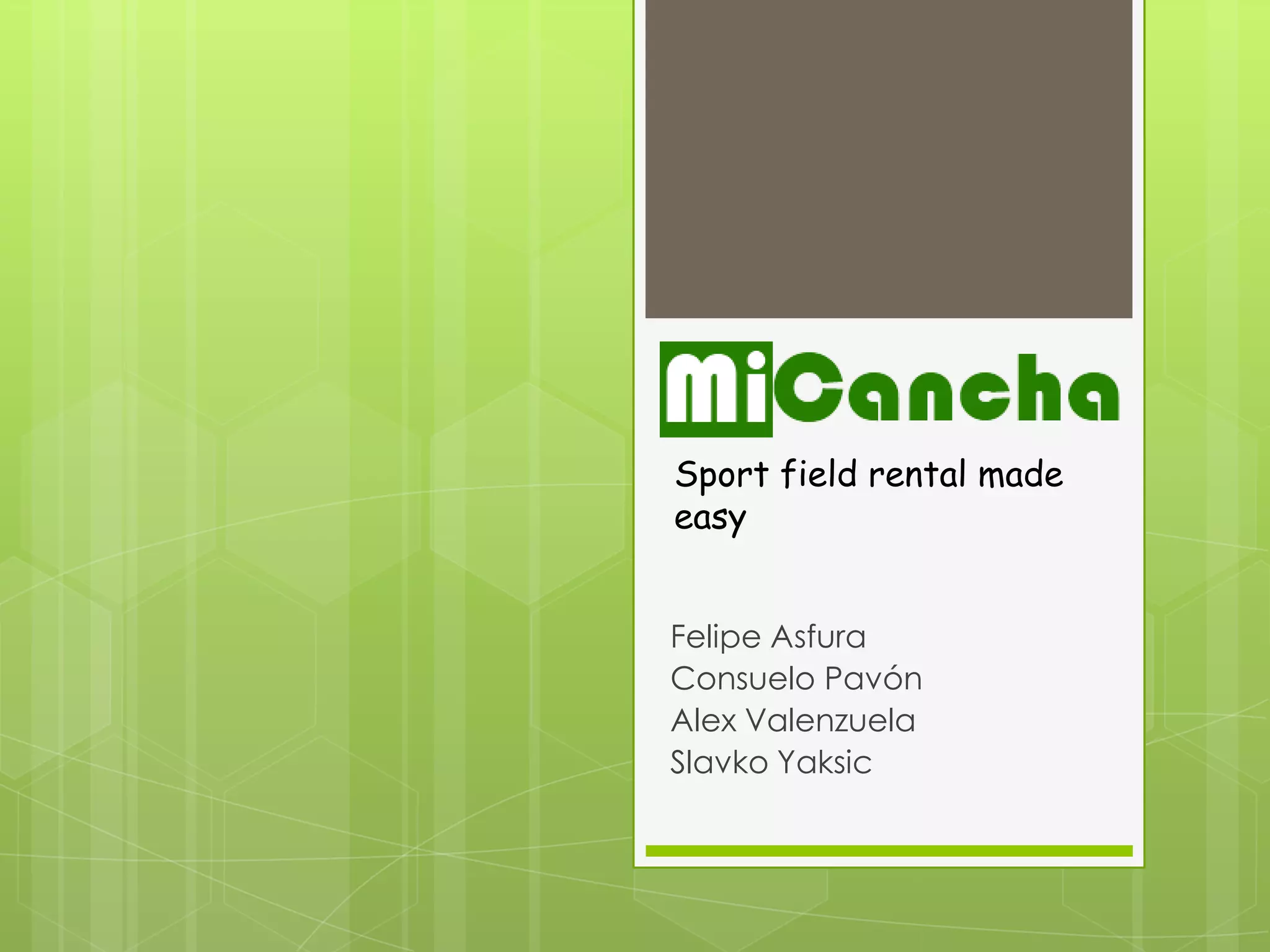
The cover slide introduces the brand name 'MiCancha' with the tagline 'Sport field rental made easy.' It lists four individuals: Felipe Asfura, Consuelo Pavón, Alex Valenzuela, and Slavko Yaksic. While it establishes the core team, it lacks specific roles or professional backgrounds, which is a common omission in early-stage decks. The green color palette and hexagonal background pattern immediately signal the sports (turf) and networking focus of the company.
Slide 2: The Problem - Information Gap
This slide identifies the core pain point for sports clubs. It uses a three-tier breakdown: Data, Info, and Visibility. The most compelling point here is the physical reality of the current market: bookings are 'Written on chalkboards' and 'Erased daily.' This highlights a massive loss of historical customer data. The slide argues that clubs are losing money because they have 'No analysis' to help them optimize earnings. It also notes that '20% gets the 80%,' implying a Pareto distribution where most clubs struggle for visibility.
Slide 3: The User Prototype
MiCancha provides a wireframe/prototype of their web interface. The URL shown is 'proyecto-canchas.cl'. The interface allows users to filter by sport (Futbol 7, Futbol 11, Tennis), date, time, and price range. A specific example for 'Club Palestino' shows a price of $21.500 for a 60-minute slot. The UI is functional, including details like parking (Estacionamiento) and snack bars. The confirmation message 'Recuerde que reservar es un compromiso' (Remember that booking is a commitment) suggests the platform is thinking about the reliability of the marketplace.
Slide 4: Technology and Mobile Strategy
This slide emphasizes the multi-platform nature of the service. It shows an iPad displaying a map-based search interface, which is critical for local discovery. The inclusion of 'Available on the iPhone App Store' and 'Google Play' logos indicates a mobile-first approach, recognizing that players likely want to book fields on the go rather than just via desktop.
Slides 5-7: Market Visuals
These slides use simple iconography to represent the user base and market scale. Slide 5 shows a single green figure (the user/organizer) connected to a team of red figures. Slide 6 provides the hard numbers for the Chilean market: 4,000 venues in the Las Condes district and 36,000 nationwide. Slide 7 places the MiCancha logo at the center of the social group, positioning the brand as the essential connector for sports communities.
Slide 8: Business Model - Trial
The revenue strategy is divided into two clear buckets. The 'Freemium' side targets the clubs, charging for 'Pay for visibility' (likely a featured listing model) and 'Detailed analytics.' The 'Advertising' side targets third parties, specifically sports brands and local 'Events & Pubs.' This is a logical way to monetize both sides of the marketplace: the service providers (clubs) and the audience (players).
Slide 9: Possible Competitors
The competitive landscape is addressed by naming three specific entities. Jogabo is dismissed because it is 'Not field rental.' Acción Total is noted as being 'Still on development.' Pichangas.cl, perhaps the most direct competitor, is criticized for a 'Lack of administration.' By focusing on the 'administration' aspect, MiCancha positions itself as a SaaS tool for clubs, not just a directory for players.
Slide 10: Financial Plan and Roadmap
This is the most data-dense slide in the set. It outlines a semester-by-semester goal from late 2012 to early 2015. Key milestones include:
2012.2: First version and main clients (10% market share) funded by Founders. · 2013.1: Online payment integration and first employee, seeking F.F.F. funding. · 2013.2: 'Take Santiago' with a 50% market share goal, seeking Angel investment for aggressive marketing. · 2014.1: 'Go nationwide!' targeting 80% market share. · 2014.2: Expansion into South America, seeking VC funding. · 2015.1: Global opening, also VC-backed.
What Works in This Deck
The deck excels at identifying a tangible, low-tech problem . The mention of chalkboards being erased daily is a visceral image that any investor can understand as an inefficiency. The market sizing is also specific; rather than just saying 'millions of players,' they count the actual venues (36,000), which are the primary customers for their SaaS offering. The roadmap is also highly structured, showing a clear progression from founder-led local operations to VC-led global expansion.
What is Missing
The most significant omission is unit economics . While they mention a freemium model, there is no indication of what a 'visibility' package costs or what the expected Lifetime Value (LTV) of a club is compared to the Cost of Acquisition (CAC). Additionally, the Team slide is very thin. In a marketplace business, execution is everything, and the deck does not explain why these four individuals are the right ones to navigate the Chilean sports scene or build the technology. Finally, there is no mention of traction to date —investors would want to know if those 10% market share goals for 2012 were actually met or if they are purely aspirational.
Founder's Guide: What to Copy
Founders should emulate the competitor slide (Slide 9). Instead of just listing logos, MiCancha provides a specific reason why each competitor is not a threat (e.g., 'Lack of administration'). This shows a deep understanding of the product gaps in the current market. The Financial Plan (Slide 10) is also a great template for showing how different funding rounds (Founders vs. Angel vs. VC) correlate to specific business milestones and market share targets. It turns a 'funding ask' into a 'growth roadmap.'
Frequently asked questions
- What is the primary value proposition for sports clubs?
- According to Slide 2, the primary value proposition is data management and visibility. Currently, clubs use chalkboards that are erased daily, meaning they have no historical data or analysis to help them earn more. MiCancha offers 'Information better than gold' by digitizing these records and providing analytics to improve club revenue.
- How does MiCancha plan to generate revenue?
- Slide 8 outlines a dual-revenue stream. The first is a Freemium model where clubs pay for increased visibility on the platform and detailed analytics. The second is an Advertising model, selling space to sports brands, event organizers, and local pubs that want to reach the platform's athletic user base.
- What is the projected timeline for international expansion?
- The Financial Plan on Slide 10 indicates that MiCancha intends to take its 'first steps on South America' in the second half of 2014. By the first half of 2015, the company aims to 'Open Worldwide,' supported by Venture Capital funding rounds.
- Who are the main competitors and how does MiCancha differentiate?
- Slide 9 lists Jogabo (which does not do field rentals), Acción Total (still in development), and Pichangas.cl (which suffers from a lack of administration). MiCancha differentiates by focusing specifically on the rental transaction and providing administrative tools for the clubs themselves.
- What specific market segments are being targeted initially?
- The deck focuses heavily on the Chilean market. Slide 6 highlights a specific starting point in 'Las Condes' with 4,000 potential targets, before scaling to the 36,000 nationwide venues. The prototype on Slide 3 specifically mentions sports like 'Futbol 7', 'Futbol 11', and 'Tennis'.