AbbeyPost’s 2012 seed deck is a lean, metric-heavy presentation that successfully raised $775,000. The deck identifies a specific, high-value gap in the e-commerce market: plus-size women's apparel, which represents an $18 billion annual spend. Rather than focusing on vague brand promises, the founders leaned into 'proprietary software' and 'manufacturing innovation' to solve the fit problem. The most compelling evidence in the deck is the retention data, showing a 60% repeat purchase rate within 30 days and a jump from a $120 first order to a $300 second order. While the deck lacks a formal…
Key takeaways
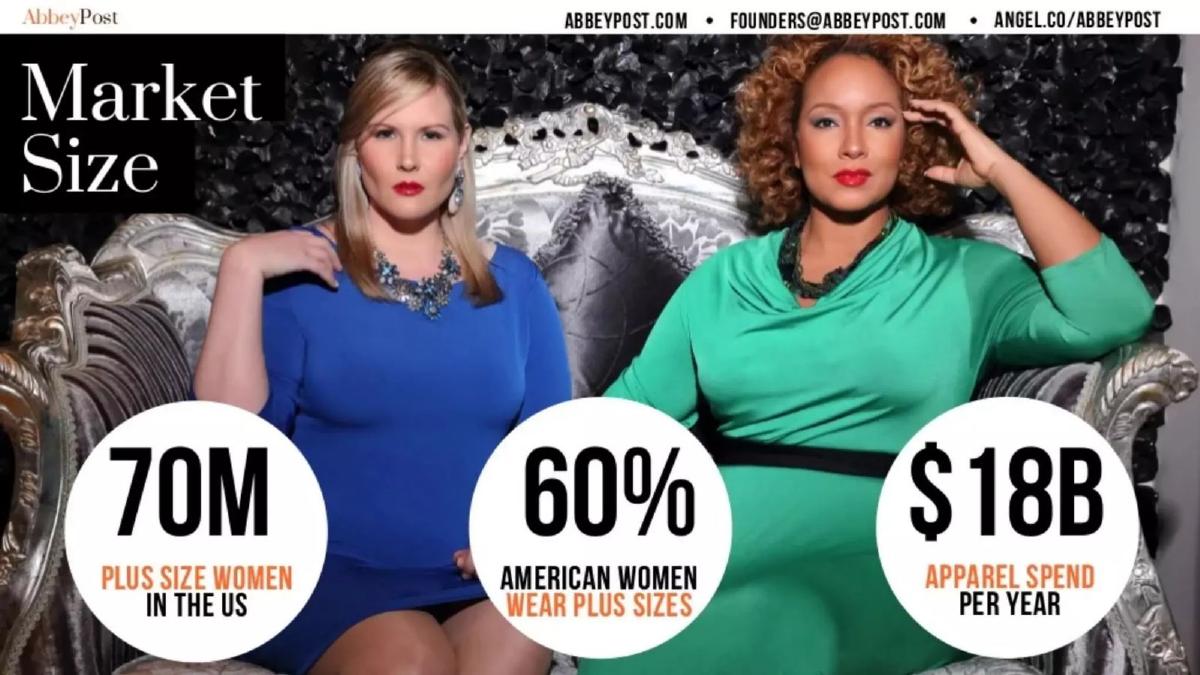
- The market size is clearly defined as 70 million plus-size women in the US spending $18 billion annually on apparel (Slide 2).
- The core problem is identified as off-the-rack clothing being cut for only one shape, despite women coming in all shapes and sizes (Slide 3).
- AbbeyPost positions itself as a technology company, citing proprietary software and manufacturing innovation rather than just a fashion brand (Slide 5).
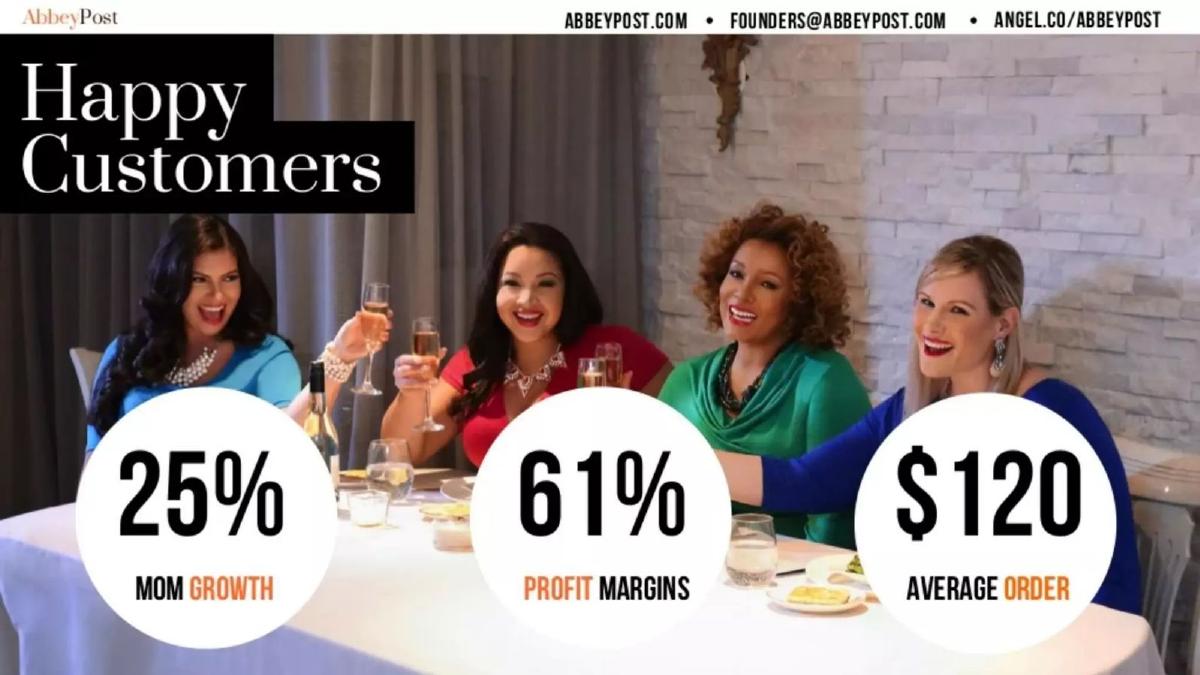
- The deck highlights a 61% profit margin, which is exceptionally high for apparel manufacturing (Slide 6).
- Retention is the primary proof of product-market fit, with 60% of customers repurchasing within 30 days (Slide 7).
- Customer lifetime value is shown to scale rapidly, with average order value increasing from $120 to $300 between the first and second purchase (Slide 7).
- The team slide features a CEO who is a second-time founder with a successful exit and a VP with 20 years of fashion manufacturing experience (Slide 8).
- The deck uses successful male-focused custom apparel brands like Bonobos and J. Hilburn as market comparables to validate the business model (Slide 9).
The AbbeyPost Seed Deck Teardown
AbbeyPost entered the market at a time when 'Mass Customization' was the buzzword of the day. However, unlike many startups that tried to customize everything for everyone, AbbeyPost focused on a massive, underserved demographic: the plus-size women's market. This 11-slide deck is a study in how to use high-conviction metrics to validate a niche-to-mass strategy.
The Hook and Market Opportunity
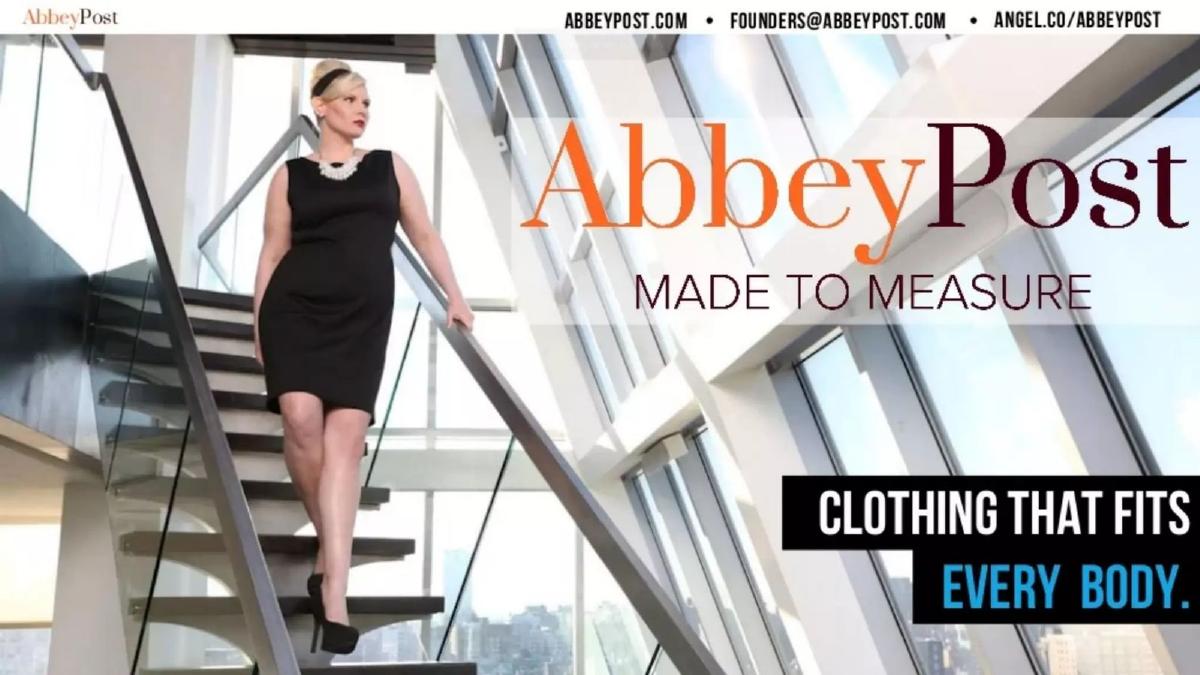
Slide 1: Title Slide The deck opens with a high-quality lifestyle image and the tagline 'Clothing that fits every body.' It immediately establishes the brand's aesthetic—modern, upscale, and inclusive. The contact information is prominently displayed at the top, including a link to their AngelList profile, which was a standard practice for seed-stage startups in 2012.
Slide 2: Market Size This slide is a masterclass in 'The Big Number.' It presents three core stats: 70 million plus-size women in the US, the fact that 60% of American women wear plus sizes, and an $18 billion annual apparel spend. By starting with the $18 billion figure, the founders immediately answer the 'Is this big enough?' question that plagues many niche e-commerce pitches.
Slide 3: The Problem The problem is stated simply: 'Off the rack clothing is cut for one shape. But women come in all shapes and sizes.' This slide uses the same models as the market slide, reinforcing the brand identity while highlighting the frustration of the current retail experience. It sets the stage for a solution that isn't just about style, but about geometry.
The Solution and Technology
Slide 4: Our Solution (Part 1) The solution is framed as 'The Plus Size Custom Fashion Revolution.' The key phrase here is 'Made to measure for a better fit.' It promises a fundamental shift in how this demographic shops, moving away from the compromise of off-the-rack sizing.
Slide 5: Our Solution (Part 2) This is a critical slide for a seed-stage investor. It moves the company from a 'clothing brand' to a 'tech-enabled platform.' It lists 'Proprietary Software,' 'Manufacturing Innovation,' and 'Made in America.' By highlighting software and innovation, AbbeyPost justifies a venture-scale valuation rather than a traditional retail multiple. The 'Made in America' claim suggests a tighter supply chain and faster turnaround times, which the catalogue listing notes as '2 weeks or less.'
Traction and Unit Economics
Slide 6: Happy Customers (Metrics) Traction is the best way to prove a solution works. Slide 6 lists 25% month-over-month (MOM) growth, 61% profit margins, and a $120 average order. A 61% margin in apparel is significant; it indicates that their 'manufacturing innovation' is actually delivering cost efficiencies, not just better fit.
Slide 7: Happy Customers (Retention) This is arguably the most important slide in the deck. It shows a 60% repeat purchase rate within 30 days. In e-commerce, a 60% 30-day retention rate is elite. Furthermore, it shows the average second order jumps to $300—more than double the first order of $120. This proves that once a customer finds a fit they trust, they significantly increase their wallet share with the brand.
The Team and Market Context
Slide 8: Our Team The team slide provides the necessary credibility to execute a complex software-plus-manufacturing play. Cynthia (CEO) is noted as a '2nd time ecommerce founder with a successful exit.' Lex (CTO) has '7 years leading ecommerce development teams,' and Cassaundra (VP) brings '20 years in fashion design & manufacturing.' This covers the three pillars of the business: leadership/exit experience, technical build, and industry-specific production knowledge.
Slide 9: The Opportunity (Comparables) To help investors understand the potential exit or scale, Slide 9 points to the men's custom apparel market. It lists J. Hilburn, Bonobos, and Trumaker & Co., stating that the sector is 'exploding in sales (and valuations).' It then poses the rhetorical question: 'How much more important is better-fitting clothing to women?' This uses the 'X for Y' strategy (e.g., 'Bonobos for women') to anchor the business model in a proven trend.
Slide 10: The Opportunity (Validation) This slide reiterates the 60% repeat purchase rate as proof that they 'nailed the product.' It’s a summary slide designed to leave the investor with one thought: 'We’re making something people want.' This is a direct nod to the Y Combinator motto, signaling that the founders understand the core requirement of a startup.
Slide 11: Closing The deck ends with the same imagery as the start, providing contact details and the AngelList link again. There is no 'Ask' slide here, which suggests this version of the deck may have been used for initial outreach or as a 'teaser' to get a meeting where the specific terms of the $775,000 raise would be discussed.
What Works in This Deck
Retention-First Storytelling: Most e-commerce decks focus on top-line revenue. AbbeyPost focuses on the fact that their customers come back and spend more. The 60% repeat rate (Slide 7) is the strongest data point in the entire presentation and likely the primary reason they successfully raised their seed round.
Clear Market Gap: The deck does a great job of explaining why the current market fails. By contrasting 'one shape' retail with 'all shapes and sizes' reality (Slide 3), they make the need for their product feel obvious rather than luxury.
High Margins: Highlighting a 61% profit margin (Slide 6) immediately differentiates them from low-margin drop-shipping or traditional retail businesses. It signals that their proprietary software is creating a real competitive advantage in production costs.
What is Missing
The Ask: There is no slide stating how much capital is being raised, the terms of the round, or the milestones the founders intend to hit with the new capital. While this is sometimes omitted for legal or strategic reasons in public versions, it is a standard requirement for a full pitch.
Go-To-Market (GTM) Strategy: While the deck shows 25% MOM growth, it doesn't explain how they are acquiring customers. Are they using influencers, SEO, paid social, or partnerships? Investors want to know if the acquisition model is as scalable as the manufacturing model.
Competitive Landscape: While they mention men's brands as comparables, they don't address other women's plus-size retailers or emerging custom-fit competitors. Acknowledging the competition and explaining the 'moat' (likely the proprietary software) would have strengthened the 'Innovation' claim on Slide 5.
What a Founder Should Copy
Use 'The Jump' in Order Value: If you have data showing that a second purchase is significantly larger than the first, highlight it exactly like Slide 7. It proves that your product isn't just a one-time novelty; it's a solution that builds trust and increases customer lifetime value (LTV).
Anchor in Proven Trends: If you are entering a new or underserved demographic, use Slide 9's approach. Show that the business model works in a parallel market (men's custom apparel) to reduce the perceived risk of your specific market entry.
Lead with Founder-Market Fit: The team slide (Slide 8) is excellent because it maps the founders' specific backgrounds to the specific challenges of the business. If you are building a tech-heavy retail business, you need a 'Lex' and a 'Cassaundra' to prove you can actually build the software and sew the clothes.
Final Verdict: The AbbeyPost deck is a lean, effective seed-stage document. It relies on the 'holy trinity' of early-stage investing: a massive market, a team that has done it before, and early data that proves customers are obsessed with the product. By focusing on retention over raw volume, they built a compelling case for a $775,000 investment.
Frequently asked questions
- How much did AbbeyPost raise with this deck?
- According to the catalogue listing, AbbeyPost raised $775,000 in a Seed round in 2012. The deck itself does not state the specific amount raised, which is common in decks shared publicly or used for general interest before a formal term sheet is issued.
- What is the primary value proposition of AbbeyPost?
- The value proposition is 'Made to Measure' apparel for plus-size women. As stated on Slide 5, they achieve this through proprietary software and manufacturing innovation, allowing them to offer custom-fit clothing that addresses the 'one shape' limitation of traditional off-the-rack retail mentioned on Slide 3.
- What are the key business metrics shared in the deck?
- The deck shares several impressive metrics: a 25% month-over-month growth rate, 61% profit margins, and a $120 average order value (Slide 6). Most notably, Slide 7 highlights a 60% repeat purchase rate within 30 days and a $300 average second order value.
- Who are the competitors mentioned in the deck?
- The deck does not list direct competitors in the plus-size custom space. Instead, Slide 9 lists successful men's custom apparel companies—J. Hilburn, Bonobos, and Trumaker & Co.—to demonstrate that the 'custom apparel' category is exploding in sales and valuations.
- What is missing from the AbbeyPost pitch deck?
- The deck is missing a formal 'Ask' slide (how much money they are raising), a 'Use of Funds' slide, a detailed 'Go-to-Market' strategy, and a 'Financial Projections' slide. It relies heavily on current traction and market opportunity rather than future roadmap details.