Andean American Gold (TSX.V: AAG) utilizes a traditional mining industry presentation format to detail the development of its Invicta project in Peru. The deck is characterized by heavy technical disclosure, including specific resource categories (Measured, Indicated, and Inferred) and a comprehensive feasibility study summary. A standout feature is the emphasis on a strategic relationship with Trafigura, which provides both a $15M debt facility and an offtake agreement for metal concentrates. The presentation successfully communicates operational readiness through recent executive appointmen…
Key takeaways
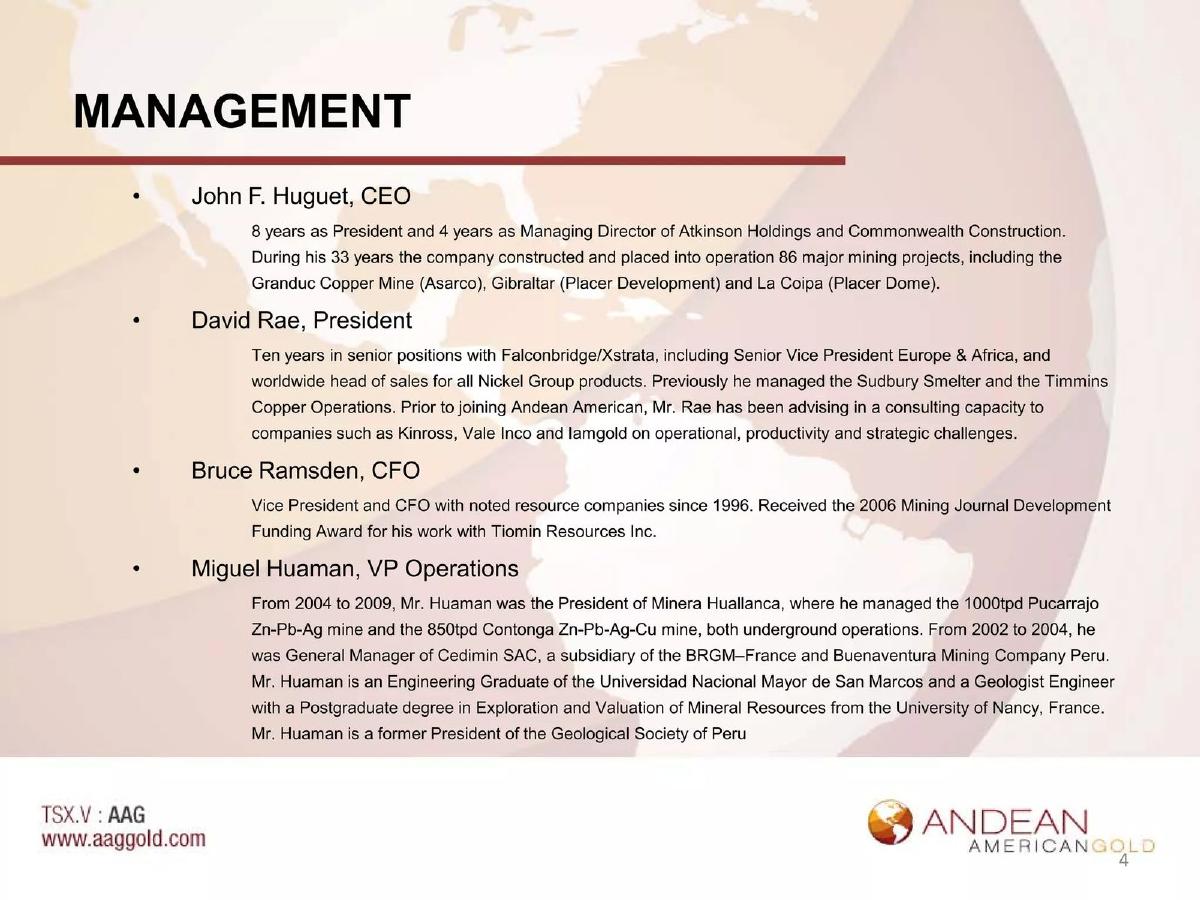
- The management team features significant industry experience, including CEO John F. Huguet's 33-year tenure involving 86 major mining projects (Slide 4).
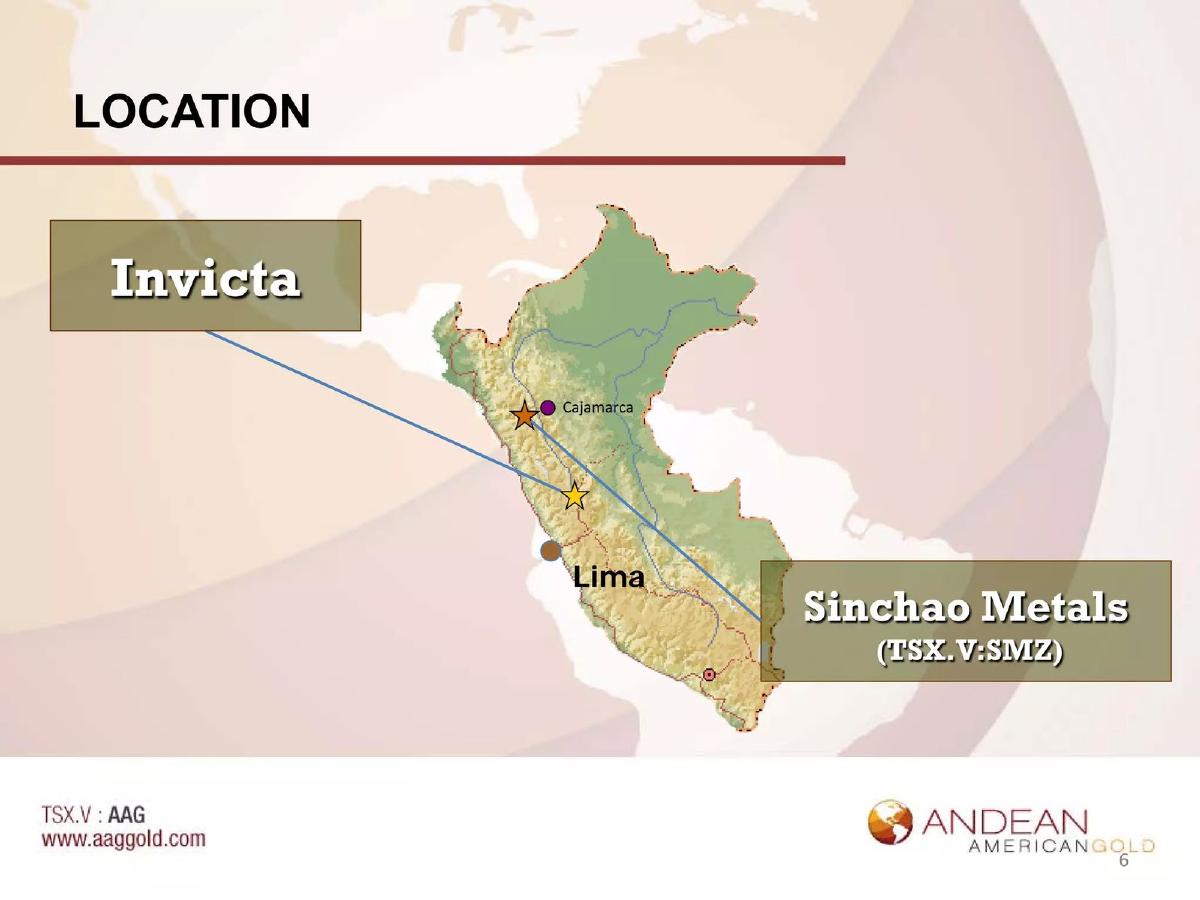
- The project is strategically located in a high-density mining region of Peru, surrounded by numerous production and exploration projects (Slide 7).
- Resource validation is precise, citing 9,866,735 tonnes in the Indicated category with specific metal grades for Gold, Silver, Copper, Lead, and Zinc (Slide 10).
- A 3D topographical model is used to visualize the physical layout of the tailings, plant, and mine relative to elevation (Slide 13).
- The feasibility study projects an average annual production of 160,857 Gold Equivalent ounces over an initial 5-year mine life (Slide 16).
- Economic projections include a remarkably short 1-year payback period based on an estimated $68M CapEx (Slide 16).
- The strategic partnership with Trafigura includes a $15M USD sub-debt facility and an option for Trafigura to underwrite project debt if other lenders fail to fund by March 31st (Slide 19).
- Recent catalysts include the appointment of Barclays Capital and WestLB as debt arrangers and a $3M private placement with Trafigura (Slide 22).
Executive Summary: The Industrial Rigor of Mining Decks
The Andean American Gold presentation is a classic example of a resource-sector pitch deck. Unlike software startups that focus on user growth and market disruption, mining companies must prove geological certainty, regulatory compliance, and capital efficiency. This deck, focused on the Invicta project in Peru, uses 24 slides to build a case centered on de-risking. By the time an investor reaches the end, the company has demonstrated that the gold is there (Resource slides), the plan to get it out is sound (Feasibility slides), and the money to build it is largely lined up (Trafigura/Debt slides).
Slide 1: Title and Branding
The cover slide is functional and professional. It features a panoramic shot of the Peruvian highlands, immediately establishing the geographic context of the company's operations. The branding for Andean American Gold is clear, and the inclusion of the TSX.V: AAG ticker symbol and the company website (www.AAGgold.com) signals that this is a publicly traded entity, likely looking for institutional or sophisticated retail investment to fund the next stage of development.
Slide 4: Management and Operational Experience
In the mining industry, the team is often the primary factor in securing debt financing. Slide 4 provides dense biographical information for four key executives. John F. Huguet (CEO) is credited with 33 years of experience and the construction of 86 major mining projects. David Rae (President) brings experience from Falconbridge/Xtrata, while Bruce Ramsden (CFO) is highlighted for his 2006 Mining Journal Development Funding Award. The inclusion of Miguel Huaman (VP Operations) , a former President of the Geological Society of Peru, adds local expertise and technical credibility. This slide is designed to reassure investors that the project is in the hands of veterans who have built mines before.
Slide 7: Geographic Context and Regional Density
Mining success is often a matter of proximity. Slide 7 uses a map of Peru to show the high density of exploration and production projects surrounding the Invicta site. By labeling nearby mines like Uchucchacua, Mallay, and Quicay , the company leverages the 'neighborhood effect'—proving that the region is geologically productive and supported by existing infrastructure. The use of red triangles for exploration and yellow circles for production projects provides a quick visual reference for the maturity of the surrounding district.
Slide 10: The Core Asset - Reserves and Resources
This is the most critical slide for any mining valuation. Andean American Gold breaks down its resources into three regulatory categories: Measured, Indicated, and Inferred . The slide lists 9,866,735 tonnes in the Indicated category. Crucially, it provides the 'grade' (concentration) for five different metals: Gold (Au), Silver (Ag), Copper (Cu), Lead (Pb), and Zinc (Zn). The table also details 'Mineable Reserves' for the first five years, totaling 7,807,157 tonnes . For an analyst, this slide provides the raw data needed to calculate the Net Present Value (NPV) of the asset based on current commodity prices.
Slide 13: 3D Visualization of Infrastructure
Mining is a massive logistical and engineering challenge. Slide 13 uses a 3D topographical model to show the relationship between the Mine, Concentrate Plant, and Tailings facility. The slide includes elevation markers (M.a.s.l.) ranging from 1100 to 3400 meters. This visualization helps investors understand the physical footprint of the project and the road access (Main Road from Choques to Plant), which is vital for assessing the feasibility of transporting equipment and ore.
Slide 16: The Feasibility Study and Economics
Slide 16 summarizes the economic potential of the Invicta project. The figures are specific and aggressive: an Average Annual Production of 160,857 Oz Gold Equivalent and an Estimated CapEx of $68M . The most striking metric is the 1 Year Payback period, which is exceptionally fast for a capital-intensive mining project. The slide also addresses environmental concerns, stating the project has 'zero liquid effluents.' A footnote specifies the price deck used for these calculations (e.g., Gold at $900/oz), allowing investors to adjust the projections based on current market fluctuations.
Slide 19: The Trafigura Relationship
Strategic partnerships are a major de-risking signal. Slide 19 details the company's relationship with Trafigura , a global trading giant with $47.3 Billion in sales (2009 figures). The agreement includes a $15M USD Sub Debt Facility and an offtake agreement where Trafigura buys the metal concentrates. Perhaps most importantly, the slide outlines a 'backstop' option: if other lenders don't fund the CapEx by March 31st, Trafigura has the option to underwrite the debt themselves. This provides a safety net for the project's financing.
Slide 22: Recent Catalysts and Momentum
The final slide in this sequence lists 'Catalysts - Last 12 Months' to show execution momentum. It separates these into Operations (e.g., EIA approval, hiring a Mill Manager) and Strategic (e.g., appointing Barclays and WestLB as debt arrangers). This slide serves as a checklist of completed milestones, proving to the investor that the company is moving steadily toward production rather than just sitting on a mineral claim.
What Works in This Deck
The deck is exceptionally strong on technical transparency . By providing detailed grade tables and specific LOM (Life of Mine) cash costs, the company invites rigorous due diligence. The Trafigura partnership is also used effectively; it isn't just a logo on a slide, but a detailed explanation of how that partnership provides financial stability and a guaranteed buyer for the product. The management bios are also well-constructed, focusing on 'mines built' rather than just 'titles held,' which is the correct metric for this industry.
What Is Missing
The most notable omission is a clear 'Ask' slide . While the CapEx is stated as $68M, the deck does not explicitly state how much equity the company is currently raising or at what valuation. There is also a lack of a detailed timeline showing the path from the current state to 'first gold.' While catalysts are mentioned, a Gantt chart or milestone map for the construction phase would help investors understand the duration of their capital lock-up. Finally, there is no competitor analysis or peer group comparison to show how AAG's valuation or resource grade compares to other junior miners in Peru.
What a Founder Should Copy
Founders in infrastructure or hardware-heavy sectors should copy the de-risking structure of this deck. Andean American Gold doesn't just say they have a good project; they show the environmental permits, the 3D engineering layout, the third-party feasibility study, and the institutional debt backing. The use of footnotes to define the 'price deck' (Slide 16) is also a best practice for any company whose revenue depends on fluctuating market prices. It shows intellectual honesty and allows for easier financial modeling by the investor.
Final Thoughts
This is a 'workhorse' deck. It isn't designed to be beautiful or to tell a poetic story; it is designed to survive the scrutiny of a mining analyst. For a company at this stage—moving from exploration to construction—the density of data is its greatest asset. The strategic alignment with a major player like Trafigura is the 'closer' that makes the high CapEx requirement feel manageable rather than insurmountable.
Frequently asked questions
- What is the primary project discussed in the Andean American Gold deck?
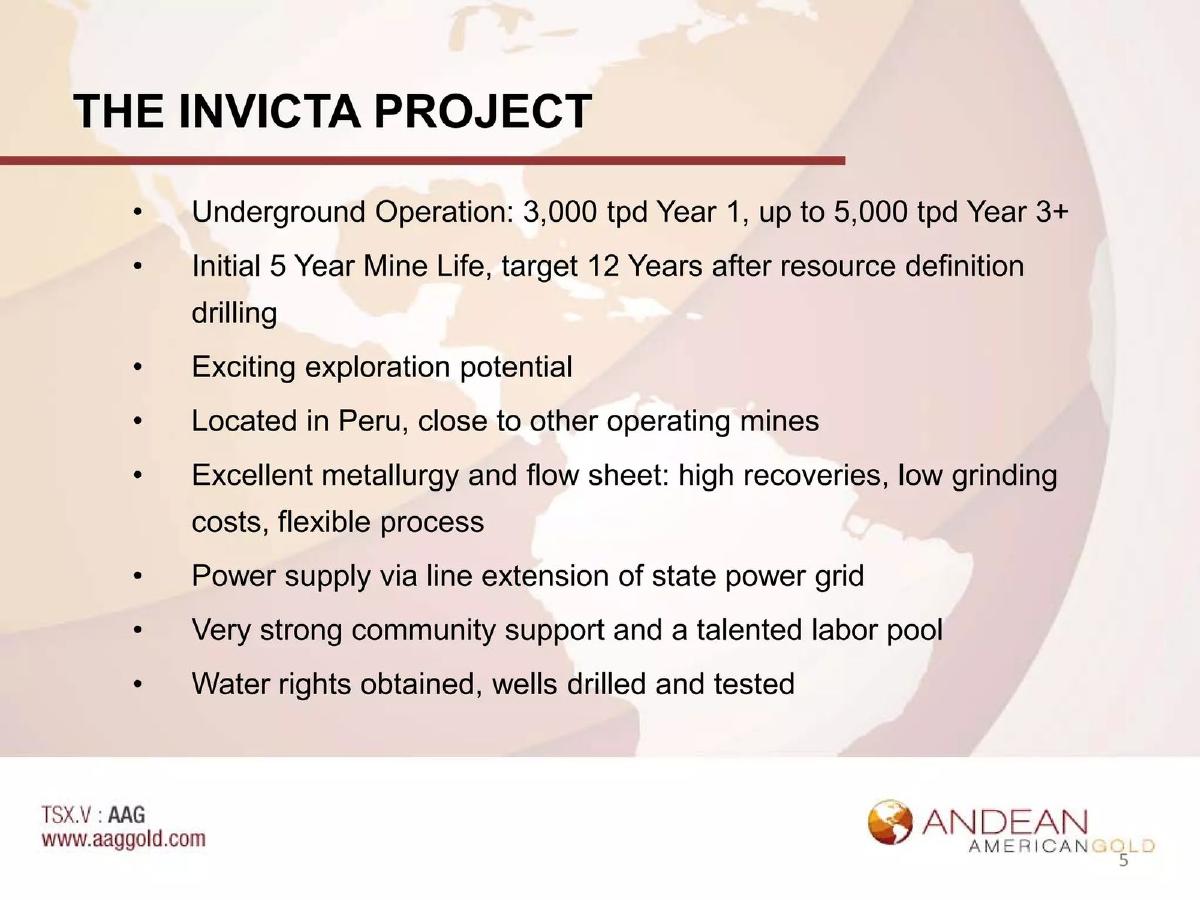
- The deck focuses almost exclusively on the Invicta project in Peru. It details the project's location, geological resources, infrastructure layout, and economic feasibility. The presentation positions Invicta as a near-production asset with significant metal reserves across gold, silver, copper, lead, and zinc.
- How does the company address environmental concerns?
- On Slide 16, the company explicitly states that the project surpasses Peruvian environmental standards. It describes the operation as a 'contained process with zero liquid effluents.' Additionally, Slide 22 notes that the Environmental Impact Assessment (EIA) has already been approved, a critical milestone for mining projects.
- What are the projected costs for gold production?
- According to the Feasibility Study on Slide 16, the Life of Mine (LOM) cash cost per ounce of gold is $451.38 on a co-product basis. When calculated on a gold-equivalent basis, the cost drops to $274.80. Most notably, on a by-product basis, the cost is listed as a negative ($126.91), suggesting that the sale of other metals covers the cost of gold extraction.
- Who are the key strategic partners mentioned?
- The most significant partner is Trafigura, the world's second-largest non-ferrous trading company. Trafigura has provided a $15M debt facility, a $3M private placement, and holds the rights to buy all base metal concentrates. The deck also mentions Barclays Capital and WestLB as the appointed debt arrangers for the project.
- What is the management team's track record?
- The team is highly experienced. CEO John F. Huguet has 33 years of experience and has been involved in 86 major mining projects. President David Rae spent ten years at Falconbridge/Xtrata, and VP Operations Miguel Huaman previously managed two underground mines in Peru and served as President of the Geological Society of Peru.