Abracadabra Robotics is a pre-seed stage startup aiming to disrupt the post-stroke rehabilitation market with Social Assistive Robots (SAR). Their deck centers on a demographic shift, noting that by 2050, the population aged 65+ will significantly outpace children under 5. The proposed solution is a humanoid robotic platform integrated with IoT devices like smart dumbbells and cups to facilitate at-home therapy. Financially, they propose a subscription model costing $450 per month in the first year, dropping to $240 in the second. While the deck clearly defines the 'win-win' for stakeholders—…
Key takeaways
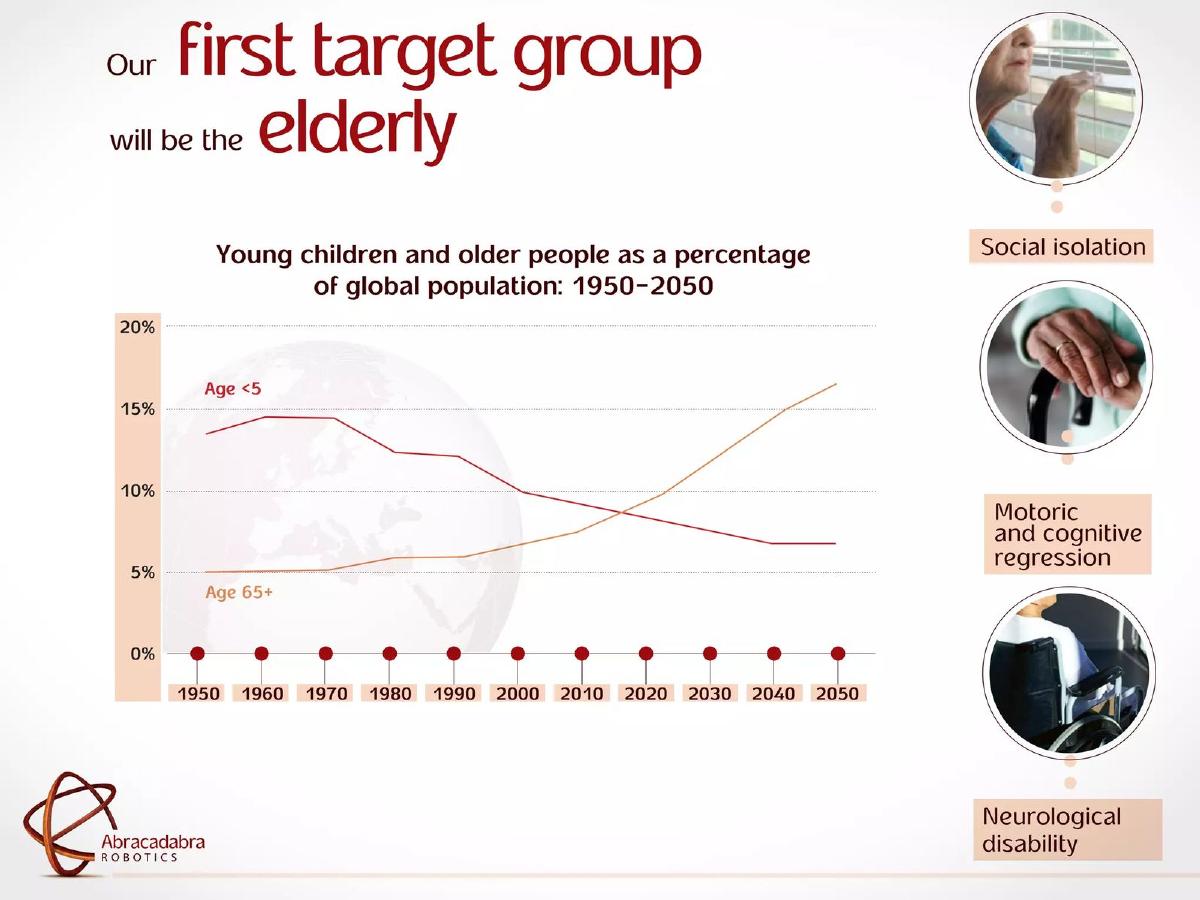
- The company identifies a massive demographic shift, citing a chart that shows the 65+ population reaching approximately 16% of the global total by 2050 (Slide 2).
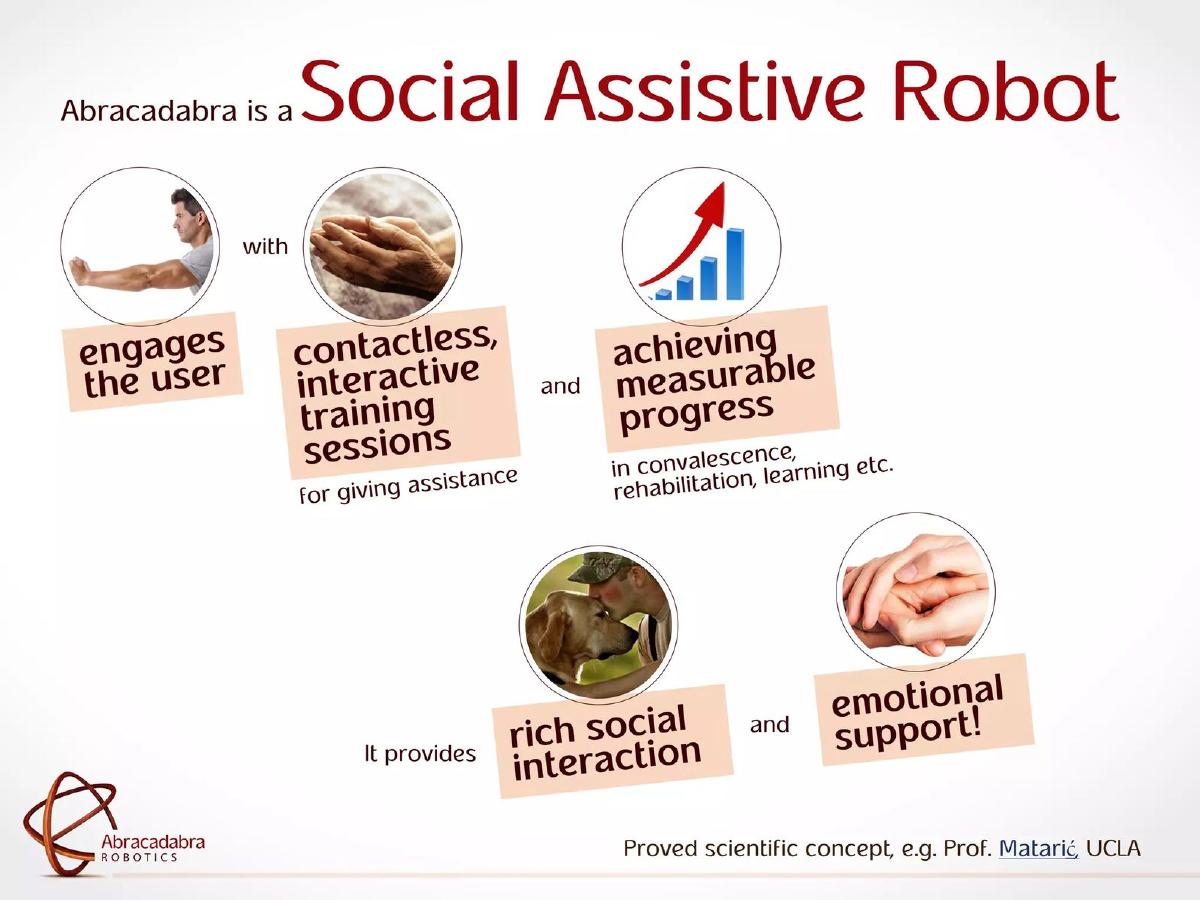
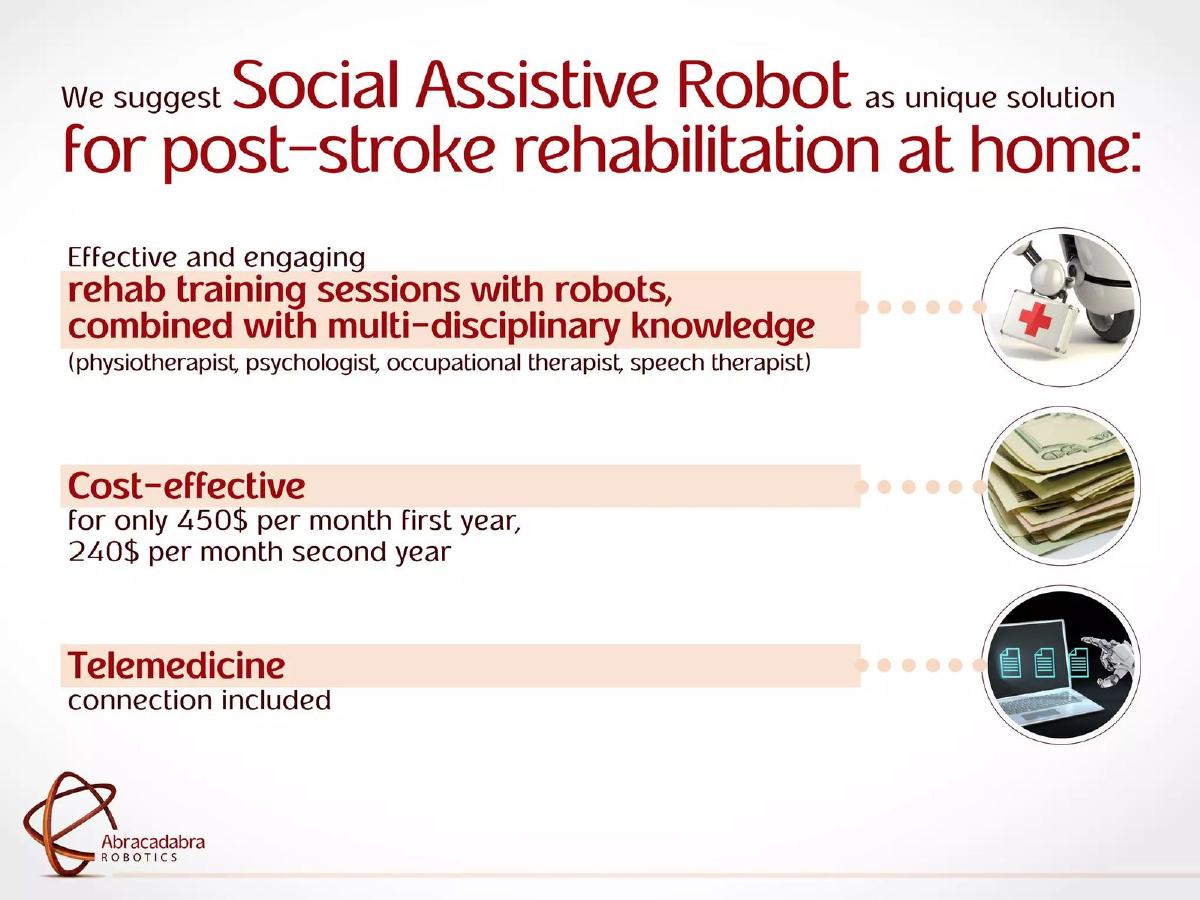
- The product is positioned as a 'Social Assistive Robot' (SAR) specifically for post-stroke rehabilitation at home (Slide 3).
- Pricing is explicitly stated as $450 per month for the first year and $240 per month for the second year (Slide 3).
- The technical approach relies on 'connected devices' including smart dumbbells, cups, and pads to enable real-time interaction (Slide 6).
- The business case targets four stakeholders: families, stroke survivors, insurance companies, and medical staff (Slide 4).
- The funding goal is a $600,000 pre-seed raise as part of a $1 million total round (Slide 7).
- Capital will be used to hire algorithm developers and engineers to build an Alpha Prototype within one year (Slide 7).
- The deck omits a team slide, competitive landscape, and current traction or intellectual property status.
Executive Summary: The Social Assistive Robot Thesis
Abracadabra Robotics presents a vision for the future of elder care and stroke recovery. The deck is a classic pre-seed narrative: it identifies a massive, undeniable demographic trend and proposes a high-tech solution to a high-cost medical problem. By focusing on Social Assistive Robots (SAR), the company attempts to bridge the gap between expensive in-person physical therapy and the isolation of at-home recovery.
Slide 1: Title and Visual Hook
The cover slide features a high-concept illustration reminiscent of 'The Creation of Adam,' showing a robotic hand and a human hand reaching toward each other with a spark of light between them. The logo for Abracadabra Robotics is an abstract, interlocking orbital shape. There is no tagline or mission statement on this slide, relying entirely on the visual metaphor of human-robot connection.
Slide 2: The Demographic Imperative
Slide 2 establishes the 'Why Now?' through a population chart titled 'Young children and older people as a percentage of global population: 1950–2050.' The chart shows a clear 'X' crossover occurring around 2015-2020. By 2050, the 'Age 65+' line is projected to reach approximately 16%, while the 'Age Social isolation , Motoric and cognitive regression , and Neurological disability . This slide successfully frames the problem as a global macroeconomic inevitability rather than a niche medical issue.
Slide 3: The Solution and Pricing Model
This slide introduces the 'Social Assistive Robot' as a 'unique solution for post-stroke rehabilitation at home.' It breaks the value proposition into three pillars:
Effective and engaging: Rehab sessions combined with multi-disciplinary knowledge (physiotherapists, psychologists, etc.). · Cost-effective: The slide explicitly lists pricing at $450 per month for the first year and $240 per month for the second year. · Telemedicine: A connection for remote monitoring is included.
The inclusion of hard pricing at the pre-seed stage is bold, though it lacks a breakdown of how these numbers were derived or if they include the hardware cost.
Slide 4: The Stakeholder Ecosystem
Titled 'win win,' this slide uses a quadrant to explain how the product benefits different parties. For the Family , it offers peace of mind. For the Survivor , it offers the opportunity to 'be revived.' For Medical Staff , it provides alerts and progress tracking. Crucially, for Insurance Companies , it is positioned as a 'cost-effective decision.' This acknowledges the complex healthcare payer landscape, though it does not provide data on current rehabilitation costs to prove the 'cost-effective' claim.
Slide 5: The Vision Statement
Slide 5 defines the company's vision: 'To create personal humanoid low-cost robotic platform with rich real-time machine-user interaction for SAR.' The slide features a stock image of a woman looking through binoculars. While the vision is clear, the term 'low-cost' is relative and not defined against existing robotic competitors like those from SoftBank or specialized medical robotics firms.
Slide 6: Technical Concept and IoT Integration
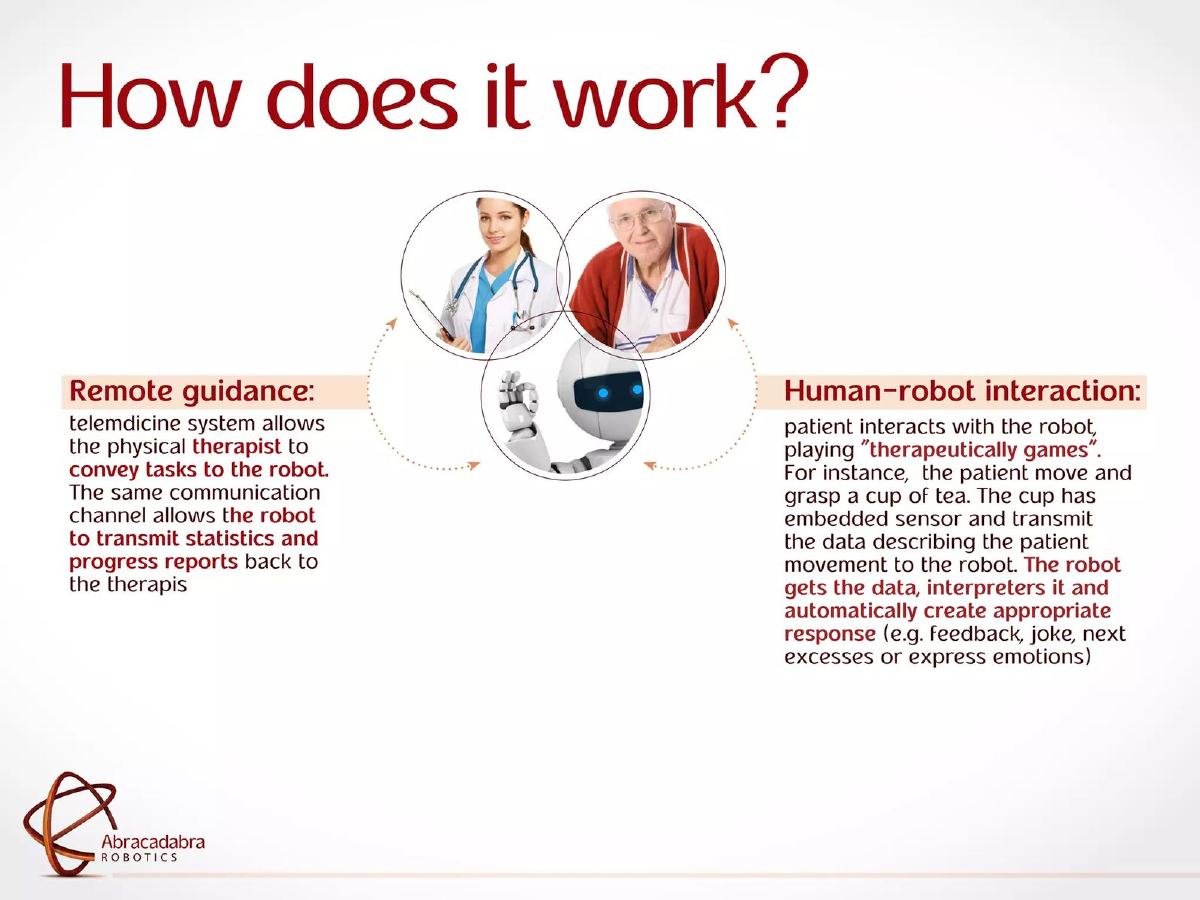
This slide explains the 'breakthrough concept for real-time collection and analysis of users actions.' It illustrates a person, a table, and a stylized robot icon. The core of the technology is 'connected devices.' The company claims to have developed a set of external tools with embedded sensors, specifically mentioning smart dumbbells, cups, and pads . These sensors create a 'smart environment' that allows for 'real-time interaction with zero margin of error.' This is the most technical slide in the deck, suggesting that the robot itself is part of a larger IoT ecosystem.
Slide 7: The Pre-Seed Ask
The final slide in this set outlines the funding requirements. The headline is 'raising pre-seed.' The text states: 'We need to raise $600,000 (of $1 million) .' This implies $400,000 may already be committed or is being sought elsewhere. The funds are intended to:
Provide a long runway. · Hire algorithm developers and engineers. · Bring the project from 'design to Alpha Prototype.' · Develop a set of 12 rehab training sessions.
The timeline for these milestones is stated as 'in the year.'
What Works in the Abracadabra Robotics Deck
The deck excels at identifying a clear, growing market. The use of UN-style demographic data (Slide 2) makes the investment opportunity feel significant. Furthermore, the company does a good job of identifying that a robot alone isn't a solution; the integration of 'smart' physical objects (dumbbells, cups) on Slide 6 shows a practical understanding of how physical therapy actually works. The explicit pricing on Slide 3 is also helpful for investors to understand the intended market positioning (premium but potentially reimbursable).
What is Missing from the Deck
The most glaring omission is a Team Slide . In a pre-seed robotics play, the technical pedigree of the founders is everything. Building humanoid robots and sensor-embedded hardware is notoriously difficult ('hardware is hard'); without seeing the engineering background of the team, the 'zero margin of error' claim on Slide 6 feels unsubstantiated. Also missing is a Competitive Landscape . Companies like Intuitive Surgical or even consumer-grade social robots like Jibo (at the time) or Moxie would be relevant comparisons. Finally, there is no mention of Regulatory Pathways . A robot used for 'stroke rehabilitation' is likely a medical device requiring FDA or CE Mark clearance, which significantly impacts the timeline and capital requirements beyond the initial $600,000.
Founder's Guide: What to Copy
Founders should emulate the way Abracadabra Robotics maps out their stakeholder 'win-win' (Slide 4). In healthcare, the person using the device is rarely the person paying for it. By identifying the benefits for insurance companies and medical staff alongside the patient, the founders show they understand the 'payer-provider-patient' triangle. Additionally, the specific use of funds on Slide 7—linking the dollar amount to a specific technical milestone (Alpha Prototype) and a specific content milestone (12 training sessions)—is a best practice for pre-seed decks.
Final Analyst Thoughts
Abracadabra Robotics has a strong 'problem' narrative but a very 'black box' solution. The deck relies heavily on the promise of future engineering. For a $600,000 ask to move from 'design' to 'prototype,' investors would typically expect to see a much deeper dive into the founders' technical expertise and a more realistic assessment of the regulatory hurdles involved in medical robotics. The IoT approach to rehab tools is a clever way to reduce the complexity required of the robot's vision systems, which is a strategic highlight of the deck.
Frequently asked questions
- What is the primary problem Abracadabra Robotics is solving?
- The company addresses the challenges of post-stroke rehabilitation, specifically social isolation, motoric and cognitive regression, and neurological disability. By providing an at-home robotic platform, they aim to make rehabilitation more engaging and cost-effective than traditional clinical settings, while maintaining a telemedicine link to professional medical staff.
- How does the technology actually work according to the deck?
- The solution is a 'humanoid low-cost robotic platform' that interacts with a 'smart environment.' This environment consists of external tools with embedded sensors, such as smart dumbbells, cups, and pads. These devices collect real-time data on user actions, which the robot analyzes to provide feedback and track progress for clinicians.
- What is the proposed business model?
- Abracadabra Robotics utilizes a subscription-based model. They quote a price of $450 per month for the first year of use, which decreases to $240 per month in the second year. This suggests a hardware-as-a-service (HaaS) model where the cost of the robot and the telemedicine connection is amortized over the rehabilitation period.
- What are the specific milestones for the pre-seed funding?
- The $600,000 investment is intended to cover a one-year runway. The primary objectives are to hire a technical team (algorithm developers and engineers) and transition the company from the 'design' phase to a functional 'Alpha Prototype,' which includes developing a set of 12 specific rehab training sessions.
- Who are the target customers and beneficiaries?
- The deck identifies a 'win-win' for four groups: the post-stroke survivor (recovery), the family (effective rehab for loved ones), medical staff (alerting clinicians and tracking progress), and insurance companies (cost-effective decision-making). This indicates a B2B2C approach where insurance or medical providers might facilitate the placement of the robots.