Gelt's seed deck is a masterclass in simplifying complex technology for investors. By positioning itself as the 'Protocol-to-Consumer' (P2C) layer, the company addresses the primary friction points of decentralized finance: usability and trust. The deck highlights a non-custodial architecture that mimics the user experience of a traditional fiat savings account, offering up to 10% APY. Key credibility markers include an audit by Quantstamp and deposit coverage via Nexus Mutual. While the deck is light on financial projections and specific market sizing, it relies heavily on the team's pedigre…
Key takeaways
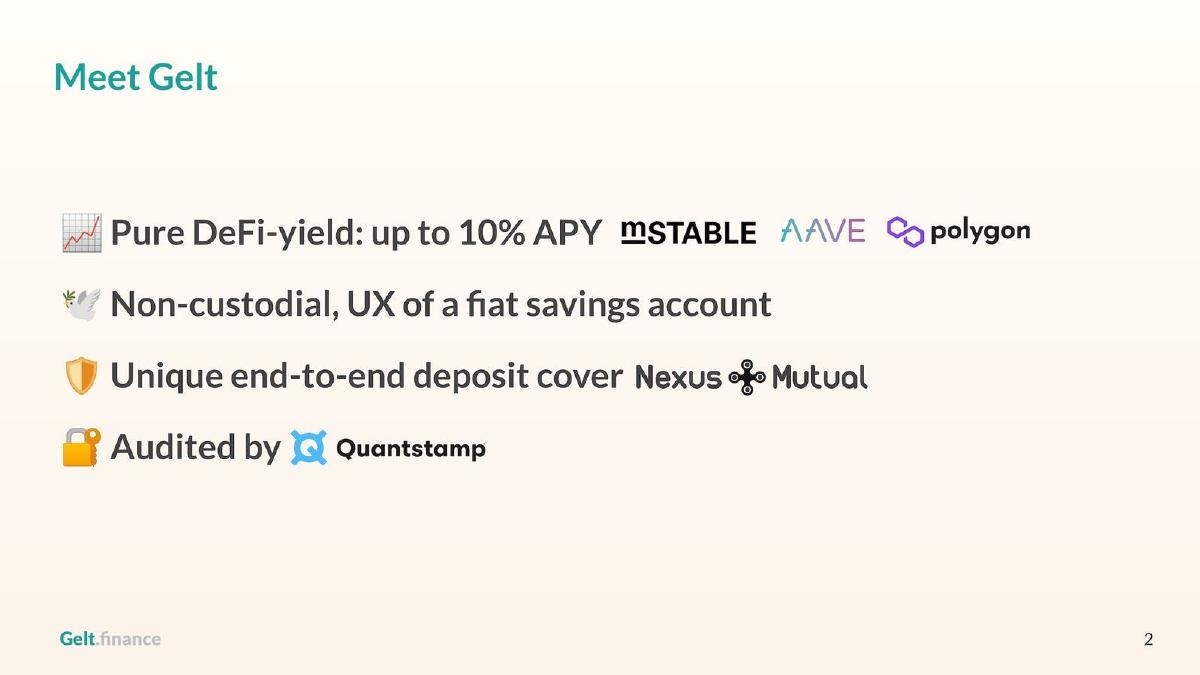
- Gelt positions itself as a non-custodial solution with the UX of a fiat savings account on slide 2.
- The company offers up to 10% APY by leveraging protocols like mStable, Aave, and Polygon as shown on slide 2.
- Security is a central theme, citing an audit by Quantstamp and deposit cover from Nexus Mutual on slide 2.
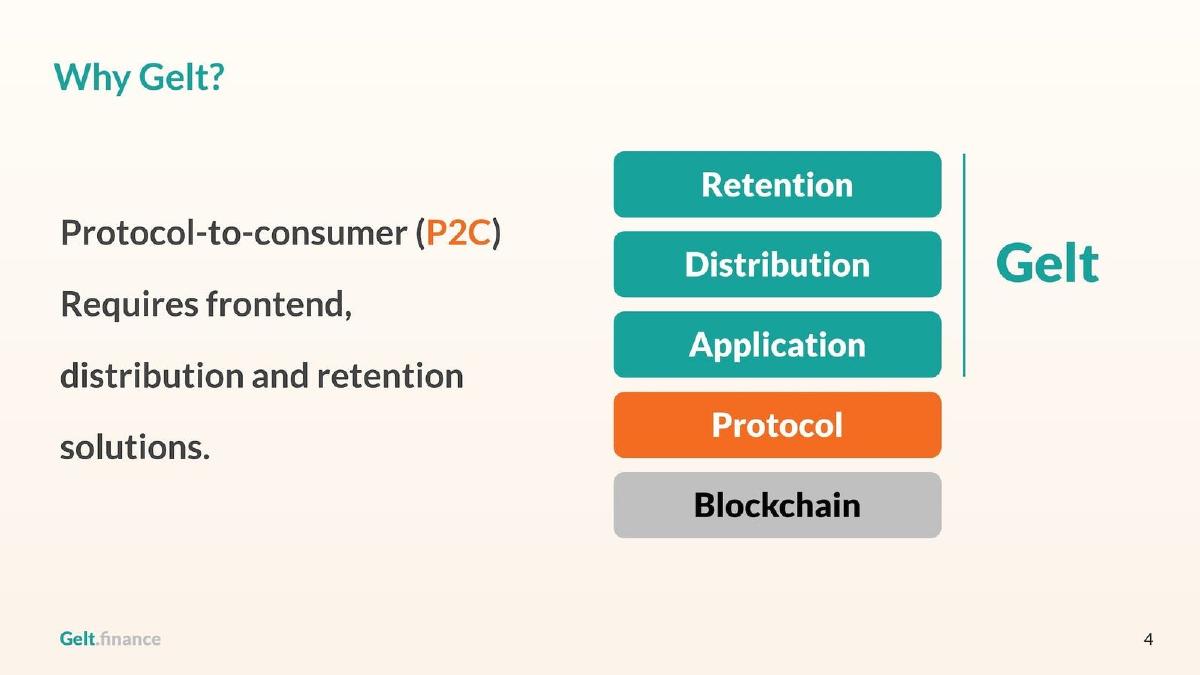
- The deck introduces the 'Protocol-to-Consumer' (P2C) framework, arguing that DeFi requires frontend, distribution, and retention layers on slide 4.
- The product architecture is visualized as a stack where Gelt sits atop the Protocol and Blockchain layers on slide 4.
- A dedicated 'Demo time!' slide (slide 6) indicates a functional product was ready during the seed raise.
- The team slide (slide 8) showcases significant institutional and startup experience, including logos from Y Combinator, UBS, and SIX Group.
- The deck omits traditional slides for market size (TAM), competition, and specific use of funds.
The P2C Bridge: Gelt's $4M Seed Deck Analysis
In 2022, the fintech landscape was heavily focused on making decentralized finance (DeFi) accessible to the average consumer. Gelt, a Europe-based startup, successfully navigated this trend by raising $4M in seed funding. Their 11-slide deck is a lean, product-focused presentation that prioritizes clarity of vision over dense financial modeling. By positioning themselves as the 'Protocol-to-Consumer' (P2C) layer, Gelt addressed the two biggest hurdles in crypto: complexity and risk.
Slide 1: Title and Leadership
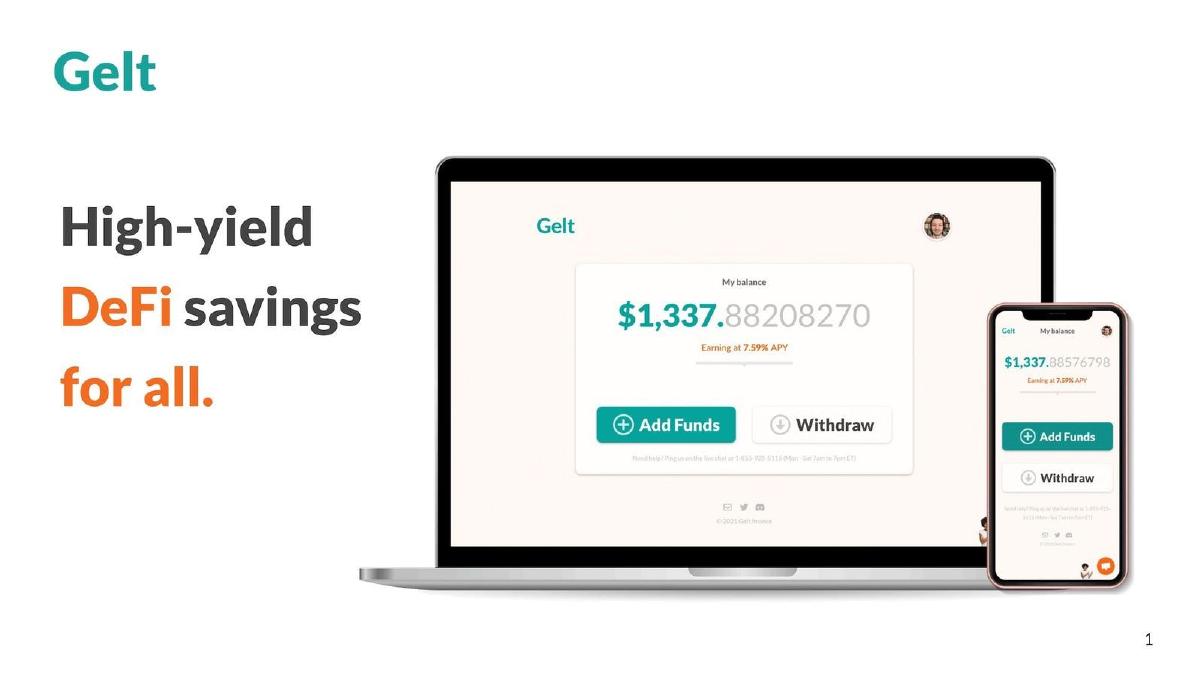
The deck opens with a simple introduction of Jeremiah Smith, the co-founder and CEO. While the text provided is a summary, the visual impact of a founder-led title slide sets a personal tone for the pitch. In seed rounds, investors are often betting as much on the founder's ability to execute as they are on the specific product mechanics.
Slide 2: The Value Proposition
Slide 2, titled 'Meet Gelt,' is the most information-dense slide in the deck. It outlines four critical pillars of the business:
Pure DeFi-yield: The slide promises 'up to 10% APY' and lists the protocols used to generate this return: mStable, Aave, and Polygon. This transparency is vital in a space often criticized for 'black box' yields. · User Experience: It claims a 'Non-custodial' setup with the 'UX of a fiat savings account.' This is the core 'hook'—giving users the benefits of crypto without the burden of private key management or complex wallet interactions. · Security: Gelt highlights 'Unique end-to-end deposit cover' through Nexus Mutual. For a savings product, addressing the fear of loss is paramount. · Audits: The mention of being 'Audited by Quantstamp' serves as a technical seal of approval, signaling that the code is enterprise-grade.
Slide 4: The Strategic Framework (P2C)
Slide 4 introduces the 'Why Gelt?' argument through a vertical stack diagram. It defines the 'Protocol-to-consumer (P2C)' model. The diagram shows Gelt occupying the top three layers of the stack: Retention, Distribution, and Application. Below these sit the 'Protocol' and 'Blockchain' layers. This slide is crucial because it defines Gelt's role not as a creator of new financial primitives, but as the essential interface that makes existing primitives useful to humans. It argues that protocols alone cannot achieve mass adoption because they lack the 'frontend, distribution and retention solutions' that Gelt provides.
Slide 6: Product Maturity
Slide 6 is a simple transition slide: 'Demo time!' While we do not see the demo itself in the static deck, the inclusion of this slide in a seed deck is a strong signal of technical progress. It tells investors that the team isn't just pitching a whitepaper; they have a working application that can be tested. In the 2022 market, having a live product was a significant differentiator from the many 'idea-stage' crypto startups.
Slide 8: The Team
The team slide is a powerhouse of credibility markers. It features five key members:
Jeremiah Smith, PhD (Founder & CEO): His academic credentials and Y Combinator background are highlighted. · Yury Oparin (Founder & CTO): Associated with SIX Group and DX.network. · Csongor Bokay (VP Blockchain): Bringing experience from CBS Interactive and Sprint. · Burgess Powell (Content and SEO): Highlighting the 'Distribution' part of their P2C strategy. · Sarah Kalvar (Community): With experience from UBS and PublicisLive.
The bottom of the slide is a 'logo wall' of institutions including McGill, Imperial College London, and Y Combinator. This slide effectively answers the 'Why this team?' question by showing a mix of deep technical expertise, institutional finance experience, and growth marketing skills.
Slide 10: The Call to Action
The final slide, 'Let's connect!', provides a clear path forward for different stakeholders. It offers 'priority access' via a specific URL and categorizes the types of outreach they are looking for: Feedback, Partner, Join the team, and Invest. This multi-pronged CTA shows that the founders are thinking about ecosystem building, not just fundraising. It also includes the CEO's direct email and social handles, maintaining the personal accessibility established on slide 1.
What Gelt's Deck Does Exceptionally Well
The Gelt deck excels at reductionism . DeFi is notoriously difficult to explain to non-technical investors, but Gelt avoids the jargon trap. By comparing their product to a 'fiat savings account' and using a simple stack diagram to explain their business model, they make the investment thesis easy to digest. The thesis is: 'DeFi has high yields but bad UX; we provide the UX and take a fee (or drive retention).'
Furthermore, the emphasis on security is a masterstroke. By placing the Quantstamp audit and Nexus Mutual insurance on the very first content slide (Slide 2), they proactively answer the investor's biggest concern: 'What happens if the money disappears?' This builds immediate trust.
What is Missing from the Gelt Deck
Despite its success, the deck leaves several standard questions unanswered:
Market Size: There is no TAM (Total Addressable Market) slide. While it is implied that the global savings market is huge, investors usually want to see the founder's specific calculation of the opportunity. · Unit Economics: The deck mentions 'up to 10% APY' for users, but it does not explain Gelt's take-rate or how the company itself generates revenue. Is it a spread on the yield, a subscription fee, or a withdrawal fee? · Competitive Landscape: In 2022, several other startups (like Eco or Argent) were attempting similar 'easy DeFi' plays. Gelt does not include a comparison matrix to show why their P2C approach is superior to competitors. · The Ask: The deck does not state the amount being raised or the milestones that the funding will enable. While Business Insider reported a $4M raise, the deck itself is silent on the terms.
Founder's Playbook: Lessons to Copy
Founders in complex technical sectors should study Gelt's Slide 4 (The Stack) . If you are building a middleware or interface layer, you must clearly define where you sit in the value chain. Gelt's 'Protocol-to-Consumer' terminology is a great example of 'category creation'—giving investors a new mental model to categorize your company.
Another takeaway is the Logo Strategy on the team slide. If your team has worked at prestigious firms or attended top universities, use those logos. They act as a cognitive shorthand for quality. Gelt's inclusion of UBS and Y Combinator logos immediately elevates the perceived 'floor' of the team's capability.
Finally, the Demo-First approach is highly effective. Even if you are presenting a deck, signaling that a demo is the centerpiece of the meeting shifts the conversation from 'what if' to 'how it works.' This is particularly important for seed-stage companies trying to prove they can actually build the technology they are promising.
Frequently asked questions
- What is the core value proposition Gelt offers to users?
- Gelt offers high-yield savings (up to 10% APY) by converting cash into stablecoins and deploying them into DeFi protocols. The key differentiator is that it provides a non-custodial service while maintaining the simple user experience of a traditional bank account, effectively hiding the complexity of the blockchain from the end consumer.
- How does Gelt address the risks associated with DeFi protocols?
- Gelt mitigates risk through two primary channels mentioned on slide 2: technical security and financial protection. Their smart contracts are audited by Quantstamp, a leading blockchain security firm, and they offer 'unique end-to-end deposit cover' through Nexus Mutual to protect users against protocol failures or hacks.
- What does Gelt mean by 'Protocol-to-Consumer' (P2C)?
- As illustrated on slide 4, P2C is Gelt's business model. They argue that while DeFi protocols and blockchains exist, they lack the necessary layers for mass adoption. Gelt provides the 'Application,' 'Distribution,' and 'Retention' layers that turn raw protocols into a consumer-ready financial product.
- Who are the key members of the Gelt founding team?
- The team is led by CEO Jeremiah Smith, PhD, and CTO Yury Oparin. The leadership includes Csongor Bokay as VP of Blockchain. The team slide highlights a mix of academic and professional backgrounds, including experience at Y Combinator, McGill, and major financial institutions like UBS.
- What is missing from the Gelt pitch deck?
- The deck is notably missing several standard venture components: there is no explicit 'Ask' slide detailing how much they are raising, no financial projections, no competitor matrix, and no detailed market sizing (TAM/SAM/SOM). It relies almost entirely on the product vision and team strength.