The Copy.AI Series A deck is an outlier in the world of venture capital presentations. Comprising only 8 slides, it eschews standard components like a dedicated team slide, market size (TAM) calculations, a formal 'Ask,' or a roadmap. Instead, the narrative is built entirely around a singular, undeniable fact: the company grew from $0 to $1.2M ARR in just seven months (Slide 4). This 'traction-first' approach works because the product—an AI copywriting tool—is shown to solve a universal pain point for a broad spectrum of B2B customers. By leaning heavily on social proof and a clear competitiv…
Key takeaways
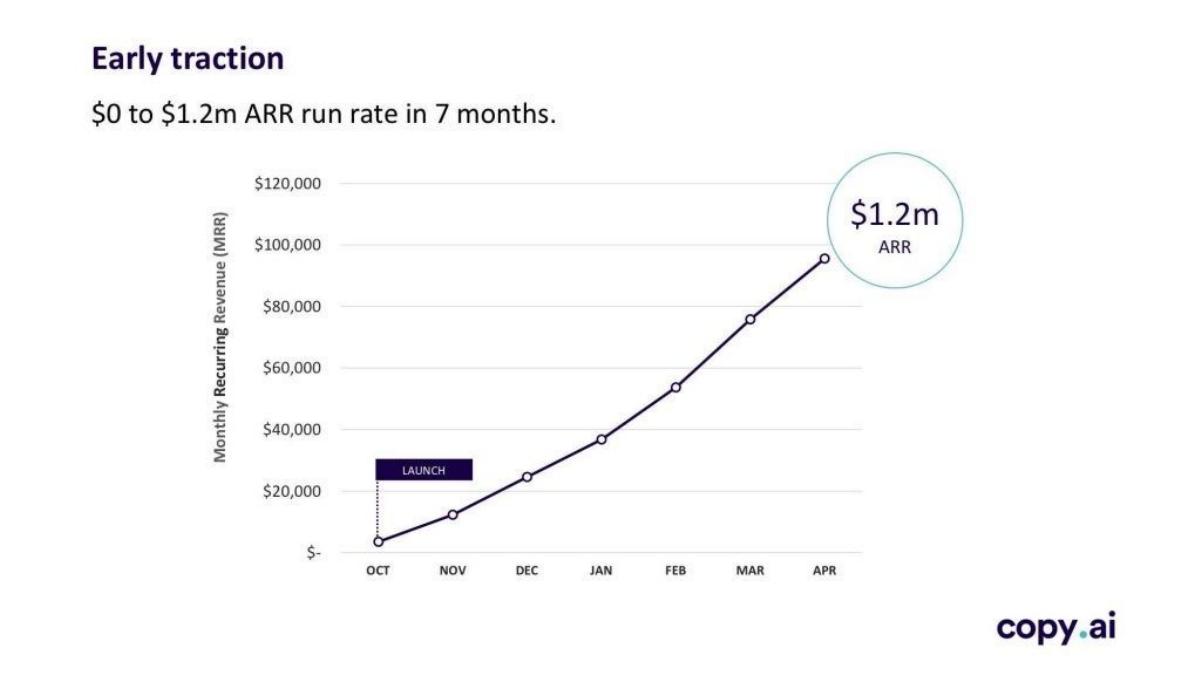
- The deck highlights a rapid revenue climb from $0 to $1.2M ARR run rate in only 7 months (Slide 4).
- The problem is defined by four friction points: time intensity, writer's block, high outsourcing costs, and limited creativity (Slide 2).
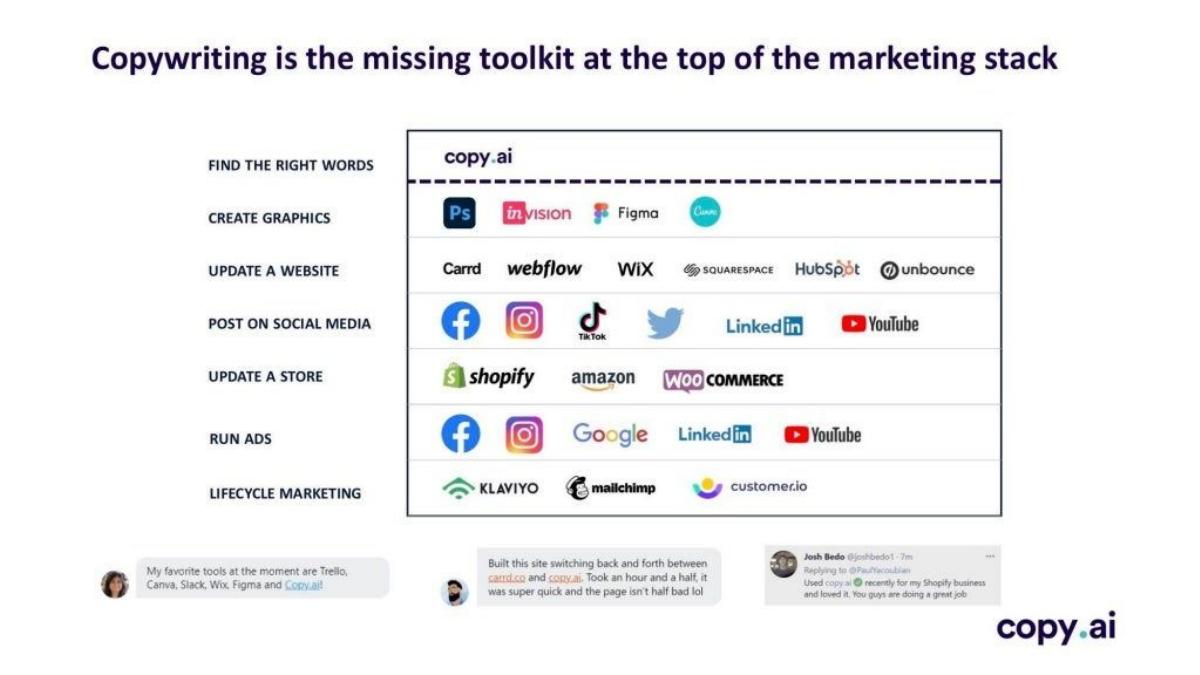
- Copy.AI positions itself as the 'missing toolkit' at the top of the marketing stack, sitting above platforms like Shopify, Facebook, and Mailchimp (Slide 6).
- The product interface is shown to be a simple three-step process: describe, click, and receive results in seconds (Slide 7).
- Social proof is a core pillar of the deck, with an entire slide dedicated to eight glowing user testimonials from Twitter (Slide 8).
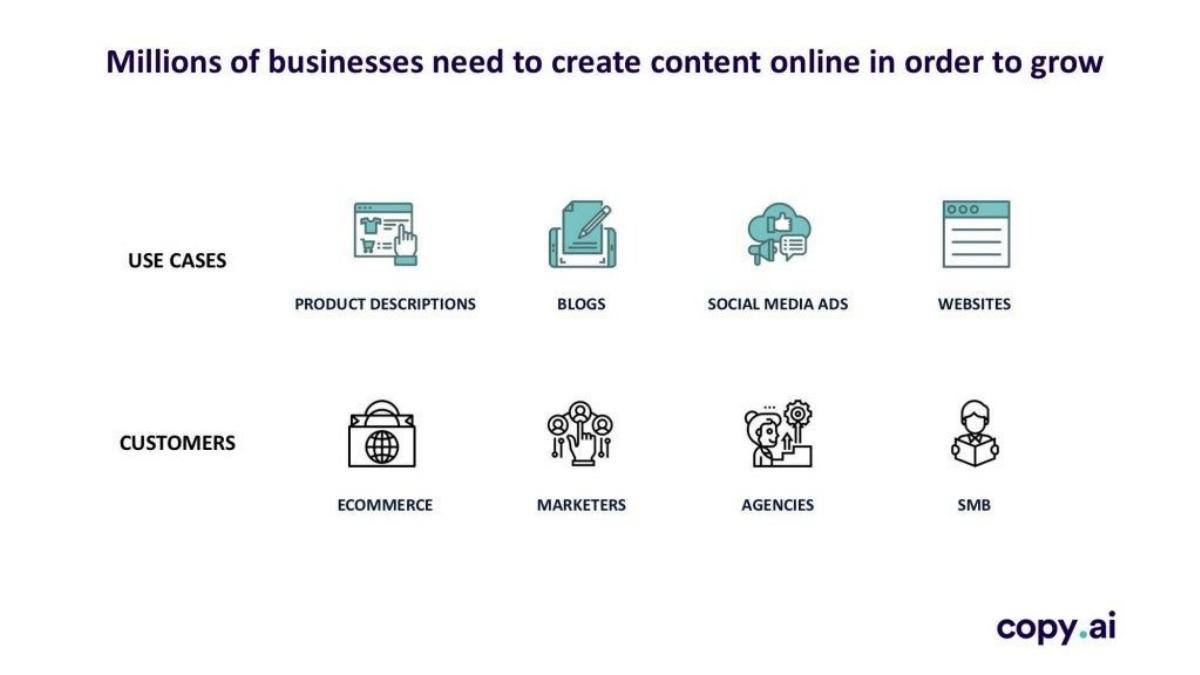
- The deck identifies four primary customer segments: Ecommerce, Marketers, Agencies, and SMBs (Slide 5).
- There is no mention of the founding team, their backgrounds, or previous successes within these 8 slides.
- The deck lacks a formal financial 'Ask' or a breakdown of how the $11M Series A funds would be allocated.
The Power of Brevity: Analyzing the 8-Slide Series A
The Copy.AI pitch deck from May 2021 is a study in efficiency. At a time when the generative AI boom was just beginning to take shape, Copy.AI used this 8-slide presentation to secure an $11M Series A. The deck does not follow the traditional 15-20 slide arc. It ignores the team, the competition's weaknesses, and the future roadmap. Instead, it focuses on a single, powerful narrative: explosive growth driven by a simple solution to a universal problem.
Slide 1: Title Slide
The deck opens with extreme minimalism. The Copy.AI logo is centered on a white background with the date 'May 2021' below it. There are no taglines or value propositions here. This sets a tone of confidence—the brand and the results will speak for themselves.
Slide 2: The Problem
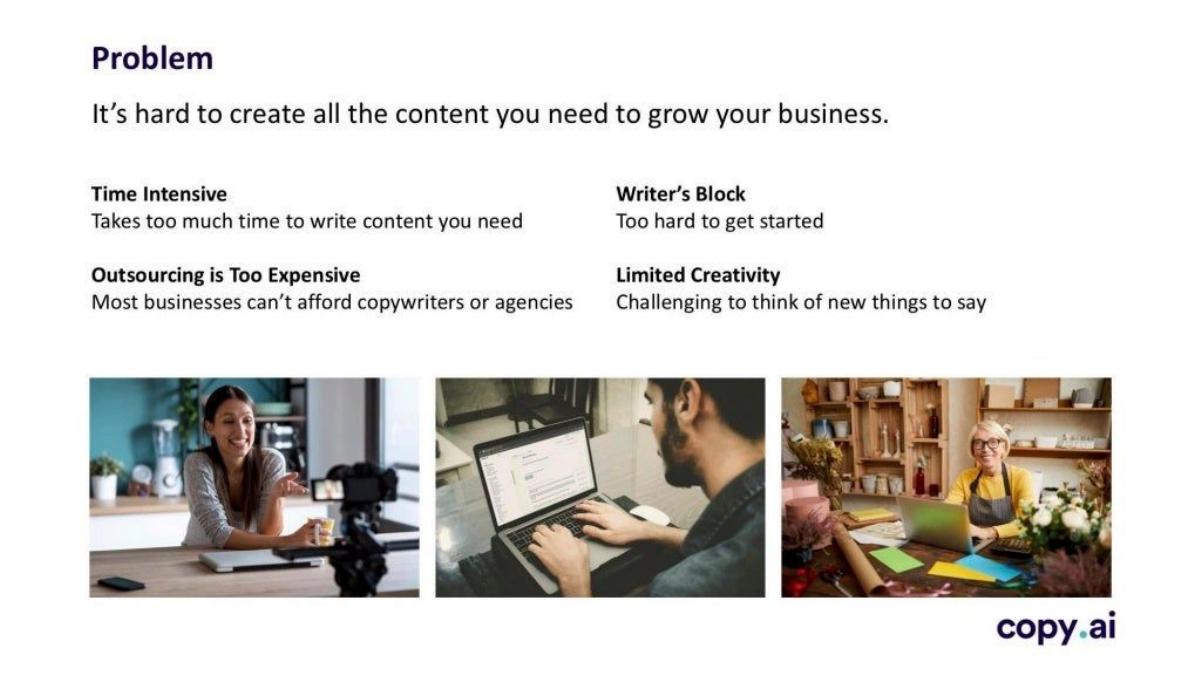
Slide 2 identifies the friction in content creation. It states, 'It’s hard to create all the content you need to grow your business.' The slide breaks this down into four specific pain points: Time Intensive (takes too much time), Writer’s Block (too hard to get started), Outsourcing is Too Expensive (agencies are unaffordable), and Limited Creativity (challenging to think of new things). The use of three lifestyle photos showing diverse business owners—a content creator, a developer, and a small shop owner—underscores that this is a broad B2B problem, not a niche one.
Slide 3: The Solution
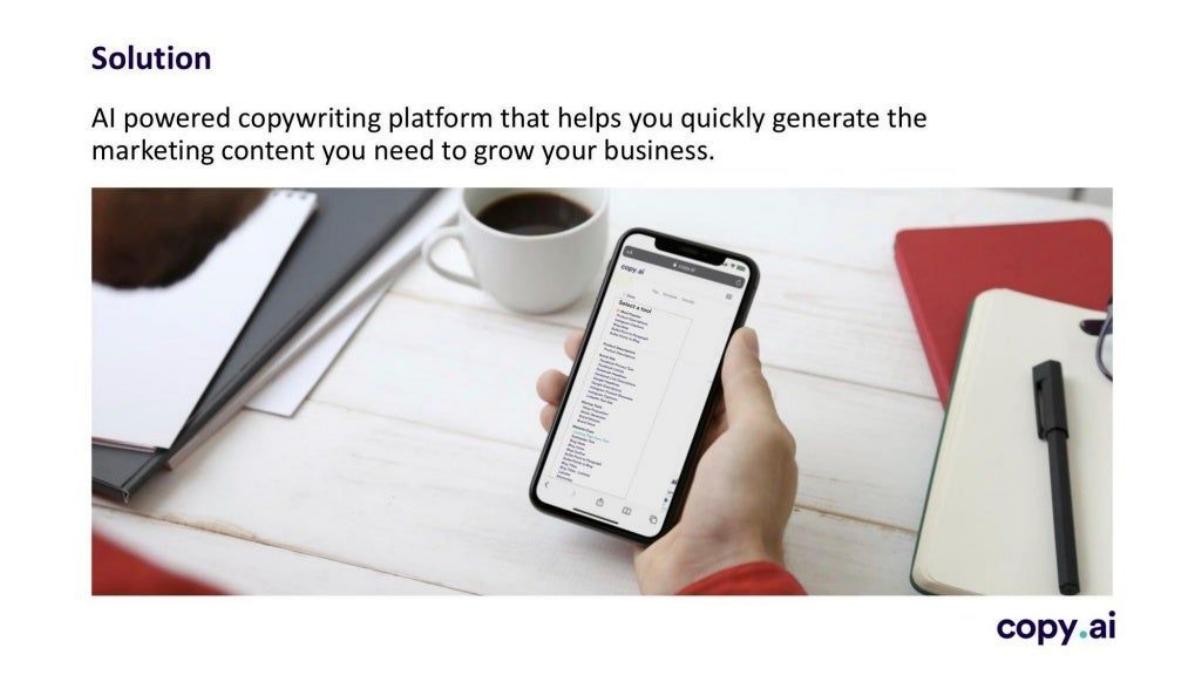
The solution is presented as an 'AI powered copywriting platform that helps you quickly generate the marketing content you need to grow your business.' The visual is a simple mobile mockup of the app. This is a crucial choice; it suggests the tool is accessible and 'always on,' moving away from the idea that professional copywriting requires a complex desktop setup.
Slide 4: Early Traction
This is the 'money slide' of the deck. It features a Monthly Recurring Revenue (MRR) graph showing a steep upward curve. The headline reads: '$0 to $1.2m ARR run rate in 7 months.' The graph starts at 'Launch' in October and ends in April at nearly $100,000 MRR. For a Series A investor, this slide answers the most important question: 'Does the market want this?' The answer provided here is an emphatic yes. The speed of growth (zero to seven figures in under a year) is the primary reason this deck can afford to be so short.
Slide 5: Use Cases and Customers
Slide 5 expands on the market opportunity by listing specific Use Cases (Product Descriptions, Blogs, Social Media Ads, Websites) and Customers (Ecommerce, Marketers, Agencies, SMB). By using simple icons, the deck illustrates that the product is a horizontal platform. It isn't just for 'bloggers'; it is for any entity that sells or communicates online.
Slide 6: The Marketing Stack Positioning
This slide is the deck's version of a competitive analysis. Instead of a 'Checklist of Features,' it shows where Copy.AI sits in the user's workflow. The headline states, 'Copywriting is the missing toolkit at the top of the marketing stack.' It places Copy.AI at the very top ('Find the Right Words'), followed by layers of existing giants: Figma/Canva (Graphics), Webflow/Wix (Website), Facebook/TikTok (Social Media), Shopify/Amazon (Store), and Mailchimp/Klaviyo (Lifecycle Marketing). This is a brilliant framing technique; it suggests that all these other billion-dollar platforms are actually 'downstream' from the content Copy.AI creates.
Slide 7: Product Simplicity
Slide 7 reinforces the 'ease of use' mentioned in the solution. It shows a screenshot of the web interface with three clear steps: 'Describe your product,' 'Click the button to create copy,' and 'Get copy results in seconds.' By showing the actual 'Brand Mission' input field and the generated outputs, the deck demystifies the AI. It looks like a utility, not a complex science experiment.
Slide 8: Social Proof
The final slide is a collection of eight Twitter testimonials. Quotes like 'It honestly feels like copy.ai understands my product better than I do' and 'We were done in an hour!' provide external validation. In a world where 'AI' can often feel like hype, showing real people (with names and handles) publicly praising the tool is a powerful way to close the deck. It proves that the $1.2M ARR isn't just from curious testers, but from 'blown away' advocates.
What Copy.AI Got Right
The primary strength of this deck is its momentum. By placing the traction slide (Slide 4) early, the founders immediately frame the rest of the presentation as an explanation of why they are winning, rather than a plea for why they might win. The positioning on Slide 6 is also a masterstroke; it avoids the 'feature war' with other AI tools and instead claims a spot as an essential utility for the entire internet economy.
What is Missing from the Deck
This deck is notable for what it leaves out. There is no Team Slide , which is usually considered mandatory. There is no Market Size (TAM) slide , though the 'Marketing Stack' visual implies a massive market. Most surprisingly, there is no 'The Ask' slide detailing how much they are raising or what the milestones for the next 18 months are. While the catalogue facts state they raised $11M, that information is not contained within these 8 slides. This suggests this deck may have been a 'teaser' or a 'intro deck' used once the lead investor was already circling, or that the traction was so high the founders could dictate terms without a formal 'Ask' slide.
Lessons for Founders
Traction trumps everything: If your growth curve looks like Slide 4, you don't need a 20-slide deck. You need to get out of the way and let the numbers talk. · Positioning over Comparison: Don't just say you are 'better' than a competitor. Show how you fit into the ecosystem of tools your customer already uses (Slide 6). · Use Social Proof: Screenshots of real customers praising your product on social media are often more convincing than a list of 'Key Features.' · Keep it Simple: Copy.AI didn't use complex diagrams to explain their AI models. They showed a text box and a 'Create' button. Investors want to see a product that users can actually use.
Frequently asked questions
- Why is there no team slide in the Copy.AI deck?
- While unusual, the omission of a team slide suggests that the traction shown on Slide 4 was so compelling that the founders' pedigree became secondary to the business's performance. In high-growth SaaS rounds, 'Product-Market Fit' as evidenced by revenue can sometimes overshadow the need for a traditional bio slide, though most founders should still include one.
- How does Copy.AI define its competitive advantage?
- Instead of a standard feature-comparison grid, Slide 6 uses a 'Marketing Stack' visualization. It positions Copy.AI as the essential first step ('Find the right words') that enables all other marketing activities, such as running ads on Google or updating a store on Shopify. This frames the tool as a prerequisite rather than a luxury.
- What is the significance of the $1.2M ARR figure?
- Reaching $1M ARR is a classic milestone for a Series A. Achieving it in 7 months (Slide 4) puts Copy.AI in the top tier of SaaS growth trajectories. This specific figure validates that the 'Problem' (Slide 2) is a high-intent pain point that businesses are willing to pay to solve immediately.
- Who are the target customers mentioned in the deck?
- Slide 5 explicitly lists four categories: Ecommerce, Marketers, Agencies, and SMBs. By showing use cases like product descriptions and blog posts, the deck argues that the market is horizontal—meaning nearly any business with an online presence is a potential lead.
- Is the lack of a 'Market Size' slide a mistake?
- For a known category like 'Marketing Software' or 'AI,' investors often already accept that the TAM is in the billions. By showing logos of Facebook, Shopify, and LinkedIn on Slide 6, Copy.AI implicitly points to the massive scale of the ecosystems they serve, making a dedicated TAM slide less critical.