Corkt is a social photo-sharing platform that prioritizes location over the creator, allowing users to 'pin' content to specific GPS coordinates. The deck argues that current social media is too focused on personalities, creating a disconnect between content and context. Corkt proposes a model where photos stay at the location they were taken, accessible only to those physically present or through specific social ties. Beyond social networking, the deck outlines B2B revenue streams through geofenced 'ephemeral ads' and B2G opportunities for municipal reporting (e.g., downed power lines). Whil…
Key takeaways
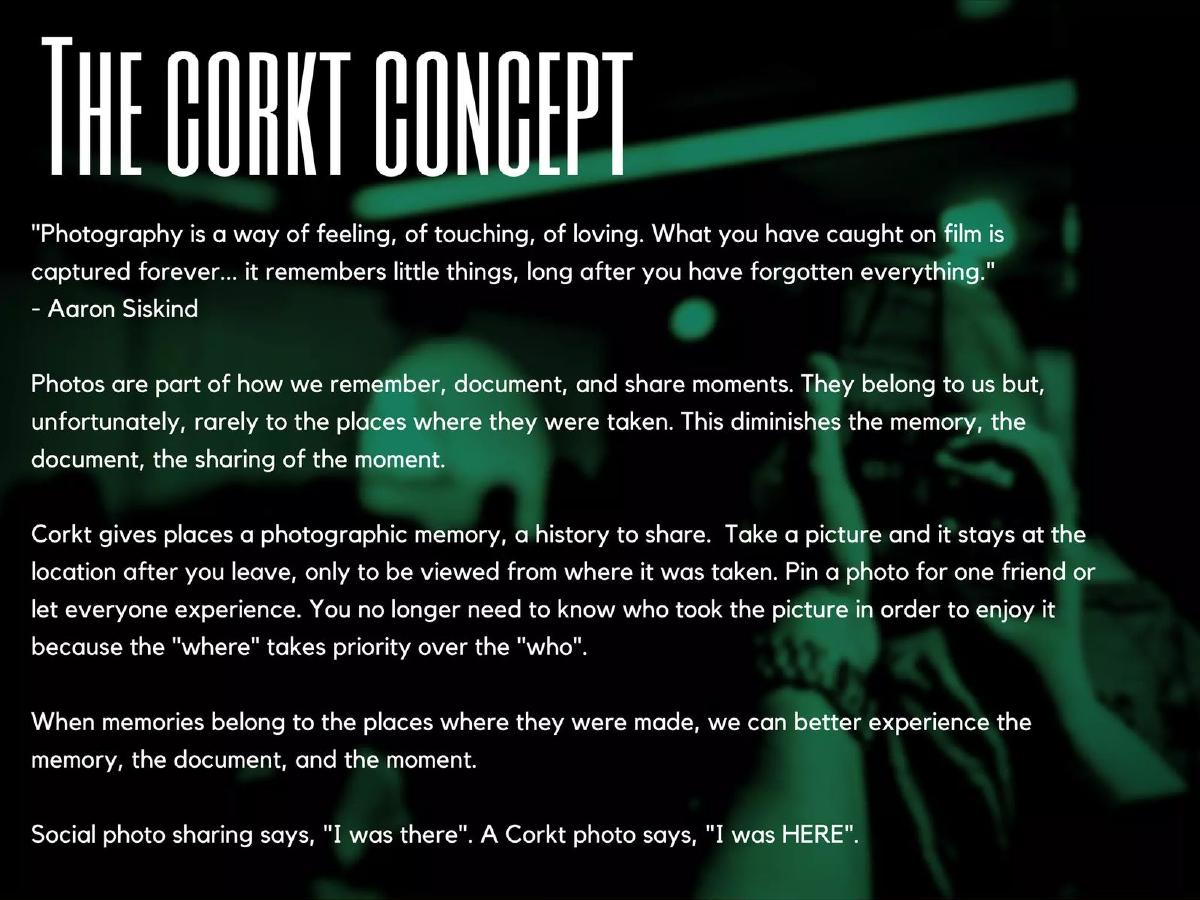
- The platform aims to shift social media priority from 'who' took a photo to 'where' it was taken (Slide 3).
- Corkt identifies a market opportunity in the 95.3% of photos taken via mobile devices as of 2017 (Slide 7).
- The business model includes B2B 'ephemeral ads' that can be served based on location frequency, such as bars or sports arenas (Slide 5).
- The deck proposes a B2G (Business to Government) utility for reporting infrastructure issues like fallen trees or bridge damage (Slide 8).
- Differentiation is claimed against Instagram and Snapchat through 'Location-specific Cloud Content' and 'Municipal Utility' (Slide 6).
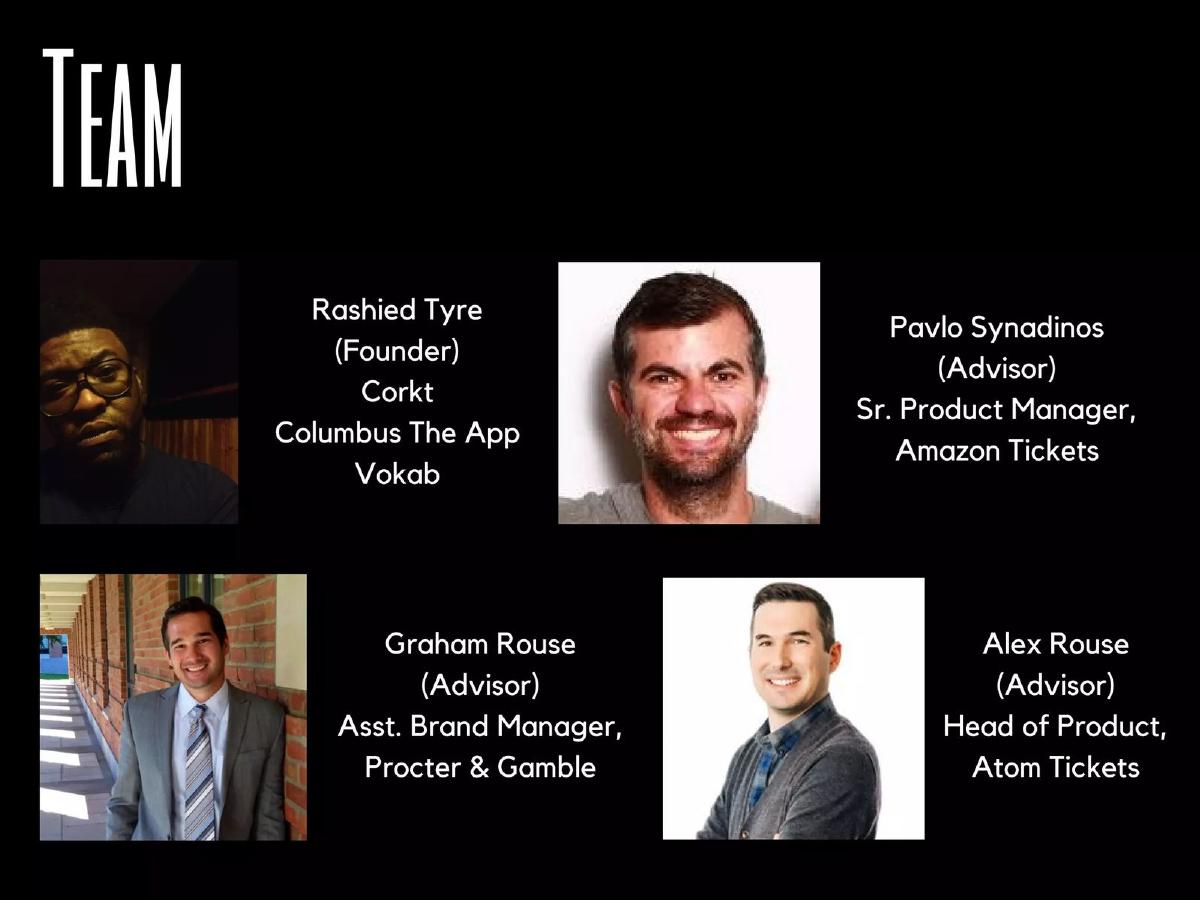
- The team consists of one founder and three advisors with backgrounds at Amazon, P&G, and Atom Tickets (Slide 2).
- The 'Ask' slide requests seed funding but omits a specific capital target, focusing instead on hiring needs like a React Native Developer (Slide 11).
- User flow mockups show a 'Location Feed', 'Photo Grid', and 'Photo Map View' to navigate content by proximity (Slide 9).
Corkt Pitch Deck Teardown
Corkt is a location-based social media platform that attempts to re-contextualize digital photography by anchoring it to physical space. The deck, consisting of 12 slides, positions the company at the intersection of social networking, hyper-local advertising, and municipal utility.
Slide 1: Title Slide
The deck opens with the company name, Corkt , and the tagline "Give the world a photographic memory." The contact email provided belongs to the founder, Rashied Tyre. The background image of feet dangling over a cityscape reinforces the theme of perspective and location.
Slide 2: Team and Advisors
The team slide lists Rashied Tyre as the Founder, citing his involvement with "Columbus The App" and "Vokab." Notably, the slide is dominated by advisors rather than a full-time executive team. These advisors include Pavlo Synadinos (Amazon Tickets), Graham Rouse (Procter & Gamble), and Alex Rouse (Atom Tickets). The heavy reliance on advisors suggests the founder is currently operating as a solo entrepreneur seeking to build out a core team with the requested funding.
Slide 3: The Corkt Concept
This slide introduces the philosophical underpinning of the app. It quotes Aaron Siskind and posits that photos belong to the places where they were taken. The key differentiator stated is: "You no longer need to know who took the picture in order to enjoy it because the 'where' takes priority over the 'who'." It distinguishes itself from traditional social media by moving from "I was there" to "I was HERE."
Slide 4: The Problem
Corkt identifies the problem as the creator-centric nature of current platforms. They argue this "strong-arms the user into the position of following popular brands [and] personalities," which limits community building. The slide claims that content without location context is "anchorless" and makes it difficult for unknown creators to reach a large audience.
Slide 5: The Solution
The solution is a platform where users "pin" photos and videos to GPS metadata. The content stays at the location, not just on the device. For the business side, the slide introduces "geo-fenced ephemeral ads," giving the example of a Subway ad appearing to someone in a Chipotle with a 30-minute flash coupon. This suggests a high-intent, location-based advertising model.
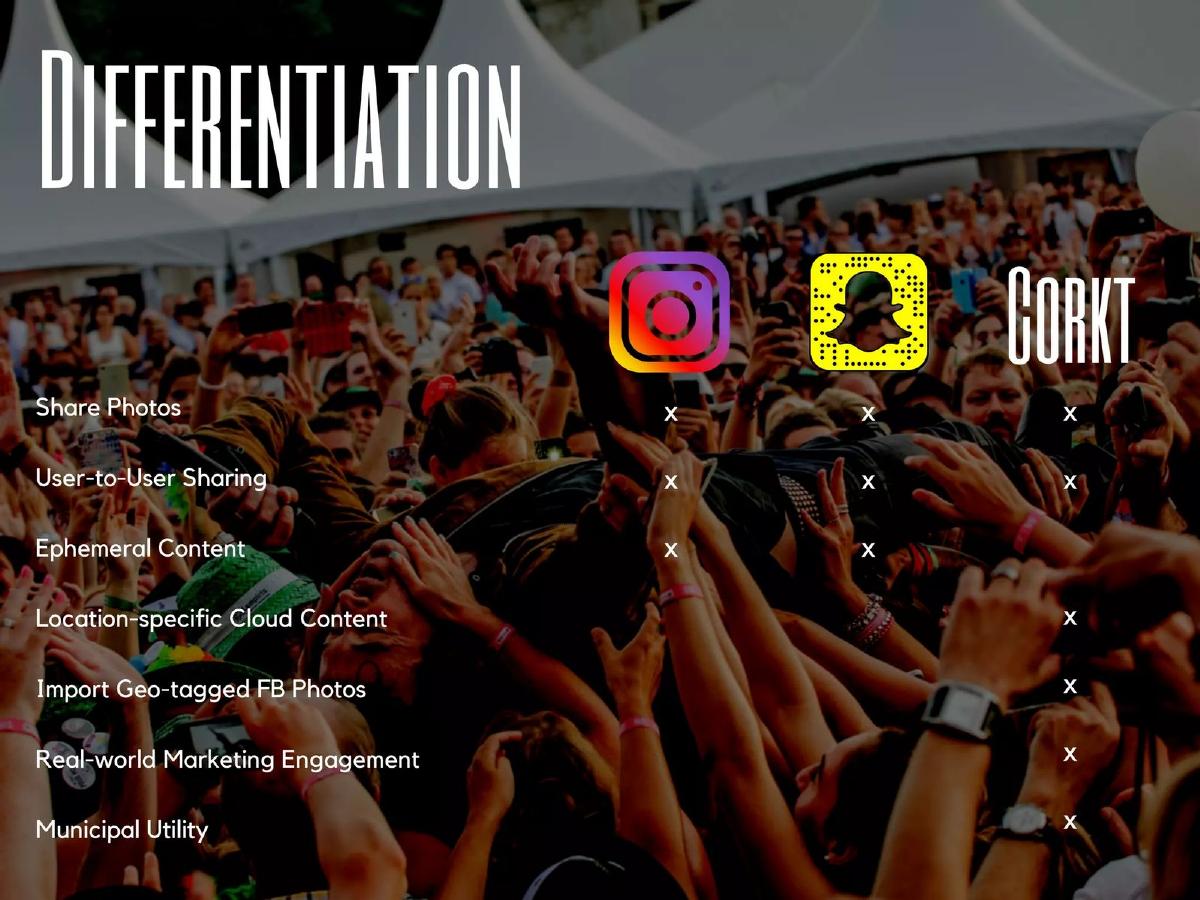
Slide 6: Differentiation
A standard comparison matrix pits Corkt against Instagram and Snapchat . While all three share photos and allow user-to-user sharing, Corkt claims exclusivity in "Location-specific Cloud Content," "Real-world Marketing Engagement," and "Municipal Utility." It also mentions the ability to "Import Geo-tagged FB Photos," which hints at a technical feature for populating the map early on.
Slide 7: Market Data
The deck uses 2017 data to show market scale. It states that 95.3% of all photos worldwide will be taken with mobile devices (85% smartphones, 10.3% tablets). A bar chart shows the total photos taken growing from roughly 600 million in 2013 to 1,200 million (1.2 billion) by 2017. Note: The chart labels are in millions, but the context of global photography usually implies billions; the slide specifically says "Millions" on the Y-axis.
Slide 8: Market Opportunity
This slide expands the use cases beyond social sharing. It lists Sporting Events, Museums, Bars, and Retail Locations as primary targets. It also introduces a B2G (Business to Government) angle, suggesting Corkt could be used for Amber Alert Responses, Downed Power Lines, and Infrastructure Issues through paid partnerships with municipalities.
Slide 9 & 10: User Flow
These slides provide high-fidelity mockups of the app interface. Features shown include:
Location Feed: A list of nearby venues (e.g., "The Genesis Block 0.01mi"). · Photo Grid: A visual gallery of images pinned to a specific spot. · Photo Map View: A Google Maps-based interface showing photo clusters in a neighborhood. · Photo Upload: A screen for tagging friends and setting privacy to "Public." · Notifications: Alerts for when friends "drop" photos at specific locations.
Slide 11: The Ask
Corkt is seeking seed funding . The slide does not list a specific dollar amount. Instead, it lists the objectives for the capital: completing native iOS and Android versions, building a web-based marketing console, hiring a UX/UI Designer and a React Native Developer , securing shared workspace in Columbus, OH , and funding localized marketing for early adoption.
Slide 12: Closing
A repeat of the title slide, providing the founder's email address once more.
What Corkt Does Well
The deck excels at defining a specific niche within a crowded market. By focusing on the "where" rather than the "who," Corkt provides a clear alternative to the influencer-driven models of Instagram and TikTok. The inclusion of B2B and B2G use cases shows that the founders are thinking about monetization beyond simple display advertising. The UI mockups are clean and effectively communicate how the location-first navigation would work in practice.
What is Missing from the Deck
The most glaring omission is traction . There is no mention of current user numbers, waitlist size, or results from a beta test. Furthermore, the Ask slide is too vague; investors typically want to see a specific funding target (e.g., $500k) and a corresponding runway estimate. The Market slide uses data that was current at the time of writing (2017) but lacks a Bottom-Up TAM/SAM/SOM analysis. Finally, there is no Business Model slide detailing the expected pricing for the municipal partnerships or the take-rate for the marketing console.
Founder Takeaways
Founders should look at Corkt’s Problem/Solution alignment as a good example of narrative flow. They identify a specific psychological gap in current social media (the "anchorless" nature of content) and build a feature set directly to address it. However, founders should avoid the Advisor-heavy Team Slide . While having big names from Amazon or P&G is helpful, investors fund the people doing the work. A solo founder with three advisors can sometimes signal a lack of core technical or operational partners. Always include a specific dollar amount in your Ask to facilitate a faster "yes" or "no" from the venture community.
Frequently asked questions
- What is the core problem Corkt is trying to solve?
- According to Slide 4, current photo sharing 'prioritizes the creator over the content.' This creates a situation where users follow personalities rather than discovering content based on their physical surroundings. Corkt argues that without location context, content is 'anchorless' and social bonds are weaker because the viewer is often in a different place than where the memory was made.
- How does Corkt plan to make money?
- Slide 5 and Slide 8 outline two primary revenue paths. First, a B2B marketing console for geofenced ephemeral ads (e.g., a 30-minute flash coupon for a nearby restaurant). Second, 'paid partnerships with municipalities' where the app acts as a reporting tool for local government issues like code violations or infrastructure damage.
- What is the current state of the product?
- Slide 11 indicates the product is in a pre-native stage. The company is seeking funding specifically to 'complete native versions (iOS, Android)' and build the 'web-based marketing console.' The presence of detailed UI mockups in Slides 9 and 10 suggests a functional prototype or MVP exists, likely in a web-app or hybrid format.
- Who is on the Corkt leadership team?
- Slide 2 lists Rashied Tyre as the Founder. The rest of the slide is dedicated to advisors: Pavlo Synadinos (Sr. Product Manager at Amazon Tickets), Graham Rouse (Asst. Brand Manager at P&G), and Alex Rouse (Head of Product at Atom Tickets). There are no other full-time employees or co-founders listed.
- What is missing from the Corkt pitch deck?
- The deck is missing several critical components for a seed round: a specific financial 'Ask' (Slide 11 lists needs but no dollar amount), traction metrics (no user numbers or pilot data), a clear go-to-market strategy beyond 'localized marketing,' and any mention of unit economics or projected burn rate.