Countingup’s 12-slide deck is a masterclass in product-led storytelling for a Series A round. The presentation centers on a 'single ledger' approach, positioning the company as a hybrid of a business bank and accounting software. By highlighting that 6.1 million UK business owners do not use accounting software (Slide 4), Countingup identifies a massive, underserved market. The deck relies heavily on social proof, showcasing top-tier Trustpilot and App Store ratings to contrast itself against traditional high-street banks (Slide 7). While the deck is visually polished and clear on its value p…
Key takeaways
- The deck identifies a total addressable market of 8.6 million UK small businesses, with 6.1 million currently lacking accounting software (Slide 4).
- Countingup estimates that 600 million hours are wasted annually on bookkeeping due to manual data transfer between banking and accounting systems (Slide 4).
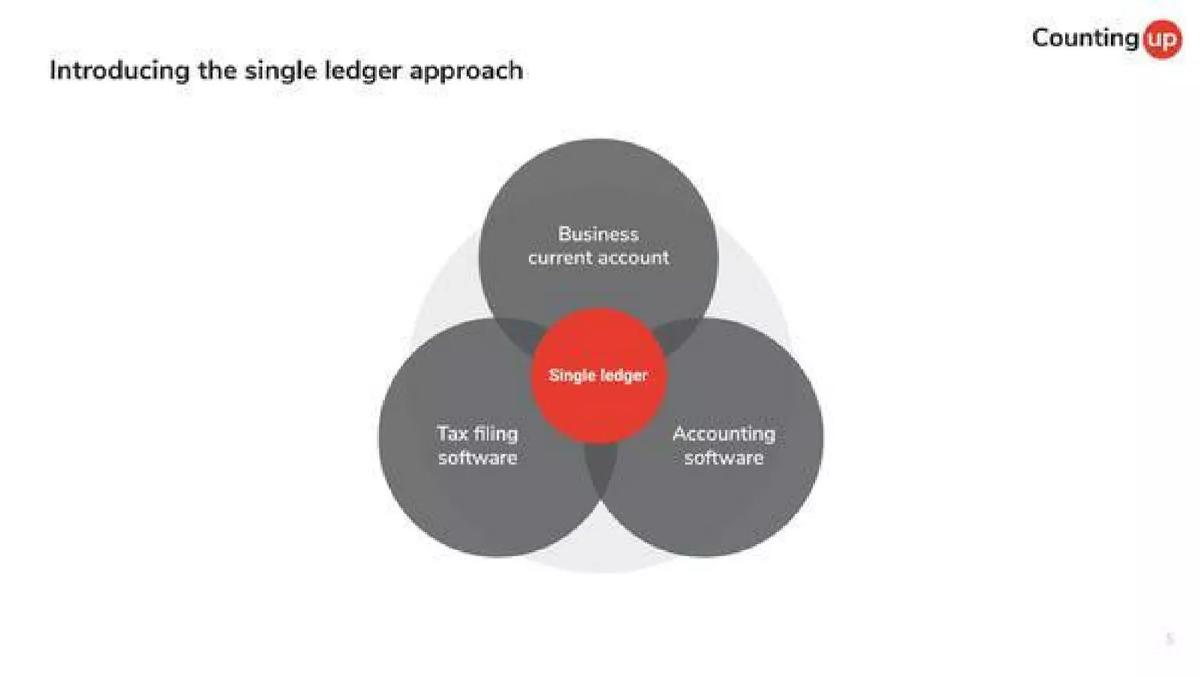
- The 'single ledger approach' is the core innovation, merging the business current account, tax filing, and accounting software into one hub (Slide 5).
- Social proof is a primary driver, with the company claiming to be the UK's most highly rated business current account on Trustpilot with a 4.6 score (Slide 7).
- The company benchmarks its growth against Xero, claiming to match the $17bn market cap incumbent's growth trajectory with substantially less capital (Slide 8).
- Countingup argues that embedding fintech in SaaS increases Average Revenue Per User (ARPU) by 2-5x (Slide 10).
- The product strategy includes a B2B2B play via an 'Accountant Hub' to reduce churn and improve margins for accounting firms (Slide 11).
- The deck completely omits a team slide, a cap table, and a specific financial ask or use of proceeds.
The Single Ledger Strategy: A Teardown of Countingup's Series A Deck
Countingup entered the UK fintech scene with a specific proposition: banking and accounting should not be two separate products. Their 12-slide deck, used to secure a $15.9 million Series A in 2017, focuses heavily on the friction of the status quo. By targeting the 'micro-business' segment—those often ignored by enterprise-grade software—Countingup built a narrative around time-saving and automated compliance. This teardown examines how they used simplicity and social proof to win over investors.
Slides 1-2: The Hook and The Mission
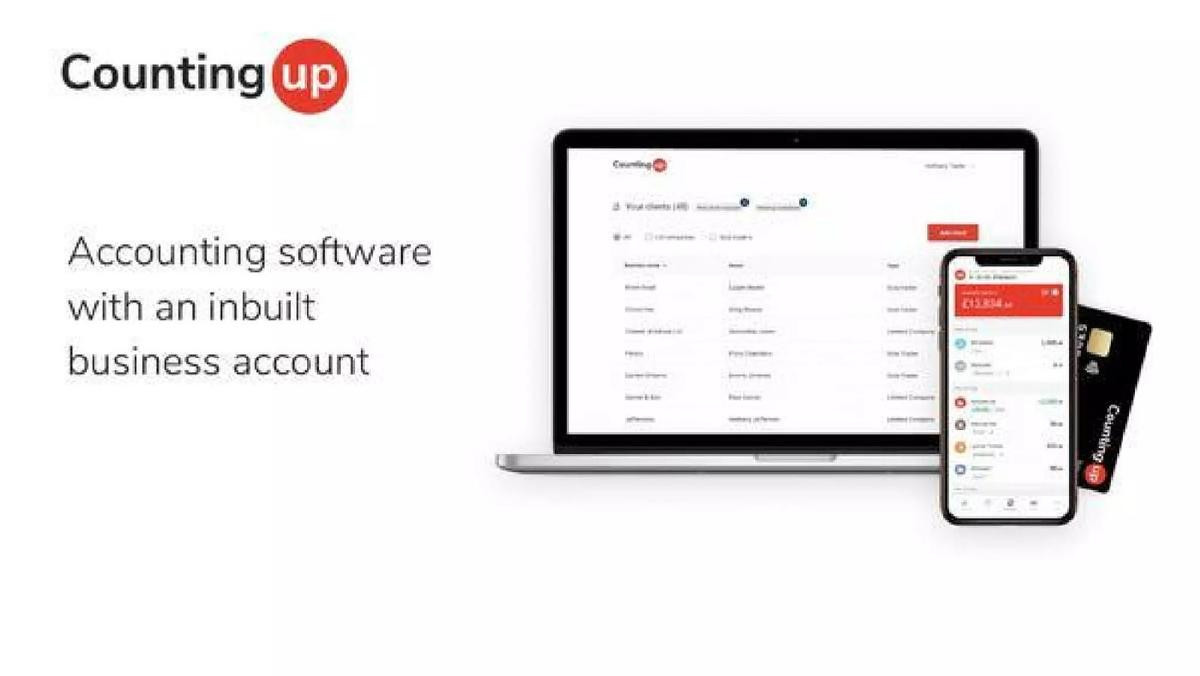
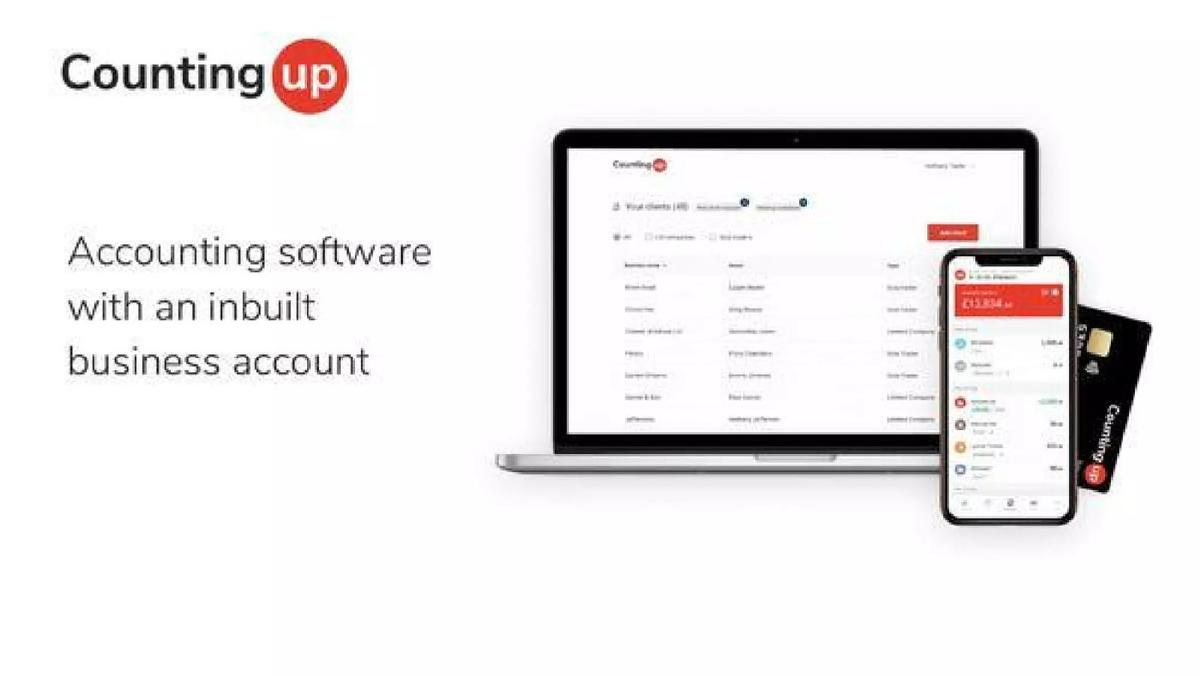
Slide 1 serves as a clean introduction, featuring the company logo and a clear value proposition: "Accounting software with an inbuilt business account." The visual includes a laptop, a smartphone, and a physical debit card, immediately signaling that this is a multi-platform, full-stack financial service. It avoids jargon, opting for a functional description of the product.
Slide 2 presents the mission: "Making it easier to run a small business." While generic, the use of a rocket icon and a minimalist layout keeps the focus on the company's ultimate goal. In a Series A deck, the mission slide is often a placeholder, but here it sets the stage for the specific pain points addressed in the following slides.
Slides 3-4: Defining the Problem and the Market Gap
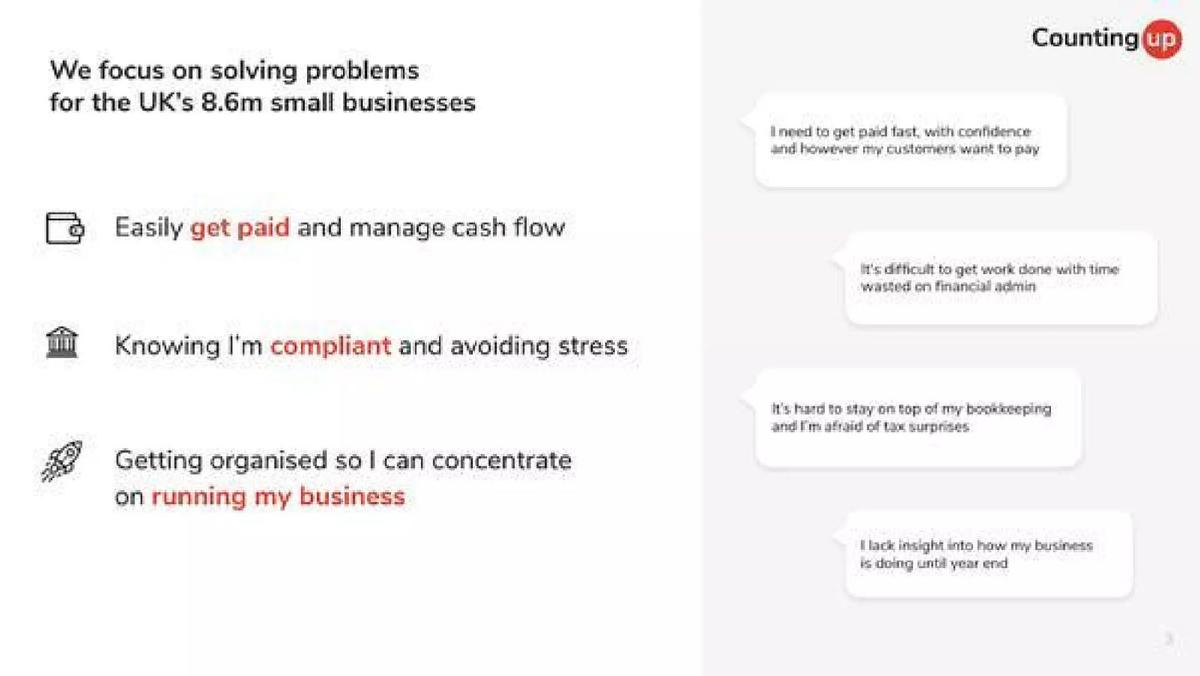
Slide 3 shifts to the customer perspective. It lists three core focus areas: getting paid, staying compliant, and getting organized. The right side of the slide features speech bubbles with customer pain points, such as "I need to get paid fast" and "I'm afraid of tax surprises." This humanizes the data and prepares the investor for the market sizing on the next slide.
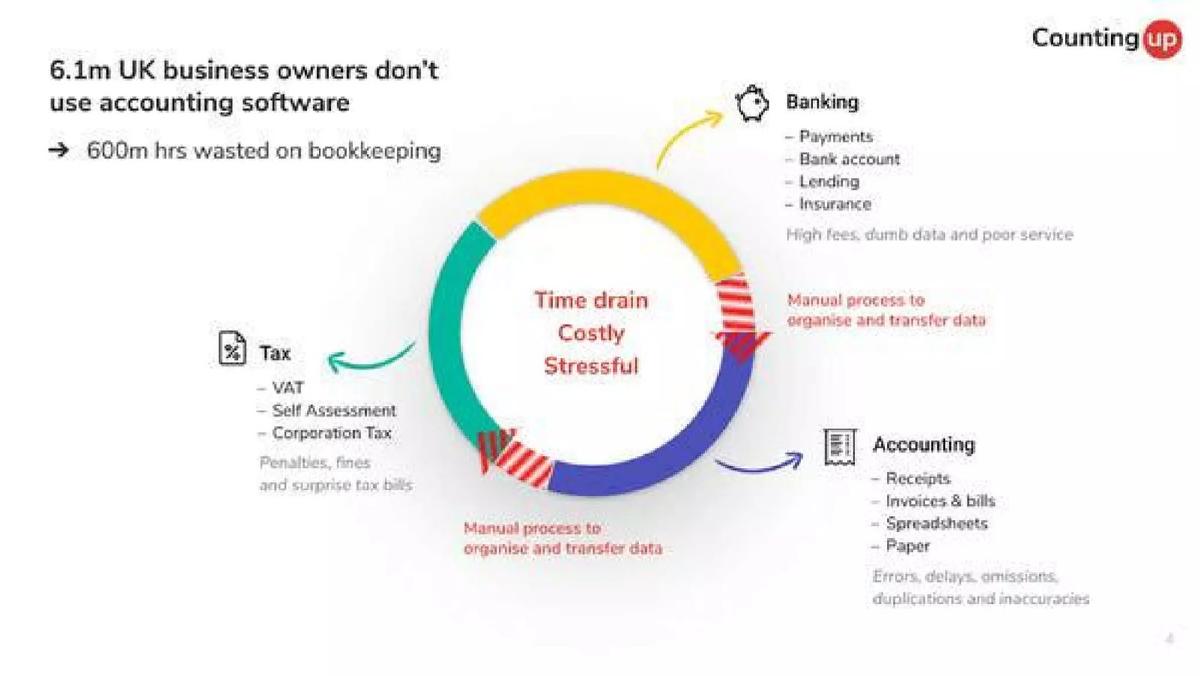
Slide 4 is the most data-dense slide in the deck. It identifies a massive market opportunity: "6.1m UK business owners don't use accounting software." This is a critical distinction; Countingup isn't just competing for existing Xero or QuickBooks users; they are targeting the non-consumers. The slide quantifies the pain, stating that "600m hrs [are] wasted on bookkeeping." A circular diagram illustrates the 'Time drain' caused by manual data transfer between banking, accounting, and tax filing. This slide successfully frames the current market as inefficient and broken.
Slides 5-6: The 'Single Ledger' Solution
Slide 5 introduces the company's unique selling point: "The single ledger approach." A Venn diagram shows the intersection of a Business current account, Tax filing software, and Accounting software. The red center, labeled "Single ledger," represents Countingup. This is a powerful visual shorthand for their product architecture, suggesting that by combining these three pillars, they eliminate the 'manual process' arrows shown on the previous slide.
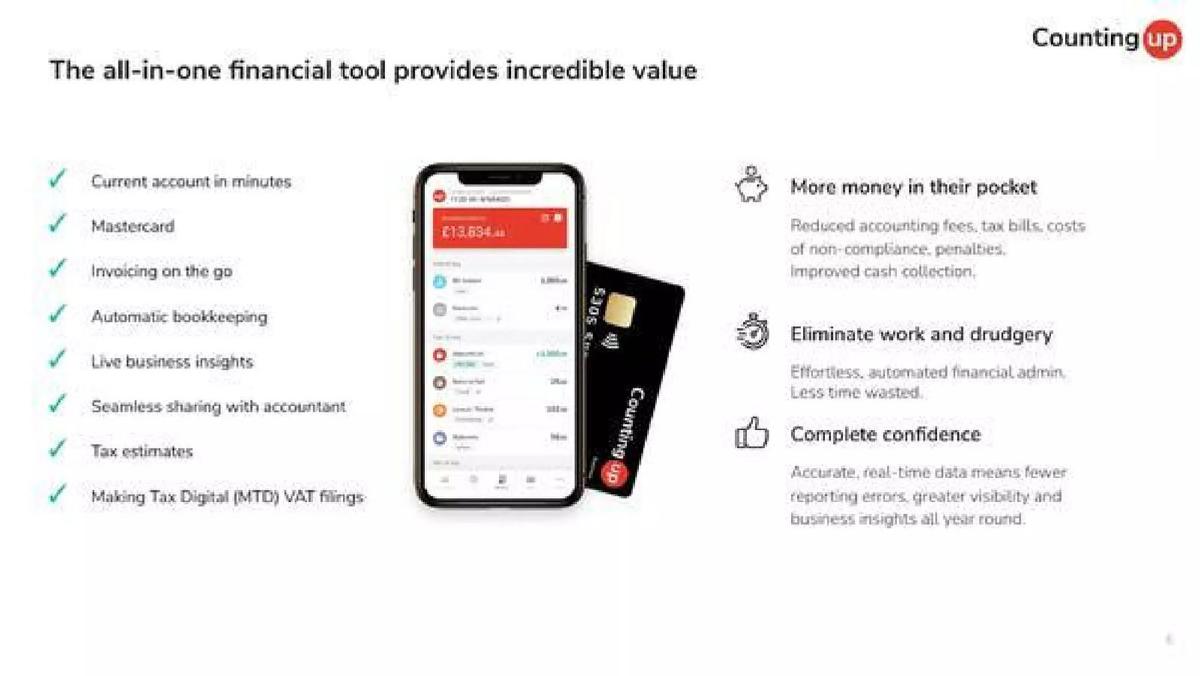
Slide 6 details the "all-in-one financial tool." It lists features like a Mastercard, invoicing on the go, automatic bookkeeping, and "Making Tax Digital (MTD) VAT filings." The slide categorizes the value into three buckets: "More money in their pocket," "Eliminate work and drudgery," and "Complete confidence." This slide bridges the gap between the high-level 'single ledger' concept and the actual user experience.
Slides 7-8: Social Proof and Growth Benchmarking
Slide 7 is dedicated entirely to validation. It claims Countingup is "The UK's most highly rated business current account on Trustpilot" with a 4.6 score. It also shows a 4.6 rating on the App Store (783 ratings) and a 4.8 on Google Play (645 total). A bar chart compares Countingup's Trustpilot rating against competitors like Starling, Tide, Metro Bank, and traditional incumbents like HSBC and Barclays. Countingup sits at the top, while Barclays and RBS are at the bottom. This slide uses external validation to mitigate the perceived risk of a young startup.
Slide 8 provides the 'Traction' metric. It features a line graph titled "Growing as fast as $17bn market cap Xero with substantially less capital." The graph tracks "# paid customers" against "Months operating." The red line (Countingup) shows a steeper and more consistent growth curve than the blue line (Xero). The slide notes that Xero had an "IPO $15m" at month 10 and "$29m" at month 34, implying that Countingup is achieving superior capital efficiency. This is a bold comparison designed to excite Series A investors looking for 'unicorn' potential.
Slides 9-11: Workflows, Moats, and the Accountant Hub
Slide 9 focuses on "Superior workflows." It shows three smartphone screens demonstrating invoicing, expense reminders, and auto-categorization that creates a P&L. This slide emphasizes that the 'single ledger' isn't just a backend concept; it results in a faster, more automated front-end experience for the user.
Slide 10 addresses the 'Why Now' and the competitive moat. Under "Increased stickiness," it claims that "Embedding fintech in SaaS increases ARPU 2-5x." It also highlights "Differentiated insights" through a central record and "Complex technology" like a proprietary bookkeeping and tax engine. This slide is intended to prove that the business model is defensible and highly profitable compared to pure-play banks or pure-play SaaS.
Slide 11 introduces the "Accountant Hub." This is a B2B2B play. By providing accountants with real-time access to client data, Countingup eliminates 'chasing' for information. The slide claims this makes accounting firms "More profitable" by improving their margins on small, cost-conscious clients. This is a clever distribution strategy; if accountants love the software, they will recommend it to their entire client base, lowering Countingup's Customer Acquisition Cost (CAC).
Slide 12: Closing
Slide 12 is a simple closing slide with the company logo on a red background. There is no contact information, no call to action, and no summary of the investment terms. It is a minimalist end to a minimalist deck.
What Works in the Countingup Deck
The deck excels at problem definition . By quantifying the 600 million hours wasted and identifying the 6.1 million business owners who use no software, they make the market opportunity feel both urgent and massive. The 'Single Ledger' visual on Slide 5 is another high point; it is a simple, memorable way to explain a complex product integration. Finally, the competitive benchmarking on Slide 8 is highly effective. Comparing a startup to a $17 billion incumbent like Xero—and showing a superior growth curve—is exactly the kind of narrative Series A investors look for.
What is Missing from the Countingup Deck
The most glaring omission is a Team Slide . In venture capital, the 'who' is often as important as the 'what,' especially in fintech where regulatory and technical expertise is paramount. There is no mention of the founders or their track records. Also missing is a Financial Ask . The deck does not state how much capital is being raised, the valuation target, or the specific milestones the funding will enable. Furthermore, while the deck mentions ARPU increases, it lacks Unit Economics (CAC, LTV, Churn) specifically for Countingup’s own user base, relying instead on industry generalizations. Finally, there is no Roadmap ; investors are left to guess what features or market expansions are coming next.
What a Founder Should Copy
Founders should emulate the social proof layout on Slide 7. Instead of just saying "customers love us," Countingup shows the exact ratings across multiple platforms and compares them directly to the industry giants they are disrupting. This builds immediate credibility. Additionally, the workflow-centric product slides (Slide 9) are a great way to show, rather than tell, how the product functions. Finally, the Accountant Hub strategy (Slide 11) is a brilliant example of identifying a secondary stakeholder who can act as a force multiplier for growth. If your product has a 'pro' user or an intermediary, showing how you make their life easier is a powerful way to demonstrate a sustainable growth engine.
Summary of Deck Facts
Company: Countingup · Sector: Fintech / Accounting SaaS · Stage: Series A · Year: 2017 · Amount Raised: $15,900,000 (per catalogue listing) · Slides: 12 · Core Metric: 10,000+ paid customers (Slide 8) · Market Opportunity: 8.6m UK small businesses (Slide 3)
Frequently asked questions
- What is the primary problem Countingup is solving?
- According to Slide 4, the primary problem is the 'time drain' and 'costly, stressful' manual process of transferring data between banking, accounting, and tax systems. They estimate 6.1 million UK business owners are underserved by existing software, leading to 600 million wasted hours on bookkeeping annually. The deck frames this as a systemic inefficiency caused by 'dumb data' and poor service from traditional banks.
- How does Countingup differentiate itself from competitors like Xero or Starling?
- Countingup differentiates through its 'single ledger' approach (Slide 5). While Xero is accounting software and Starling is a bank, Countingup combines both. Slide 8 explicitly compares their growth to Xero, suggesting they are reaching similar milestones with less capital. Slide 10 further emphasizes 'increased stickiness' by embedding fintech directly into the SaaS product, which they claim traditional fintechs have not mastered.
- What metrics does the deck use to prove product-market fit?
- The deck relies on three types of metrics: user sentiment, growth trajectory, and unit economics. Slide 7 shows a 4.6 Trustpilot rating and 4.8 App Store rating. Slide 8 displays a growth chart showing the company reaching over 10,000 paid customers within 40 months. Slide 10 mentions a 2-5x increase in ARPU by embedding fintech into SaaS, though it cites this as a general industry trend rather than a specific internal metric.
- Who is the secondary target audience for the Countingup platform?
- While the primary users are small business owners, Slide 11 identifies accountants as a key secondary audience. The 'Accountant Hub' is designed to fit into professional workflows, eliminating the need to 'chase' clients for data or re-authorize bank feeds. By making accountants more profitable, Countingup creates a referral engine and reduces churn among the end-users.
- What critical information is missing from this pitch deck?
- This deck is surprisingly light on corporate structure. It lacks a team slide, which is highly unusual for a Series A. There is no mention of the founders' backgrounds or the size of the engineering team. Additionally, there is no 'The Ask' slide detailing how much money is being raised or how it will be spent, and no detailed financial projections or burn rate information.