The Cover Genius pitch deck is a highly professional, metric-dense presentation that focuses on the 'Insurtech' shift from legacy systems to microservices. Rather than spending time on the problem of insurance generally, it focuses on the specific execution of embedded insurance at the point of sale. The deck excels at providing concrete evidence of value, citing specific revenue uplifts (e.g., 513% growth in warranty revenue for a global marketplace) and operational scale (2.5M customers in 2020). It positions their XCover platform not just as a product, but as a global distribution infrastr…
Key takeaways
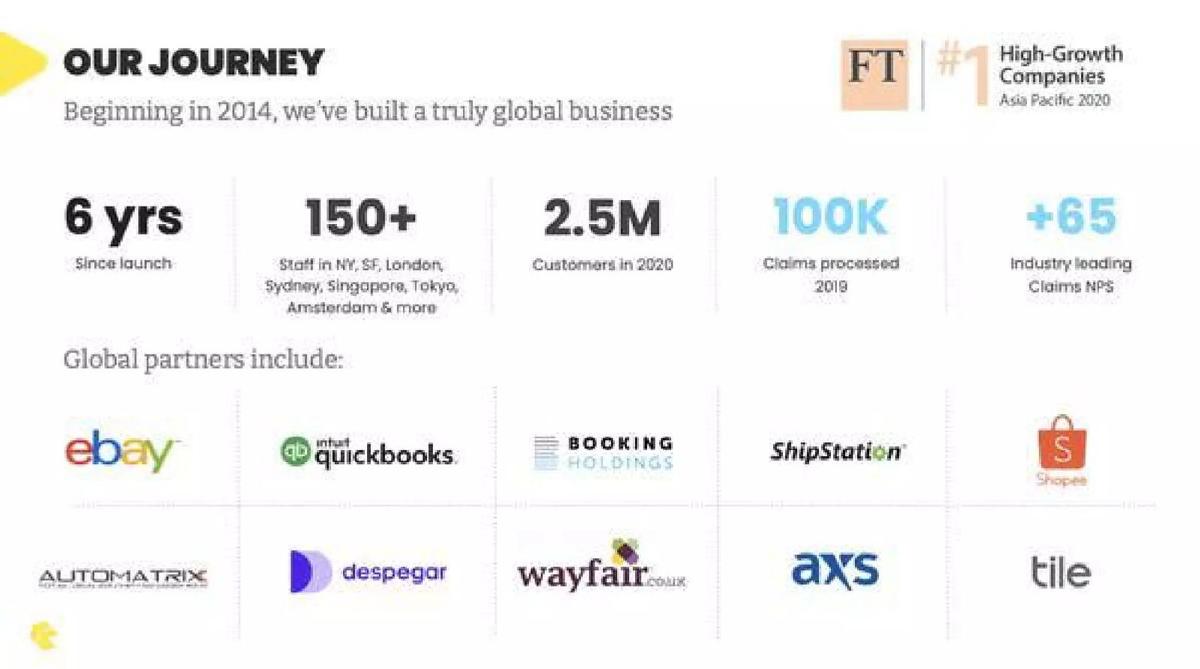
- The company highlights a massive scale of 2.5M customers in 2020 and 100k claims processed in 2019 on slide 3.
- Social proof is the core of the deck, featuring enterprise logos like eBay, Intuit QuickBooks, and Booking Holdings on slides 3 and 6.
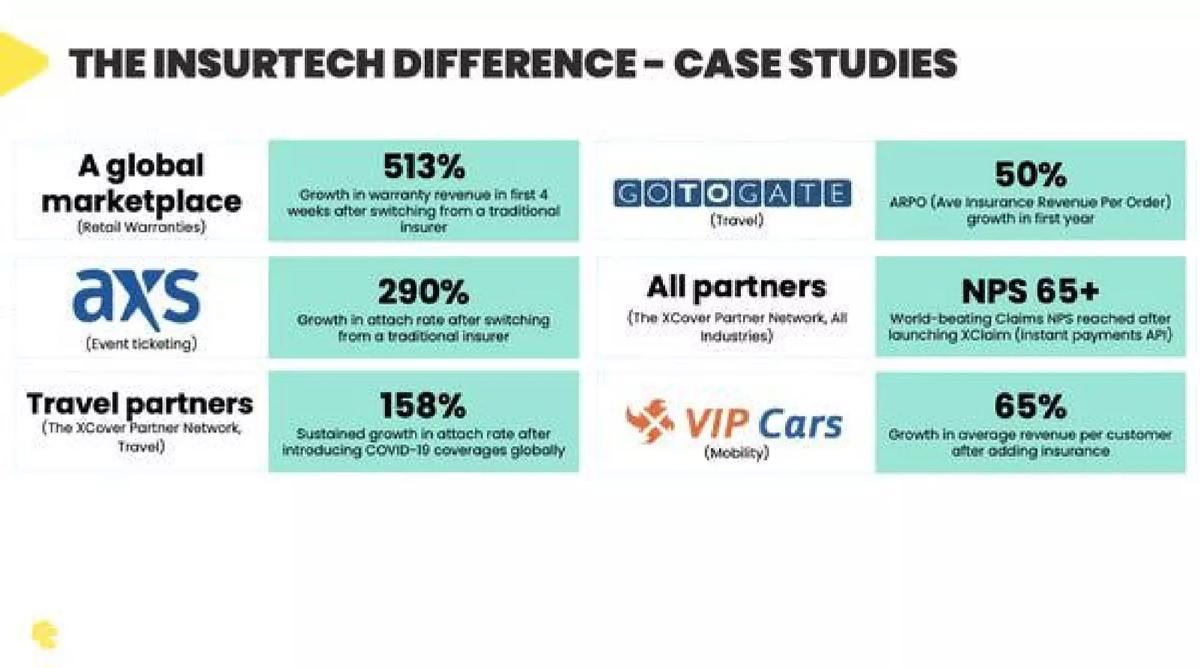
- Slide 5 provides specific ROI metrics, such as a 513% growth in warranty revenue for a retail marketplace after switching to Cover Genius.
- The deck uses a direct comparison table on slide 7 to contrast 'Traditional Insurers' (legacy systems, 20+ day claims) with 'Cover Genius' (microservices, instant payments).
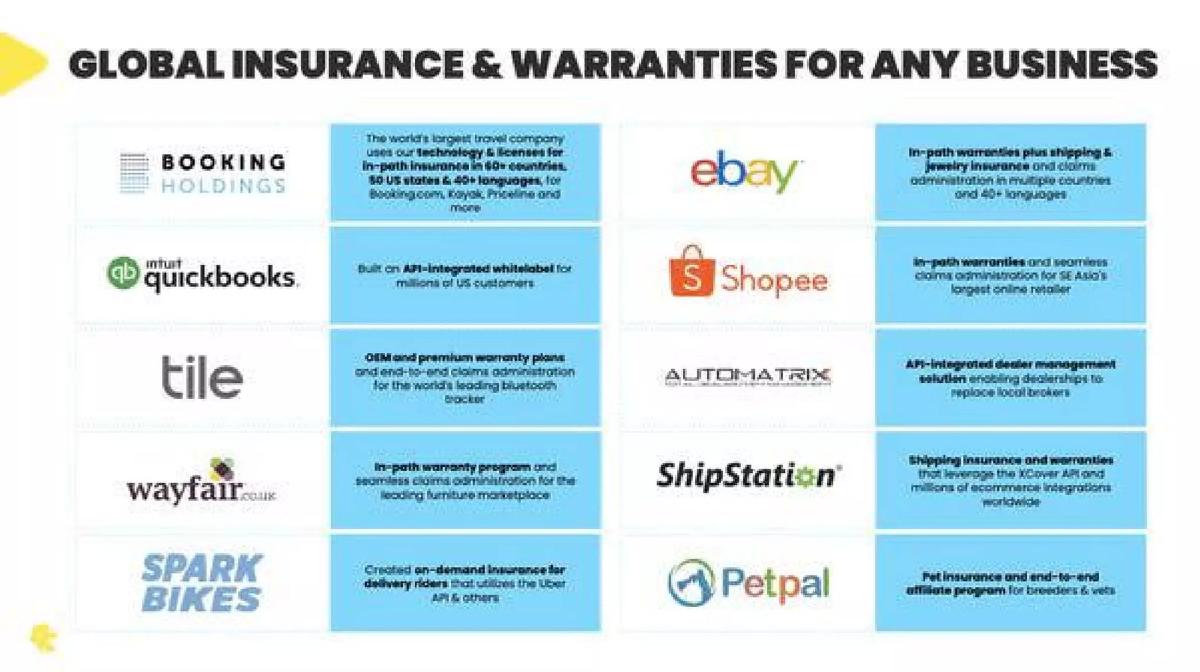
- Global reach is a recurring theme, with the platform supporting 60+ countries, 50 US states, and 40+ languages as noted on slide 7.
- The technology stack is explicitly detailed on slide 10, showing a microservices architecture including 'BrightWrite' for pricing and 'XClaim' for payments.
- Customer satisfaction is quantified with an industry-leading Claims NPS of +65, cited on slides 3, 7, and 11.
- Slide 12 demonstrates the data advantage, noting $9BN+ in sales fed into their optimization engine and 1.7M price experiments conducted between July 2019 and June 2020.
Introduction: The Infrastructure of Embedded Insurance
Cover Genius, founded in 2014, represents a shift in the insurance industry toward 'embedded' solutions. This 12-slide deck, used during their later-stage growth, focuses heavily on the transition from legacy insurance models to a modern, API-driven approach. The deck is characterized by high-density data, enterprise-grade social proof, and a clear architectural explanation of their technology stack. With $165.1 million raised, this teardown examines how they communicated their value to sophisticated investors.
Slides 1-2: The Mission and Positioning
The deck opens with a clean, high-contrast title slide stating "GLOBAL INSURANCE & WARRANTIES FOR ANY BUSINESS" (Slide 1). This immediately establishes the company's broad horizontal reach. Slide 2 follows with a concise mission statement: "We enable the world’s largest digital companies to protect their global customers, at the point of sale or sign up." This slide is critical because it defines their B2B2C model—they are not selling to consumers directly; they are an enablement layer for 'the world's largest digital companies.'
Slide 3: The Journey and Traction
Slide 3 is a 'traction' powerhouse. It lists five key metrics that define their six-year journey since launch: 150+ staff across global hubs (NY, SF, London, Sydney, etc.), 2.5M customers in 2020 , 100K claims processed in 2019 , and an industry-leading Claims NPS of +65 . The slide also features the Financial Times logo, ranking them as the #1 High-Growth Company in Asia Pacific 2020 . The bottom half of the slide introduces a logo wall including eBay, QuickBooks, Booking Holdings, and Wayfair , setting the stage for the enterprise-focused narrative that follows.
Slides 4-5: The Paradigm Shift and Case Studies
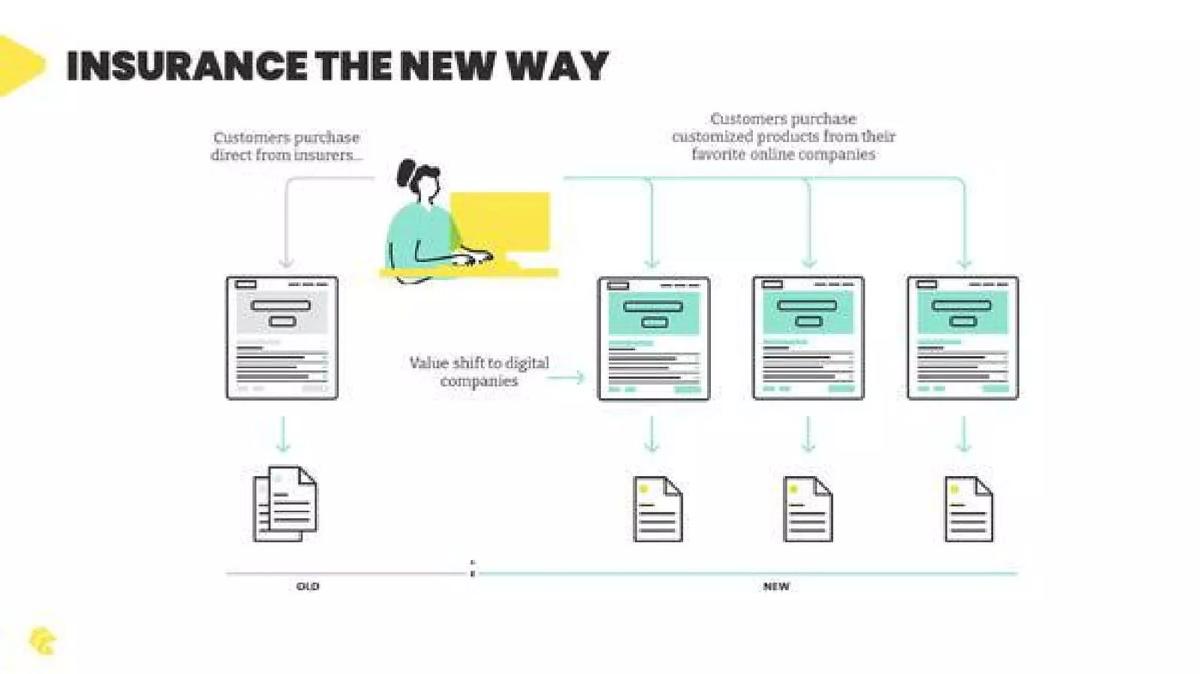
Slide 4, titled "INSURANCE THE NEW WAY," uses a simple diagram to show the 'value shift to digital companies.' It contrasts the 'Old' way (customers buying direct from insurers) with the 'New' way (customers buying customized products from their favorite online companies). Slide 5, "THE INSURTECH DIFFERENCE - CASE STUDIES," provides the quantitative proof for this shift. It lists specific, impressive growth metrics for partners: 513% growth in warranty revenue for a global marketplace, 290% growth in attach rate for AXS, and 50% ARPO (Average Insurance Revenue Per Order) growth for Gotogate. These numbers are designed to prove that Cover Genius isn't just a convenience; it is a significant revenue driver for partners.
Slides 6-7: Global Capability and Competitive Comparison
Slide 6 provides a deeper dive into their partnerships, explaining exactly how companies like Booking Holdings use their technology for "in-path insurance in 60+ countries, 50 US states & 40+ languages." This emphasizes their ability to handle the complex regulatory and linguistic hurdles of global insurance. Slide 7, "THE INSURTECH APPROACH," is a classic comparison table. It pits "Traditional Insurers" against "Cover Genius." Key differentiators include "Legacy systems" vs. "Microservices," "Static pricing" vs. "Dynamic pricing," and "20+ days, checks via mail" vs. "Instant payments" for claims. This slide effectively frames traditional insurers as obsolete and Cover Genius as the modern standard.
Slides 8-10: The XCover Platform and Architecture
Slide 8 introduces "XCOVER" as a standalone brand. Slide 9 explains that "XCOVER IS AN INSURANCE DISTRIBUTION PLATFORM" and uses two personas—a Millennial buying a bicycle and a Business Traveler booking flights—to illustrate how the API bundles policies (theft, baggage, medical) from different insurers in real-time. Slide 10 provides a technical breakdown of the "XCOVER’S MICROSERVICES ARCHITECTURE." It identifies two core engines: BrightWrite (Pricing and Risk) and XClaim (Payments and Claims). It further breaks these down into functional modules like "Notice of Loss," "Claim Administration," and "Fulfillment." This level of detail is intended to reassure technical due diligence teams that the platform is modular and scalable.
Slides 11-12: The Claims Experience and Data Advantage
Slide 11 focuses on "THE CLAIMS EXPERIENCE," showcasing a screenshot of the user interface. It lists features like "24/7 global assessment with scientific fraud detection" and "Instant payments in 90+ currencies." The final slide, "BRIGHTWRITE: DATA ANALYTICS AND OPTIMIZATION" (Slide 12), highlights their data moat. It claims "$9BN+ sales fed into BrightWrite’s optimization engine" and "1.7M price experiments" between July 2019 and June 2020. This concludes the deck by suggesting that their competitive advantage grows with every transaction, as their pricing engine becomes more refined through massive data ingestion.
What Works in This Deck
Specific, Verifiable ROI: The use of exact percentages (513%, 290%, 65%) in the case studies on Slide 5 is far more effective than vague claims of 'increased revenue.' It shows the company has a deep understanding of its partners' unit economics.
Infrastructure Positioning: By focusing on 'Microservices' and 'APIs' rather than just 'Insurance,' Cover Genius positions itself as a tech company rather than a financial services firm. This is crucial for achieving the higher valuation multiples associated with SaaS and Fintech infrastructure.
Global Readiness: The repeated mention of 60+ countries, 40+ languages, and 90+ currencies addresses the biggest pain point for global e-commerce players: the fragmentation of local insurance markets. The deck successfully argues that Cover Genius is the only 'one-stop-shop' for global distribution.
What Is Missing From This Deck
The Team: There is no mention of the founders, their backgrounds, or the executive leadership team. While the company's traction speaks for itself, investors usually want to see who is steering the ship, especially in a highly regulated industry like insurance.
Financial Projections: While the deck shows partner growth, it does not show the company's own P&L, burn rate, or revenue projections. This information was likely reserved for a secondary data room, but its absence in the main deck is notable.
The Ask: The deck does not state how much capital is being raised or how that capital will be deployed. This suggests the deck may have been used for general partnership development or as a preliminary teaser for a round that was already in late-stage negotiations.
What a Founder Should Copy
The Comparison Table (Slide 7): This is a textbook example of how to frame a competitor. By choosing specific operational metrics (days to pay, architecture type, licensing) rather than just 'features,' they make the incumbent look fundamentally incapable of competing.
The 'Journey' Slide (Slide 3): Combining a timeline with high-level metrics and a logo wall is a great way to establish immediate credibility. It tells the story of the company's growth without requiring a long narrative.
Use of Personas (Slide 9): Explaining a complex API through the lens of a 'Millennial' and a 'Business Traveler' makes the technology relatable. It helps investors visualize the end-user experience, which can often get lost in discussions about back-end infrastructure.
Data Moat Presentation (Slide 12): If your business generates data that improves your product, quantify it. Stating the number of 'experiments' and the total dollar volume of sales analyzed provides a concrete sense of the 'intelligence' behind the platform.
Frequently asked questions
- What is the primary value proposition of Cover Genius according to the deck?
- The primary value proposition is enabling digital companies to protect their global customers at the point of sale or sign-up through an API-integrated platform. As shown on slide 4, they facilitate a 'value shift' where customers purchase customized insurance products directly from their favorite online companies rather than through traditional, fragmented insurance brokers.
- How does Cover Genius demonstrate its competitive advantage over legacy insurers?
- On slide 7, the company uses a side-by-side comparison. They highlight that while traditional insurers use legacy systems and take 20+ days to pay claims via mail, Cover Genius uses a microservices architecture to provide instant payments. They also emphasize their ability to handle regulation and licensing internally, which traditional models struggle to scale globally.
- What specific financial impact does the platform have on its partners?
- Slide 5 lists several case studies: a global marketplace saw 513% growth in warranty revenue, AXS saw a 290% growth in attach rate, and VIP Cars saw a 65% growth in average revenue per customer. These figures suggest that the platform's optimization engine significantly outperforms traditional insurance offerings in a retail environment.
- What are the core components of the XCover technology stack?
- As detailed on slide 10, the XCover platform consists of two primary engines: BrightWrite (Pricing and Risk API) and XClaim (Instant payments and claims administration). These are supported by six microservices: Notice of Loss, Claim Administration, Instant Payments, Notifications, CRM, and Fulfillment.
- Is there information regarding the founders or the investment ask in this deck?
- No. This 12-slide version of the deck completely omits a team slide, biographical information about the founders, and a specific funding 'Ask' or use of proceeds. This is common in later-stage decks where the company's metrics and brand partnerships are considered the primary drivers of the investment thesis.