Cradle's pitch deck focuses on the 'Intelligent Phone Experience' designed for the modern, distributed workforce. By identifying a specific $10 billion target market within the broader $680 billion business telco industry, Cradle positions itself as a streamlined alternative to complex call center software. The deck highlights significant customer pain points, such as the fact that 74% of customers will switch businesses due to a poor phone experience. With a founding team boasting exits and senior roles at companies like Spidertracks, FiveStars, and Xero, the deck leans heavily on execution…
Key takeaways
- Cradle defines its mission as providing an 'Intelligent Phone Experience' to connect customers to the modern workforce (Slide 1).
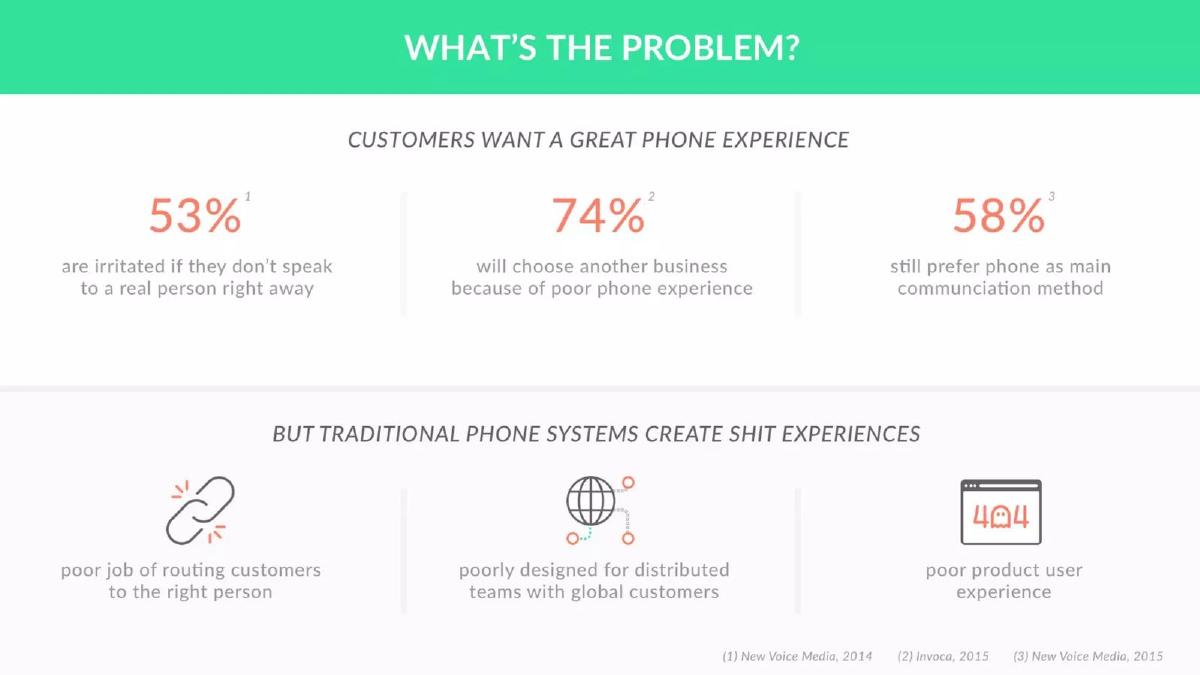
- The problem is quantified by high customer friction: 53% are irritated if they don't speak to a person immediately, and 74% will switch businesses due to poor phone experiences (Slide 2).
- Target customers are specifically defined as SMBs with 10-100 people that have high-value inbound conversations but don't need complex call center features (Slide 3).
- The deck identifies a $10 billion addressable market for SMBs within the larger $680 billion business telco sector (Slide 4).
- Product focus is placed on cross-device native experiences and ease of setup, moving away from traditional hardware (Slide 5).
- The founding team has strong pedigree, including a CEO who grew a previous company to $10MM ARR and a co-founder from Xero (Slide 7).
- The deck uses aggressive language to describe the current state of the market, calling traditional systems 'shit experiences' (Slide 2).
- There is a notable absence of a specific 'Ask' or financial breakdown in the provided slide sequence (Slides 1-8).
Slide-by-Slide Analysis
Slide 1: Title Slide
The deck opens with a clear, high-level value proposition: "INTELLIGENT PHONE EXPERIENCE to connect customers to the modern workforce." The imagery features a person using a mobile device in a natural setting, signaling a move away from the traditional desk-bound office environment. The branding is clean, utilizing a wave-form logo that reinforces the audio/communication nature of the product.
Slide 2: The Problem
Cradle uses a two-pronged approach to define the problem. First, they cite consumer expectations using third-party data from New Voice Media and Invoca. They note that "53% are irritated if they don't speak to a real person right away" and "74% will choose another business because of poor phone experience." Crucially, they point out that "58% still prefer phone as main communication method," debunking the myth that phone calls are obsolete. The bottom half of the slide attacks current solutions, labeling them "SHIT EXPERIENCES" due to poor routing, lack of support for distributed teams, and poor UI.
Slide 3: Target Customer Base
This is a strong segmentation slide. Cradle isn't trying to be everything to everyone. They define their niche as "SMBs WITH HIGH VALUE PHONE CONVERSATIONS." They further narrow this to companies with 10-100 people who want easy configuration without "sophisticated call centre features." They highlight a specific pain point: high-value calls that "often go unanswered." This suggests they are targeting professional services, high-end retail, or boutique agencies rather than mass-market support centers.
Slide 4: Potential Market Size
The market slide uses a Venn diagram to show the intersection of various sectors. They start with a massive $680b Telco for Business market but quickly home in on more relevant figures. They identify Unified Communication (UC) at $60b and UCaaS at $20b . Their specific target market is listed as "SMBs $10b." By narrowing the focus, the founders demonstrate a realistic understanding of their initial go-to-market strategy rather than claiming they will capture the entire $680b telco industry.
Slide 5: Product and User Experience
Titled "WE OBSESS OVER USER EXPERIENCE," this slide shows the product across three form factors: a desktop/laptop interface, a mobile dialer, and a mobile contact list. The text emphasizes that the product is "INCREDIBLY EASY TO SET UP AND INSTALL" and offers a "NATIVE EXPERIENCE ON EVERY DEVICE." The visual of the 'Transfer' screen on mobile suggests that complex office phone functions are being simplified for a smartphone-first workforce.
Slide 6: Transition Slide
A simple gradient slide with the text "OUR PROPOSAL." In a full presentation, this would likely lead into the business model, the specific investment ask, or the technical roadmap. In this 8-slide selection, it serves as a separator between the market/product overview and the team introduction.
Slide 7: The Team
The "HUMBLE AMBITION WITH DIVERSE EXPERIENCE" slide is a highlight of the deck. James McCarthy (CEO) is credited with growing Spidertracks to $10MM ARR . Gary Liu (Design and Growth) comes from FiveStars, a company with $40MM ARR . Max Annear-Henderson (Technology) brings experience from Xero . This slide establishes that the founders have seen 'what good looks like' at scale. The note at the bottom, "we also happen to be really good friends," is a common trope intended to signal team stability and reduced co-founder conflict risk.
Slide 8: Closing Slide
The final slide features the URL cradle.io and a 'thank you' in multiple languages (English, Maori, and Mandarin). The background image of sheep is a nod to the team's New Zealand roots (reinforced by the Massey University logos on the team slide). It is a standard closing slide but lacks a clear call to action or contact information for a specific individual.
What Works Well
Specific Customer Profiling: The deck does an excellent job of defining who the product is not for. By explicitly stating they aren't building for companies that need 'sophisticated call centre features,' they carve out a defensible niche in the SMB space where simplicity is a feature, not a bug.
Data-Driven Problem Statement: Using 2014 and 2015 data (as cited on Slide 2) to prove that customers still prefer the phone is vital. It preemptively answers the investor question: "Isn't everyone just using Slack or email now?"
Founder Pedigree: The team slide is exceptionally strong for an early-stage company. Having a CEO who has already scaled a company to $10MM ARR significantly de-risks the execution side of the investment for many VCs.
What Is Missing
Traction Metrics: There is no mention of current revenue, number of customers, or growth rates. Without these, it is impossible to tell if this is a pre-seed idea or a Series A pitch. Even early pilot data or a waitlist count would have added weight to the proposal.
Business Model: The deck explains what the product does and who it is for, but not how it makes money. Is it per-user per-month? Is there a usage-based component for minutes? This is a critical omission for a SaaS/Telco hybrid.
Competitive Landscape: While they attack 'traditional systems,' they don't address modern competitors like Aircall, Dialpad, or RingCentral. Investors need to know how Cradle wins against other cloud-native incumbents, not just how they beat old hardware PBX systems.
The Ask: The most significant omission is the lack of a funding request. There is no mention of how much capital is being raised, the valuation, or the milestones that the funding will enable the team to reach.
Founder Takeaways
Narrow your TAM: Don't just show a trillion-dollar market. Show the specific $10B slice you can actually win. Cradle's Slide 4 is a perfect example of this 'nested' market sizing. · Use aggressive positioning if you can back it up: Calling competitors 'shit' is a bold move. It works here because it's immediately followed by specific reasons why (poor routing, bad UI) that resonate with the target SMB audience. · Highlight relevant scale: If you have worked at a unicorn or scaled a previous company, don't just list the name. List the ARR or the specific department you led, as seen on Slide 7. · Visualise the 'Modern' aspect: If your product is for a 'modern workforce,' your slides should look modern. Cradle's use of whitespace, clean icons, and mobile-first mockups reinforces their brand message without needing extra text.
Frequently asked questions
- What is Cradle's primary value proposition?
- Cradle aims to replace 'traditional phone systems' that provide poor user experiences and are difficult to configure. Their value proposition centers on an 'Intelligent Phone Experience' that is easy to set up, works across all devices natively, and is specifically built for distributed teams who handle high-value inbound customer calls without needing the complexity of a full-scale call center.
- Who is the ideal customer for Cradle according to the deck?
- Cradle targets Small and Medium Businesses (SMBs) with 10 to 100 employees. These companies typically have mobile or distributed teams and handle high-value phone conversations that are currently being missed or poorly routed. They explicitly state they are for companies that do not require 'sophisticated call centre features,' focusing instead on simplicity and ease of maintenance.
- How does Cradle justify the market opportunity?
- The deck uses a nested market size approach. It identifies the total 'Telco for Business' market at $680 billion. Within that, it looks at Unified Communication (UC) at $60 billion and Unified Communication as a Service (UCaaS) at $20 billion. Cradle specifically targets the $10 billion SMB segment of that market, suggesting a focused rather than broad-spectrum approach.
- What evidence of founder-market fit is presented?
- The team slide highlights significant relevant experience. CEO James McCarthy previously founded Spidertracks, growing it to $10MM ARR across 99 countries. Gary Liu has growth experience at FiveStars ($40MM ARR), and Max Annear-Henderson was a senior software engineer at Xero. This combination of scaling, design, and technical leadership at established SaaS firms provides strong credibility for the venture.
- What critical information is missing from this pitch deck?
- The provided slides lack several key components required for a full investment evaluation. There are no slides detailing current traction (revenue, user growth, or churn), no competitive landscape analysis beyond a general critique of 'traditional systems,' no business model or pricing details, and no specific 'Ask' regarding the amount of capital being raised or the intended use of funds.