CreatorDB’s Series A deck is a masterclass in leading with efficiency metrics rather than just growth. By reporting a Rule of 40 score of 51% and a Burn Multiple of 0.16 on slide 3, the company immediately signals to investors that they are building a sustainable, high-margin business in a historically fragmented market. The deck successfully positions the company as a data infrastructure play rather than a simple marketing agency, citing 7 billion data points collected daily and two granted patents. While the deck lacks a specific 'Ask' slide and detailed unit economics like CAC/LTV, the str…
Key takeaways
- The company reports a high Net Dollar Retention (NDR) of 115%+, indicating strong customer expansion (Slide 3).
- CreatorDB emphasizes capital efficiency with a 2024 Burn Multiple of 0.16 and a Rule of 40 score of 51% (Slide 3).
- The platform claims a massive data scale, collecting 7B+ data points daily across 32M+ creator profiles (Slide 3).
- The business model is diversified across Agency, SaaS, Talent, and API offerings to capture multiple revenue streams (Slide 5).
- CreatorDB differentiates itself from competitors like Mavrck and Upfluence through localized data for APAC/NA/EU and a self-serve software focus (Slide 11).
- The technology stack is backed by 2 granted patents and 7 in-process patents focused on AI, NLP, and data pre-processing (Slide 3).
- Pricing for the SaaS product is transparently listed as a base monthly fee of $100 to $1000 for brands (Slide 9).
- The deck highlights a 3x increase in gross revenue rate over the last two years, though specific dollar amounts are omitted (Slide 3).
The Moneyball of Influencer Marketing
CreatorDB’s pitch deck for their $4.7M Series A is a study in quantitative storytelling. In an industry often criticized for 'vanity metrics' like likes and followers, CreatorDB positions itself as the analytical backbone of the creator economy. The opening slide sets the tone immediately, referencing the 'Moneyball revolution,' a clear nod to data-driven efficiency over traditional scouting (or in this case, manual influencer selection). As reported by Business Insider, this round was raised in 2024, a year where investors shifted focus from 'growth at all costs' to 'efficient growth,' and this deck reflects that shift perfectly.
Slide 1: Title and Vision
The cover slide is minimalist, featuring the company logo and the tagline: "Leading the creator economy’s much needed Moneyball revolution." By using the term 'Moneyball,' the founders are signaling to investors that they understand the core inefficiency of the market: brands are spending billions without sufficient data to predict ROI. The design is clean, using a purple and orange palette that feels modern but professional.
Slide 2: The Evolution
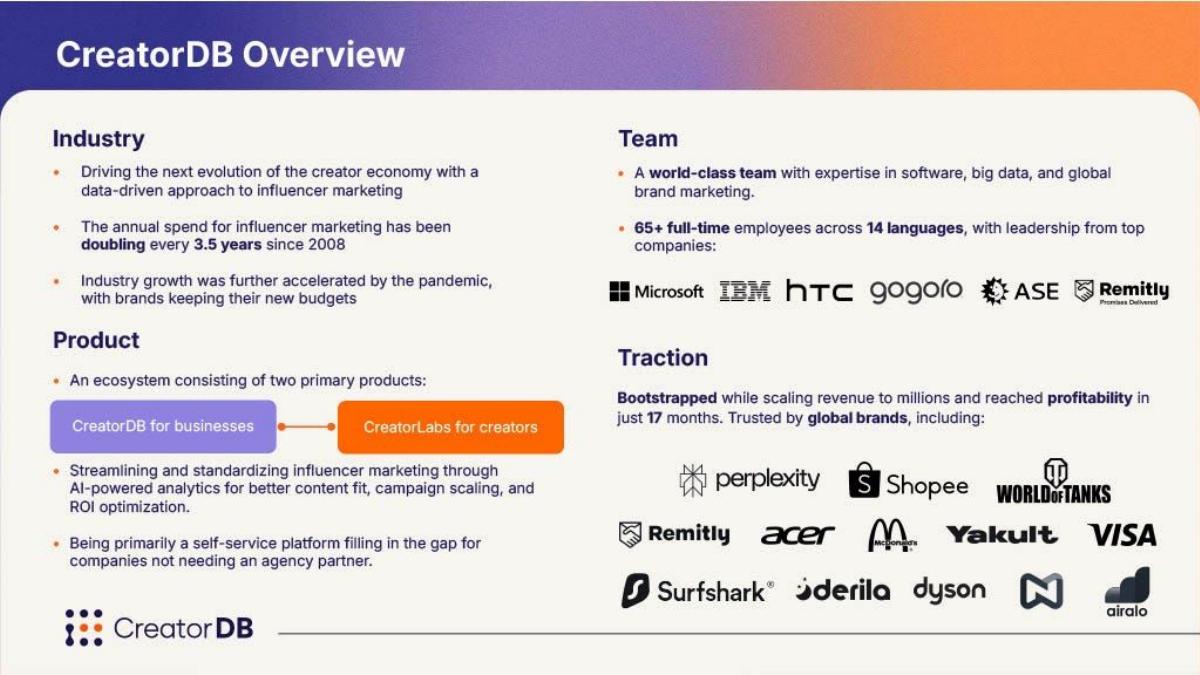
Slide 2 expands on the vision, stating the company is "Driving the next evolution of the creator economy with a data-driven approach to influencer marketing." This serves as a bridge between the high-level vision and the specific business metrics that follow. It establishes the 'Why Now'—the industry is evolving, and data is the catalyst.
Slide 3: The Traction Powerhouse
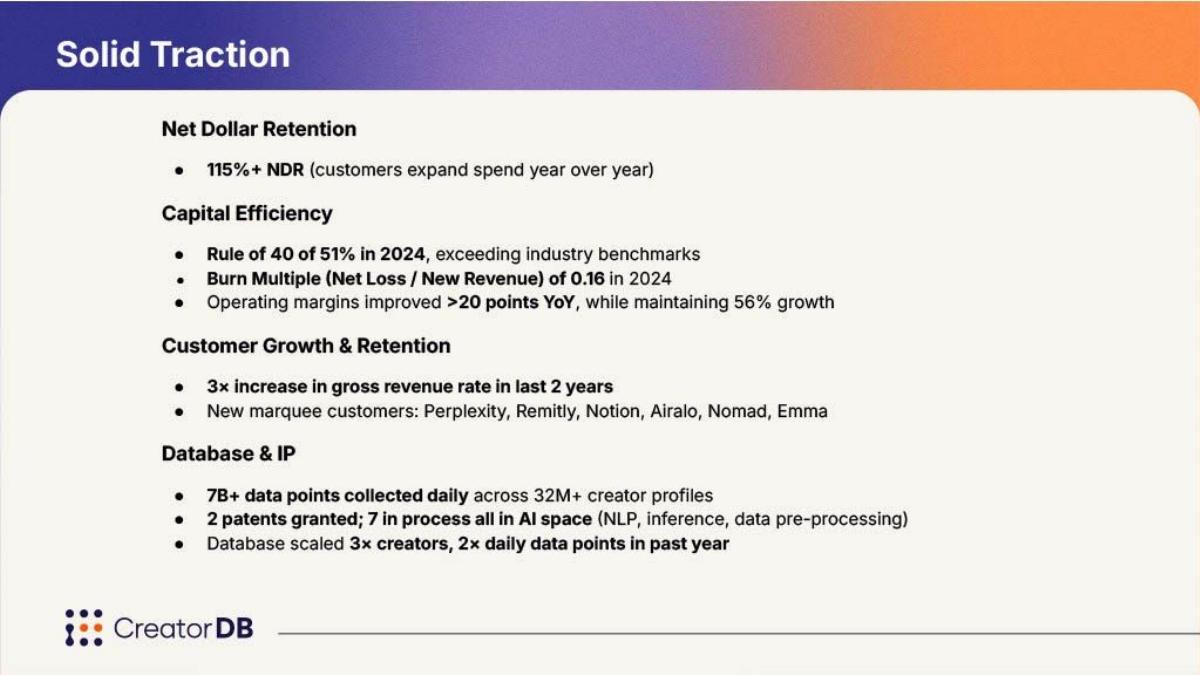
This is arguably the most important slide in the deck. Instead of burying traction at the end, CreatorDB leads with it. The slide, titled "Solid Traction," breaks down performance into four categories:
Net Dollar Retention: 115%+ NDR, which tells investors that once a customer starts using CreatorDB, they spend more over time. · Capital Efficiency: A Rule of 40 score of 51% and a Burn Multiple of 0.16. These are elite-tier SaaS metrics that prove the company is not burning excessive cash to grow. · Customer Growth: A 3x increase in gross revenue rate over 2 years and a list of marquee customers including Perplexity, Remitly, Notion, Airalo, Nomad, and Emma. · Database & IP: 7B+ data points collected daily and 2 granted patents (with 7 more in process).
Slide 4: The Problem
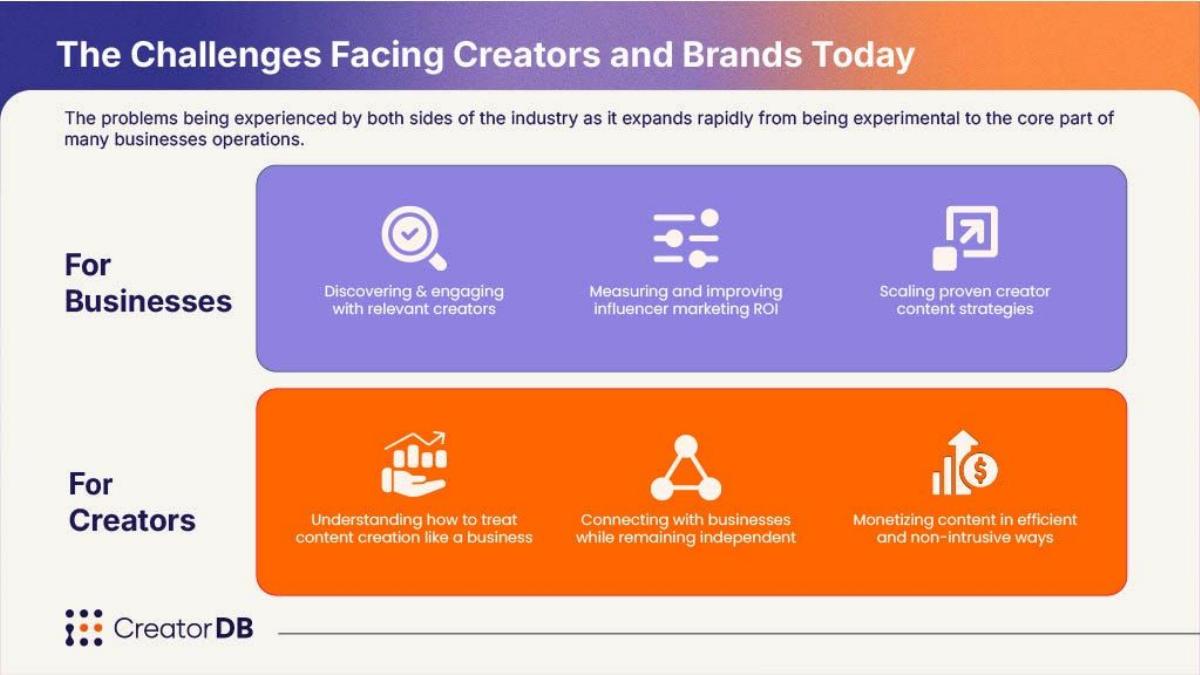
Titled "The Challenges Facing Creators and Brands Today," this slide (based on the text provided) identifies the friction points in the current market. While the visual is not shown, the narrative focus is on the difficulty of discovery, management, and measurement in a fragmented creator landscape.
Slide 5: The Ecosystem
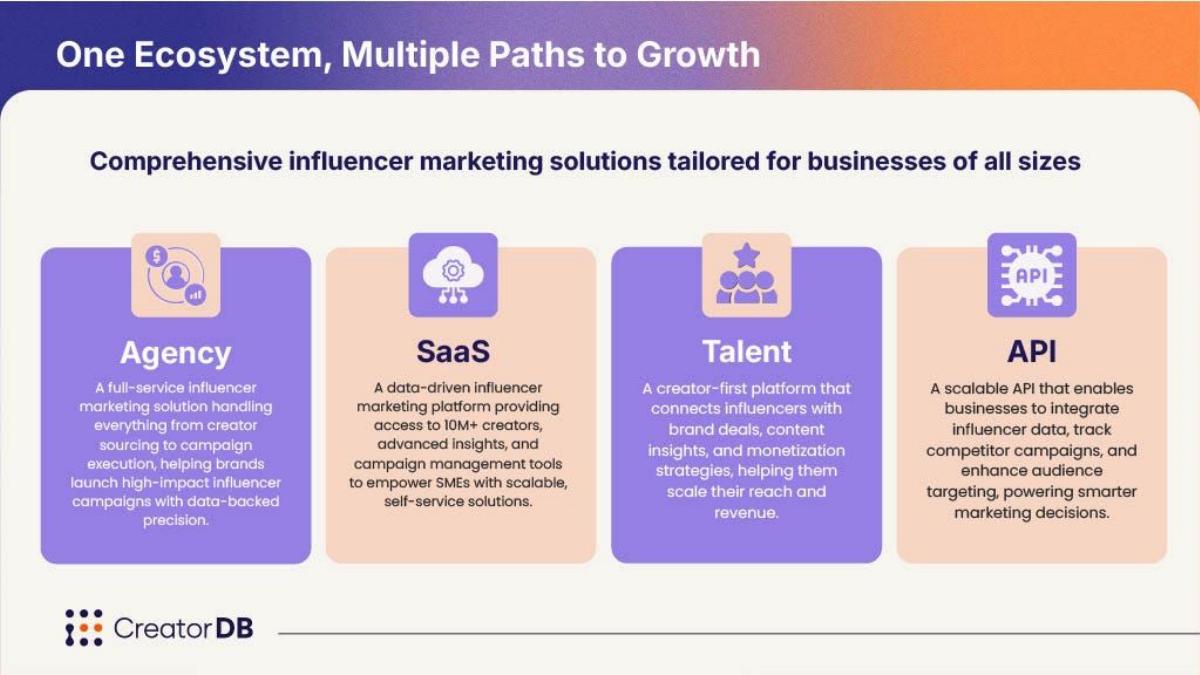
Slide 5, "One Ecosystem, Multiple Paths to Growth," explains the product offering. It categorizes the business into four pillars:
Agency: A full-service solution for campaign execution. · SaaS: A data-driven platform providing access to 10M+ creators for SMEs. · Talent: A creator-first platform for monetization strategies. · API: A scalable way for other businesses to integrate CreatorDB’s data.
This slide demonstrates that CreatorDB is not just a tool, but a platform that can capture value at every stage of the influencer marketing lifecycle.
Slide 6: The Competitive Edge
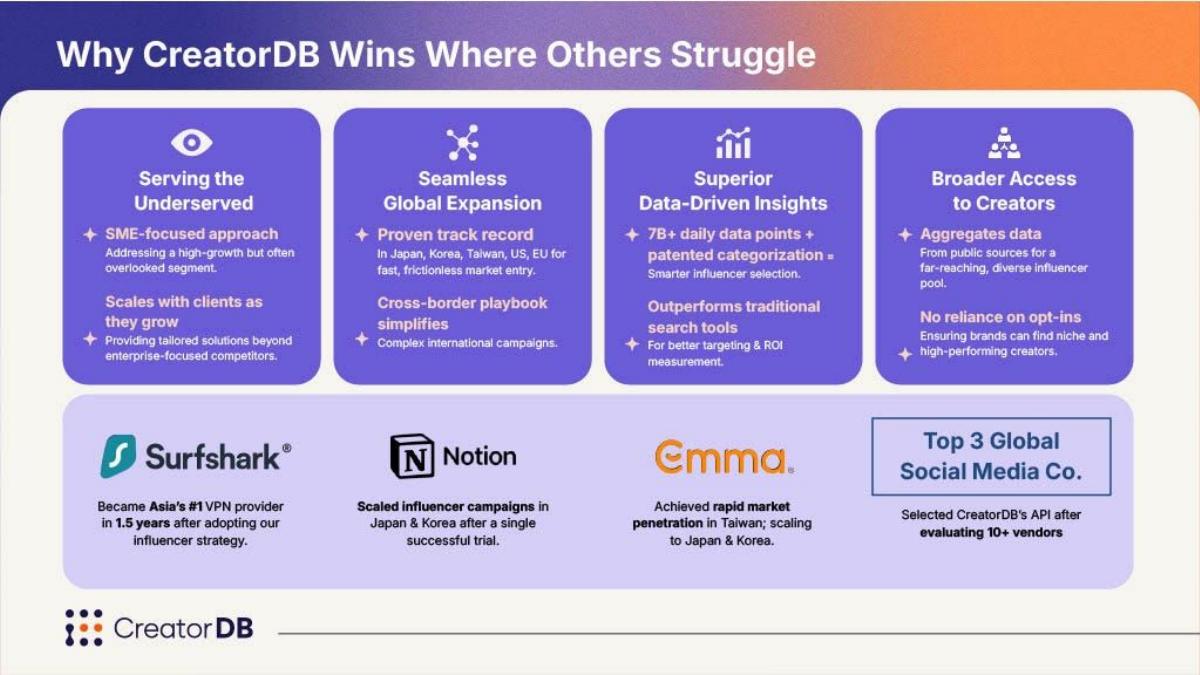
Titled "Why CreatorDB Wins Where Others Struggle," this slide likely addresses the limitations of legacy platforms. The text suggests a focus on technical superiority and the ability to handle the scale of the modern creator economy, which is further detailed in the data-specific slides.
Slide 7: The Data Engine
Slide 7, "Unlocking the Power of Influencer Data," provides the 'how' behind their claims. It lists three massive numbers: 10M+ creators in the database, 7B+ data points collected per day, and 800k+ creators with direct contact info. It also highlights their AI stack: "AI > DEEP LEARNING > NLP." The slide lists specific outputs of this tech, such as price estimation and a recommendation engine, which are critical for brands trying to automate their marketing spend.
Slide 8: Global Advantage
This slide focuses on the company's "Global Advantage." Given the company is headquartered in Asia (as reported by the publisher), this slide likely highlights their ability to bridge the gap between Western brands and the massive, fast-growing influencer markets in the APAC region.
Slide 9: Business Models
Slide 9 provides transparency on how the company makes money. It breaks down revenue into:
Transactions: Taking a percentage of creator transactions. · SaaS: A base monthly fee of $100 - $1000 for brands. · Data: Selling datasets and API access.
The mention of "CreatorDB 2.0" suggests a recent product evolution that has streamlined these revenue streams.
Slide 10: Market Opportunity
Titled "Massive, Fast-Growing Market Opportunity," this slide provides the TAM (Total Addressable Market) analysis. While specific figures aren't quoted in the text, the goal is to show that the influencer marketing sector is large enough to support a multi-billion dollar exit.
Slide 11: The Competitive Landscape
The "Competitors" slide uses a classic checkmark grid to compare CreatorDB against Mavrck, Upfluence, and Traackr. CreatorDB claims to be the only one that offers all five listed features: data on millions of influencers, independent content categorization, auto-generated reports, localized data for APAC/NA/EU, and a self-serve software focus. Notably, it marks competitors as lacking in the 'localized data' and 'self-serve' categories.
Slide 12: The Team
The team slide, "Led by Experienced Builders in Tech and AI," introduces the leadership. While the specific names aren't detailed in the provided text beyond the CEO, the focus is on their background in building scalable technology and AI systems, reinforcing the 'data-first' narrative.
Slide 13: The Close
The final slide is a standard "Thank You" with contact information for Clayton Jacobs, Founder & CEO. It includes his email and the company URL, maintaining the professional and direct tone of the rest of the deck.
What CreatorDB Does Well
The standout feature of this deck is its unapologetic focus on efficiency metrics. In the current venture climate, a 0.16 Burn Multiple is a massive green flag. It tells investors that the founders are disciplined and that the business model has inherent leverage. By placing these metrics on Slide 3, they ensure that every subsequent slide is viewed through the lens of a high-performing, sustainable business.
Furthermore, the diversification of revenue streams (Slide 9) is a smart move. It shows that CreatorDB isn't just a SaaS tool that might churn, but a data provider and a transaction layer. This 'multi-pronged' approach makes the company more resilient and increases the potential ceiling for the business.
What is Missing from the Deck
Despite the strong metrics, there are a few notable omissions:
The Ask: The provided slides do not include a specific 'Ask' slide detailing how much they are raising (though we know it was $4.7M) or how they plan to allocate that capital (e.g., 40% engineering, 30% sales, etc.). · Unit Economics: While NDR is excellent, the deck lacks specific Customer Acquisition Cost (CAC) and Lifetime Value (LTV) data. For a Series A, investors usually want to see the 'machine'—if I put $1 in, how much comes out and how long does it take? · Case Studies: While they list marquee customers like Notion and Perplexity, the deck doesn't show a specific 'before and after' case study. Showing exactly how Notion used their data to save money or increase reach would have made the 'Moneyball' claim even more tangible.
Founder Takeaways: What to Copy
Lead with your 'Why You Win' metrics. If you have a Rule of 40 score above 40% or a Burn Multiple below 1.0, put it on the first three slides. Don't wait for the investor to ask for it in the Q&A. CreatorDB uses these numbers to build immediate credibility.
Own a specific 'Tech' narrative. CreatorDB doesn't just say they have a database; they cite 7 billion data points per day and specific patents. If you are building in a crowded space like influencer marketing, you must prove that your 'moat' is technical, not just a better UI or a bigger sales team.
Use a competitive grid that highlights 'Modern' needs. Instead of just listing features, CreatorDB’s competitive grid (Slide 11) focuses on 'Self-serve' and 'Localized data.' These are specific pain points for modern, global marketing teams. When building your own grid, don't just pick features you have; pick features that the market is currently demanding and your competitors are failing to provide.
Frequently asked questions
- What is CreatorDB's primary competitive advantage according to the deck?
- According to slide 11, CreatorDB differentiates itself through its 'self-serve software focus' and 'localized data and customer success for APAC/NA/EU.' While competitors like Mavrck and Traackr collect data on millions of influencers, the deck claims they lack the specific localized data and self-service capabilities that CreatorDB provides to global brands.
- How does CreatorDB justify its AI and data claims?
- The company points to technical validation on slide 3, noting two granted patents and seven in-process patents specifically in the AI space, covering NLP, inference, and data pre-processing. They also cite a massive data ingestion rate of 7 billion data points daily, which fuels their recommendation engine and price estimation tools shown on slide 7.
- What are the different ways CreatorDB generates revenue?
- Slide 9 outlines three primary business models: Transactions (taking a percentage of creator transactions and margins on managed campaigns), SaaS (monthly fees between $100 and $1000), and Data (selling datasets and API access to other creator economy tools). This multi-pronged approach allows them to serve both small businesses and large enterprises.
- Who are some of CreatorDB's notable customers?
- On slide 3, the company lists several high-profile 'marquee customers' including Perplexity, Remitly, Notion, Airalo, Nomad, and Emma. The presence of tech-forward companies like Perplexity and Notion serves as a strong signal of the platform's utility for modern digital marketing teams.
- What financial efficiency metrics does the deck highlight?
- The deck leans heavily on the 'Rule of 40,' reporting a score of 51% in 2024. It also highlights a very low Burn Multiple of 0.16, meaning they are generating significant new revenue for every dollar spent. Additionally, they report that operating margins improved by over 20 points year-over-year while maintaining 56% growth (Slide 3).