Medable’s Series D deck is a masterclass in capitalizing on a massive market shift. By framing the COVID-19 pandemic as the catalyst for 'The year of decentralized research,' Medable positioned its Unified Cloud Platform as the essential infrastructure for the future of drug development. The deck leans heavily on enterprise-grade social proof, noting that 5 of the top 10 pharmaceutical companies and 5 of the top 7 CROs are clients. While the version of the deck available for public review has several data-heavy slides redacted with purple blocks, the narrative remains clear: clinical trials a…
Key takeaways
- The deck identifies a massive inefficiency in drug development, citing a $2.6B cost per approval and a 12-year timeline on slide 3.
- Medable leverages the pandemic as a permanent market accelerator, labeling 2020 as 'The year of decentralized research' on slide 4.
- Enterprise traction is a core pillar, with slide 6 claiming 100% client retention and partnerships with 5 of the top 10 global pharma companies.
- The platform's scale is significant, reporting over 1 million patients across more than 60 countries and 60 languages on slide 7.
- The product architecture is presented as a 'Unified Cloud Platform' that integrates eConsent, TeleVisits, and digital biomarkers on slide 8.
- Medable demonstrates a comprehensive 'Participant Journey' on slide 10, covering everything from social media recruitment to data lock.
- Financial momentum is highlighted by a 300% growth in revenue during 2020, as stated on slide 6.
- The deck includes a detailed list of 16 KPIs on slide 14, though the specific values are redacted in this version.
Executive Summary: The $304M Series D Narrative
Medable’s 2022 pitch deck is a textbook example of a Series D presentation. At this stage, investors are looking for dominant market positioning, proven enterprise scale, and a clear path to becoming an industry standard. Medable delivers this by framing the entire clinical trial industry as an antiquated system that was forced to modernize by the global pandemic. The deck uses a mix of high-level visionary goals and dense, operational workflows to prove that they aren't just a software vendor, but a critical infrastructure layer for drug development.
Slide 1: Title and Vision
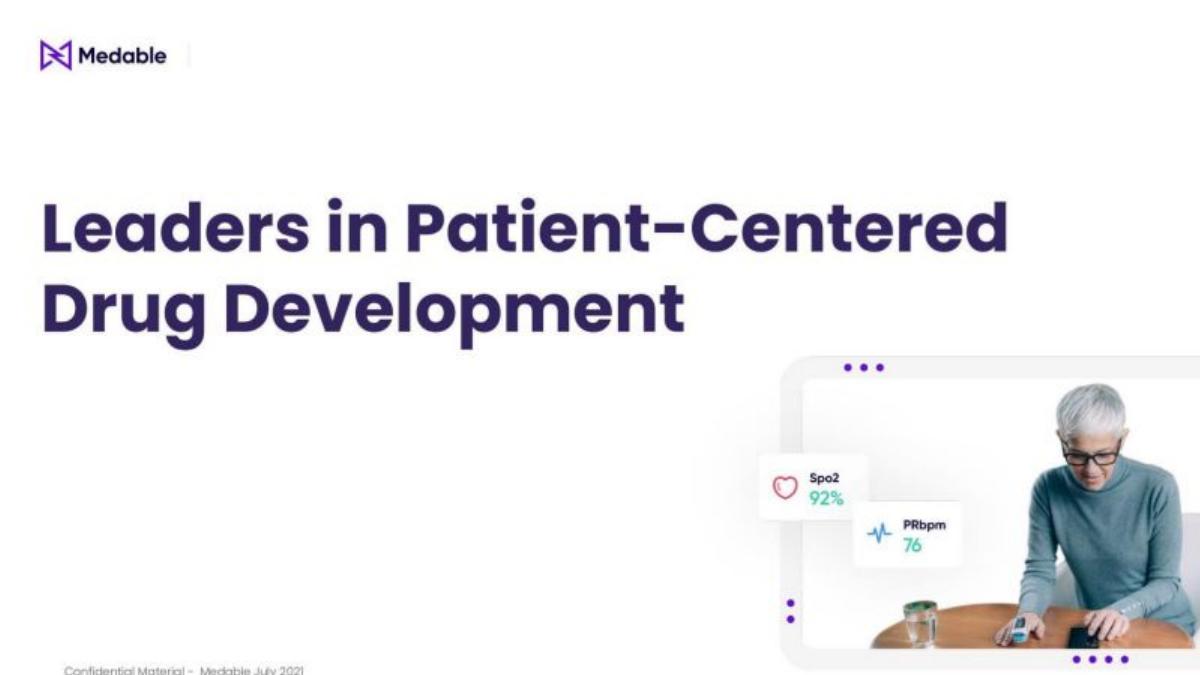
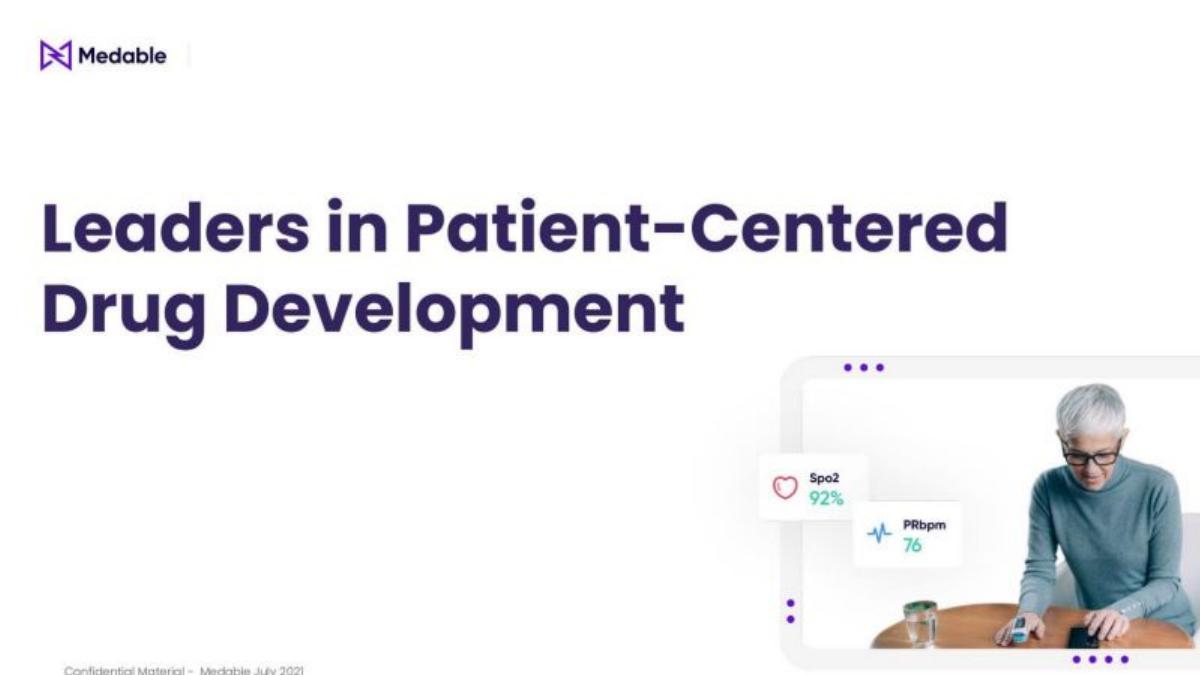
The deck opens with a bold claim: "Leaders in Patient-Centered Drug Development." The imagery features an elderly woman using a pulse oximeter and a smartphone, immediately grounding the high-tech 'Unified Cloud' pitch in a real-world patient use case. This visual reinforces the 'patient-centered' theme that recurs throughout the deck.
Slide 2: The Leading Team
Medable leads with its team, emphasizing the medical credentials of its CEO, Michelle Longmire, MD . The slide features six key executives, including the CTO, COO, and leads for strategy, business development, and product. A small footnote indicates that the COO is no longer at Medable, a piece of transparency that is rare in pitch decks but necessary for late-stage due diligence.
Slide 3: The Mission and the 'Broken' Status Quo
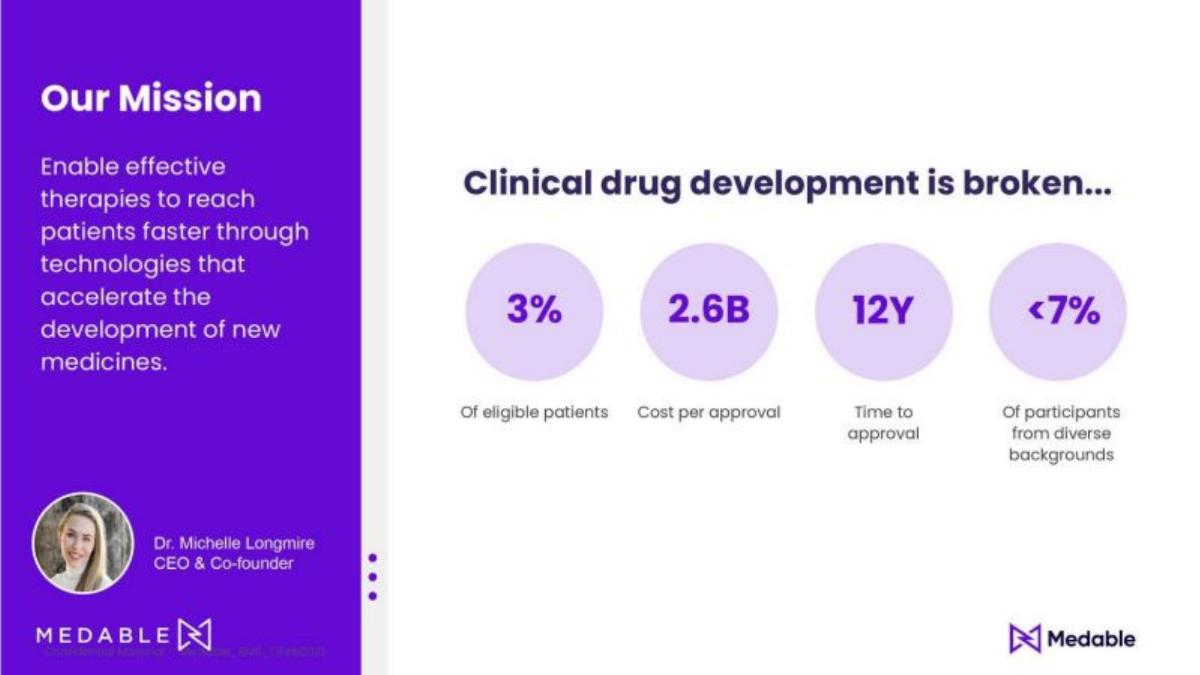
This is the 'Problem' slide. Medable identifies four staggering statistics to prove clinical drug development is inefficient: 3% of eligible patients participate, $2.6B cost per approval, 12Y time to approval, and <7% diversity in participants. By quantifying the pain, Medable sets the stage for a solution that promises to 'enable effective therapies to reach patients faster.'
Slide 4: The COVID-19 Catalyst
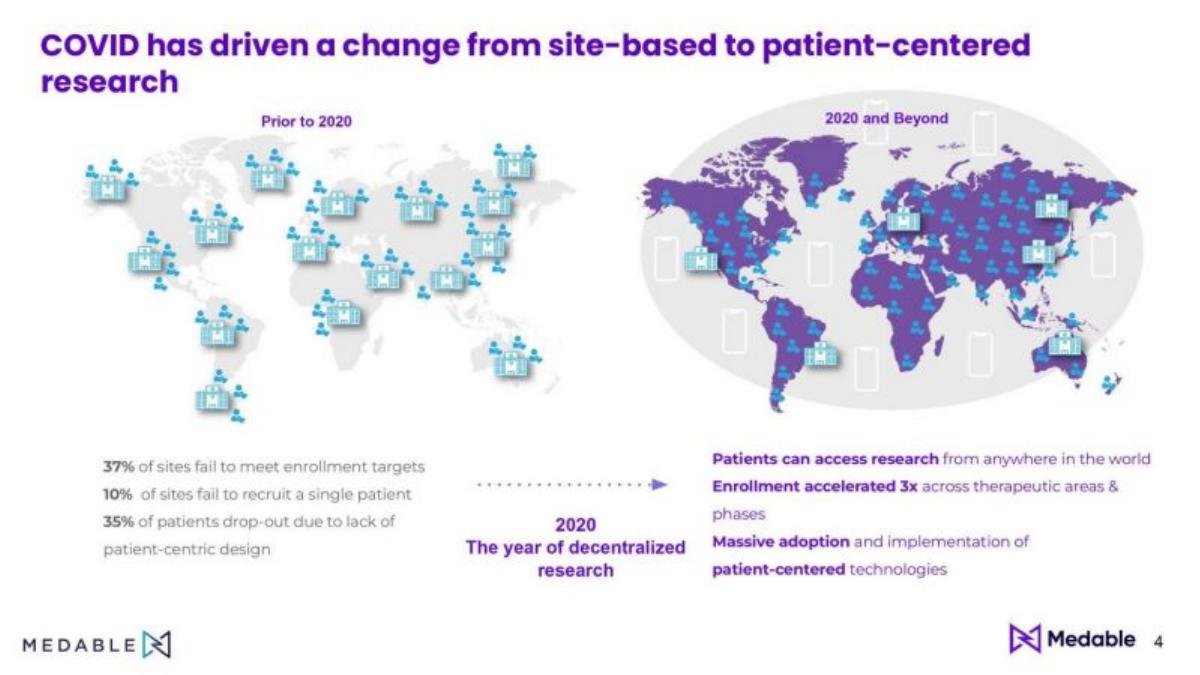
Slide 4 is the 'Why Now?' slide. It contrasts the 'Prior to 2020' site-based research model with the '2020 and Beyond' decentralized model. It notes that 37% of sites fail to meet enrollment targets and 35% of patients drop out due to lack of patient-centric design. Medable claims that in the new era, enrollment has accelerated 3x across therapeutic areas.
Slide 5: Positioned to Win
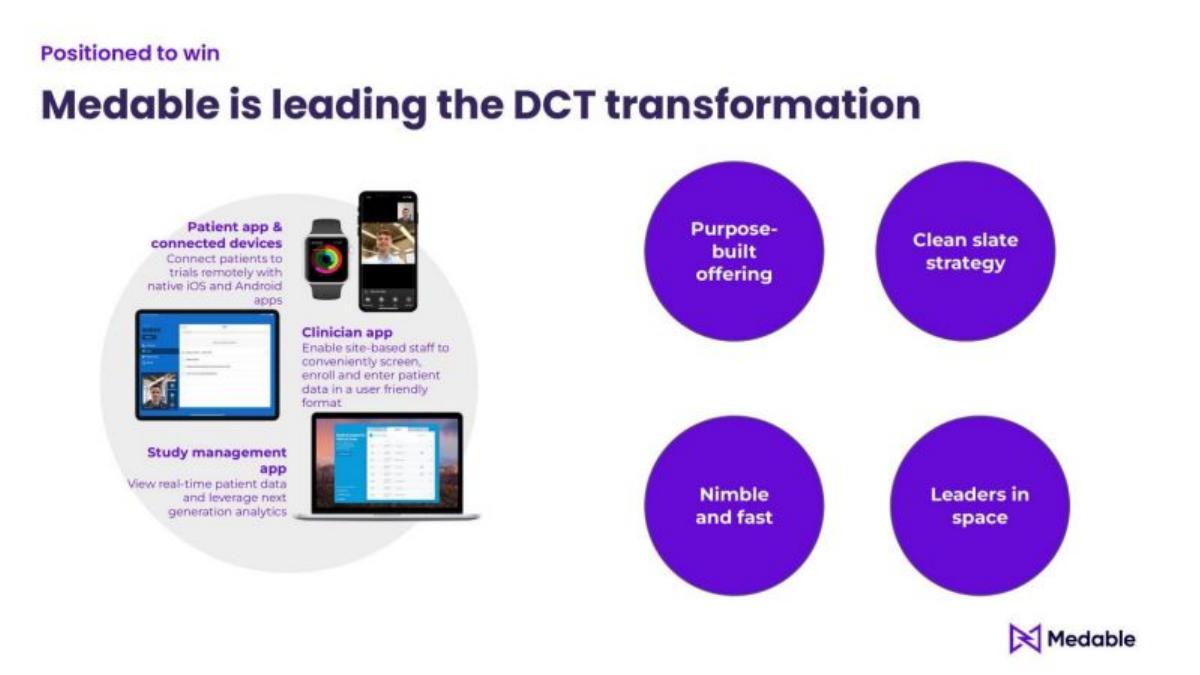
This slide introduces the product ecosystem. It highlights three primary interfaces: the Patient app & connected devices , the Clinician app , and the Study management app . It lists four competitive advantages: a purpose-built offering, a clean slate strategy, being nimble and fast, and being leaders in the space.
Slide 6: Digital & Decentralized Traction
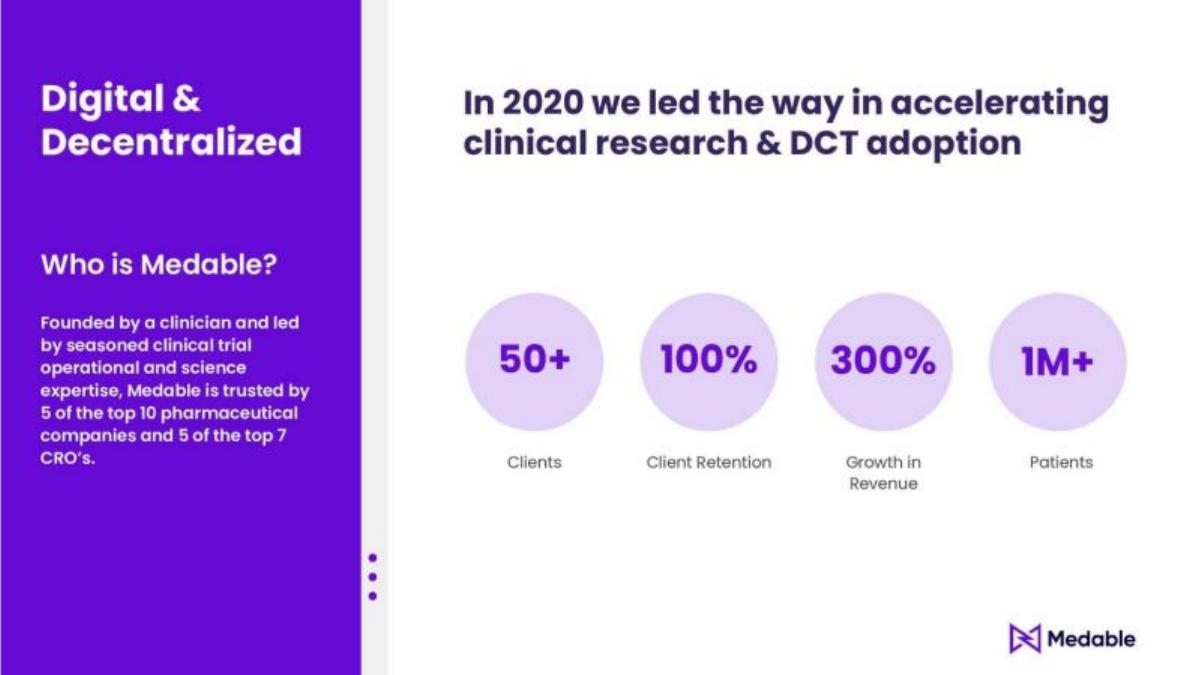
This is the 'Traction' slide, and it is arguably the strongest in the deck. Medable claims to be trusted by 5 of the top 10 pharmaceutical companies and 5 of the top 7 CROs . The metrics are equally impressive: 50+ Clients , 100% Client Retention , 300% Growth in Revenue , and 1M+ Patients .
Slide 7: Global Capability
To serve 'Big Pharma,' a platform must be global. Slide 7 highlights Medable's reach: 125+ Global DCTs (Decentralized Clinical Trials), 60+ Countries , and 60+ Languages . It also mentions compliance with FDA CFR21 Part 11, HIPAA, and GDPR , which are non-negotiable requirements in healthcare technology.
Slide 8 & 9: The Unified Cloud Platform
These slides provide a technical and functional deep dive. Slide 8 shows a complex diagram of the 'Unified Cloud Platform,' illustrating how data flows from sensors and wearables through an automation and AI layer into a data warehouse. Slide 9 focuses on the user experience, describing the interface as 'Flexible, Dynamic, Engaging' and listing features like eConsent, TeleVisits, and eSource .
Slide 10: The Participant Journey
This slide maps out the entire lifecycle of a clinical trial participant on the Medable platform. It starts with Recruitment via Referral, Social Media or Clinic and moves through Eligibility screening, TeleConsent, eDiary, TeleVisits, and Real Time Data Capture , ending with Data Lock . This proves the platform handles the 'end-to-end' journey, not just a single niche task.
Slides 11-16: The Redacted Financials
These slides represent the meat of a Series D deck: Subscription Revenue (Slide 11), Committed Annual Recurring Revenue (Slide 12), Bookings (Slide 13), KPIs (Slide 14), ROI in product (Slide 15), and the 2021 Operating Plan (Slide 16). In this version of the deck, the data is hidden behind purple blocks. However, slide 14 is still valuable for founders as it lists the exact metrics Medable tracks, including Net Revenue Retention , Human Capital Efficiency (ARR per headcount), and Blended CAC Ratio .
Slide 17: Radically Advancing Clinical Research
The deck concludes by returning to high-level impact. It categorizes its success into four buckets: Access & Diversity , Value to Patients , Speed , and Driving Industry Change . It specifically mentions measuring success through Net Promoter Score (NPS) and patient satisfaction.
What Medable Does Well
The Medable deck excels at Social Proof . For a Series D company, the most important metric is often 'who else is using this?' By naming the percentage of top-tier pharma companies and CROs they have captured, they create a sense of inevitability. If the industry leaders are using Medable, the smaller players must follow suit to remain competitive.
Furthermore, the deck does an excellent job of Contextualizing the Market . They don't just say they have a good product; they argue that the world changed in 2020 and their product is the only one built for the new reality. This 'New World' narrative is a powerful way to justify high valuations and rapid growth expectations.
What is Missing from the Deck
While the redactions hide the specific financials, there are a few structural omissions worth noting:
Competitive Landscape: The deck claims Medable is 'leading,' but it does not show a traditional competitor matrix. In a crowded health-tech space, seeing how they differentiate against legacy players like Medidata or newer entrants would be valuable. · The 'Ask': There is no slide explicitly stating how much they are raising or what the use of funds will be. While this is often handled in a separate document or a verbal conversation at the Series D level, its absence makes the deck feel more like a corporate brochure than a fundraising tool. · Unit Economics: While Slide 14 lists 'Blended CAC Ratio' as a KPI, the deck doesn't explain the underlying unit economics of a single trial or a single enterprise contract.
What Founders Should Copy
Founders should study Slide 10 (The Participant Journey) . Many startups struggle to explain exactly how their product works in practice. Mapping out the user journey step-by-step, with screenshots of the mobile and desktop interfaces, makes a complex cloud platform feel tangible and easy to understand.
Additionally, the KPI list on Slide 14 is a gold standard for SaaS companies. Even if you aren't at Series D, tracking metrics like 'Human Capital Efficiency' (ARR/Headcount) and 'Organic ARR Growth' shows investors that you have a sophisticated understanding of how to scale a business, not just how to build a product.
Final Verdict: This deck is designed to prove that Medable is the 'winner' in the decentralized clinical trial category. It uses massive enterprise logos and a global scale narrative to make the investment feel like a safe bet on a dominant market leader.
Frequently asked questions
- What is the primary problem Medable is solving?
- According to slide 3, clinical drug development is 'broken.' Medable points to four specific pain points: only 3% of eligible patients participate, the cost per drug approval is $2.6 billion, the time to approval averages 12 years, and less than 7% of participants come from diverse backgrounds. Their mission is to use technology to accelerate this process and reach patients faster.
- How did COVID-19 impact Medable's business model?
- Slide 4 explains that COVID-19 drove a fundamental shift from site-based to patient-centered research. Medable claims this shift accelerated enrollment by 3x across various therapeutic areas. By positioning 2020 as the 'year of decentralized research,' they argue that the industry has reached a point of 'massive adoption' for their specific technology stack.
- What are the key components of the Medable platform?
- Slide 8 and 9 detail a 'Unified Cloud Platform' that includes a Patient App, a Clinician App, and a Study Management App. Specific features mentioned include eConsent, eCOA (Electronic Clinical Outcome Assessment), TeleVisits, remote screening, and integration with wearables and sensors. This allows for real-time data capture and analytics throughout the trial lifecycle.
- What kind of market traction does Medable show?
- Medable demonstrates significant enterprise-level traction on slide 6. They report having over 50 clients, including 5 of the top 10 pharmaceutical companies and 5 of the top 7 Contract Research Organizations (CROs). They also boast 100% client retention and a 300% increase in revenue in 2020, with over 1 million patients on the platform.
- Is the financial data fully transparent in this deck?
- No. Slides 11 through 16, which cover Subscription Revenue, Committed ARR, Bookings, KPIs, and the 2021 Operating Plan, are almost entirely redacted with purple blocks. While the headers and metric definitions (like 'Blended CAC Ratio' and 'Sales Efficiency Ratio') are visible on slide 14, the actual figures are hidden, which is common for late-stage decks shared publicly.