The June 2012 Medgenics investor presentation serves as a technical and clinical update for a company already trading publicly under the ticker MDGN. The narrative centers on the 'Biopump' platform, which uses a patient's own skin tissue to produce therapeutic proteins like Erythropoietin (EPO) and Interferon Alpha (IFN-a). By providing in vitro data showing sustained production for over six months, the deck attempts to de-risk the biological viability of the platform. The company lists a robust pipeline targeting massive markets, including diabetes ($15.5b) and arthritis ($20.9b), though mos…
Key takeaways
- The Biopump method involves a five-step process: harvest, process (10-14 days), measure, implant, and reversible ablation (Slide 7).
- Medgenics provides long-term in vitro data for EPODURE, showing sustained EPO secretion for 185 days (Slide 10).
- The INFRADURE platform for Hepatitis shows sustained IFN-a production for over 244 days in vitro (Slide 13).
- Clinical progress is highlighted by US FDA clearance for a Phase IIb trial in dialysis patients with anemia (Slide 16).
- The company has established a US Biopump GMP processing center in California to meet release criteria (Slide 16).
- The pipeline targets 11 different conditions, with the largest 2010 market sales noted as Arthritis at $20.9 billion (Slide 19).
- The management team is heavily weighted toward clinical and regulatory expertise, including a former FDA cell/gene-therapy group leader (Slide 4).
- The company was dual-listed on the NYSE Amex (MDGN) and AIM (MEDU, MEDG) at the time of the presentation (Slide 1).
Medgenics 2012 Investor Presentation Teardown
This teardown analyzes a subset of slides from the Medgenics June 2012 investor presentation. At this time, the company was positioned as a clinical-stage gene therapy firm focused on sustained protein delivery. Unlike early-stage startups, Medgenics was already public, which shifts the tone of the deck from 'visionary' to 'execution-oriented.'
Slide 1: Title and Public Listing
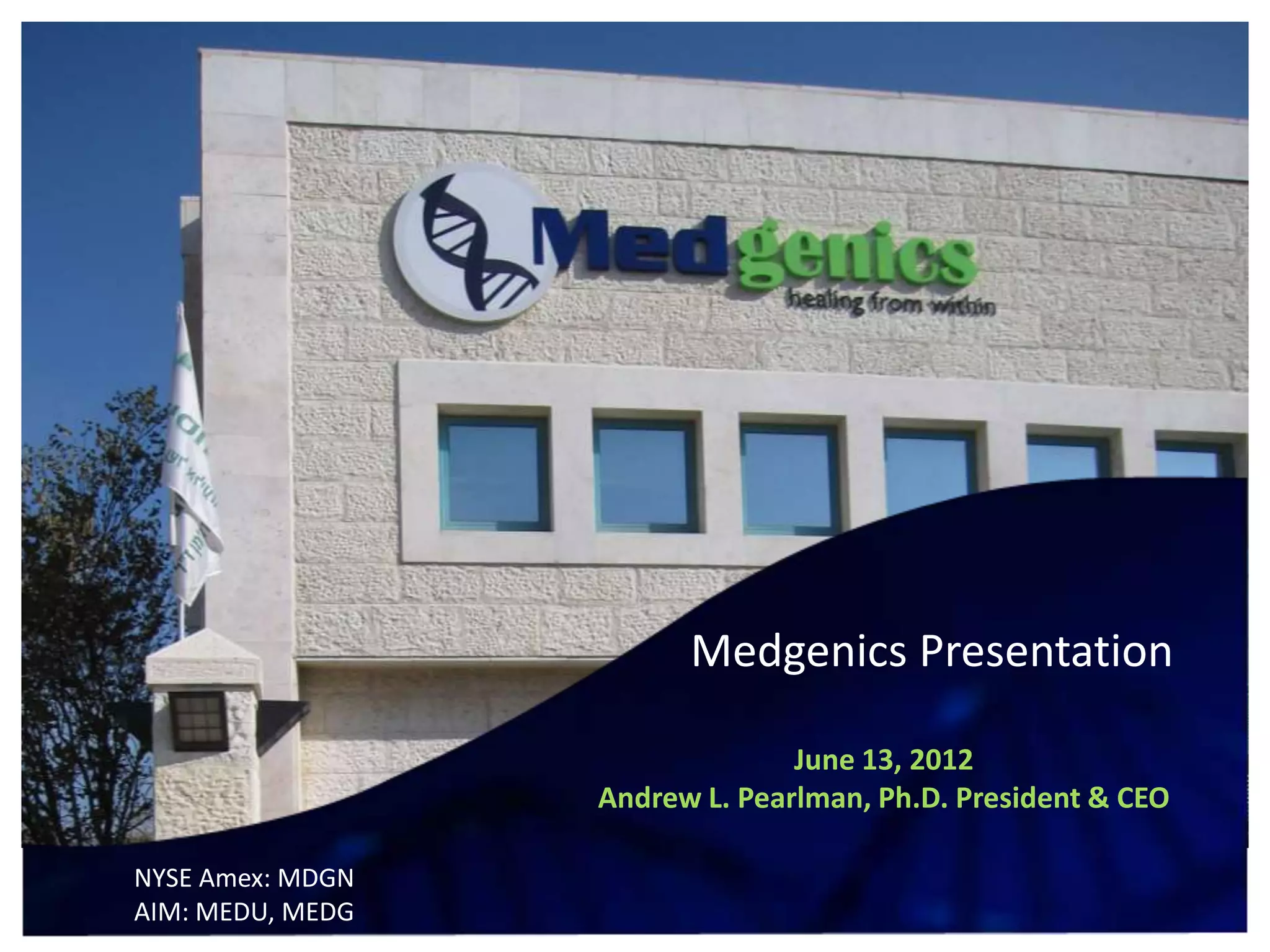
The cover slide establishes immediate credibility by listing the company's public tickers: NYSE Amex: MDGN and AIM: MEDU, MEDG. The imagery features the Medgenics headquarters, a physical manifestation of the company's scale. The presentation is dated June 13, 2012, and attributed to Andrew L. Pearlman, Ph.D., President & CEO. The tagline 'healing from within' succinctly summarizes the biological approach of the company.
Slide 4: Experienced Management Team
This slide is divided into three pillars: Board of Directors, SAB/Advisors, and Management. It is a 'heavyweight' team slide, emphasizing deep institutional and regulatory ties. Key highlights include:
Andrew L. Pearlman, PhD: Over 25 years in Biomed. · Eugene Bauer, MD: Former Dean of Stanford Medical School. · Isaac Blech: Noted biotech investor with ties to Celgene and ICOS. · Andra E. Miller, PhD: Former FDA cell/gene-therapy group leader (listed under Advisors). · Gary Brukardt: Former CEO of Renal Care Group, which sold for $3.5B.
The inclusion of a former FDA group leader is a strategic move to signal to investors that the company understands the regulatory path for gene therapy, which was notoriously difficult in the early 2010s.
Slide 7: The Biopump Method
This slide explains the mechanics of the product. It breaks the process down into five clear steps: harvesting tissue via needle biopsy, processing it for 10-14 days to transfer the desired gene, measuring protein production, implanting the 'Biopump,' and the ability to reverse the process via ablation. The slide includes a visual comparison of a Biopump next to a toothpick to emphasize its small size, and a photo of a patient's abdomen showing the harvest and implant sites. This makes a complex biological process feel tangible and manageable for a clinician.
Slide 10: EPODURE in vitro Data
Focusing on their anemia treatment, EPODURE, this slide provides technical validation. A bar chart shows 'Long term in vitro EPO secretion' over 185 days. The data suggests that the protein production remains relatively stable after the initial 'Time to Implant' (marked at day 9). The Y-axis uses a logarithmic scale (1 to 10,000 IU/Biopump/day), showing that the pumps can maintain high-level production for 6+ months. This slide is critical for proving that the 'sustained' part of their value proposition is backed by laboratory evidence.
Slide 13: INFRADURE in vitro Data
Mirroring the format of slide 10, this slide covers INFRADURE, the treatment for Hepatitis. It shows sustained Interferon Alpha (IFN-a) production for over 244 days. Again, the 'Time to Implant' is noted at day 9. The consistency of the bars across eight months of testing is intended to combat the common gene therapy hurdle of 'expression fading,' where the body or the modified cells stop producing the protein over time.
Slide 16: Recent Achievements in 2012
This is the 'momentum' slide. It lists milestones achieved in the first and second quarters of 2012:
Positive meeting with NIH RAC for Phase IIb trials in dialysis patients. · Approval for Phase IIa clinical study of EPODURE in Israel. · Filing for FDA Orphan Drug Designation for INFRADURE (Hepatitis D). · US FDA Clearance to initiate Phase IIb trials for anemia. · Launch of a US Biopump GMP (Good Manufacturing Practice) processing center in California.
The launch of the GMP facility is a significant operational milestone, indicating the company was moving beyond R&D into clinical manufacturing.
Slide 19: Pipeline for Biopump Platform
This slide demonstrates the versatility of the platform. It lists 11 different conditions, the associated protein, the development stage, and the 2010 market sales for that protein. The table shows:
Anemia: At Phase II ($9.2B market). · Hepatitis: Phase I/II ($2.7B market). · Hemophilia: Preclinical ($4.4B market). · Diabetes: Future Candidate ($15.5B market). · Arthritis: Future Candidate ($20.9B market).
By listing 'Future Candidates' in massive markets like Diabetes and Arthritis, the company is signaling a high ceiling for growth, even if their current clinical focus is narrower.
Slide 22: Closing Image
The final slide in this set is a photograph of the Medgenics team at the NYSE Euronext, dated September 6 (Tuesday). This serves as a reminder of the company's public status and its successful listing on a major US exchange. It is a 'prestige' shot intended to leave investors with a sense of the company's legitimacy and institutional acceptance.
What Medgenics Does Well
Medgenics excels at technical transparency. In an industry where 'black box' technology is common, they provide clear, step-by-step visuals of how the Biopump is harvested and implanted. The use of in vitro data charts (Slides 10 and 13) provides the necessary scientific evidence to support their claims of sustained delivery. Furthermore, the management slide is exceptionally strong, specifically highlighting regulatory expertise which is the primary gatekeeper in biotech.
What is Missing from the Deck
As a public company presentation, this deck lacks several elements found in a standard startup pitch. There is no 'Problem' slide—it assumes the audience understands that daily injections for anemia or hepatitis are a burden. There is no 'Competition' slide comparing Biopump to traditional biologics or other gene therapy platforms like AAV vectors. Most importantly, there is no financial data regarding cash runway, burn rate, or the specific cost of the Phase IIb trials, which are critical metrics for biotech investors.
Founder Takeaways
Founders in the deep tech or life sciences space should study Slide 7. It takes a complex, multi-week medical procedure and distills it into five easy-to-understand steps with scale-reference photos. Additionally, the use of the 'Pipeline' slide (Slide 19) is a masterclass in showing 'Platform Potential.' By showing that the same delivery mechanism can work for EPO, Insulin, and Interferon, they transform from a 'one-drug company' into a 'platform company,' which significantly increases their perceived valuation and strategic importance.
Frequently asked questions
- What is the core technology behind Medgenics?
- The core technology is the 'Biopump,' a platform that uses a small piece of the patient's own skin tissue. This tissue is genetically modified to produce a specific therapeutic protein and then re-implanted under the patient's skin to provide a continuous, long-term dosage. According to slide 7, the process is reversible through simple excision if treatment needs to be stopped.
- What clinical stages had Medgenics reached by June 2012?
- By the date of this presentation, Medgenics had reached several milestones. Slide 16 notes that they received US FDA clearance to initiate a Phase IIb trial for anemia in dialysis patients and approval for a Phase IIa study in Israel. Their hepatitis treatment, INFRADURE, had filed for FDA Orphan Drug Designation and was preparing for Phase I/II trials.
- How does Medgenics address the market size for its treatments?
- Slide 19 provides a detailed pipeline table that correlates specific proteins with disease states and their respective 2010 global sales figures. They target high-value markets such as Anemia ($9.2b), Diabetes ($15.5b), and Arthritis ($20.9b). This slide positions the Biopump as a platform capable of disrupting multiple multi-billion dollar drug categories.
- Who were the key members of the Medgenics leadership team?
- The team was led by Dr. Andrew L. Pearlman, who had over 25 years of experience in the biomed sector. The board and advisory staff included significant industry figures, such as Eugene Bauer (former Dean of Stanford Med School) and Isaac Blech (investor in Celgene and ICOS), as shown on slide 4.
- Is there a financial 'ask' in this pitch deck?
- No, this specific deck does not contain a slide detailing a funding requirement, valuation, or use of proceeds. Because Medgenics was already a publicly traded company on the NYSE Amex and AIM at the time (Slide 1), this presentation likely functioned as a general investor relations update rather than a private placement pitch.