MedArrive’s Series A deck is a masterclass in ecosystem positioning. Rather than building a workforce from scratch, MedArrive utilizes under-leveraged EMS professionals to provide in-home care, a strategy that addresses the high costs of hospital settings. The deck focuses heavily on the 'why now'—citing the COVID-19 pandemic and the shift toward value-based care as primary catalysts. With a strong emphasis on social proof through testimonials from major health plans like SCAN and Bright Health, the presentation successfully argues that MedArrive is a 'critical infrastructure' play. While the…
Key takeaways
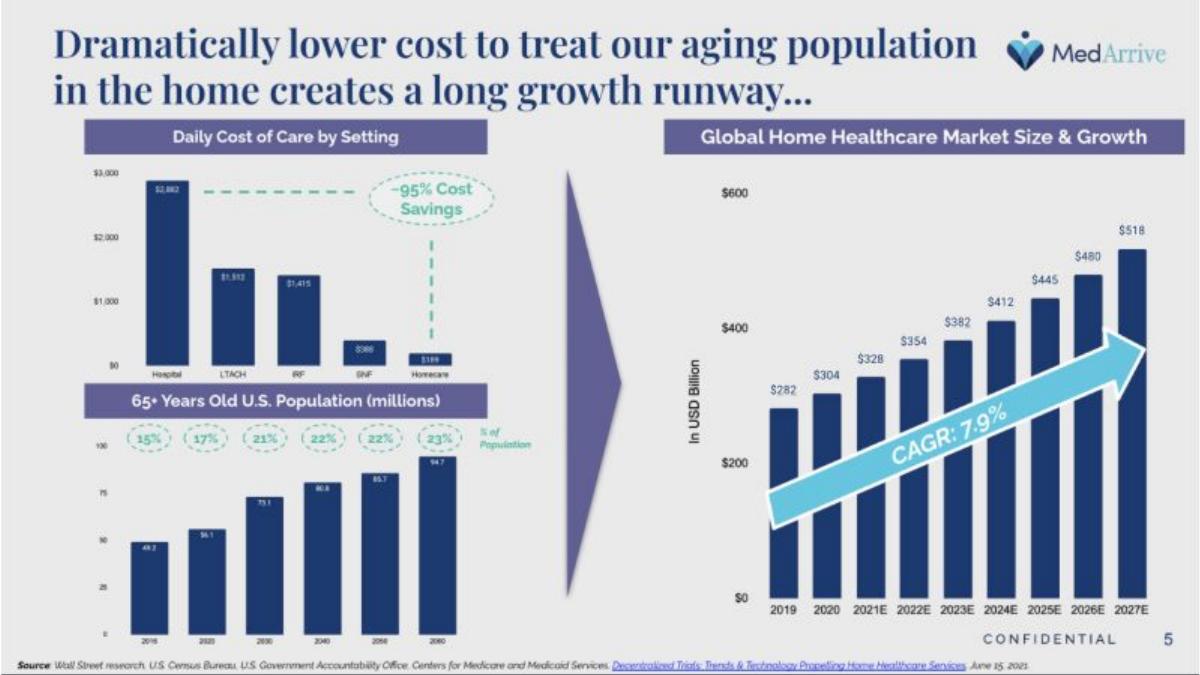
- The platform claims a ~95% cost savings by shifting care from hospital settings ($2,882/day) to homecare ($189/day) as shown on slide 5.
- MedArrive positions itself as a three-sided marketplace connecting patients, health providers/payors, and field providers like EMTs and Paramedics (slide 11).
- The market opportunity is backed by a projected Global Home Healthcare Market size of $518 billion by 2027 with a 7.9% CAGR (slide 5).
- The founding team features deep experience from Uber Health, Lyft, and major healthcare systems like Optum and Epic (slide 9).
- Strategic backing is highlighted from top-tier investors including Kleiner Perkins and Define Ventures (slide 10).
- The deck utilizes video 'ride alongs' with SCAN Health Plan and LA County to provide tangible proof of service delivery (slides 15 and 16).
- MedArrive targets the 'medically complex and socially vulnerable' by filling the gap between non-medical personal care and high-intensity hospital care (slide 7).
- The business model relies on increasing labor utilization for EMS providers, allowing them to 'practice at the top of their scope' (slide 12).
Executive Summary: The Infrastructure for In-Home Care
MedArrive’s Series A pitch deck, used to secure $25 million in 2021, focuses on a specific logistical gap in the American healthcare system: the under-utilization of EMS professionals for non-emergency care. The deck is structured to move the investor from the macro problem (aging population and high costs) to a specific, scalable solution (EMS + Telemedicine). By positioning themselves as 'critical infrastructure' rather than just a service provider, MedArrive makes a play for a massive market share in the $500B+ home healthcare sector.
Slide 1: Title and Mission
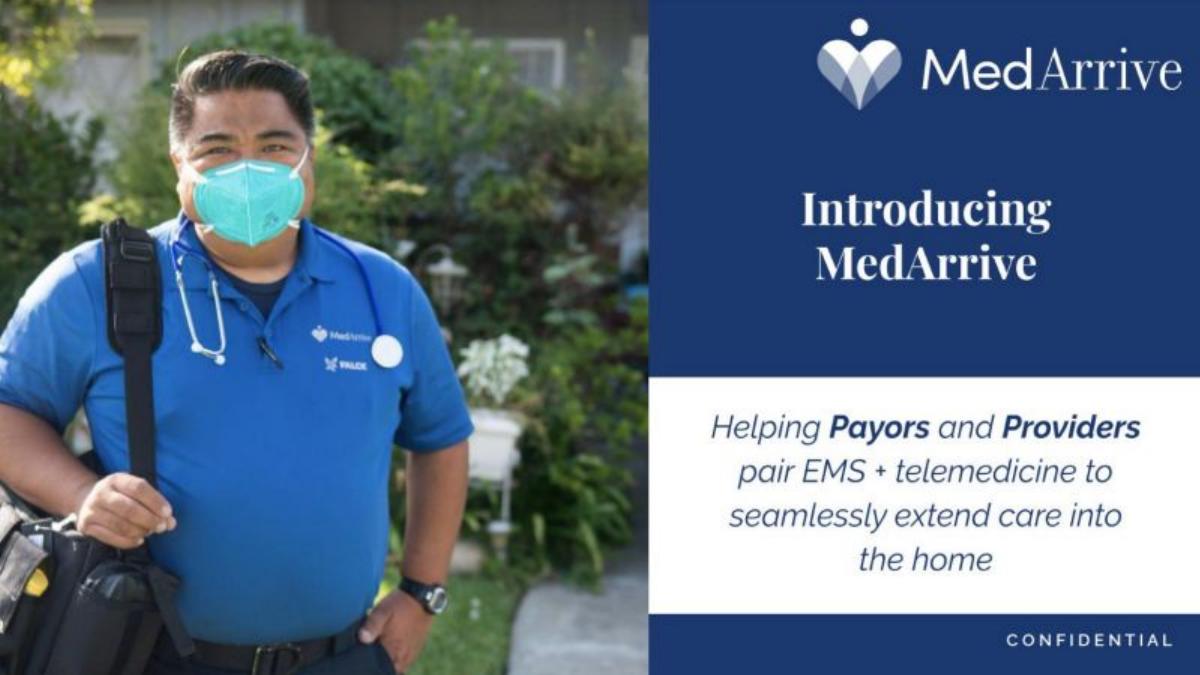
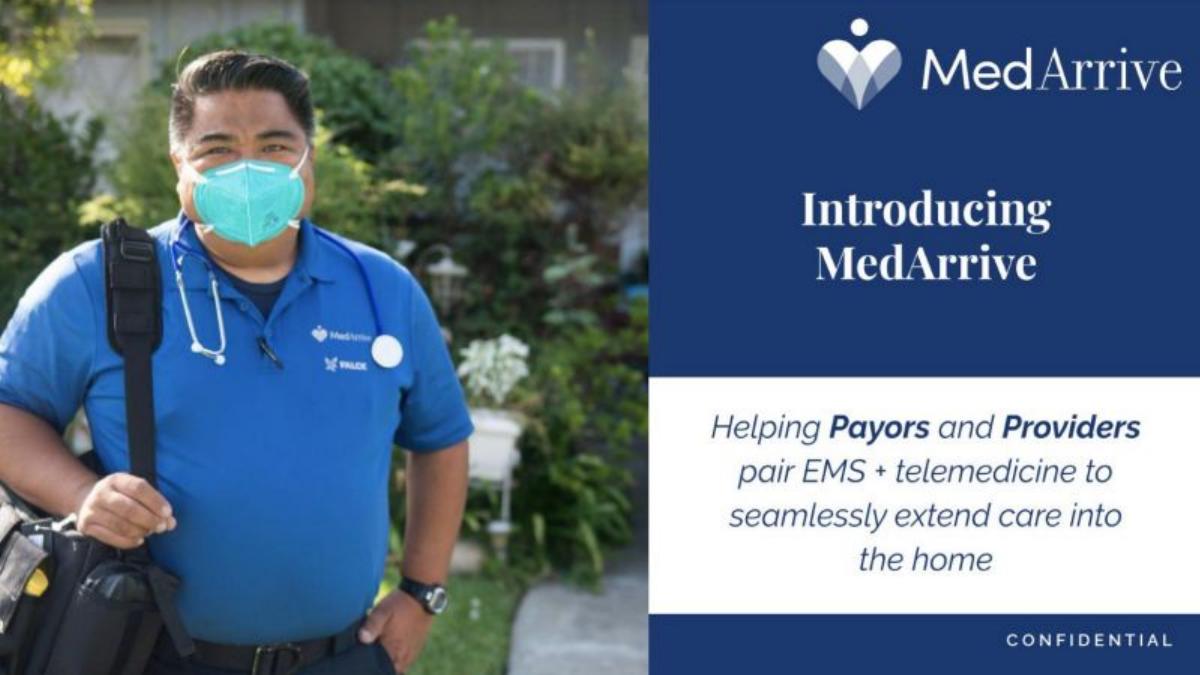
The cover slide introduces MedArrive with a clear, high-level value proposition: 'Helping Payors and Providers pair EMS + telemedicine to seamlessly extend care into the home.' The imagery features a field provider in uniform, immediately grounding the tech platform in physical reality. The use of the word 'Confidential' and the clean, professional branding sets a serious tone for a Series A pitch.
Slide 2: The Human Element
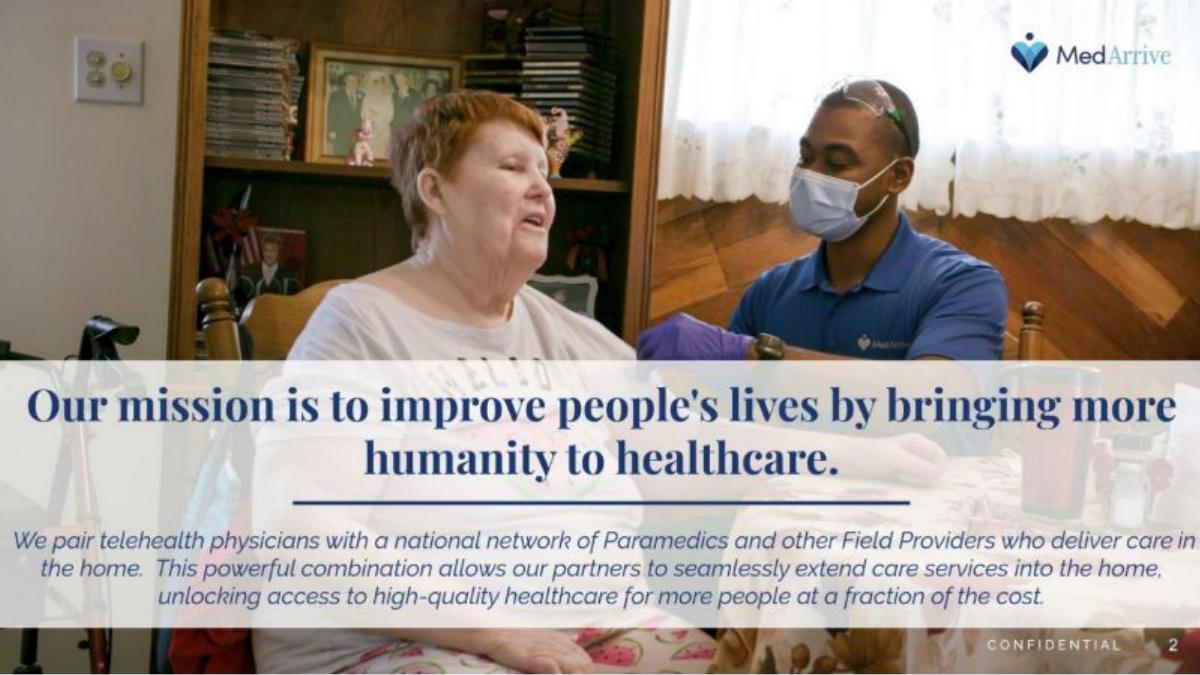
Slide 2 defines the mission: 'to improve people's lives by bringing more humanity to healthcare.' It explains the core mechanism: pairing telehealth physicians with a national network of Paramedics and Field Providers. This slide is crucial because it clarifies that MedArrive isn't just a software company; it's an orchestration layer for physical care delivery.
Slide 3: Validation Through Partnerships
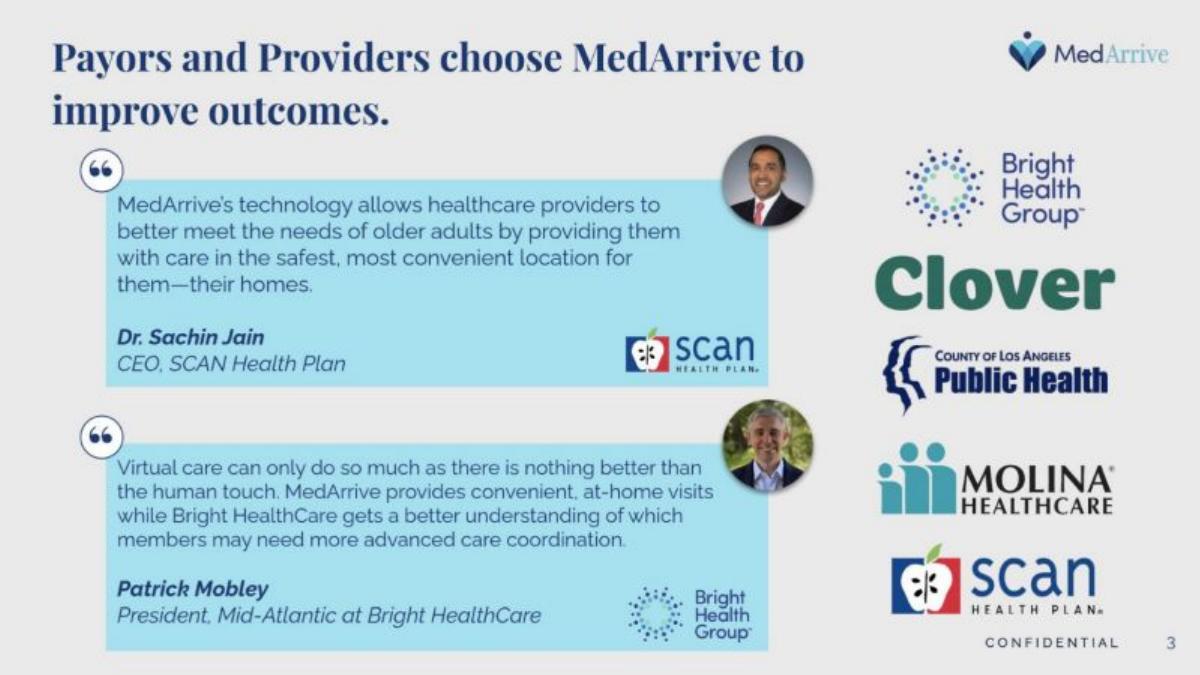
MedArrive leads with social proof. Slide 3 features testimonials from Dr. Sachin Jain (CEO of SCAN Health Plan) and Patrick Mobley (President at Bright Health Group). By showcasing logos like Clover, Molina Healthcare, and LA County Public Health, the company demonstrates that it has already moved past the pilot phase and is integrated with major industry players.
Slide 4 & 5: The Market Opportunity
Slide 4 serves as a transition, stating 'WE NEED BETTER IN-HOME CARE SOLUTIONS.' Slide 5 provides the data to back this up. It highlights a staggering 95% cost savings, comparing the $2,882 daily cost of a hospital stay to the $189 cost of homecare. It also includes a demographic chart showing the 65+ population growing to 94.7 million by 2060 and a market size chart projecting the global home healthcare market to reach $518 billion by 2027 at a 7.9% CAGR.
Slide 6: The 'Why Now'
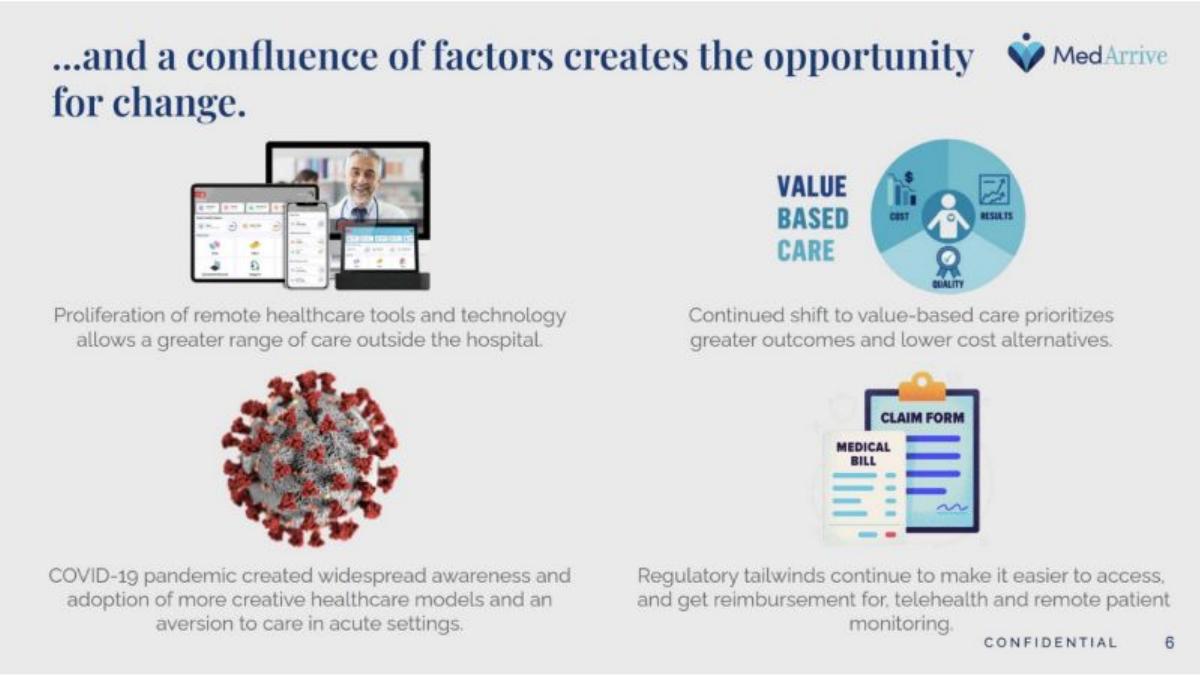
This slide identifies four 'confluence of factors' creating the opportunity: Remote Tech Proliferation , Value-Based Care , COVID-19 Pandemic , and Regulatory Tailwinds . This is a standard but necessary slide for a 2021-era deck, explaining why this specific model is finally viable and necessary.
Slide 7: Defining the Continuum of Care
Slide 7 uses a house graphic to map out where MedArrive fits in the medical landscape. It positions the company in the 'Medical' tier (high physician involvement) but focused on 'Acute/Episodic Care' and 'Chronic/Longitudinal Care.' This helps investors understand that MedArrive is more clinical than a simple home-health aide service but more flexible than a 'Hospital at Home' model.
Slide 8 & 9: The Team
Slide 8 is a transition slide leading into the team bios on Slide 9. The team is a significant strength. CEO Dan Trigub brings experience from Uber Health and Lyft, while COO Inna Plumb comes from Blue Apron and Evercore. The inclusion of a CTO from Optum/Epic and a VP of Clinical Operations from NYU Langone shows a balance of tech-scale expertise and deep clinical roots.
Slide 10: Advisers and Investors
MedArrive lists high-profile advisers with backgrounds in the White House (Obama administration), US Medicaid, and EMS leadership. Below the advisers, the 'Investor Backing' section features heavy hitters: Kleiner Perkins , Define Ventures , Redesign Health , and SCAN Health Plan . This level of institutional support is a strong signal for a Series A round.
Slide 11 & 12: The Three-Sided Marketplace
Slide 11 illustrates the platform as the center of a triangle connecting Patients, Health Providers/Payors, and Field Providers. Slide 12 breaks down the 'Why they need MedArrive' for each group. For Field Providers (EMTs/Paramedics), the value is 'increased labor utilization' and the ability to 'practice at the top of their scope.' This is a key differentiator, as it suggests MedArrive is helping solve the labor shortage/burnout issues in the EMS industry.
Slide 13: Contact Information
A standard 'Thank you' slide with direct contact information for the CEO, COO, and CTO. This signals the end of the core narrative before moving into the appendix/supplemental materials.
Slide 14, 15 & 16: Ride Alongs
The deck concludes with a 'Ride Alongs' section. Slides 15 and 16 provide links to videos of actual visits with SCAN Health Plan and LA County. Slide 15 specifically mentions that 'Over 100 SCAN members and their families have been vaccinated at home.' This provides tangible, visual evidence of the service in action, which is often more persuasive than charts alone.
What MedArrive Does Well
The MedArrive deck excels at ecosystem positioning . It doesn't try to fight the existing healthcare players; it positions itself as the tool that makes them more efficient. By using EMS workers—who are already distributed across the country and often under-utilized between emergency calls—MedArrive presents a solution that feels both innovative and practical. The heavy use of testimonials and logos from payors (the people who actually write the checks in healthcare) is a masterclass in de-risking a Series A investment.
What is Missing from the Deck
Despite its strengths, the deck is light on unit economics and financial projections . There is no mention of the take-rate, the cost of acquisition for new EMS partners, or the specific margins on a per-visit basis. Furthermore, the deck lacks a competitive landscape slide. While the 'Hospital at Home' market is mentioned, there is no direct comparison to other startups in the space. Finally, the Ask is missing; while we know from the catalogue that they raised $25M, the deck itself does not state the amount sought or the milestones they intend to hit with the capital.
Founder's Playbook: What to Copy
The 'Why Now' Slide: MedArrive perfectly captures the specific regulatory and social shifts (COVID, Telehealth reimbursement) that made their business possible in 2021. · Social Proof Early: Don't wait until the end to show your customers. Putting testimonials on Slide 3 forces the investor to view the rest of the deck through the lens of 'this is already working for major players.' · Marketplace Dynamics: If you are a marketplace, clearly define the 'What's in it for them' for every participant, as MedArrive does on Slide 12. · Pedigree Alignment: Notice how the team slide highlights logos like Uber Health and Lyft. This isn't just vanity; it tells a story of 'we have scaled logistics platforms before, and now we are doing it for healthcare.'
Frequently asked questions
- What is MedArrive's primary value proposition?
- MedArrive's value proposition is built on cost reduction and access. By using a network of EMTs and Paramedics to deliver in-home care, they claim to reduce the daily cost of care by approximately 95% compared to a hospital setting. This allows payors to be more proactive about hospitalizations and readmissions while providing patients with safer, more convenient care in their own homes.
- How does MedArrive source its field workforce?
- Unlike many home-health startups that hire staff directly, MedArrive partners with existing EMS (Emergency Medical Services) providers. This allows them to tap into a national network of trained professionals who can deliver care under the guidance of telehealth physicians. This 'labor utilization' strategy helps EMS agencies diversify their revenue streams and maximize their profit.
- Who are the key customers for MedArrive?
- The deck identifies 'Payors and Providers' as the primary customers. Specifically, it lists logos and testimonials from SCAN Health Plan, Bright Health Group, Clover, Molina Healthcare, and the County of Los Angeles Public Health. These organizations use MedArrive to improve patient outcomes and lower the total cost of care for their members.
- What are the main market drivers mentioned in the deck?
- MedArrive cites four major tailwinds: the proliferation of remote healthcare technology, the shift toward value-based care, regulatory changes making telehealth reimbursement easier, and the COVID-19 pandemic, which increased both the adoption of creative healthcare models and patient aversion to acute care settings.
- Is there a specific financial ask in this pitch deck?
- No, the 17-slide deck provided does not include a specific 'Ask' slide detailing the amount of capital being raised or the intended use of funds. It also omits detailed financial projections and unit economics, focusing instead on the team, the market opportunity, and the operational model.