The Akido Labs Series A deck is a masterclass in narrative-driven fundraising for complex infrastructure. Rather than leading with technical API documentation, the company anchors its value proposition in a poignant human story—the 'Jane Doe' case study—to illustrate the catastrophic failures of fragmented data in public health. This emotional hook transition seamlessly into hard traction metrics, including 300% year-over-year growth and presence in over 100 metros. By the time the deck introduces the technical solution, the investor is already convinced of the problem's moral and economic ur…
Key takeaways
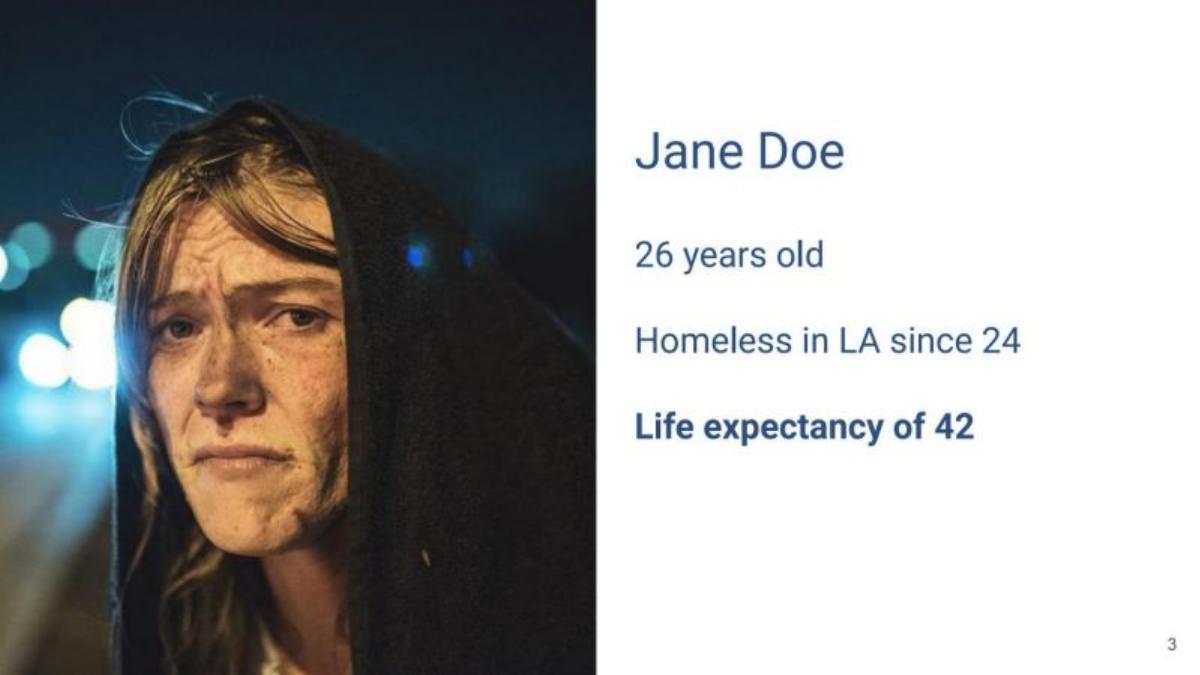
- The deck uses a specific persona, 'Jane Doe,' to humanize the consequences of data silos (Slide 3).
- Akido Labs reports significant scale with presence in 100+ metros and 600+ local services (Slide 8).
- The company claims 300% year-over-year growth, providing strong momentum for a Series A round (Slide 8).
- A case study with Los Angeles County demonstrates a 50x increase in territory coverage for outreach (Slide 10).
- The platform's utility is proven through diverse use cases, from COVID-19 tracking to foster care welfare (Slides 10-11).
- The founding team leverages deep institutional credibility from the University of Southern California D-Health Lab (Slide 12).
- The deck omits traditional financial projections, business model details, and a specific 'ask' slide.
- The problem is framed as data being 'firewalled,' 'fragmented,' and 'non-standard' (Slide 7).
The Narrative Hook: Humanizing Infrastructure
Akido Labs operates in the highly technical world of healthcare APIs and data interoperability. However, their Series A deck avoids the common pitfall of leading with technical specifications. Instead, it leads with a moral imperative. By the time an investor reaches the technical solution, they have been walked through a tragic, preventable human outcome. This teardown examines how Akido Labs used this narrative to secure a $25 million Series A.
Slides 1-2: The Vision and the Stakes
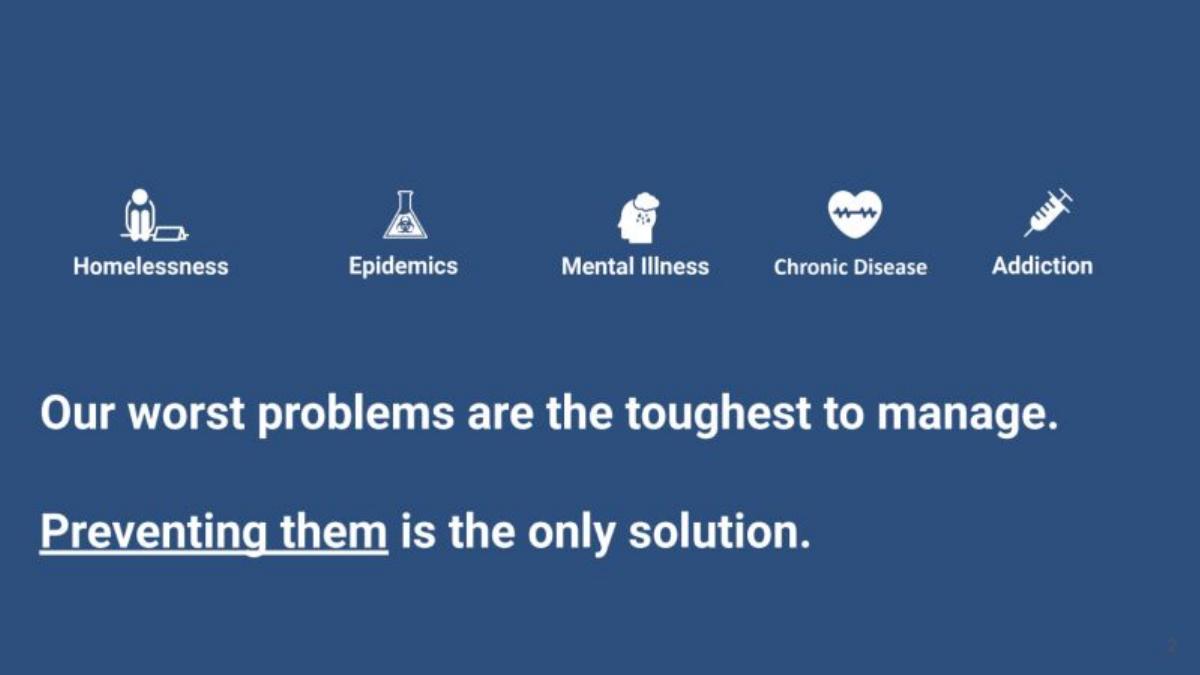
Slide 1 is a standard title card, identifying Prashant Samant as the CEO. It is clean and professional, using a 'Confidential' watermark to establish a sense of exclusivity. Slide 2 immediately sets the stage by listing five of society's most difficult challenges: Homelessness, Epidemics, Mental Illness, Chronic Disease, and Addiction. The slide's core thesis is stated clearly: 'Preventing them is the only solution.' This moves the conversation from 'data management' to 'crisis prevention.'
Slides 3-5: The Story of Jane Doe
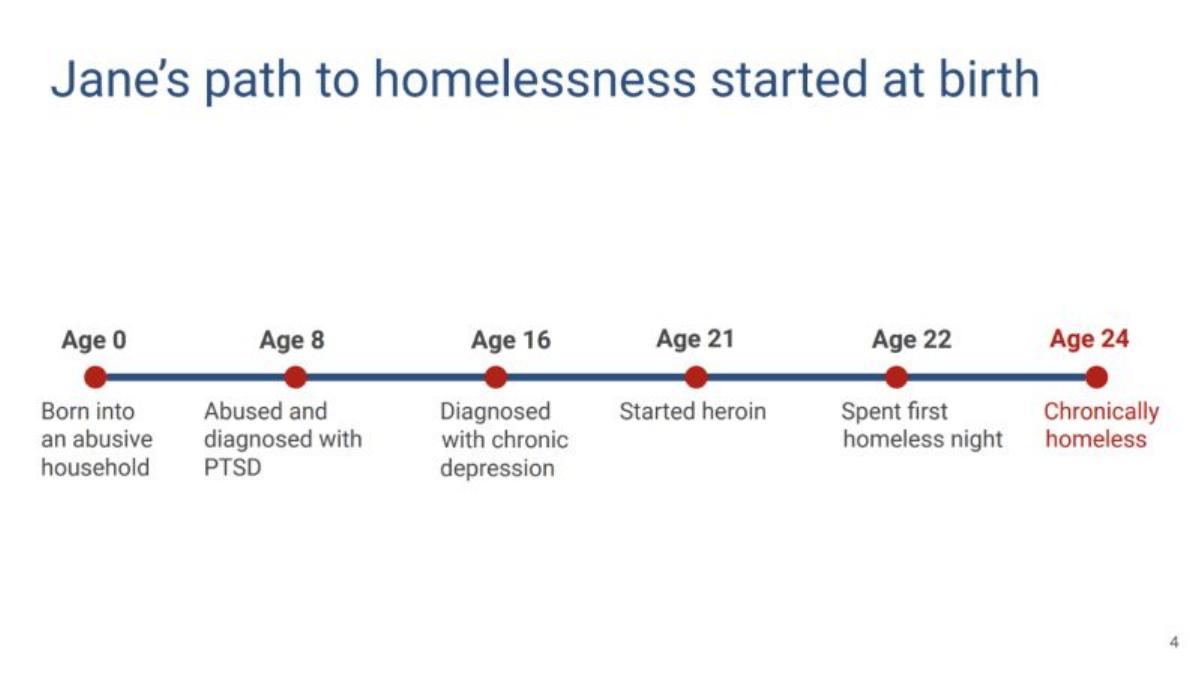
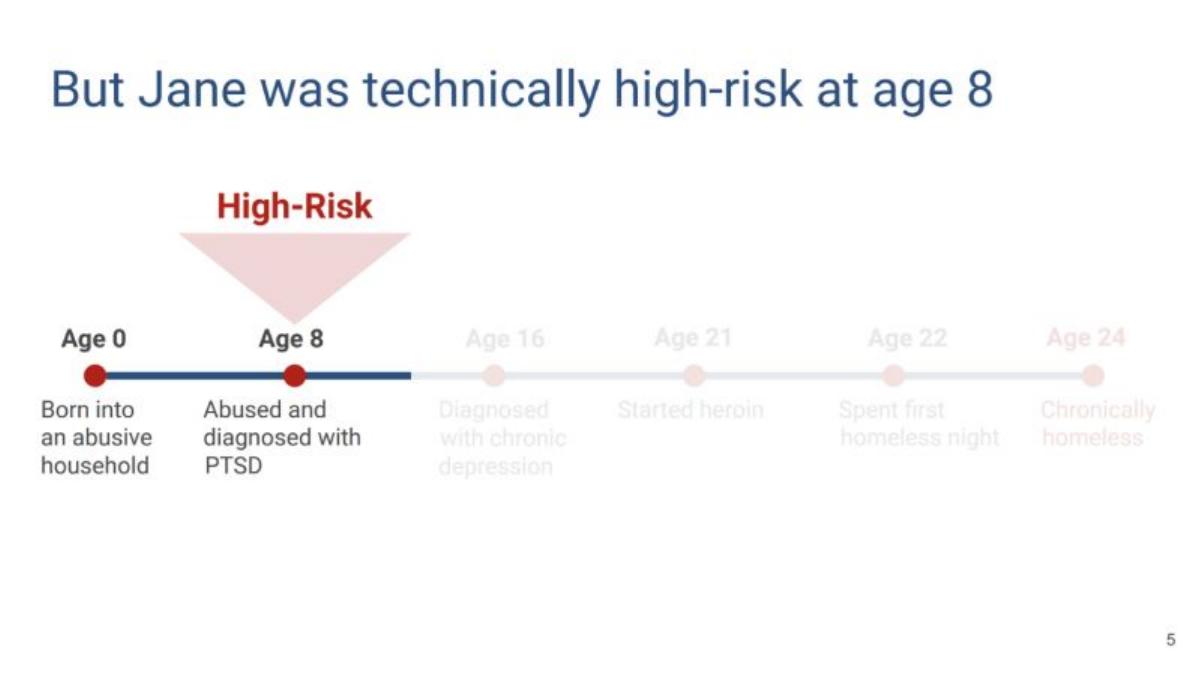
This section is the emotional heart of the deck. Slide 3 introduces 'Jane Doe,' a 26-year-old homeless woman in LA with a life expectancy of only 42. Slide 4 provides a timeline of her life, showing a path from an abusive household at age 0 to chronic homelessness at age 24. Slide 5 delivers the 'aha' moment for the investor: Jane was technically 'high-risk' at age 8. The implication is that if the right data had been shared between the right agencies at age 8, the outcome at age 24 could have been avoided. This frames data silos not as an IT problem, but as a life-and-death social failure.
Slides 6-7: The Barrier to Solution
Slide 6 addresses a common investor objection: 'Won't A.I. Solve This?' The answer provided is 'Not Yet...' This creates a bridge to Slide 7 , which defines the actual problem. The deck argues that AI cannot work because the data is 'Firewalled & behind red tape,' 'Fragmented across silos,' and 'Non-standard.' This slide identifies the 'enemy'—outdated municipal and healthcare silos—that Akido Labs intends to dismantle.
Slides 8-9: Traction and the Platform
Having established the problem, Slide 8 shifts to hard evidence. Akido Labs claims a presence in 100+ Metros, 600+ Local services, and a 300% YoY growth rate. The map visualization shows a dense concentration of dots across the United States, suggesting significant market penetration. Slide 9 finally introduces the 'Akido Platform.' It is depicted as a central hub that ingests data from Healthcare Services, NGOs, and Municipal Services to feed into local and national programs. This is the first time the 'product' is actually shown, and it is presented as the solution to the fragmentation described on Slide 7.
Slides 10-11: Case Studies and Versatility
Slide 10 provides a deep dive into their work with Los Angeles County. It lists specific goals (scaling testing and vaccination for the homeless) and outcomes, including 12,000+ vaccinations and 30,000+ tests. Most impressively, it claims a '50x increase in territory coverage.' Slide 11 demonstrates that the platform is not a one-trick pony. It lists partnerships with the City of Santa Monica (homelessness), Polaris (disabilities), and QPI (foster care). This proves the platform's versatility across different sectors of public health and social welfare.
Slide 12: The Team
The deck concludes its narrative with Slide 12 , highlighting the founders' pedigree. By stating they are the 'creators of the University of Southern California D-Health Lab,' they establish immediate domain expertise. The inclusion of logos like Keck Medicine of USC and Adventist Health provides third-party validation of their institutional ties. This slide reassures investors that the team has the deep-rooted connections necessary to navigate the 'red tape' mentioned earlier in the deck.
What Akido Labs Does Well
The most striking element of this deck is its narrative arc . It follows a classic storytelling structure: the stakes (Slide 2), the victim (Slide 3), the missed opportunity (Slide 5), the villain/obstacle (Slide 7), and the hero/solution (Slide 9). For an infrastructure company, this is an incredibly effective way to build urgency. Most API companies fail because they sell 'pipes'; Akido Labs sells the 'water' that saves lives.
Furthermore, the traction metrics on Slide 8 are presented with high density. Using '100+ Metros' and '600+ Local Services' suggests that the company has already moved past the pilot stage and is into the scaling phase. This is critical for a Series A pitch where investors are looking for proof of product-market fit.
What is Missing from the Deck
Despite its narrative strength, the deck is missing several components that are usually mandatory for a Series A round:
Business Model: There is no mention of how Akido Labs makes money. Are they a SaaS platform with per-user fees? Do they charge per data integration? Is it a volume-based model? This is a significant omission for a $25M round. · Competition: The deck ignores the competitive landscape. Large players like Palantir or specialized healthcare integrators like Redox are not mentioned. Investors generally want to see how a startup differentiates itself from incumbents. · Financial Projections: There are no charts showing revenue growth, burn rate, or future projections. While '300% YoY growth' is mentioned, it lacks the context of actual dollar amounts. · The Ask: The deck does not state how much capital is being raised or how it will be used. While this information is often shared in a separate document or during the meeting, its absence in the deck makes the presentation feel more like a 'company overview' than a 'fundraising pitch.'
What Founders Should Copy
Founders building 'boring' back-end infrastructure should copy the 'Jane Doe' approach . If your software makes a process 20% more efficient, find the person whose life is 20% better because of that efficiency and tell their story first. This creates an emotional connection that technical diagrams cannot achieve.
Additionally, the Case Study format on Slide 10 is excellent. It breaks down the 'Goal,' 'Implementation,' and 'Outcomes' into clear bullet points. Using a '50x increase' metric is far more memorable than saying 'we improved coverage.' Founders should always look for that one 'power metric' that illustrates a massive leap in performance rather than incremental improvement.
Finally, the clean aesthetic of the deck is worth emulating. It uses a limited color palette (mostly blues and greys), plenty of white space, and high-quality iconography. This gives the impression of a mature, stable company, which is exactly what healthcare and municipal partners look for in a data provider.
Conclusion
The Akido Labs deck is a sophisticated piece of marketing that successfully bridges the gap between social impact and technical infrastructure. While it leaves many financial and competitive questions unanswered, it excels at creating a 'must-solve' problem in the mind of the investor. For a $25 million round, the goal of the deck is often to secure the second meeting where the missing details (financials, business model) can be discussed in depth. In that regard, this deck is a highly effective door-opener.
Frequently asked questions
- What is the core product of Akido Labs according to the deck?
- While the deck focuses heavily on outcomes, the catalogue facts and Slide 9 describe the Akido Platform as a secure data-sharing layer. It acts as a standardized API that pulls data from healthcare, non-profit, and municipal services to power local and national public health programs. It essentially solves the 'red tape' and 'fragmentation' of outdated healthcare silos.
- How does Akido Labs demonstrate market traction?
- Traction is presented on Slide 8 through three key metrics: presence in over 100 metropolitan areas, integration with more than 600 local services, and a 300% year-over-year growth rate. This is further supported by specific partnerships with high-profile entities like Los Angeles County and the City of Santa Monica.
- What is the 'Jane Doe' narrative and why is it used?
- The 'Jane Doe' narrative (Slides 3-5) is a storytelling device used to illustrate how a lack of data intervention leads to chronic homelessness. By showing that a person can be identified as 'high-risk' at age 8 but fall through the cracks until age 24, Akido Labs argues that their data platform is a preventative necessity rather than just a technical convenience.
- Who are the founders and what is their background?
- As shown on Slide 12, the company was founded by Prashant Samant (CEO) and Jared Goodner (CTO), who were the creators of the University of Southern California (USC) D-Health Lab. The team also includes Sanjit Mahanti as Head of Business Development. Their background suggests a strong foundation in academic and clinical health-tech innovation.
- What is missing from this pitch deck?
- The deck is notably missing several standard venture components: a detailed business model (how they charge), a competitive landscape analysis, 3-5 year financial projections, and a specific 'Ask' slide detailing how much they are raising and the intended use of funds. It functions more as a vision and traction overview than a complete financial prospectus.