Ajinomatrix is a food technology startup aiming to digitize taste and smell, though the provided slides focus more on operational theory than technical specifications. The deck leans heavily on the company's pedigree within the Founder Institute and Y Combinator’s Startup School as a proxy for traction. A significant portion of the presentation is dedicated to 'Believable Projections' and a detailed LTV calculation that assumes a 1-year customer lifetime and specific production costs for a Proof of Concept. While it identifies five parallel markets and associated risks, the deck suffers from…
Key takeaways
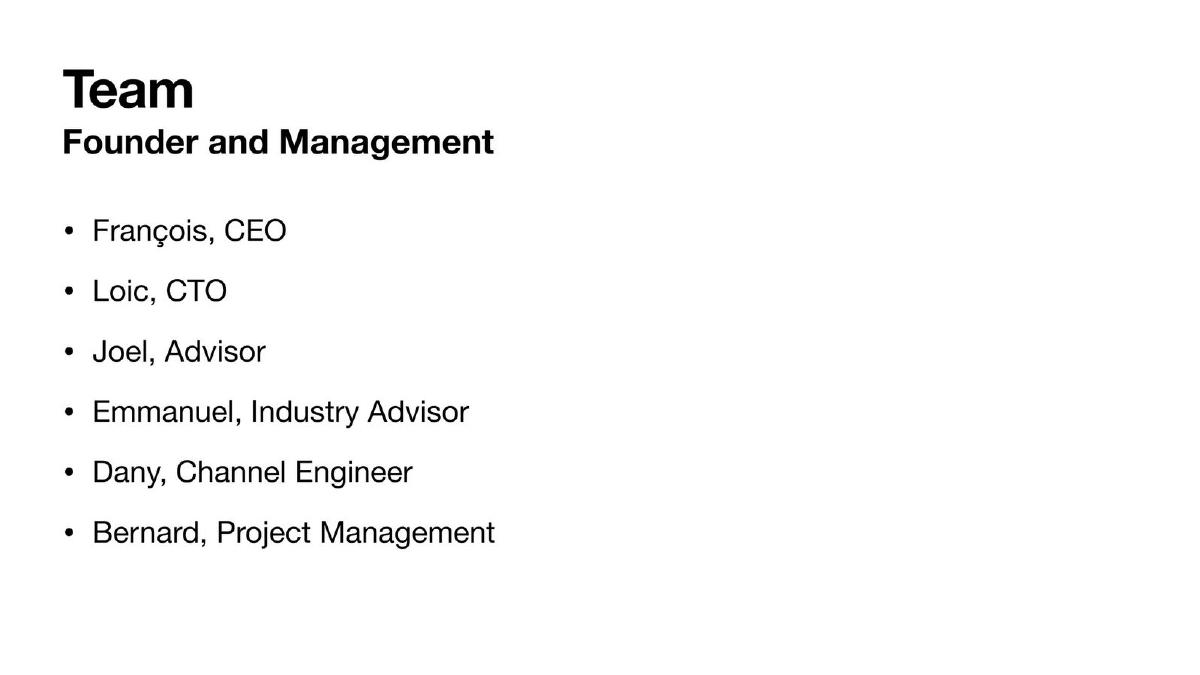
- The team consists of six members, including a CEO, CTO, and two advisors, but lacks professional biographies or past company success metrics (Slide 2).
- Traction is primarily defined by the completion of accelerator programs like Startup School by Y Combinator and Founder Institute (Slide 5).
- Financial projections are based on an LTV calculation of 56,250€, derived from 91,250€ in gross sales minus 35,000€ in PoC production costs (Slide 6).
- The company identifies a 'Risk that the product not being properly developed to the client’s specs' as a primary market risk (Slide 7).
- Product milestones are clearly staged, with a goal to reach 50 customers by month 17 of operations (Slide 8).
- The deck claims a 90% conversion rate on presentations, though the context for this metric is not fully defined (Slide 9).
- Marketing strategy relies on a US-based agency, Ink&Key, for SEO and content-based solutions (Slide 10).
- There is no mention of a specific funding 'ask' or valuation in the provided slides.
Slide-by-Slide Teardown
Slide 1: Title and Contact
The cover slide features a high-resolution image of avocados and limes, establishing a clear connection to the food industry. It includes the CEO's email and a Belgian phone number (+32). The subtitle '15’ reading' suggests this is a long-form deck intended for deep review rather than a quick pitch. The branding is minimal, using a bold sans-serif font for the company name, Ajinomatrix.
Slide 2: Team
The team slide lists six individuals: François (CEO), Loic (CTO), Joel (Advisor), Emmanuel (Industry Advisor), Dany (Channel Engineer), and Bernard (Project Management). This slide is notably thin on detail. There are no headshots, no last names for most members, and no mention of prior experience or education. In a professional fundraising context, this lack of 'social proof' or pedigree is a significant weakness.
Slide 3: Market Opportunity
This slide is largely decorative, featuring an overhead shot of food preparation. The text is limited to three keywords: 'Scaling / Platform / Adressablility' (sic). It fails to define the Total Addressable Market (TAM), Serviceable Addressable Market (SAM), or the specific pain point the company is solving. The misspelling of 'addressability' is a minor but noticeable editorial oversight.
Slide 4: Positive Early Traction
Continuing the food-centric imagery with a green smoothie, this slide lists 'MVP / Pilots / Partnerships / Programs' as areas of traction. However, it provides no specific names of partners or results from pilots. It serves more as a category header than a data-driven traction slide.
Slide 5: Traction - Completed Programs
This slide provides the most concrete evidence of the company's progress to date. It highlights their status as alumni of the Founder Institute and their participation in Startup School by Y Combinator. It also mentions 'WSL For techno-entrepreneurs' as being in 'pre-follow-up.' This suggests the founders have undergone significant entrepreneurial training, which adds a layer of credibility to their operational structure.
Slide 6: Financials - Lifetime Customer Value
Slide 6 attempts a deep dive into unit economics. The calculation presented is: 30,417€ (average sales/month) x 3 products x 1 year lifetime = 91,250€. They then subtract 35,000€ in 'production costs for PoC' to reach a final LTV of 56,250€. The slide also includes a table comparing CAC (Customer Acquisition Cost) at different scales (X1, X1.5, X2) against the LTV. While the math is transparent, the assumption of a 1-year lifetime for a B2B product and the inclusion of PoC costs in an LTV calculation are unconventional.
Slide 7: Risk Management
This is a rare inclusion in a pitch deck. The founders list six market risks, including the fear that five parallel markets might share risks and the possibility of the product not meeting client specs. While honesty is generally appreciated, listing 'Risk of the client not properly using the product' without a corresponding mitigation strategy might give investors pause regarding the product's usability or complexity.
Slide 8: Product Milestones
The roadmap is divided into four stages. Milestone 1 is the PoC with a pilot producer. Milestone 2 targets 10 suppliers within 3 months. Milestone 3 involves the 'complete solution' including licensing and an e-market. Milestone 4 aims for 50 customers by month 17. This provides a clear timeline for execution, though it remains unclear if Milestone 1 has already been achieved.
Slide 9: Credibility and Projections
The slide claims their projections are 'well built' and 'within the framework of FI' (Founder Institute). It mentions a '90% conversion rate on presentation.' This is a bold claim that lacks context—does it mean 90% of people who see the deck invest, or 90% of sales leads convert? Without clarification, such high percentages can appear unrealistic to seasoned analysts.
Slide 10: Marketing Strategy
The final slide in this set focuses on content marketing. It names a specific US agency, Ink&Key, that is handling their SEO and narrative. It acknowledges the need to develop an 'entry funnel' on the website. This shows a tactical understanding of digital lead generation, though it is focused entirely on inbound marketing rather than direct B2B sales efforts.
What Ajinomatrix Does Well
Transparency in Risk: Most founders attempt to hide potential pitfalls. Ajinomatrix dedicated an entire slide to market risks. This level of self-awareness can be a signal of a mature management team that is prepared for the 'trough of sorrow' that follows initial product launches.
Structured Roadmap: The product milestones on Slide 8 are specific and time-bound. By setting a goal of 50 customers by month 17, the founders give investors a clear metric by which to measure future success. This is much more effective than vague statements about 'global expansion.'
Accelerator Pedigree: Leveraging the logos of Y Combinator and Founder Institute is a smart move for a team that may not have a long list of previous exits. It signals that the business model has been vetted by external mentors and follows a standardized startup methodology.
What is Missing from the Ajinomatrix Deck
The 'How' of the Technology: After ten slides, it is still not entirely clear what the product actually is. Is it a sensor? A software platform? A chemical analysis tool? The deck relies on food photography to set the mood but fails to show a single screenshot of the software or a photo of the hardware.
Competitive Landscape: There is no mention of competitors. In the food-tech and digitization space, there are numerous incumbents and well-funded startups. Investors need to know why Ajinomatrix’s approach to 'digitization' is superior to existing laboratory or sensory analysis methods.
The Ask: The most significant omission is the funding request. The deck does not state how much money the company is looking to raise, what the valuation expectations are, or how the funds will be allocated across the four milestones mentioned on Slide 8.
Detailed Team Bios: Listing first names only is insufficient. Investors invest in people first, especially at the seed stage. The lack of last names and professional history makes it impossible for an analyst to perform basic due diligence on the team's ability to execute the plan.
Founder's Guide: What to Copy and What to Avoid
Copy the Milestone Format: Slide 8 is a great template for a roadmap. It breaks down the journey from PoC to a specific customer count (50) within a specific timeframe (1.5 years). This allows investors to visualize the growth trajectory clearly.
Avoid the 'Vague Traction' Slide: Slide 4 is a 'filler' slide. It lists categories of traction without providing data. If you have pilots, name the companies. If you have an MVP, show a screenshot. Never use a slide just to say you have 'positive early traction' without proving it immediately.
Refine Your LTV Presentation: While the math on Slide 6 is clear, mixing PoC production costs into an LTV calculation is confusing. Founders should keep unit economics (LTV/CAC) separate from one-time R&D or PoC expenses. LTV should represent the recurring value of a customer once the product is in a steady state.
Include a Clear 'Ask': Every investor deck must end with a clear call to action. Tell the investor exactly what you need to reach the next milestone. Without an 'Ask' slide, the deck is a presentation, not a pitch.
Frequently asked questions
- What is the core technology behind Ajinomatrix?
- The provided slides do not explicitly describe the underlying technology. While the imagery suggests food preparation and green smoothies, the text focuses on 'digitization' and 'parallel markets.' It appears to be a software or sensor-based platform for the food industry, but the specific mechanism for digitizing taste or smell is omitted from this shortened version of the deck.
- How does the company calculate its Lifetime Value (LTV)?
- On Slide 6, Ajinomatrix calculates LTV by taking average sales of 30,417€ per month, multiplying by 3 products, and assuming a 1-year lifetime to reach 91,250€. They then subtract 35,000€ in production costs for the Proof of Concept (PoC) to arrive at a 'final' LTV of 56,250€. This is a non-standard way to present LTV, as it mixes gross revenue with specific PoC costs.
- What stage is the company currently in?
- The company is in the pre-revenue or very early pilot stage. Slide 8 notes that their 'first milestone is to manage the PoC with a pilot producer' and their second is to reach 10 suppliers within 3 months. As of the deck's date, they are likely still refining the MVP based on their 'Completed Programs' status.
- Who are the key people involved in Ajinomatrix?
- The team slide (Slide 2) lists François as CEO, Loic as CTO, and Dany as Channel Engineer. They are supported by two advisors, Joel and Emmanuel, and a project manager named Bernard. No last names (except for the CEO on the cover) or professional backgrounds are provided, which is a significant omission for a seed-stage pitch.
- What are the biggest risks identified by the founders?
- Slide 7 is dedicated to 'Market Risks.' The founders are concerned about managing five parallel markets simultaneously, the risk of the product not meeting client specifications, and the potential for clients to use the product incorrectly. They also highlight the challenge of managing a 'formula/recipe Bank' for marketing purposes.