Aladino is a cryptocurrency mining venture that aims to democratize access to mining hardware through the sale of NFTs representing hash rate. The company's core value proposition, as stated on slide 01, is to 'Mine Alts, SAVE IN BTC.' The business model relies heavily on a multi-tier affiliate structure, detailed on slide 09, which incentivizes members to sell NFTs and build sales organizations. The deck frames the current market 'bad news'—specifically the Bitcoin halving and rising costs—as an opportunity to follow the investment strategies of large funds by installing $100 million worth o…
Key takeaways
- The company's primary slogan is 'Mine Alts, SAVE IN BTC,' suggesting a strategy of mining alternative coins and converting them to Bitcoin (Slide 01).
- Aladino identifies the 2024 Bitcoin halving as a threat to traditional miners, noting that a BTC price of $98,000 may be needed for publicly-listed companies to remain profitable (Slide 03).
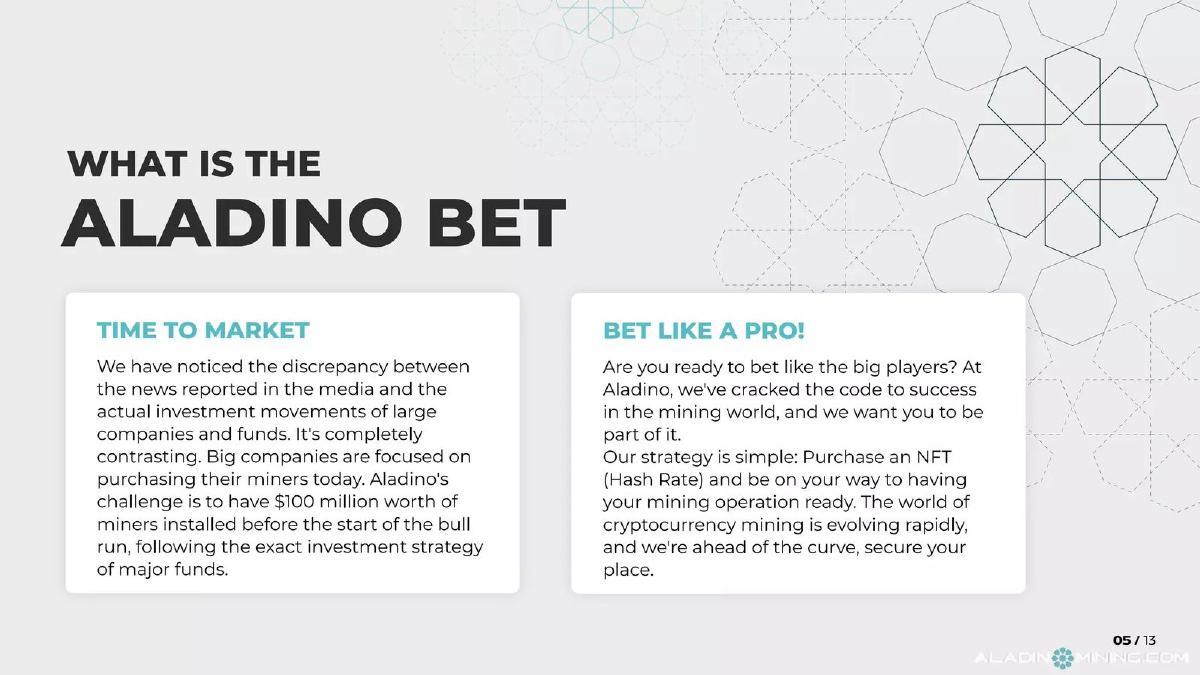
- The 'Aladino Bet' involves installing $100 million worth of mining hardware before the start of the next bull market (Slide 05).
- The business model utilizes an 'automatic autoshipping' system where NFT purchases fund mining operations that feed into a swapping layer (Slide 07).
- The affiliate plan is highly complex, featuring 8 ranks and 16 levels of commission, with 'Rank Advance Bonuses' ranging from 100 USDT to 80,000 USDT (Slide 09).
- The leadership team consists of Michele Domizi (CEO), Michele Pelagagge (COO), and Paolo Musumeci (CFO), though their professional histories are described in informal, narrative terms (Slide 11).
- The deck includes a prominent 'Earnings and Income Disclaimer,' stating there is no guarantee that users will achieve specific income levels (Slide 13).
- A significant portion of the deck is dedicated to the affiliate compensation structure rather than the technical specifications of the mining hardware or data centers (Slide 09).
Executive Summary and Value Proposition
Slide 1: Title Slide
The deck opens with the company name, ALADINO , and a clear subtitle: "Mine Alts, SAVE IN BTC." The visual design uses a geometric, Islamic-inspired pattern. The slide establishes the core premise: the company focuses on mining alternative cryptocurrencies but delivering the value to the user in Bitcoin. A website URL, aladinomining.com, is provided in the corner.
Slide 3: Mining Market Bad News
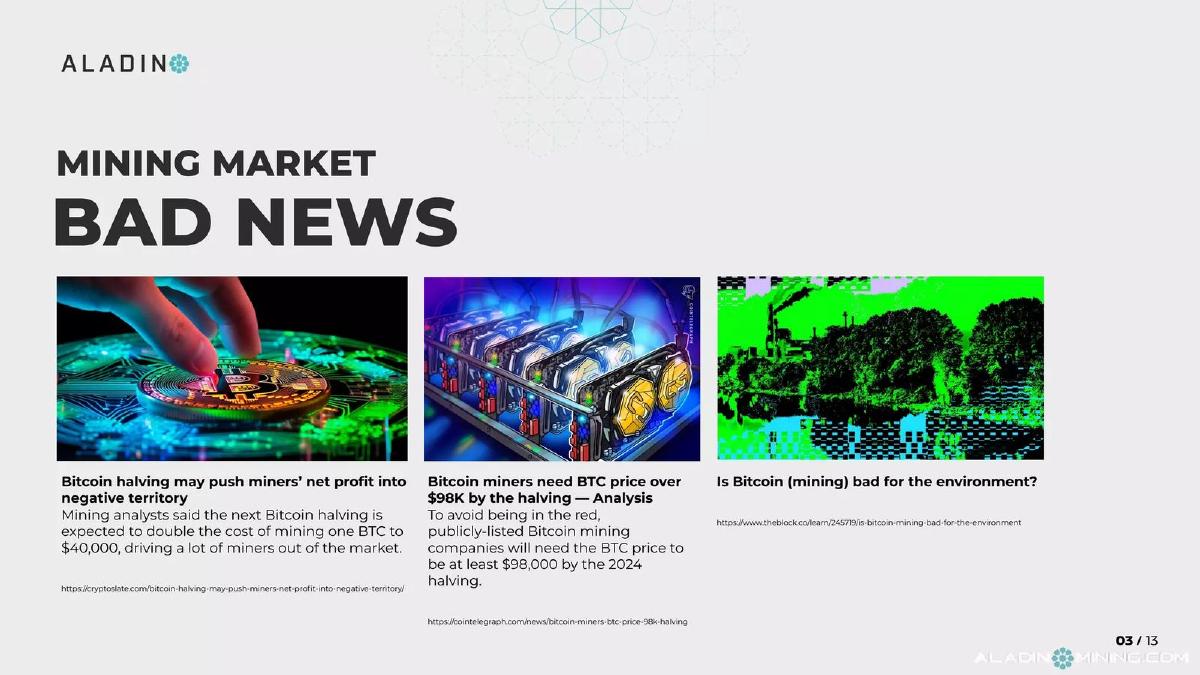
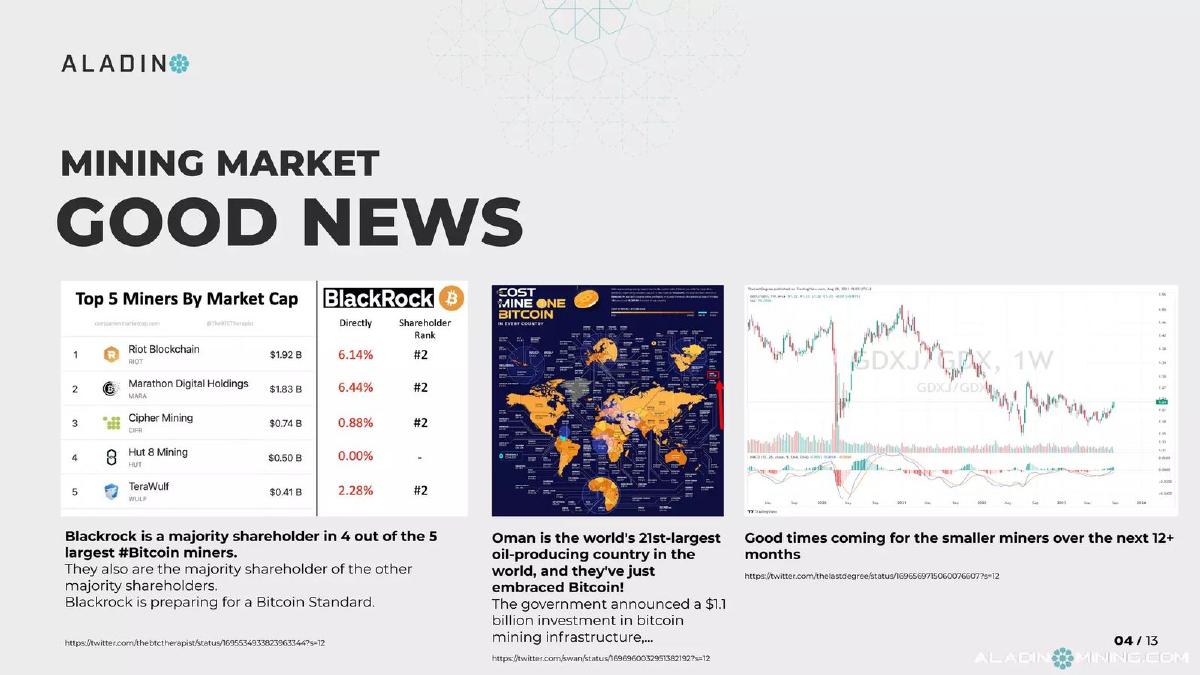
This slide serves as the 'Problem' slide, though it is framed as 'Bad News.' It cites three external sources to highlight market pressures: CryptoSlate , Cointelegraph , and The Block . The key points are that the Bitcoin halving may push miners' net profit into negative territory, with costs to mine one BTC potentially doubling to $40,000 . It also notes that publicly-listed companies might need a BTC price of $98,000 to stay profitable after the 2024 halving. Finally, it touches on the environmental concerns surrounding Bitcoin mining. By highlighting these pressures, Aladino sets the stage for a solution that avoids the low-margin trap of direct BTC mining.
Slide 5: What is the Aladino Bet
Aladino positions its strategy as a 'bet' aligned with institutional players. The slide is divided into two sections: Time to Market and Bet Like a Pro! . The company claims to have noticed a discrepancy between media reports and the actual movements of large funds. Their stated challenge is to have $100 million worth of miners installed before the start of the bull run. The mechanism for participation is the purchase of an NFT (Hash Rate) . The slide promises that this strategy allows retail users to follow the 'exact investment strategy of major funds.'
Slide 7: Business Model
This slide provides a flow chart of the Aladino ecosystem. It describes the system as the "first 'automatic autoshipping' in the industry." The process begins with the NFT , which leads to Mining . The mining activity generates Altcoins , which are then processed through a Swapping Layer to become Bitcoin . This Bitcoin is then distributed as Mining Reward (MR) and Mining Reward Bonus (MRB) . There is also a side-path for Affiliates (CV) . A note at the bottom states that 'Miner's computers now meet the monthly minimum industry requirements,' suggesting a shift from previous affiliate requirements.
Slide 9: Affiliate Plan
This is the most data-dense slide in the deck, outlining a Multi-Level Marketing (MLM) style compensation structure. It features 8 ranks. Requirements for these ranks include a Personal NFT purchase (from 25 USDT at Rank 1 to 50,000 USDT at Rank 8) and Group Volume (CV) (up to 2,000,000 CV at Rank 8). The plan pays out commissions across 16 levels, with Level 1 offering 10% and Level 2 offering 5%. Higher ranks unlock 'Infinity Bonuses' (up to 10% from level 17 onwards) and 'Rank Advance Bonuses' that peak at 80,000 USDT . The slide defines 1 CV as equal to 1 USDT.
Slide 11: Team Aladino
The team slide introduces three executives. Michele Domizi (CEO) is described with a personal narrative about motorcycles and sports, noting he is 'not a big fan of the social scene.' Michele Pelagagge (COO) is credited with marketing, sales, and administrative experience, with a focus on 'conscious business.' Paolo Musumeci (CFO) is identified as a former certified public accountant and tax consultant who moved into crypto mining to 'make people happy.' The descriptions are more biographical and philosophical than a traditional list of past corporate achievements or exits.
Slide 13: Welcome and Disclaimer
The final slide repeats the 'Mine Alts, SAVE IN BTC' slogan and adds a significant Earnings and Income Disclaimer . It explicitly states that 'there is no guarantee that you will make these levels of income' and that 'results may vary' based on individual capacity and business experience. It warns of 'unknown risks in business and on the internet' and concludes by stating the company is not responsible for the user's actions. This slide is labeled 'V. 2.4' in the bottom right corner.
What Aladino Does Well
The deck is visually consistent and uses a clean, professional color palette. The value proposition is very easy to understand: buy an NFT to get mining rewards in Bitcoin. By focusing on the 'Bad News' of the Bitcoin halving, the founders successfully create a sense of urgency and a 'why now' narrative. The business model flow chart on slide 07 is a helpful visual aid for understanding how the company intends to bridge the gap between mining altcoins and paying out in BTC. Furthermore, the affiliate plan on slide 09 is extremely detailed, leaving no ambiguity for potential recruiters about how they will be compensated for growing the network.
What is Missing from the Aladino Deck
From a traditional venture capital perspective, this deck is missing several critical components. First, there is no technical specification for the mining hardware. A $100 million deployment requires significant infrastructure, power agreements, and cooling solutions, none of which are mentioned. Second, the 'Swapping Layer' is treated as a black box; there is no explanation of the fees, slippage, or platforms used to convert altcoins to BTC. Third, the Team slide lacks professional pedigree; while the individuals may be capable, the deck does not list specific former companies, years of experience in the mining sector, or previous successful ventures. Finally, there is no 'Ask' slide . It is unclear if the company is seeking equity investment, or if the deck is simply a marketing tool to sell NFTs and recruit affiliates.
What Other Founders Can Copy
Founders can learn from the way Aladino uses external validation on slide 03. By citing reputable news sources like Cointelegraph and The Block, they ground their 'Problem' slide in industry-wide consensus rather than just their own opinion. The clear slogan ('Mine Alts, Save in BTC') is also a strong example of how to distill a complex technical process into a five-word benefit for the end-user. Additionally, the use of a detailed disclaimer on the final slide is a necessary practice for any startup operating in the highly regulated and volatile cryptocurrency space, as it manages expectations and provides a layer of legal protection.
Final Analyst Thoughts
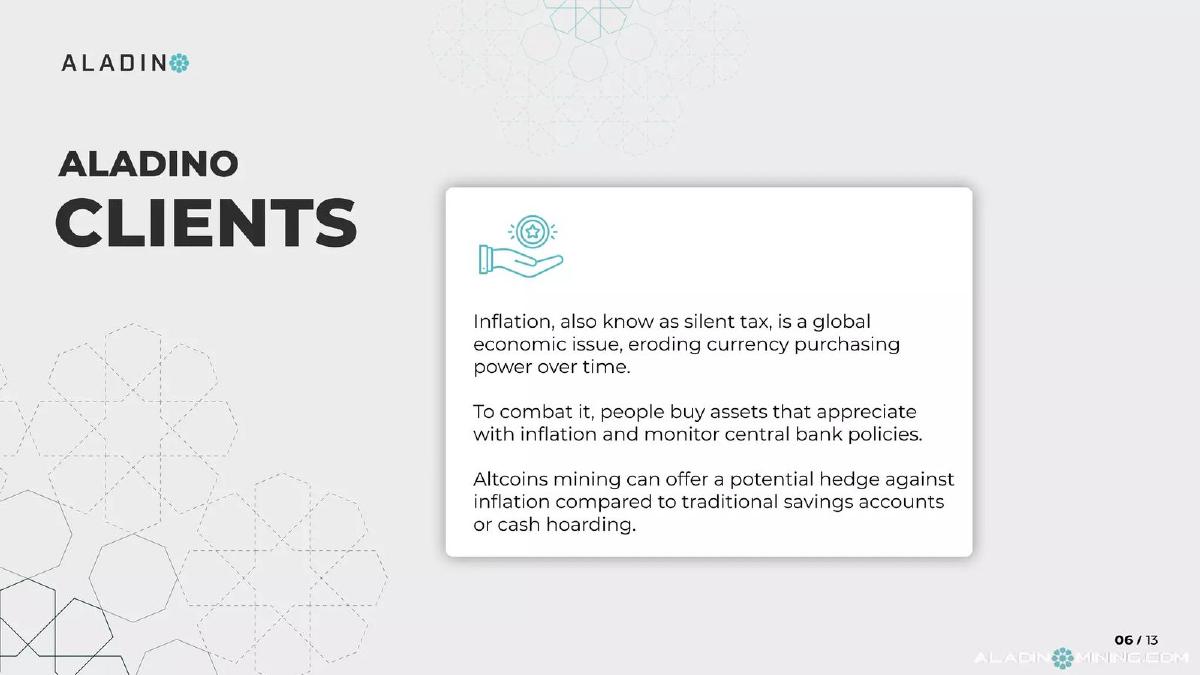
The Aladino deck is less a fundraising tool for equity and more a sales and recruitment manual for a mining-based affiliate network. The heavy emphasis on the 16-level commission structure suggests that user acquisition is the primary engine of the business. While the 'Aladino Bet' of $100 million in hardware is ambitious, the lack of operational detail regarding data centers, electricity costs, or hardware procurement makes it difficult to assess the feasibility of the mining operation itself. Investors would likely require a much deeper dive into the unit economics of the mining rewards versus the high payouts promised in the affiliate plan to ensure the model is sustainable long-term.
Frequently asked questions
- What is the core product Aladino is selling?
- Aladino sells NFTs that represent 'Hash Rate' or mining power. According to slide 05, the strategy is for users to purchase an NFT to have their mining operation ready. These NFTs fund the purchase and installation of physical mining hardware, allowing users to participate in the rewards of mining without managing the hardware themselves.
- How does the 'Mine Alts, Save in BTC' strategy work?
- Slide 07 illustrates a flow where 'Mining' produces 'Altcoins.' These altcoins are then passed through a 'Swapping Layer' which converts them into 'Bitcoin.' The rewards are then distributed as 'Mining Reward (MR)' and 'Mining Reward Bonus (MRB)' to the NFT holders and affiliate members.
- What are the requirements to move up the affiliate ranks?
- Slide 09 details three main requirements: Personal NFT value (ranging from 25 USDT to 50k USDT), Group Volume (CV) from the entire organization, and a 'Max Volume in 1 Leg' rule (typically 60%) to ensure balanced recruitment across the affiliate's network.
- Who are the founders of Aladino?
- The team includes CEO Michele Domizi, who mentions a background in sports and a 'soft spot for motorcycles'; COO Michele Pelagagge, who claims experience in marketing, sales, and administrative operations; and CFO Paolo Musumeci, a former certified public accountant and tax consultant (Slide 11).
- What is the stated goal for Aladino's hardware deployment?
- As stated on slide 05, Aladino's specific challenge and goal is to have $100 million worth of miners installed before the start of the next cryptocurrency bull run, mimicking the investment strategies they attribute to major funds.