Double's 2021 Series A deck is a masterclass in product-led service positioning. By framing their executive assistant (EA) service as a 'platform for executive efficiency' rather than a traditional staffing agency, Double justifies a tech-enabled valuation. The deck relies heavily on the quality of their human capital, noting that only 0.5% of applicants are accepted, while simultaneously showcasing a robust software suite including task management, 1-tap delegation, and weekly digests. With 600+ customers and 200+ assistants at the time of the raise, the traction was clear. The presentation…
Key takeaways
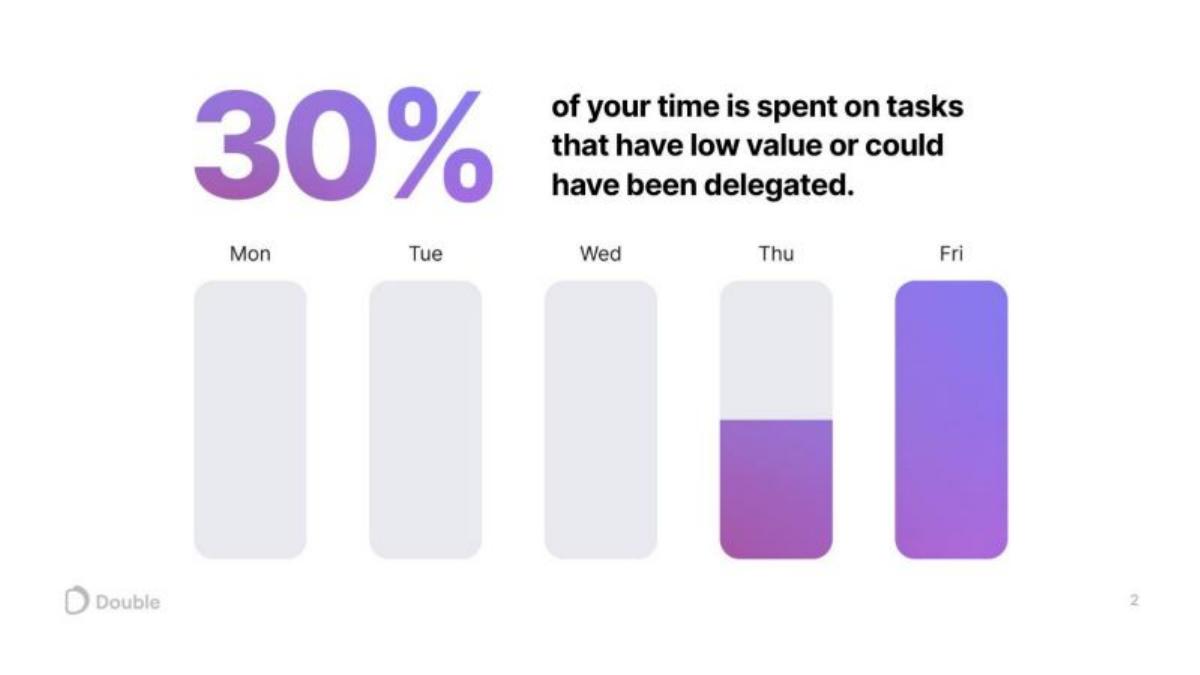
- Double identifies that 30% of an executive's time is spent on low-value tasks that could be delegated (Slide 4).
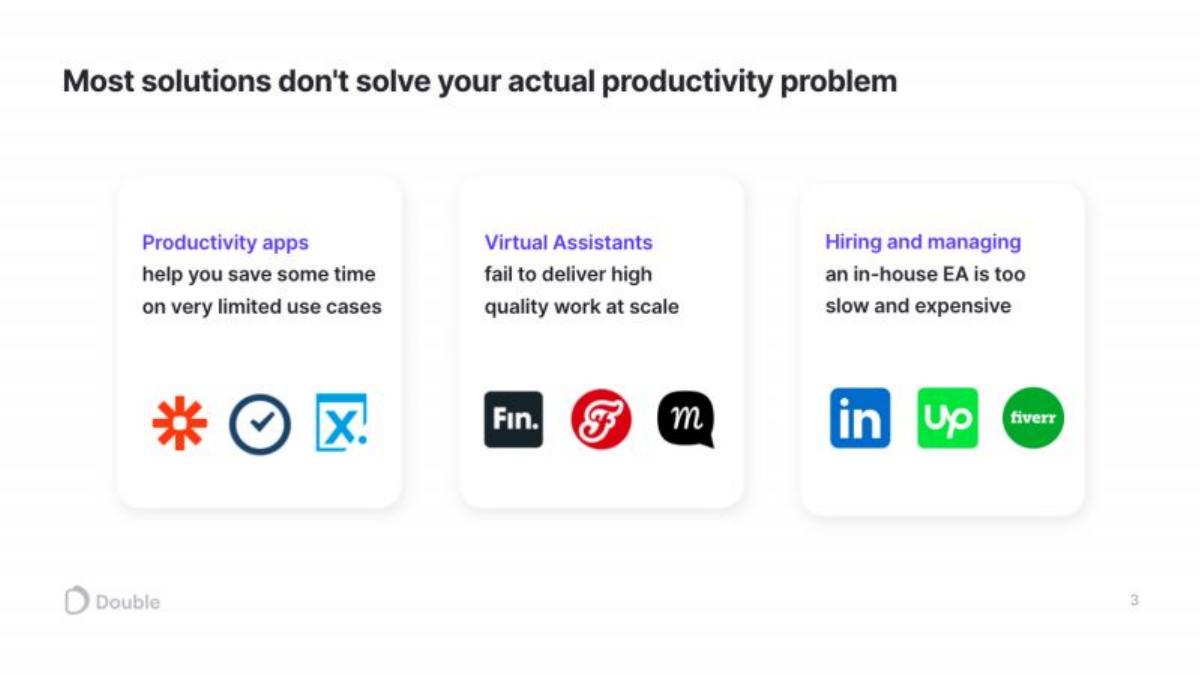
- The company positions itself against three failing alternatives: limited productivity apps, low-quality virtual assistants, and expensive in-house EAs (Slide 5).
- Traction is demonstrated through 600+ current customers and 200+ Double assistants across the US (Slide 7).
- The supply-side quality is a key moat, with an acceptance rate of only 0.5% from over 5,000 monthly applicants (Slides 9-10).
- Double differentiates through a proprietary app that features 1-tap delegation and automated weekly digests (Slides 13-16).
- The business model is transparent, offering tiered monthly packages from $300 (5 hours) to $2,000 (50 hours) with a $300 onboarding fee (Slide 17).
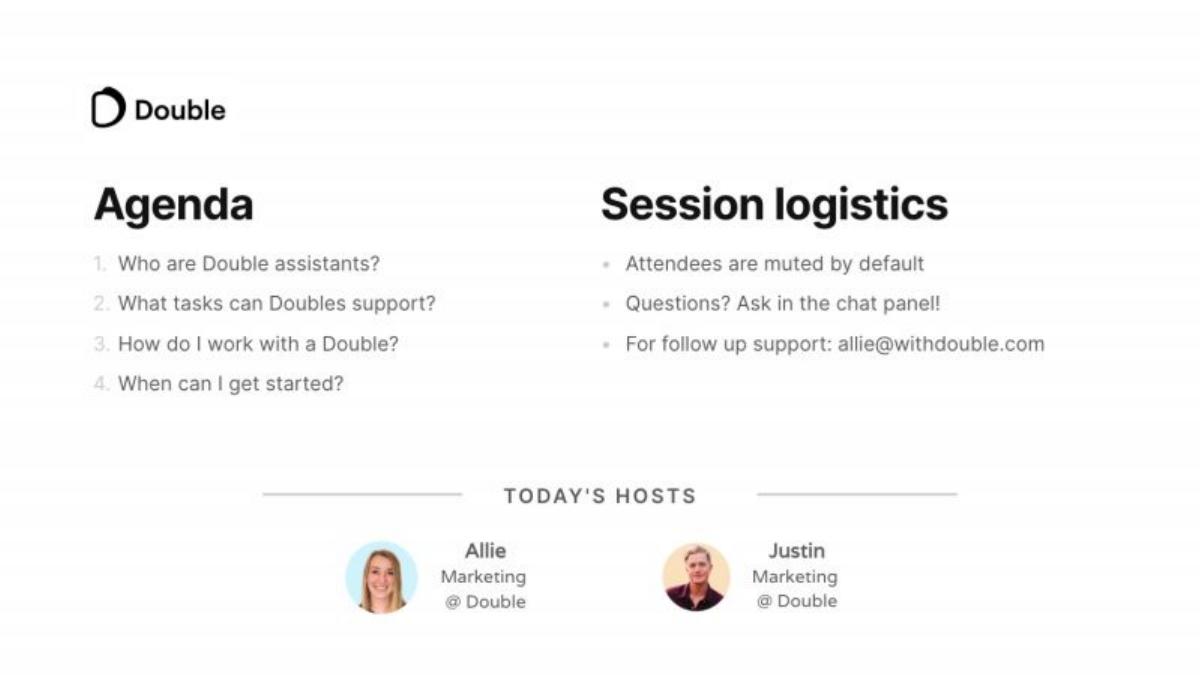
- The deck omits a traditional 'Team' slide featuring founders' backgrounds, instead focusing on marketing hosts for the session (Slide 2).
- The 'Next Steps' slide provides a clear operational timeline, showing a 5-15 business day matching process (Slide 18).
Executive Summary: The Managed Marketplace for Time
Double’s Series A deck is a focused pitch for a service that feels like a utility. By 2021, the 'Virtual Assistant' market was crowded with low-cost offshore options, but Double carved out a premium niche by focusing on US-based, highly vetted talent paired with a custom software stack. The $8.5M raise led by Daphni suggests that investors bought into the idea that administrative support could be scaled through a platform model rather than a traditional agency model.
Slides 1-3: The Setup and Logistics
The deck opens with a clean, purple-gradient brand identity. Slide 1 introduces the core value proposition: "The fast-growing platform for executive efficiency." It immediately positions the company as a 'platform' rather than a service. Slide 2 is an agenda slide for what appears to be a webinar or a group pitch session, hosted by Allie and Justin from the marketing team. This indicates the deck might have been used for customer acquisition or a broad investor presentation. Slide 3 is an interactive poll slide, a tactic used to engage the audience and qualify leads in real-time.
Slides 4-6: Defining the Productivity Problem
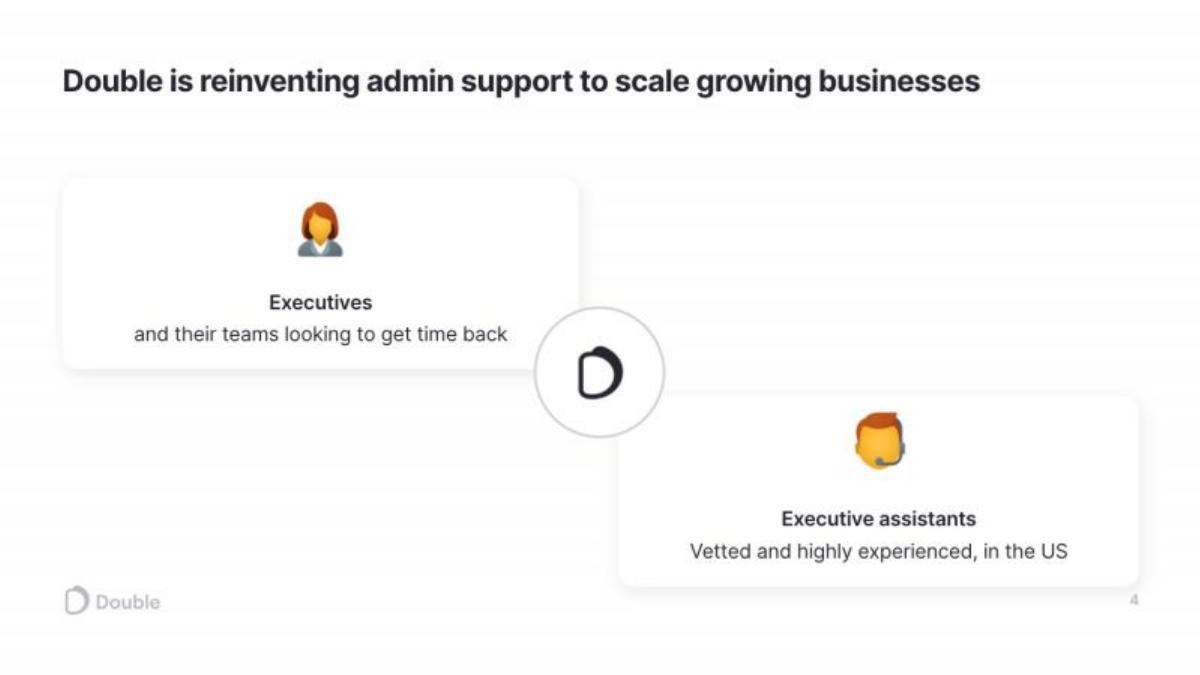
Slide 4 presents a compelling statistic: "30% of your time is spent on tasks that have low value or could have been delegated." This is the 'Why Now' and 'Why Us' anchor. It visualizes a work week where Thursday and Friday are essentially lost to administrative overhead. Slide 5 performs a competitive teardown. It groups competitors into three categories: apps that are too limited, virtual assistants that lack quality, and in-house hires that are too expensive. This sets the stage for Slide 6 , which introduces Double as the bridge between executives looking to get time back and vetted, US-based assistants.
Slides 7-8: Traction and Mission
Slide 7 is the primary traction slide. It features a map of the US dotted with assistant profiles, claiming 600+ current customers and 200+ Double assistants . The key metric here is the 16+ average hours saved per month per customer. This slide proves product-market fit and geographic coverage. Slide 8 briefly states the mission: "Allow you to focus on what you do best." It’s a standard emotional hook to transition from the 'what' to the 'how.'
Slides 9-11: The Supply-Side Moat
For a service business, the quality of the people is the product. Slide 9 emphasizes that only the top 0.5% of applicants become Double assistants. It lists criteria like executive support experience and being 'tech-savvy.' Slide 10 quantifies the top-of-funnel interest, noting 5,000+ applicants per month and a rigorous vetting process involving 12+ assessments and 3 interviews. Slide 11 highlights the 'dedicated' nature of the service—customers get a consistent assistant in their timezone, available 9am-6pm, rather than a random pool of workers.
Slides 12-16: The Software Layer
This section is what justifies Double's status as a 'platform.' Slide 12 lists the tasks supported, ranging from calendar management and travel to personal tasks like booking babysitting. Slides 13 through 16 showcase the Double app. The deck highlights task management for shared visibility, 1-tap delegation via a Chrome extension (Slide 15), and templates for best practices. Slide 14 shows a 'Weekly delegation digest' delivered via email, which provides a summary of progress. This software reduces the 'management tax' that usually comes with hiring an assistant.
Slides 17-18: Business Model and Onboarding
Slide 17 breaks down the pricing. It is a transparent, tiered subscription model: Starter ($300/mo for 5 hours) , Plus ($700/mo for 15 hours) , Pro ($1,300/mo for 30 hours) , and Team ($2,000/mo for 50 hours) . All plans include a dedicated assistant and the full software suite. There is also a $300 onboarding fee . This model provides predictable recurring revenue, which is highly attractive to VCs. Slide 18 outlines the 'Next steps,' showing a timeline from the initial questionnaire to an onboarding call within 5-15 business days.
Slides 19-22: Closing and Call to Action
The deck concludes with standard closing slides. Slide 19 is a placeholder for questions, and Slide 20 provides a call to action with a bit.ly link to get started. The final slides are administrative or promotional for the platform hosting the deck.
What Works in This Deck
The 'Platform' Framing: Double successfully avoids being labeled as a 'temp agency.' By leading with the software (Slides 13-16) and using terms like 'efficiency platform,' they position themselves as a tech-enabled solution that scales better than a human-only service.
Supply-Side Metrics: Stating a 0.5% acceptance rate and 5,000+ monthly applicants is a powerful way to signal quality without having to show every single resume. It tells investors that Double has solved the hardest part of a managed marketplace: sourcing high-quality supply.
Clear Unit Economics: The pricing slide is refreshingly simple. By showing the hourly rate equivalent ($40-$60/hr) and the tiered packages, the deck makes it easy for an investor to model out the revenue potential per 1,000 customers.
What Is Missing
Founder Backgrounds: Surprisingly, this version of the deck lacks a traditional 'Team' slide. While Slide 2 introduces marketing hosts, there is no mention of the founders' previous exits, relevant industry experience, or technical pedigree. For a Series A, investors usually want to see the leadership's 'right to win.'
Financial Projections: While current traction is shown (600+ customers), there are no forward-looking financial projections or a 'The Ask' slide detailing how the $8.5M will be spent (e.g., hiring, marketing, R&D). This information may have been shared in a separate data room or a more confidential version of the deck.
Market Size (TAM): The deck doesn't explicitly define the Total Addressable Market. While the '30% time waste' problem is universal for executives, the deck doesn't quantify how many executives globally fit their $300-$2,000/month target profile.
What a Founder Should Copy
The Competitive Matrix: Slide 5 is an excellent example of how to group competitors by their 'failure mode' rather than just listing features. It tells a story of why current solutions aren't enough.
Visualizing the Product in Situ: Slides 14 and 15 show the product exactly where the user is (in the browser, in Gmail). This helps investors visualize the 'stickiness' of the product and how it integrates into a user's existing workflow.
The Onboarding Timeline: Including a 'Next Steps' slide (Slide 18) with specific timeframes (e.g., '5-15 business days') demonstrates operational maturity. It shows that the company has a repeatable process for scaling the customer base.
Frequently asked questions
- What is Double's core business model?
- Double operates as a B2B managed marketplace. They charge customers a monthly subscription fee based on the number of hours of executive assistant support required. According to slide 17, these tiers range from $300 for 5 hours to $2,000 for 50 hours, equating to an hourly rate of $40-$60. They also charge a one-time $300 onboarding fee.
- How does Double use technology to differentiate from a staffing agency?
- Double provides a proprietary app that integrates with Gmail, Slack, and Chrome. As shown on slides 13-16, this software enables '1-tap delegation,' shared visibility on task status, and automated weekly digests. This tech layer is designed to reduce the friction of delegation, which is a common pain point in human-led services.
- What are the requirements for becoming a Double assistant?
- Double maintains high supply-side standards to ensure quality. Slide 9 states that assistants must have prior experience supporting executives and remote work experience. They must be US-based and 'tech-savvy.' The vetting process includes over 12 skills and personality assessments and three interviews with the HQ team.
- Who are Double's primary competitors according to the deck?
- Slide 5 categorizes competition into three buckets: Productivity apps (Zapier, Todoist, X.ai), Virtual Assistant firms (Fin, Fancy Hands, Magic), and traditional hiring platforms (LinkedIn, Upwork, Fiverr). Double argues these solutions are either too limited in scope, too low in quality, or too expensive to manage.
- What traction did Double have at the time of this Series A deck?
- According to slide 7, Double had over 600 current customers and a network of 200+ assistants. They reported that their customers save an average of 16+ hours per month. The deck also mentions receiving over 5,000 applications from prospective assistants every month.